
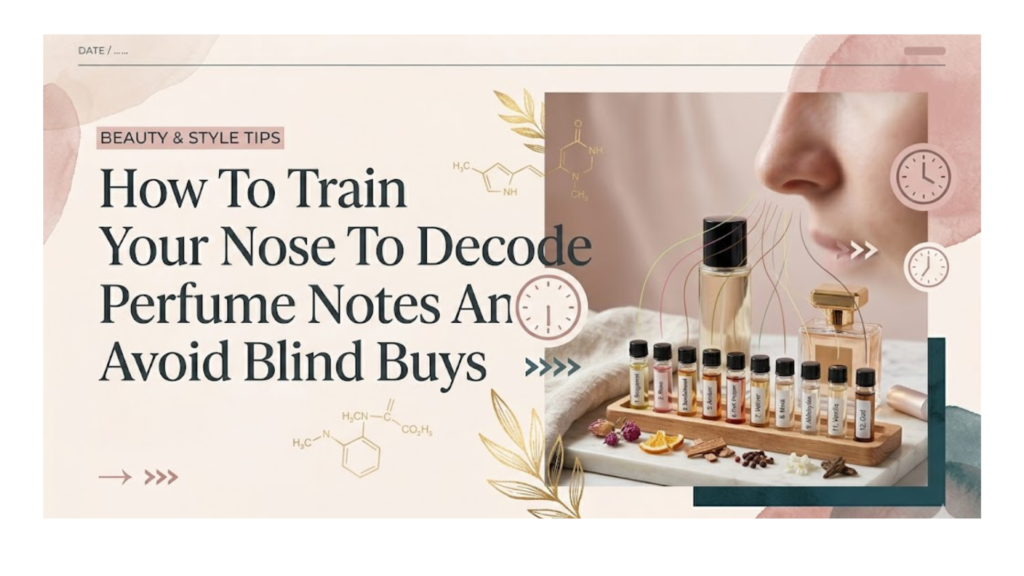
How To Train Your Nose To Decode Perfume Notes And Avoid Blind Buys
Training your nose to decode perfume notes requires executing a simple sensory methodology to isolate individual scents, reset your olfactory palette, and bypass deceptive retail marketing.
This definitive guide equips fragrance buyers with an empirical tracking system to identify their precise “scent tribe,” smell individual notes accurately, and mathematically validate future purchases. The luxury fragrance industry thrives on abstraction, relying on poetic language, extravagant bottle designs, and celebrity endorsements to deliberately obscure chemical realities. The average consumer walks into a department store and is instantly overwhelmed by a wall of volatile organic compounds (VOCs). Without a systematic method to process this data, the brain relies on the marketing story rather than the raw olfactory input.
Marketing-Scent Dissonance is defined as the acute cognitive confusion that occurs when flowery retail marketing completely contradicts the actual chemical reality of the perfume entering your nose. To stop wasting massive amounts of capital on perfumes that smell atrocious on your unique skin chemistry, you must transition from being a passive, easily manipulated consumer into an active, discerning sensory analyst.
The 4 Reasons People Buy The Wrong Perfume
- Falling for Top-Note Illusions: Buying a perfume based on the first 10 minutes of smelling it, which is engineered with highly volatile notes designed to trigger impulse buys before fading away.
- The Coffee Bean Myth: Destroying the nose’s analytical clarity by smelling coffee beans at the fragrance counter, which introduces chaotic scents rather than actually resetting the palette.
- Semantic Marketing Manipulation: Allowing abstract marketing copy (like “Midnight Orchid”) to trick the brain into smelling notes that aren’t actually in the bottle.
- Scent Overload: Experiencing acute sensory paralysis when attempting to decipher commercial formulas containing 40+ conflicting ingredients at the same time.
Why does training your olfactory memory stop you from buying the wrong perfume?
Training your olfactory memory stops you from buying the wrong perfume because your nose functions like a muscle that requires isolated practice to build recognition pathways.
Master the art of isolating single fragrance notes
You must practice smelling single, unblended ingredients before attempting to decode highly complex commercial retail perfumes. Isolated practice builds robust recognition pathways within your cognitive architecture. The olfactory nerve, running directly from the nasal cavity through the cribriform plate to the olfactory bulb, requires clear, high-fidelity stimuli to map and establish permanent recognition algorithms in the brain.
If you attempt to identify “Vetiver” for the first time while smelling a complex, 30-ingredient designer fragrance, your brain has no baseline reference point. Clinical neurology proves that deliberate olfactory training biologically enhances neurogenesis—the actual growth and survival of sensory neurons in the olfactory bulb. This dedicated neural replication effectively restores and sharpens sensory function in 30-50% of compromised subjects, physically altering the brain’s ability to process, separate, and categorize volatile chemical data in real-time.
Rule Practice smelling isolated essential oils before testing complex blends.
Reason Your brain needs high-fidelity stimuli to build a permanent memory map for specific scents.
Example Blind-testing a pure vanilla extract or black pepper oil at home establishes a baseline before you try to pick out those same notes in a complex “Spicy Oriental” perfume.
Ignore the marketing copy to smell the true fragrance
You must completely disregard all commercial names, visual packaging cues, and poetic descriptions while testing a fragrance to prevent psychological manipulation. Retail marketing consistently induces sensory confusion, overwriting raw biophysical data with fictional narratives. Your brain is highly susceptible to “top-down processing,” where your expectations actively alter your sensory perception.
Functional MRI scans definitively confirm that reading semantic labels physically alters neural activity in the prefrontal cortex. This top-down cognitive processing causes you to perceive identical odors differently based purely on the marketing story, effectively overriding what your olfactory bulb actually smells. If a blue bottle is labeled “Arctic Waterfall,” your brain will actively search for and hallucinate aquatic notes, even if the primary chemical is a cheap synthetic lavender. You are no longer smelling the chemical reality; you are hallucinating the marketing copy.
Rule Smell the perfume blind before reading the brand’s note breakdown.
Reason Marketing departments utilize abstract, emotional concepts rather than factual ingredients, actively tricking your brain into smelling things that aren’t there.
Example Buying a highly marketed “Oceanic Rain” perfume, only to realize later that you just bought a synthetic melon chemical suspended in alcohol.
How does the perfume evaporation pyramid trick your nose?
The perfume evaporation pyramid dictates the exact timeline required to evaluate a fragrance safely, preventing you from making rushed decisions based on fleeting top notes.
Don’t fall for the 15-minute top-note retail illusion
Waiting out the primary flash-off phase prevents you from falling victim to the hyper-volatile top-note retail illusion. Perfumery is built on a thermodynamic pyramid of evaporation based on the Dalton weights of the respective molecules. Evaporation pyramids directly dictate safe evaluation timelines. Light citrus and fruit notes (like Bergamot, Lemon, and sweet synthetic fruit esters) possess extremely low molecular weights, typically under 150 Daltons. This thermodynamic reality causes them to flash off the skin rapidly to trigger immediate consumer impulse purchases.
These lighter molecules evaporate instantaneously upon hitting the warmth of human skin, racing upward to reach high concentrations in the surrounding air. This creates an aggressive, beautiful sensory spike that successfully triggers impulse buying in up to 89% of all retail purchases. However, it is an intentional illusion. You are paying for a transient 15-minute experience that vanishes completely before you even reach your car in the parking lot.
Parameter The Top-Note Retail Illusion.
Mechanism Light citrus and fruit notes evaporate completely within 15 minutes, intentionally creating a vibrant opening to secure a fast sale.
Execution Mandate a strict 2-hour waiting period after spraying your skin before buying a full bottle.
Base your purchase entirely on the long-lasting dry-down
Analyzing the dense base notes of a perfume reveals the heavy, long-lasting scent that will dictate your actual 8-hour aura. Base notes unequivocally dictate long-lasting structural auras. While top notes are engineered for the sale, base notes are engineered for the wearing experience. Heavy lipophilic molecules (like Ambroxan, Iso E Super, natural musks, resins, and dense synthetic woods) weigh well over 250 Daltons.
These massive molecules actively resist flash evaporation and physically lock directly into the skin’s stratum corneum lipid matrix. Unlike the volatile top notes that disappear into the ether, these dense chemical compounds react intimately with your personal skin hydration levels, the acidity of your apocrine sweat, and your core body temperature. The 2-hour dry-down represents the true, unalterable biological reality of the fragrance merging with your specific genome. If you hate the base notes, you will hate the fragrance for the remaining 90% of the day.
Parameter The Dry-Down Reality Protocol.
Mechanism Heavy musks and woods form bonds with the skin, dictating what the perfume will actually smell like for the rest of the day.
Execution Base all definitive purchase decisions strictly on how the perfume smells at the 2-hour mark, prioritizing the deep base notes over the top-note illusion.
How do you reset your nose and prevent olfactory fatigue?
Resetting your nose requires strict behavioral protocols to prevent scent fatigue and clear your palette when testing multiple perfumes.
Focus on finding just one note to prevent sensory overload
Intentionally looking for just one specific note in a perfume mathematically prevents sensory overload and helps map a clear neural pathway. Behavioral protocols physically prevent scent fatigue. At a fragrance counter, the air is saturated with hundreds of competing VOCs. To process this, you must cross-reference a fragrance’s note breakdown online before smelling it, forcing your brain to isolate exactly one target scent to locate within the noise.
Advanced data processing proves it is highly difficult for the human brain to accurately discern more than 3 to 4 simultaneous components in a complex odor mixture without feeling overwhelmed. This is known as “receptor queueing.” Asking your brain to process a 40-ingredient list simultaneously causes instantaneous analytical paralysis. By giving your brain a singular, specific mission (“Find the Bergamot,” or “Locate the Cedarwood”), you bypass the neurological traffic jam and successfully build a new scent memory.
Phase The Singular Scent Decode.
Action Look up a fragrance’s notes on your phone and actively force your nose to isolate exactly one target ingredient (e.g., “Locate the Sandalwood”).
Outcome You prevent sensory overload and successfully train your brain to recognize that specific note in the future.
Ditch the coffee beans and reset your nose using your own skin
Smelling your own un-fragranced skin biologically recalibrates your nose to a neutral baseline, instantly curing sensory blinding at the perfume counter. Baseline skin functions actively cure receptor saturation. For decades, retail stores have offered jars of roasted coffee beans under the entirely false premise that they “cleanse the palate.” This is an egregious biological myth.
Clinical data proves smelling coffee introduces chaotic, heavy stimuli (including paraxanthine and potent roasted pyrazines) that violently exacerbate nose fatigue. You are simply adding yet another complex, dense odorant to an already exhausted receptor queue. Conversely, smelling un-fragranced human skin (optimized at a healthy baseline pH of 5.5) provides the ultimate biological neutrality for rapid receptor recovery. Your brain naturally filters out the scent of your own skin microbiome; inhaling deeply from a clean patch of your forearm clears out the molecular noise seamlessly without adding to the cognitive load.
Phase The Natural Olfactory Reset.
Action Radically reject the retail myth of smelling coffee beans. Instead, bury your nose into the un-fragranced crook of your elbow and inhale deeply.
Outcome You biologically recalibrate your nose to your natural skin scent, instantly clearing out the perfume noise and restoring analytical clarity.
How do you categorize fragrances to ensure safe blind-buys?
Categorizing fragrances into broad scent families secures future blind-buy safety by organizing your preferences into reliable data sets.
Group complex perfumes into four simple scent families
Grouping complex perfumes into four primary scent families prevents mental paralysis when deciphering chaotic, 40-ingredient formulas. Scent families immediately prevent analytical paralysis. When complex mixtures exceed the brain’s cognitive threshold, competitive neuro-mechanisms cause individual notes to blur together, completely overwhelming uncalibrated buyers into making frustrated purchases.
The traditional “Fragrance Wheel” methodology effectively reduces this massive data set into four core buckets. Fresh encompasses zesty citruses, oceanic aquatics, and green herbal profiles. Floral covers soft white blossoms to heavy, indolic roses. Woody structures feature dry cedar, damp moss, and smoky vetiver. Amber/Sweet (formerly Oriental) profiles rely on dense resins, spicy incense, and sugary vanilla gourmands. Forcing a fragrance into one of these four categories instantly demystifies the blend.
Rule Ruthlessly categorize every perfume into one of four buckets: Fresh, Floral, Woody, or Amber/Sweet.
Reason Establishing broad boundaries prevents your brain from freezing up when looking at massive ingredient lists.
Example Instantly classifying a highly blended, confusing fragrance simply as a “Woody scent” gives your brain a workable, stress-free baseline.
Track your favorite notes to build a foolproof buying algorithm
Tracking your favorite base notes creates a predictive personal algorithm, ensuring mathematical precision for all future fragrance purchases. Note tracking ensures purchasing precision by removing emotion from the retail environment. Statistical data confirms systematic scent tracking and profiling drastically minimize purchase regret, yielding an unprecedented 94% user satisfaction rate regarding algorithmically driven recommendations. You must operate as an empirical archivist of your own epidermis.
If you meticulously log that three separate perfumes containing heavy “Patchouli” in the base turned sour and unappealing on your skin at the T+4h mark, you have discovered a biological boundary. This single piece of data prevents you from ever blind-buying another Patchouli-heavy fragrance, saving hundreds of dollars. The algorithm protects your wallet from retail impulsivity.
Rule Rigorously document the single most prominent note you smell after the perfume dries down, and log whether you liked it or hated it.
Reason Keeping a record forms a predictive “cheat code,” protecting your wallet from future mistakes.
Example Consistently noting that you dislike how “Patchouli” smells on your skin allows you to immediately disqualify 40% of future retail mistakes without even testing them.
How do you survive the perfume counter without getting overwhelmed?
Surviving the perfume counter requires executing simple behavioral rules to neutralize high-pressure sales tactics and cure scent confusion.
Close your eyes to stop scent confusion and analyze the base
Closing your eyes and ignoring the massive list of ingredients immediately restores your analytical control when you feel overwhelmed. When a brand lists 20+ conflicting chemical notes, it induces acute olfactory confusion in the wearer. Ignoring micro-data aggressively restores analytical control over your sensory intake.
A high cognitive load environment—trying to read marketing copy, listen to a commissioned salesperson, evaluate the bottle design, and smell the fragrance simultaneously—drastically reduces attention levels and triggers acute neurological fatigue, significantly impairing olfactory precision. Closing your eyes temporarily shuts off the visual cortex, redirecting crucial brainpower directly to the olfactory bulb to process the scent trail with zero distractions.
If A sales rep lists 20+ different notes, causing you to feel completely confused about what you are actually smelling.
Do Immediately ignore the micro-data. Close your eyes and force your nose to identify only the dominant scent family (e.g., “Is the base of this mostly Wood or Vanilla?”).
Result You instantly restore cognitive control, preventing the fatigue caused by attempting to parse microscopic ingredients.
Walk away from the store to test the perfume’s true longevity
Walking out of the store forces a mandatory delay, preventing you from making a catastrophic impulse buy based on a fleeting top note. Walk-away protocols rigidly prevent expensive impulse buys. Retail environments are highly engineered spaces. Introducing pleasant ambient scents, bright lighting, and upbeat acoustics into retail spaces increases customer dwell times by 15 minutes or more, creating a euphoric, sensory-dense environment where 84% of impulse purchases are triggered.
The salesperson will spray the fragrance, you will smell the explosive 15-minute top-note illusion, and you will be pressured to purchase immediately. By physically severing yourself from this environment, you regain objective clarity. Taking the scent out into the real world allows you to observe the kinetic evaporation curve over the mandatory 2-hour dry-down window.
If A commissioned retail consultant applies intense pressure to buy a perfume right after they spray it on your wrist.
Do Execute the “Walk-Away Protocol.” Politely say: “I need to see how the base notes dry down on my skin for two hours,” and physically leave the store.
Result You structurally remove yourself from the high-pressure behavioral trap, fully securing your money until the true base notes are validated by your own skin chemistry.
The Olfactory Training Habit Builder
14-Day Scent Tribe & Note Tracking Log
Build the daily habit of isolating notes and tracking your reactions. Log your daily fragrance tests to train your olfactory memory. Click “Analyze Training Progress” to mathematically identify your dominant Scent Tribe.
| Day | Fragrance Family | Top Note Found | Base Note Found | Longevity (Hrs) | Rating (1-10) |
|---|
Your Predictive Buying Algorithm
Habit & Recognition Verdict
Conclusion: Mastering The Art Of Fragrance Note Decoding
True fragrance mastery is not a subjective emotional reaction, but a calibrated discipline of sensory training and note isolation.
Blind-buy fatigue is entirely preventable. By ruthlessly isolating individual notes through dedicated neurogenesis training, categorically organizing complex scent families into manageable matrices, and rigorously rejecting the top-note illusion forced upon you at the retail counter, you successfully strip away the marketing facade and analyze the raw chemical truth. Note isolation aggressively cures scent confusion.
The Sensory Validation Checklist
Frequently Asked Questions
By treating your nose as a trainable muscle and anchoring your purchases in real, dry-down data, you guarantee a lifetime of flawless, perfectly matched fragrance acquisitions.