
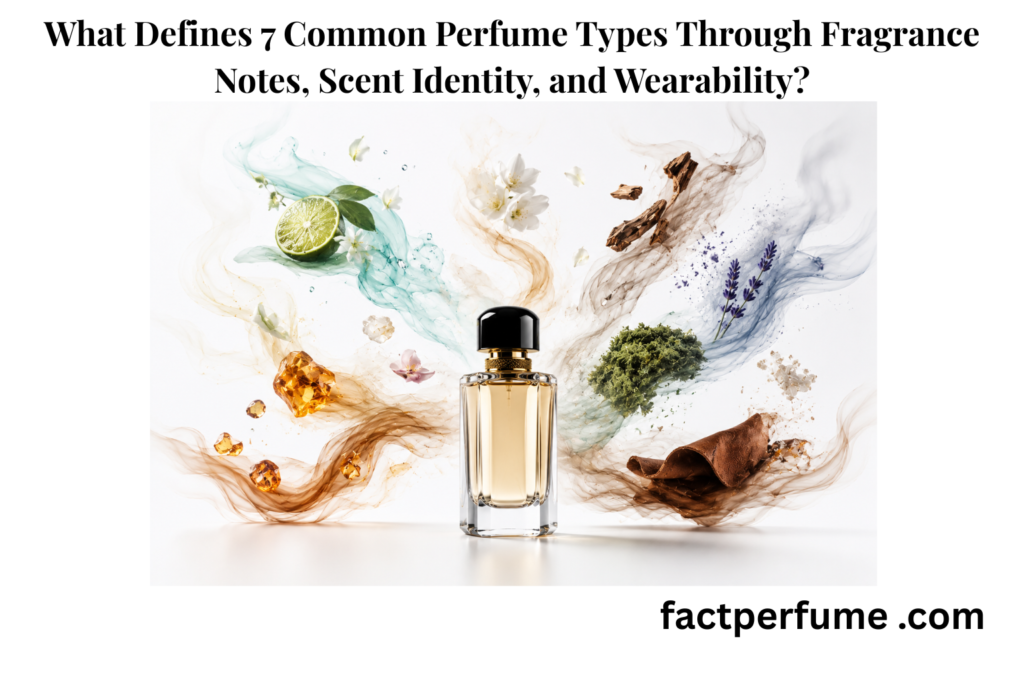
What Defines 7 Common Perfume Types Through Fragrance Notes, Scent Identity, and Wearability?
The 7 common perfume types are Fresh, Floral, Amber, Woody, Fougère, Chypre, and Leather, and each type is defined by recurring fragrance notes, scent identity, wearability, and how it behaves on skin and in real settings.
This guide explains what perfume types mean, how they differ from concentration types, how each family usually smells, where each type is easiest or hardest to wear, how to test the dry-down, how to layer cautiously, and how to avoid common wearing mistakes before choosing a final scent direction.
What Are Perfume Types and How Are They Different From Concentration Types?
Perfume types in this guide are fragrance-family categories, not concentration categories, so Fresh, Floral, Amber, Woody, Fougère, Chypre, and Leather describe scent identity rather than perfume strength labels like eau de parfum or eau de toilette.
A perfume type groups scents by shared notes, smell direction, and olfactive identity. Fresh perfumes often feel clean or bright, Amber perfumes often feel warm or resinous, and Leather perfumes often feel smoky or suede-like, even though each formula can still behave differently on skin.
Concentration terms such as parfum, eau de parfum, eau de toilette, eau de cologne, and body mist belong to a separate strength and dilution topic. They can influence how a fragrance wears, but they do not tell you whether the perfume smells fresh, floral, woody, mossy, aromatic, or leathery.
Perfume types help readers compare scents without relying only on brand names, gender labels, bottle design, price, or trend language. A family label gives a faster way to ask whether the scent is clean, romantic, warm, grounded, aromatic, formal, or bold before testing the actual formula.
Fragrance-family systems vary by source, so this page uses seven common types as a practical consumer framework. Gourmand is discussed as an Amber-adjacent sweet direction, not as a separate eighth type in this guide.
Core terms snapshot: A note is a named scent impression, an accord is a blended scent structure, and dry-down is the way a perfume changes after the opening settles into the heart and base. Projection describes how far scent radiates, while sillage describes the scent trail left behind.
- Top notes shape the first impression but should not decide the whole perfume.
- Heart notes reveal the main scent identity after the opening starts to settle.
- Base notes show the deeper dry-down, comfort, and remaining character without guaranteeing exact longevity.
What Are the 7 Common Perfume Types at a Glance?
The 7 common perfume types can be understood quickly by comparing their dominant notes, scent identity, best wear context, and main watch-out. This table is a quick identification tool, not a full article for every family.
| Perfume Type | Common Notes | Scent Identity | Best Wear Context | Watch-Out |
|---|---|---|---|---|
| Fresh | Citrus, green, aquatic, herbal | Clean, bright, airy | Daytime, warm weather, shared spaces | May fade quickly or feel sharp if over-sprayed |
| Floral | Rose, jasmine, orange blossom, tuberose, violet | Romantic, expressive, soft or heady | Spring, weddings, polished daily wear | Dense florals can feel strong in heat |
| Amber | Vanilla, benzoin, labdanum, resins, spices, musks; sometimes gourmand sweet facets | Warm, resinous, sweet, sensual | Cool weather, evening, cozy or formal settings | Can feel heavy, cloying, or too sweet |
| Woody | Cedarwood, sandalwood, vetiver, patchouli, oud | Dry, grounded, elegant | Professional settings, evenings, signature scents | Can feel austere or dusty |
| Fougère | Lavender, coumarin, oakmoss, geranium, herbs | Aromatic, clean, classic | Office, daytime, classic grooming styles | Can feel sharp or traditional |
| Chypre | Bergamot, labdanum, oakmoss, patchouli | Mossy, formal, contrast-rich | Formal events, cool weather, statement dressing | Can feel abstract or bitter |
| Leather | Leather accord, suede, smoke, tobacco, saffron | Smoky, dark, bold | Cold weather, evening, confident wear | Can feel harsh or animalic |
What Defines Fresh and Floral Perfume Types Through Everyday Wearability?
Fresh and Floral perfume types are often the easiest entry points because they use familiar scent signals: clean brightness in Fresh perfumes and flower-based expression in Floral perfumes. Fresh usually feels crisp, airy, casual, and low-risk, while Floral can feel soft, expressive, polished, creamy, powdery, or heady depending on the flowers used.
What makes Fresh perfumes smell clean, bright, and easy to wear?
Fresh perfumes smell clean, bright, and easy to wear because they often use citrus, green, aquatic, herbal, or airy notes that create a crisp and casual scent identity. Bergamot, lemon, grapefruit, green notes, aquatic notes, and herbs can make the scent feel uplifting, sporty, office-friendly, and warm-weather appropriate.
Fresh perfumes can feel bright and easy to wear, but the full dry-down still matters before judging.
What makes Floral perfumes romantic, expressive, and versatile?
Floral perfumes feel romantic, expressive, and versatile because different flowers can create soft, bright, creamy, powdery, green, indolic, or heady scent identities. Rose, jasmine, orange blossom, tuberose, lily, violet, and peony can shape very different floral personalities.
Floral perfumes can range from soft and romantic to dense and heady, so Floral should not be reduced to only sweetness or one gender label.
How Do Amber and Woody Perfume Types Differ in Warmth, Depth, and Occasion Fit?
Amber and Woody perfume types differ because Amber usually emphasizes warm, resinous sweetness, while Woody usually emphasizes dry, grounded structure. Both can feel elegant and present, but neither type guarantees stronger performance because formula, concentration, application amount, skin condition, and setting still matter.
Amber is usually warmer, sweeter, richer, cozier, and more enveloping. Woody is usually drier, more structured, more grounded, and less obviously sweet.
What makes Amber perfumes feel warm, resinous, sensual, or sweet?
Amber perfumes feel warm, resinous, sensual, or sweet because they often use balsamic materials, vanilla-like warmth, resins, spices, musks, labdanum, benzoin, or edible-sweet facets. Some Amber perfumes overlap with gourmand impressions such as caramel, praline, or tonka-like warmth, but Amber remains the primary type in this seven-family framework.
Amber perfumes can overlap with gourmand sweetness, but this page keeps Gourmand inside the Amber-adjacent context rather than treating it as an eighth root type.
What makes Woody perfumes feel dry, grounded, and elegant?
Woody perfumes feel dry, grounded, and elegant because wood notes often create structure, earthiness, polish, smoke, or mineral-like dryness instead of obvious sweetness. Sandalwood, cedarwood, vetiver, patchouli, oud, and dry woods can make the family feel mature, polished, earthy, smoky, or minimalist.
Woody perfumes often feel grounded and elegant, but very dry woods can feel sharp, dusty, or austere on some wearers.
What Makes Fougère, Chypre, and Leather Perfume Types More Complex to Wear?
Fougère, Chypre, and Leather perfume types are more complex to wear because they rely on constructed accords, historical associations, sharper contrasts, mossy depth, smoke, or animalic facets rather than simple clean, sweet, or floral cues. Complex does not mean automatically better; it means these families may take more testing and context awareness.
- Fougère is aromatic, clean, green, herbal, and classic, often shaped by lavender, coumarin, oakmoss, geranium, bergamot, and herbs.
- Chypre is contrast-driven, balancing a brighter opening with darker mossy, labdanum, patchouli, or woody depth.
- Leather is smoky, suede-like, animalic, polished, or dramatic, depending on how leather, smoke, tobacco, saffron, honey, and woods are handled.
How does Fougère create an aromatic, classic perfume profile?
Fougère creates an aromatic, classic perfume profile by combining fresh, herbal, lavender-like, coumarin-like, and mossy elements into a clean but structured accord. It often suits daytime, office, year-round use, and classic grooming-style fragrances, although older-style Fougère scents may feel too traditional or sharp for some modern users.
Fougère perfumes should be understood through their aromatic structure rather than reduced to one gender label.
Why does Chypre balance bright citrus with dark mossy depth?
Chypre balances bright citrus with dark mossy depth by contrasting a fresh opening, often bergamot-like, against labdanum, oakmoss, patchouli, or mossy-woody base structures. It can feel sophisticated, abstract, dry, elegant, formal, and contrast-rich.
Chypre perfumes can feel formal, mossy, dry, and contrast-rich, but beginners may find them abstract or bitter.
What makes Leather perfumes smoky, animalic, and statement-driven?
Leather perfumes feel smoky, animalic, and statement-driven because they use leather, suede, smoke, tobacco, saffron, honey, woods, or tar-like facets to create a dark and memorable scent identity. They often suit cold weather, evening wear, niche fragrance settings, and confident signature use, but they can feel harsh or too animalic in close shared spaces.
Leather perfumes can feel smoky, bold, and statement-driven, but Leather should not be treated as universally masculine or universally formal.
Which Perfume Type Should You Choose Based on Season, Occasion, and Skin Feel?
The right perfume type depends on season, occasion, environment, desired scent effect, and how comfortable the fragrance feels on your skin over time. Heat can make dense scents feel stronger, while cold air can soften lighter scents, so setting matters as much as family identity.
Fresh and lighter Floral types often suit warm weather, daytime, and low-risk daily wear. Amber, Woody, Chypre, and Leather often suit cooler weather, evening use, and stronger scent presence, while Fougère can work well in office or grooming-style settings when it is not too sharp.
Skin feel matters, but it should not be treated as a guaranteed formula. Dry skin may make some perfumes feel shorter-lived, while moisturized skin may help scent remain noticeable; offices, travel, religious spaces, classrooms, clinics, and shared vehicles usually require softer projection.
| Variable | Fresh | Floral | Amber | Woody | Fougère | Chypre | Leather |
|---|---|---|---|---|---|---|---|
| Season | Warm weather | Spring/summer | Cool weather | Cool/year-round | Year-round | Cool/formal | Cold weather |
| Occasion | Casual/day | Social/polished | Evening/date/cozy | Work/evening | Office/day | Formal/statement | Evening/niche |
| Scent Strength | Light to moderate | Soft to strong | Moderate to strong | Moderate to strong | Moderate | Moderate to strong | Strong |
| Environment | Shared spaces | Social settings | Open/cool spaces | Professional settings | Groomed settings | Formal spaces | Controlled settings |
| Beginner Friendliness | High | High to medium | Medium | Medium | Medium | Lower-medium | Lower |
Use this matrix as guidance, not a rigid rule. Formula and setting can change how any perfume type feels.
How Should You Test Perfume Types Before Buying or Wearing Them?
Perfume types should be tested on skin through the full dry-down because the opening, heart, and base can reveal different levels of freshness, sweetness, dryness, heaviness, and comfort. A first spray shows only the opening, not the whole fragrance.
Test one or two perfumes at a time on clean skin, then check them beyond the paper-strip stage. Strong Amber, Leather, or Chypre perfumes are especially easy to misjudge after smelling many other scents in a store.
| Stage | What to Check | Why It Matters |
|---|---|---|
| First spray | Opening brightness and top notes | Shows first impression only |
| 15 minutes | Early transition | Reveals sharpness, sweetness, or freshness |
| 1 hour | Heart notes | Shows main scent identity |
| 4 hours | Base development | Shows comfort, depth, and remaining character |
| 8 hours | Residual scent if present | Helps judge long dry-down without forcing exact longevity |
The timing is approximate and formula-dependent, so use it as a testing rhythm rather than a performance promise.
How Can You Layer Perfume Types Without Creating Clashing Notes?
Perfume types layer best when one scent direction supports another instead of forcing several dominant notes to compete at the same time. Start with one lighter scent over one deeper scent, then reduce sprays so the blend does not become louder than either perfume alone.
Fresh + Woody, Floral + Amber, and Woody + Leather can work because one direction can brighten, warm, or deepen the other. Floral + Amber may become gourmand-leaning when vanilla, resin, or edible facets are present, so test the pairing at home before wearing it in public.
Avoid layering two dense, sweet, smoky, or animalic perfumes before understanding each one alone. Clashing usually happens when multiple fragrances compete for the same dominant space, so the safest starting point is one simple scent with one deeper scent.
| Starting Pairing | Why It Can Work | Watch-Out |
|---|---|---|
| Fresh + Woody | Brightness softens dry structure | Too much citrus can turn sharp |
| Floral + Amber | Floral body gains warmth or sweetness | Can become sweet or heavy |
| Woody + Leather | Shared dry depth supports boldness | Can feel intense indoors |
What Common Mistakes Should You Avoid When Wearing Different Perfume Types?
Most perfume type mistakes happen when the scent family does not match the setting, spray count, temperature, dry-down, or layering combination. A perfume type is not automatically bad just because it performs poorly in the wrong context.
| Problem | Likely Cause | Practical Fix |
|---|---|---|
| Fresh perfume fades quickly | Light citrus, aquatic, green, or airy notes | Moisturize skin, choose Fresh-Woody styles, or reapply lightly when appropriate |
| Amber feels too heavy | Dense resins, vanilla, spices, musks, or gourmand sweet facets | Use fewer sprays, wear in cool weather, or choose a softer amber style |
| Floral turns sharp or powdery | Heady, indolic, powdery, or diffusive floral materials | Test the full dry-down and choose softer floral-musky styles |
| Woody feels too dry | Dry woods, vetiver, cedar, or earthy facets dominate | Try softer Woody-Fresh or creamy sandalwood styles |
| Chypre feels too formal | Mossy, bitter, dry, or abstract contrast dominates | Wear in formal/cooler settings or choose a softer fruity/floral chypre |
| Leather feels too intense | Smoke, suede, tobacco, tar, or animalic facets dominate | Use fewer sprays and reserve for controlled/cooler settings |
| Layering becomes muddy | Too many dominant notes compete | Pair one simple scent with one deeper scent and test first |
What Is the Final Checklist for Choosing the Right Perfume Type?
The best way to choose the right perfume type is to identify the dominant scent family first, then match it to the setting, season, skin comfort, dry-down, and desired scent identity. Use this as a final decision tool after comparing the seven primary families.
- Identify the dominant perfume type first: Fresh, Floral, Amber, Woody, Fougère, Chypre, or Leather.
- Match the type to the desired scent identity: clean, romantic, warm, grounded, aromatic, formal, or bold.
- Notice gourmand sweetness only as a possible Amber-adjacent direction, not as a separate primary type.
- Match the type to the season and setting.
- Test the perfume on skin before judging.
- Wait for the dry-down before deciding.
- Use fewer sprays for dense perfume types.
- Avoid strong layering until each perfume is understood alone.
- Choose a perfume type that fits real life, not only the bottle, brand, trend, or first spray.
Frequently Asked Questions
The 7 common perfume types in this guide are Fresh, Floral, Amber, Woody, Fougère, Chypre, and Leather. These are fragrance-family types, and other classification systems may use different names or subfamilies. Gourmand is treated here as a related sweet or edible direction inside Amber context, not as one of the seven primary types.
Perfume types are not the same as perfume concentrations because type describes scent identity, while concentration describes how much aromatic material is present in the formula. Parfum, eau de parfum, eau de toilette, eau de cologne, and body mist are concentration examples, not fragrance-family examples.
Fresh and lighter Floral perfumes are often easiest for beginners because they usually feel familiar, wearable, and less heavy in everyday settings. Softer Amber, Woody, and Fougère styles can also work for beginners, but no type is universally best for every person or setting.
No perfume type automatically lasts the longest because longevity depends on formula, concentration, skin condition, climate, and application amount. Amber, Woody, Leather, and some Chypre styles may feel more persistent, but exact hours should not be assumed without testing the specific perfume.
Different perfume types can be layered together, but layering works best when one scent supports the other instead of competing with it. Fresh + Woody or Floral + Amber can be simple starting points, while multiple dense, smoky, sweet, or animalic scents should be tested carefully before public wear.
Conclusion
Perfume types help readers understand fragrance by grouping scents into practical families such as Fresh, Floral, Amber, Woody, Fougère, Chypre, and Leather. The useful path is to identify the type, understand its notes, match it to season and occasion, test the dry-down, layer carefully, and avoid mistakes caused by setting, spray count, or clashing profiles.
Perfume types are guides, not rigid rules. The best choice is the family that fits your real environment, skin comfort, desired scent identity, and the way the perfume behaves after the opening settles.