
How Do Fresh Perfumes Balance Clean Notes, Skin Chemistry, and Longevity?
Fresh perfumes balance clean notes, skin chemistry, and longevity by using bright scent materials that feel crisp at first, then relying on formula structure, application method, skin condition, and storage to shape how long the freshness remains noticeable.
This page explains what fresh perfumes are, which note families create their clean identity, how skin and environment affect perceived longevity, how to choose them by situation, how to apply them carefully, and how to troubleshoot weak performance without making the scent heavy.
What Are Fresh Perfumes and What Scent Identity Do They Create?
Fresh perfumes are fragrances built around clean, bright, crisp, airy, watery, citrus, green, herbal, or lightly aromatic scent effects that make the scent feel refreshing and easy to wear. Freshness is a scent character, not one fixed ingredient group.
Fresh perfumes often create a clean, uplifting, low-cloying impression because they lean toward brightness, airiness, wateriness, green sharpness, soft musk, or soapy polish rather than dense sweetness or heavy smoke.
The dedicated fresh page narrows the category into Fresh perfume identity. Fresh perfumes also sit inside the wider perfume types system.
Core terms snapshot: A fresh perfume can smell citrusy, aquatic, green, herbal, musky, soapy, or airy. Perceived longevity means how long the scent remains noticeable to the wearer, while projection describes how far the scent radiates.
- Citrus fresh emphasizes sparkling brightness through bergamot, lemon, mandarin, or grapefruit impressions.
- Aquatic fresh emphasizes watery, marine, breezy, or ozonic effects.
- Clean/soapy fresh emphasizes soft musk, laundry-like polish, or aldehydic brightness.
What Distinctive Notes Define the Scent Identity of Fresh Perfumes?
The distinctive notes that define fresh perfumes usually fall into citrus, aquatic, green, herbal, clean, soapy, musky, and lightly aromatic groups. These groups help readers understand what kind of freshness they are smelling before judging the dry-down.
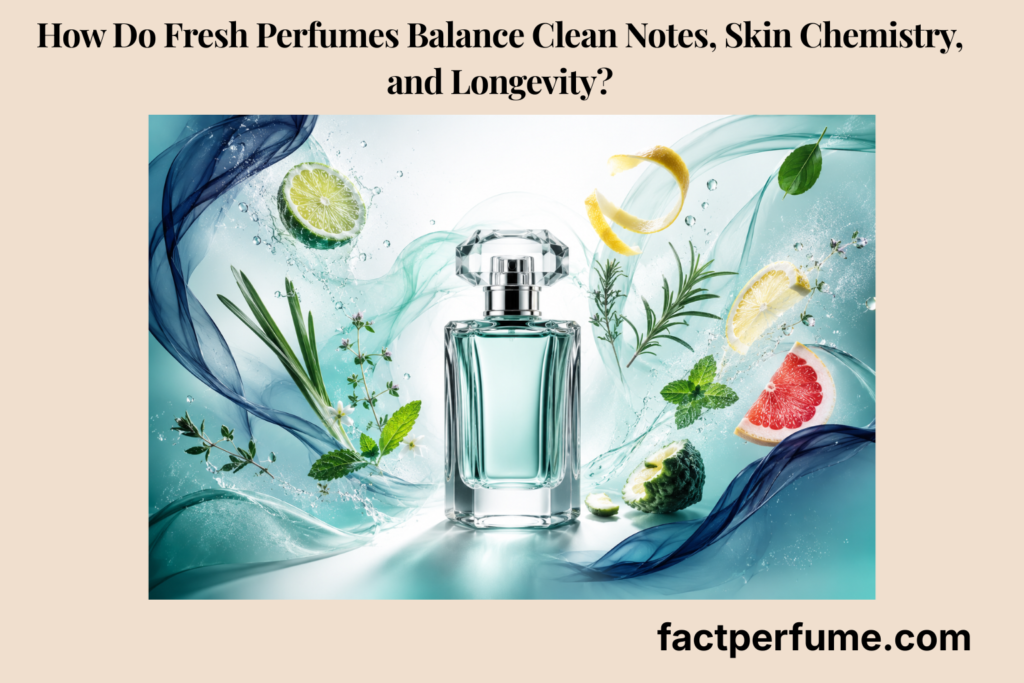
Citrus fresh perfumes often use bergamot, lemon, mandarin, or grapefruit to create a sparkling and energetic opening. Aquatic fresh perfumes use marine, watery, sea-salt-like, or ozonic effects to suggest air, breeze, and clean water.
Green fresh perfumes can feel crisp and botanical through galbanum, mint, basil, leafy accords, or grass-like notes. Clean and soapy fresh perfumes often use clean musks, aldehydic lift, or laundry-like impressions to create a polished close-contact effect.
Citrus profiles need careful framing because citrus notes and longevity can behave differently from the bright opening to the softer dry-down.
| Fresh Subtype | Common Notes | Scent Impression | Typical Behavior | Citation Need |
|---|---|---|---|---|
| Citrus fresh | Bergamot, lemon, mandarin, grapefruit | Sparkling, bright, sharp, energetic | Strong opening, softer dry-down | Cite only if discussing volatility examples |
| Aquatic fresh | Marine accord, watery notes, sea-salt effects, ozonic materials | Airy, breezy, clean, modern | Formula-dependent | Cite only for specific aroma chemicals |
| Green fresh | Galbanum, mint, basil, leafy accords, grass-like notes | Crisp, botanical, sharp, natural-smelling | Can feel vivid or bitter | Cite only for ingredient-specific claims |
| Clean/soapy fresh | Clean musks, aldehydic effects, laundry-like accords | Soft, polished, office-friendly | Usually moderate and close-wearing | Cite for safety or material claims |
How Do Skin Chemistry, Heat, and Environment Affect Fresh Perfumes?
Skin chemistry, heat, and environment affect fresh perfumes by changing how quickly light notes seem to soften, how smoothly the fragrance sits on skin, and how long the scent remains noticeable. Many citrus, green, and airy top-note-heavy compositions can feel bright at first and softer later.
Dry skin may reduce perceived wear for some users because fragrance can have less hydrated surface support. Oily or moisturized skin may support a smoother scent surface, but formula, climate, application amount, and wearer perception still matter.
Body heat and hot weather can make lighter compositions seem more fleeting, especially when the formula depends strongly on bright opening notes. Skin chemistry can change fresh perfume development because fresh perfume skin chemistry affects how clean notes settle, soften, or remain noticeable.
For skin-sensitivity context, fragrance allergy and patch testing are clinical topics, while cosmetic allergen guidance explains why sensitive users may need to check labels or contact manufacturers.
Which Fresh Perfumes Should You Choose Based on Occasion and Environment?
The best fresh perfume choice depends on the setting, because heat, closeness, activity level, and formality change how much brightness, softness, and projection feels appropriate. High heat usually suits aquatic, citrus, or light aromatic fresh profiles, while office settings usually suit clean musk, soapy, green, or soft citrus styles.
Gym and active settings require very light use, and fresh perfume should not be used to cover sweat. Evening casual wear can work better when freshness is supported by musk, tea, vetiver, soft woods, or gentle ambery-woody structure.
| Situation | Best Fresh Profile | Suggested Notes | Spray Level | Avoid |
|---|---|---|---|---|
| High heat / summer | Aquatic, citrus, light aromatic | Citrus, marine, tea, mint, light herbs | Light to moderate | Heavy sweet bases, overspraying |
| Office / close contact | Clean musk, soapy, green, soft citrus | Musk, aldehydic effects, bergamot, leafy notes | Light | Loud projection, dense sweetness |
| Gym / active setting | Very light citrus, mint, tea, clean fresh | Lemon, mint, tea, clean musk | Very light | Using perfume to hide sweat |
| Casual daytime | Citrus, aquatic, green | Grapefruit, watery accord, basil, leafy notes | Moderate | Harsh reapplication |
| Evening casual | Fresh with structure | Musk, vetiver, soft woods, tea, ambery/woody support | Moderate | Treating fresh perfume like a heavy night scent |
Use this matrix as guidance, not a universal rule. Formula and setting can change how any fresh perfume behaves.
How Should You Apply Fresh Perfumes for Better Performance?
Fresh perfumes can feel smoother and more noticeable when they are applied to clean, hydrated skin, allowed to dry naturally, and refreshed lightly instead of overloaded at the first spray. An unscented moisturizer can support a smoother scent surface when appropriate.
Pulse-adjacent areas can help scent develop without aggressive rubbing. Fabric may hold scent longer than skin, but delicate materials should be tested first because some perfumes can stain or mark fabric.
For users focused on wear time, fresh perfume longevity can often be improved through skin preparation, careful application, and light refreshing.
Fresh Perfume Application and Layering Protocol
- Moisturize: Apply an unscented lotion to clean skin when appropriate.
- Spray skin: Apply fresh perfume moderately to pulse-adjacent areas.
- Spray fabric carefully: Mist clothing only after checking fabric safety.
- Let dry: Allow the perfume to settle naturally without rubbing.
- Refresh lightly: Reapply a small amount later instead of overspraying early.
How Can You Improve the Longevity of Fresh Perfumes Without Changing Their Identity?
Fresh perfume longevity can often be supported without changing the scent identity by improving skin preparation, choosing formulas with subtle base structure, refreshing lightly, and storing bottles correctly. The goal is better perceived longevity, not turning a fresh scent into a heavy perfume.
Dry skin can be supported with unscented moisturizer when appropriate. Citrus-heavy openings can be balanced by choosing fresh perfumes with musk, woods, tea, vetiver, or ambery-woody support where the formula allows.
Weak projection later in the day is better handled with light reapplication than overspraying early. Projection should stay moderate because fresh perfume sillage works best when the scent feels clean and breathable instead of sharp or overwhelming.
Storage matters because proper fresh perfume storage can protect brightness, and fragrance-stability guidance notes that heat, light, air, and humidity may accelerate scent-quality changes in vulnerable materials.
| Problem | Likely Cause | Best Fix | What to Avoid |
|---|---|---|---|
| Fresh perfume disappears quickly on dry skin | Low surface hydration may reduce perceived wear | Use unscented moisturizer before spraying | Applying heavily to irritated skin |
| Citrus opening fades quickly | Citrus-heavy opening may rely on lighter materials | Choose fresh perfumes with musk, woods, tea, vetiver, or ambery/woody support | Expecting citrus alone to carry the dry-down |
| Weak projection later in the day | Light formula, low spray amount, heat, or skin absorption | Reapply lightly with a travel atomizer | Overspraying at the beginning |
| Fresh scent loses brightness over time | Heat, light, humidity, or air exposure may affect scent quality | Store in a cool, dark, dry place | Bathroom storage or open-cap exposure |
| Fresh perfume feels harsh at first | Sharp citrus, green, or aldehydic opening | Spray earlier before close contact or choose softer clean musks | Rubbing wrists aggressively |
What Mistakes Should You Avoid When Wearing Fresh Perfumes?
The main mistakes to avoid with fresh perfumes are poor storage, aggressive rubbing, overspraying, choosing unsupported citrus for all-day wear, and using fragrance to cover poor hygiene. These mistakes can make a fresh scent weaker, sharper, or less appropriate for the setting.
Heat, light, air, and humidity can weaken freshness over time, so bathroom storage is risky for bright profiles. Rubbing can add friction and heat after spraying. Overspraying can make a fresh perfume sharp or intrusive instead of longer-lasting.
| Fresh Perfume Mistake | Consequence | Correction |
|---|---|---|
| Storing fresh perfumes in hot, bright, humid bathrooms | The scent may lose brightness or stability faster | Store in a cool, dark, dry place |
| Rubbing perfume aggressively | Heat and friction may disturb the opening | Let perfume dry naturally |
| Overspraying to force longevity | The scent may become sharp or intrusive | Apply moderately and refresh later |
| Choosing only citrus for all-day wear | The opening may soften before the base develops | Choose citrus with musk, woods, tea, vetiver, or ambery/woody support |
| Using perfume to hide sweat | Freshness may clash with body odor | Prioritize hygiene first, then apply lightly |
What Is the Ultimate Checklist for Mastering Fresh Perfumes?
Mastering fresh perfumes means choosing the right fresh profile, applying it with restraint, supporting perceived longevity, and protecting the bottle from storage conditions that weaken the scent. Use this checklist before buying, applying, or troubleshooting a fresh scent.
- Choose citrus fresh perfumes for brightness, sparkle, and energetic openings.
- Choose aquatic fresh perfumes for heat, airiness, and clean marine-style effects.
- Choose green fresh perfumes for crisp, botanical, leafy, or herbal sharpness.
- Choose clean musk or soapy fresh perfumes for polished close-contact wear.
- Moisturize skin before spraying when appropriate to support smoother perceived wear.
- Spray lightly on fabric only after checking that the fabric is safe for perfume.
- Avoid heat, light, humidity, and bathroom storage.
- Let perfume dry naturally instead of rubbing it aggressively.
- Reapply lightly instead of overspraying at the beginning.
- Choose fresh perfumes with musk, woods, tea, vetiver, or ambery/woody support when longer perceived wear is needed.
Frequently Asked Questions
A perfume smells fresh when it uses clean, bright, crisp, watery, citrus, green, herbal, musky, or soapy scent effects that create an airy and refreshing impression.
Fresh perfumes do not always fade quickly, but citrus-heavy, airy, and top-note-focused compositions can feel softer sooner than heavier base-rich scents. Formula, skin, heat, application, and storage all affect perceived longevity.
Fresh perfumes are often practical in hot weather because citrus, aquatic, green, and clean profiles usually feel lighter and less cloying. They are not automatically suitable for every wearer or setting.
Fresh perfume may feel more noticeable when applied to clean, moisturized skin, supported by subtle base notes, stored properly, and refreshed lightly instead of oversprayed.
Fresh perfumes are not automatically safe for sensitive skin. Suitability depends on the formula, ingredient list, application amount, skin condition, and individual reaction. Patch testing may be appropriate when sensitivity is a concern.
Conclusion
Fresh perfumes work best when their clean scent identity is matched with the right note profile, skin preparation, environment, application method, and storage habit. Their freshness can come from citrus, aquatic, green, herbal, musky, soapy, or lightly aromatic effects, but their perceived longevity depends on formula structure and real-world conditions.
The strongest fresh perfume routine is simple: choose the right profile, apply with restraint, avoid rubbing and overspraying, refresh lightly when needed, and protect the bottle from heat, light, humidity, and frequent air exposure.