
How Do Perfume Types Influence Your Fragrance Selection?
Perfume types influence fragrance selection by helping buyers identify the broad scent character, emotional expression, wearing context, and development style they are most likely to enjoy. Family labels can narrow a large fragrance market into useful directions, but they cannot guarantee exact notes, performance, skin behaviour, safety, or personal suitability because individual formulas can differ substantially within the same family.
This article explains the foundational perfume types, their broad performance tendencies, their relationship to identity and personal expression, their seasonal and occasion context, their olfactory layering potential, the mistakes that can distort selection, and the practical testing process needed before choosing a fragrance.
What Perfume Types Define the Foundational Fragrance Families?
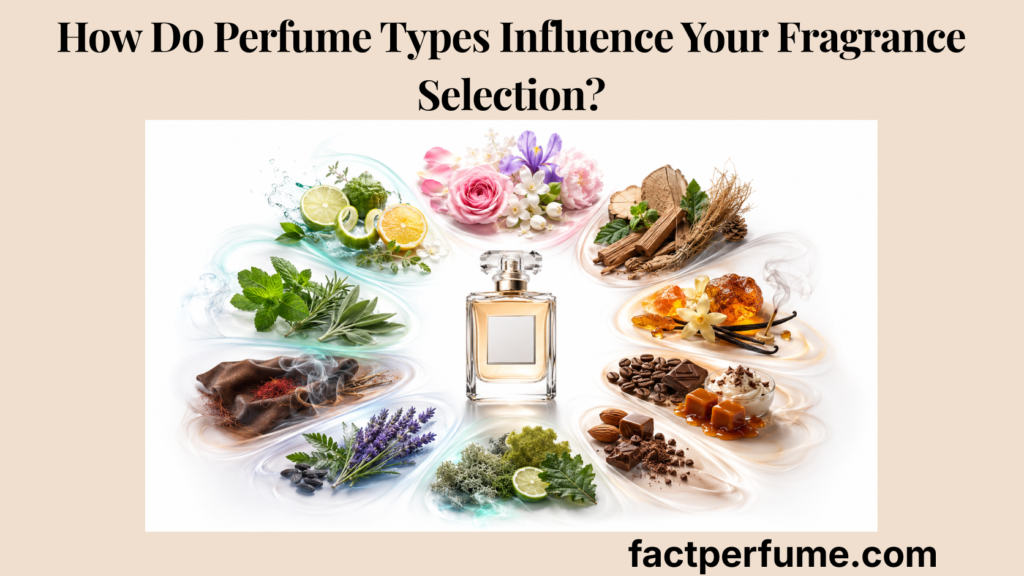
The foundational perfume types include fresh, floral, woody, amber, gourmand, chypre, fougère, leather, and aromatic families, although modern classification systems may group or subdivide them differently. A perfume type describes a dominant olfactory direction, not a complete formula, concentration, quality grade, or performance promise. Many modern perfumes combine families such as floral woody, fresh aromatic, or amber gourmand. Readers who need a broader taxonomy can compare the system of common perfume types before applying those labels to a purchase decision.
How Do Fresh Perfume Types Shape Fragrance Selection?
Fresh perfume types shape fragrance selection by offering bright, crisp, watery, citrus, green, or airy directions that often suit buyers seeking clarity or an understated impression. Bergamot, lemon, grapefruit, neroli, herbs, aquatic effects, and light musks are common references within several fresh sub-directions. Citrus may feel sparkling, aquatic effects spacious, and green effects leafy or grassy. Fresh character does not guarantee weak performance because woods, musks, aromatics, or amber materials may support the later stages.
How Do Floral Perfume Types Shape Fragrance Selection?
Floral perfume types shape fragrance selection by offering one of the widest ranges of expression, from transparent and fresh to creamy, powdery, sweet, or intensely white-floral. Rose, jasmine, tuberose, ylang-ylang, iris, orange blossom, violet, and peony can each be interpreted differently. Peony may feel dewy, iris powdery, and white florals creamy, green, or heady. Floral is too broad to predict one performance pattern or restrict the scent to one gender.
How Do Woody Perfume Types Shape Fragrance Selection?
Woody perfume types shape fragrance selection by providing dry, earthy, creamy, smoky, or grounding structures that can feel polished, calm, rugged, or formal depending on the formula. Sandalwood may suggest smooth creaminess, cedar can feel dry or pencil-like, and vetiver may appear earthy, grassy, smoky, or clean. Patchouli, guaiac wood, oud, and dry woods can add depth. Woody perfumes can also be fresh and transparent, so the family does not guarantee density, masculinity, premium quality, or long wear.
How Do Amber and Gourmand Perfume Types Shape Fragrance Selection?
Amber and gourmand perfume types shape fragrance selection by directing buyers toward warm, sweet, resinous, spicy, balsamic, creamy, roasted, or dessert-like experiences. Amber compositions often use impressions associated with vanilla, benzoin, labdanum, incense, tonka, and resins, while gourmands suggest caramel, coffee, chocolate, honey, almond, cream, or baked foods. The families can overlap where vanilla, tonka, and sweet spices meet. They are not identical, however: amber can be dry or smoky, and gourmand can be airy or restrained. Neither label guarantees strong projection, long wear, or sensual appeal.
How Do Chypre, Fougère, Leather, and Aromatic Perfume Types Shape Fragrance Selection?
Chypre, fougère, leather, and aromatic perfume types shape fragrance selection by offering structured contrasts, herbal freshness, mossy depth, suede-like texture, smoky facets, or traditional grooming associations.
Chypre perfumes usually create contrast between a bright opening and a mossy, woody, patchouli-like, or dry base. The term describes a structural tradition rather than one ingredient, and modern interpretations can differ considerably.
Fougère perfumes often combine lavender or aromatic freshness with coumarin-like sweetness, herbs, mossy effects, and woods. Their historic grooming associations do not restrict them to one gender.
Leather perfumes may suggest polished leather, soft suede, dry hide, smoke, tar-like effects, spice, or animalic warmth. Their tactile character can feel elegant to one wearer and challenging to another.
Aromatic perfumes centre on herbs such as lavender, rosemary, sage, basil, or mint. They may remain bright and green or become deeper through woods, spice, fougère structure, or amber.
Standard Perfume Types Wheel Breakdown
The perfume types wheel works best as a quick selection map rather than a universal classification system.
| Type | Core character | Common references | Selection cue | Limitation |
|---|---|---|---|---|
| Fresh | Bright, airy, green | Citrus, water, herbs | Clarity and freshness | Opening may change quickly |
| Floral | Petal-like, creamy, powdery | Rose, jasmine, iris | Broad expression | Very diverse category |
| Woody | Dry, earthy, smooth | Cedar, vetiver, sandalwood | Grounded structure | No longevity guarantee |
| Amber | Warm, resinous, sweet | Vanilla, resins, incense | Enveloping warmth | Density varies |
| Gourmand | Edible, creamy, roasted | Caramel, coffee, almond | Familiar sweetness | Can feel cloying |
| Chypre | Bright, mossy, dry | Citrus, patchouli, woods | Structured contrast | Taxonomy varies |
| Fougère | Herbal and groomed | Lavender, herbs, woods | Aromatic structure | Cultural associations vary |
| Leather | Suede-like, smoky, dark | Suede, smoke, spice | Distinctive texture | Can divide preference |
| Aromatic | Herbal, green, lively | Mint, rosemary, sage | Herbal freshness | Sharp facets may challenge |
Practical takeaway: Use the wheel to shortlist directions, then test the finished perfume.
Why Do Different Perfume Types Project and Last Differently?
Different perfume types can project and last differently because formulas use materials with different volatility, concentration, supporting structures, and application behaviour, but the family label alone cannot predict performance. Longevity is wear duration, projection is nearby radiation, and sillage is the trail left in the air. Dose, surface, clothing, climate, and perception also matter. Family tendencies should therefore be interpreted alongside a separate evaluation of perfume longevity, not used as fixed rankings.
Why Do Fresh Perfume Types Sometimes Fade Faster?
Fresh perfume types may lose part of their opening brightness earlier when a formula relies heavily on more volatile citrus, green, or airy materials without enough persistent support. Citrus and transparent green impressions can create a vivid opening that recedes during development. That change does not prove that the entire fragrance has disappeared, because musks, woods, aromatics, florals, or amber materials may remain. Concentration and base structure can alter the result, so a full-wear test should distinguish fading top impressions from total longevity.
Why Do Woody Perfume Types Sometimes Feel More Persistent?
Woody perfume types can feel more persistent when less volatile wood, vetiver, patchouli, resinous, or musky materials support the later stages. Sandalwood may remain creamy, while cedar, vetiver, or dry woods create a sharper drydown. Persistence remains a formula-level tendency rather than a family guarantee. A lightly structured woody fragrance may fade sooner than a fresh perfume supported by lasting musks or woods, and natural wood materials are not automatically more persistent than synthetic aroma materials.
Why Can Amber and Gourmand Perfume Types Feel Stronger?
Amber and gourmand perfume types can feel stronger when sweet, balsamic, vanilla-like, resinous, spicy, or roasted accords create a dense sensory impression. Perceived density is not identical to projection: a sweet amber may feel rich close to the skin while leaving a restrained trail. Dose, temperature, humidity, and proximity can change the experience or reduce clarity. Some amber and gourmand perfumes remain soft or airy, so sweetness should not be treated as an objective measurement of strength, longevity, or sillage.
Why Do Floral Perfume Types Vary So Much in Performance?
Floral perfume types vary widely in performance because transparent florals, powdery florals, creamy white florals, fruity florals, woody florals, and ambered florals use different supporting structures. Peony may settle into musk, while jasmine or tuberose becomes creamy, green, sweet, or expansive. Iris may feel powdery and close, whereas an ambered floral may develop more warmth. Floral impressions can also dominate different stages of wear, which makes product-level testing more reliable than assigning the whole family one performance range.
Perfume Type Performance Matrix
The performance matrix compares possible development patterns without fixed hours, scores, or rankings.
| Type | Opening | Possible drydown | Main variables | Best test |
|---|---|---|---|---|
| Fresh | Citrus, green, airy | Musk, herbs, woods | Base support, dose, climate | Recheck after brightness fades |
| Floral | Petal-like, creamy | Powder, musk, amber | Structure, surface, dose | Observe heart and drydown |
| Woody | Dry, earthy, smooth | Woods, vetiver, smoke | Formula, clothing, warmth | Test full wear |
| Amber | Warm, resinous, sweet | Balsamic, musky, smoky | Dose, temperature, base | Apply conservatively |
| Gourmand | Sweet, creamy, roasted | Vanilla-like, woody | Density, climate, perception | Check comfort over time |
| Chypre | Bright, green, dry | Mossy, woody, musky | Balance, surface, dose | Compare opening and base |
| Fougère | Herbal, fresh | Woods, moss, musk | Structure, concentration | Follow the transition |
| Leather | Smoky, dry, suede-like | Woods, amber, musk | Accord, dose, warmth | Test lightly in context |
| Aromatic | Herbal, cooling | Woods, spice, fougère | Climate, support, airflow | Recheck after herbs settle |
Practical takeaway: Family performance is a testing hypothesis, not a product guarantee.
Which Perfume Types Best Match Your Identity Beyond Traditional Gender Marketing?
The perfume types that best match personal identity are those that express the wearer’s desired mood, style, and presence rather than the gender category printed on the packaging. Gendered categories are commercial and cultural frameworks expressed through design, naming, advertising, and retail placement. They do not determine who may enjoy floral, woody, sweet, fresh, smoky, or leather scents. Marketing labels become easier to interpret when readers understand gender positioning without restricting the wearer. The most useful direction becomes clearer when personal preference guides the decision instead of trends or stereotypes.
Which Perfume Types Feel Clean and Minimal?
Fresh, citrus, aquatic, green, soft musk, and light aromatic perfume types often support a clean or minimal expression because they can create a crisp, transparent, or restrained impression. “Clean” is a sensory description, not evidence that a perfume is safer, purer, or free from potential irritants. Soft musk may feel quiet, while citrus aromatics can feel sharp. Buyers seeking minimalism should evaluate clarity, sweetness, texture, and actual intensity rather than assuming that every fresh family is subtle or automatically suitable for a shared environment.
Which Perfume Types Feel Elegant or Romantic?
Floral, powdery, iris, rose, white-floral, and soft amber perfume types can support elegant or romantic expression when their sweetness, texture, and intensity suit the wearer. Elegance may appear through iris, restrained rose, smooth woods, or dry chypre structure. Romance may be associated with soft petals, creamy florals, musk, or warm amber, but both ideas remain subjective. Rich white florals can feel much bolder than transparent peony or rose compositions, so buyers should choose the desired degree of softness, radiance, sweetness, and formality.
Which Perfume Types Feel Grounded and Professional?
Woody, aromatic, chypre, vetiver, cedar, and moss-supported perfume types can feel grounded or professional when the formula and application fit the setting. Dry woods, restrained herbs, polished vetiver, and structured chypre effects may communicate composure, yet professionalism is not an inherent property of one family. Smoky woods may feel assertive, while a controlled aromatic remains unobtrusive. The practical goal is a clear, well-managed scent presence, not a masculine-authority stereotype or a universal office rule.
Which Perfume Types Feel Warm, Sensual, or Bold?
Amber, gourmand, leather, smoky, spicy, oud, and resinous perfume types can create warm, sensual, or bold expression when the wearer enjoys their density and applies them with contextual restraint. Warmth may come from balsamic or resinous effects; boldness from smoke, leather, or dark woods. Sensuality remains subjective and cannot be guaranteed by one note or family. Leather and smoke can feel polished and soft in one formula or dark and polarizing in another.
Identity Expression Type Matrix
The identity matrix links desired expression to flexible scent directions without assigning gender or personality.
| Expression | Useful types | Supporting directions | Potential mismatch |
|---|---|---|---|
| Clean and minimal | Fresh, citrus, soft musk | Airy herbs, light woods | Sharpness may feel impersonal |
| Elegant and polished | Floral, iris, chypre | Rose, powder, smooth woods | Richness may feel traditional |
| Romantic and soft | Floral, soft amber, musk | Peony, orange blossom, cream | Sweetness may become heavy |
| Grounded and composed | Woody, aromatic, vetiver | Cedar, herbs, dry musk | Smoke may feel severe |
| Warm and comforting | Amber, gourmand, woody | Resins, tonka, soft spice | Density may become tiring |
| Bold and distinctive | Leather, oud, spicy amber | Smoke, suede, dark woods | Can divide preference |
| Energetic and lively | Fresh, citrus, green | Mint, neroli, herbs | Brightness may feel sharp |
Practical takeaway: Confirm the desired expression through full wear, not marketing labels.
Which Perfume Types Best Match Your Season, Climate, and Occasion?
The perfume types that best match a season, climate, or occasion are those whose scent character and applied intensity remain comfortable in the actual environment. Temperature, humidity, airflow, clothing, proximity, and dose may change diffusion. Seasonal labels are therefore conventions rather than laws: fresh types can feel heavy when overapplied, while rich types can remain manageable at a restrained level. Environmental matching requires a deeper understanding of season and climate rather than rigid summer and winter categories.
Which Perfume Types Work Well in Warm Weather?
Fresh, citrus, aquatic, green, aromatic, soft floral, and clean musk perfume types often feel easier in warm weather when their applied intensity remains light and comfortable. Warmth may increase diffusion beyond what a cooled shop test suggests. Humidity, airflow, skin condition, and air conditioning can further change the experience. Rich amber, gourmand, leather, or woody fragrances are not automatically unsuitable for heat, because restrained application may keep a deeper composition comfortable. Freshness is one useful direction, not the only correct warm-weather choice.
Which Perfume Types Work Well in Cold Weather?
Amber, gourmand, woody, spicy, leather, resinous, and rich floral perfume types can feel well suited to cold weather because their warmth and depth may remain comfortable as diffusion changes. Cool air may quiet a scent, while heated close spaces can reverse that effect. A rich fragrance that works outside may become excessive after entering a heated room. Personal preference still controls the choice, and some wearers may prefer citrus, green, or aromatic fragrances throughout colder periods.
Which Perfume Types Work Well for Office Wear?
Fresh, soft floral, clean musk, light woody, subtle citrus, and controlled aromatic perfume types can suit office wear when application respects proximity, ventilation, and workplace scent policies. An office-appropriate result depends more on actual intensity than the family name. A persistent clean musk or sharp aromatic may be more noticeable than expected, while a restrained woody fragrance may remain close. Check fragrance policies and consider shared rooms, meetings, and transport. No family is universally appropriate where a fragrance-free policy applies.
Which Perfume Types Work Well for Evening and Formal Occasions?
Amber, woody, leather, chypre, rich floral, spicy, and gourmand perfume types can suit evening or formal occasions when their depth supports rather than dominates the setting. Formal dress does not require strength, especially with close seating, dining, or indoor heat. Fresh, floral, or aromatic perfumes can also work when they fit the wearer’s style. The goal is coherence among scent character, personal expression, venue, and social distance rather than obedience to one family rule.
Seasonal and Occasion Type Decision Matrix
The seasonal matrix combines climate, social distance, and applied intensity without prescribing spray counts.
| Context | Useful directions | Intensity aim | Possible mismatch |
|---|---|---|---|
| Hot outdoors | Fresh, citrus, green, aromatic | Light and controlled | Sharpness or excess diffusion |
| Warm indoors | Soft floral, musk, light woody | Close and restrained | Dense sweetness fills the room |
| Cool outdoors | Woody, amber, spicy, rich floral | Moderate for context | Becomes heavy indoors |
| Office or classroom | Fresh, soft floral, light woody | Restrained | Any persistent scent may disrupt |
| Formal event | Chypre, floral, woody, amber | Polished, not necessarily strong | Overapplication dominates |
| Evening social event | Amber, spicy, leather, gourmand | Context-dependent | Smoke or sweetness overwhelms |
| Close-contact occasion | Soft musk, subtle fresh, light woody | Discreet | Trail exceeds personal space |
Practical takeaway: Match the perfume to the real environment, not only the season or event name.
How Can You Layer Different Perfume Types to Create a Custom Signature?
Different perfume types can be layered into a custom signature by combining a simple base with one compatible supporting direction and testing the result at a low application level. Layering combines two or more perfumes or scented products. Compatibility here refers to olfactory balance, not guaranteed skin suitability. One direction should normally remain dominant while the second adds brightness, warmth, softness, or contrast. Controlled combinations become easier to plan when the buyer understands perfume layering. Test one simple pairing at a time.
Which Perfume Types Commonly Layer Well With Fresh Perfume Types?
Fresh perfume types commonly layer well with citrus, green, aquatic, light floral, soft musk, or restrained aromatic directions because shared brightness can preserve clarity. Soft musk can extend cleanliness, while light florals add texture. Citrus and herbs can reinforce energy, but too many sharp materials may create a piercing result. Dense gourmand, smoky, or resinous bases may overwhelm a delicate opening, so begin with low application and observe the combined drydown before adding more.
Which Perfume Types Commonly Layer Well With Floral Perfume Types?
Floral perfume types commonly pair with soft amber, musk, light woods, restrained vanilla, citrus, or powdery directions when the supporting layer does not obscure the central floral character. Transparent florals may suit citrus or musk; creamy florals may suit soft woods or amber. Rich florals can already contain substantial sweetness and density. Combining them with a heavy gourmand may therefore become cloying, making controlled testing more reliable than assuming compatibility from the note lists.
Which Perfume Types Commonly Layer Well With Woody Perfume Types?
Woody perfume types commonly pair with citrus, aromatic, spicy, soft amber, leather, vetiver, or musk directions when the combination preserves one clear dominant structure. Citrus or herbs may brighten woods, while amber softens them. Leather may deepen a polished woody base, but several smoky, resinous, or oud-like fragrances can compete and obscure the structure. The woody fragrance does not always need to be applied first; sequence depends on format, intensity, and the intended balance.
Which Perfume Types Should Not Be Layered Heavily Together?
Multiple dense gourmand, smoky leather, resinous amber, oud, or heavy woody perfume types should not be layered heavily when sweetness, smoke, spice, and depth compete instead of forming one clear direction. The concern is sensory overload, not automatic medical danger. Reduce the number of products or the total dose when the blend becomes muddy, overly sweet, or excessively smoky. Olfactory overload must remain separate from skin irritation, which requires stopping use if concerning symptoms develop.
Olfactory Layering Compatibility Matrix
The layering matrix shows broad pairing logic and the main overload risk.
| Base | Possible partner | Shared logic | Overload risk | Controlled test |
|---|---|---|---|---|
| Fresh | Soft musk | Adds softness | Musk hides brightness | Test separately, then combine lightly |
| Citrus | Green or aromatic | Extends crispness | Excess sharpness | Begin with the softer scent |
| Floral | Light woods | Adds structure | Floral becomes austere | Use a small woody accent |
| Floral | Soft amber | Adds warmth | Sweetness becomes heavy | Keep amber restrained |
| Woody | Citrus or aromatic | Adds brightness | Opening becomes sharp | Add a minimal accent |
| Woody | Soft amber | Adds warmth | Base becomes dense | Keep one scent dominant |
| Gourmand | Musk or light woods | Reduces edible weight | Blend becomes cloying | Avoid another dense gourmand |
| Leather | Woods or spice | Supports texture | Smoke becomes overpowering | Test on separate areas |
| Aromatic | Fresh or woody | Connects herbs and structure | Camphor sharpness increases | Let the opening settle |
Practical takeaway: Use one dominant direction and one supporting accent.
How Can You Avoid Common Mistakes When Wearing Unfamiliar Perfume Types?
Common mistakes with unfamiliar perfume types can be avoided by sampling first, using controlled application, observing the complete drydown, and testing the fragrance in realistic conditions. Blind buying overvalues marketing, while heavy application hides structure. A contextual mismatch can also make a suitable perfume seem inappropriate. Individual wear can vary, which is why buyers should understand skin type without treating dry, oily, or other broad labels as fixed predictors.
How Can Unfamiliar Perfume Types Change on Skin?
Unfamiliar perfume types can smell different on skin because warmth, moisture, sweat, other body products, application amount, environment, and individual perception influence the wearing experience. Scented lotion or other products may alter development and introduce misleading impressions. Avoid reducing every difference to body chemistry or skin pH. Compare finalists on clean, non-irritated skin according to product directions, while remembering that this skin evaluation remains observational rather than diagnostic.
How Can Dense Perfume Types Become Overwhelming?
Dense amber, gourmand, leather, oud, smoky, or heavy woody perfume types can become overwhelming when application amount and environmental diffusion exceed the intended intensity. Temperature, ventilation, proximity, and room size can make the same dose feel controlled or excessive. Heavy application may also blur distinctions among sweetness, woods, spice, smoke, and resin. Begin conservatively with an unfamiliar dense profile and reassess after development. Strong odour is not automatically medical harm, but concerning physical discomfort requires stopping use.
How Can the Wrong Perfume Type Feel Inappropriate for the Setting?
A perfume type can feel inappropriate when its applied intensity, sweetness, smoke, dryness, or scent trail conflicts with the venue, proximity, climate, or social expectations. Dense gourmand may distract in class, while smoky leather dominates shared transport. A quiet fresh fragrance may become difficult to perceive outdoors. The family itself is not always the problem, because lowering the dose, changing the occasion, or selecting a softer interpretation may correct the mismatch. Cultural and workplace expectations should be observed rather than assumed.
How Can You Reduce Olfactory Adaptation While Comparing Perfume Types?
Olfactory adaptation can be reduced during comparison by limiting exposure, creating breaks between tests, recording observations, and avoiding repeated heavy application. Olfactory adaptation is reduced awareness after continued or repeated odour exposure; human olfactory-adaptation research describes a perceptual decrease after repeated or prolonged odorous exposure, so noticing less scent does not necessarily prove that the perfume has disappeared. Pause between comparisons, seek relatively unscented air, and return to labelled tests later. Avoid relying on coffee beans as a guaranteed sensory reset.
Type Mistake Troubleshooting Table
The troubleshooting table separates testing errors from the perfume family itself.
| Mistake | Likely cause | Immediate correction | Better next test |
|---|---|---|---|
| Buying from the opening | First impression mistaken for full wear | Delay the decision | Recheck heart and drydown |
| Applying too much | Unfamiliar density | Stop adding scent | Retest conservatively |
| Assuming fresh means weak | Family stereotype | Observe the base | Compare full wear |
| Assuming woody means lasting | Label treated as proof | Separate character from duration | Conduct a wear test |
| Choosing by gender label | Marketing overrode preference | Reassess the scent | Compare across categories |
| Ignoring the setting | Dose did not fit proximity | Change context or dose | Test realistically |
| Layering many dense types | Competing structures | Return to one scent | Add one accent only |
| Testing too many perfumes | Sensory fatigue | Pause | Resume with a small group |
| Assuming disappearance | Adaptation reduced awareness | Avoid reapplication | Recheck after a break |
| Testing irritated skin | Unsuitable surface | Stop testing | Retest only when appropriate |
Practical takeaway: Correct the method, dose, or context before rejecting a whole family.
How Should You Test Different Perfume Types Before Choosing One?
Different perfume types should be tested through a staged process that uses paper for preliminary comparison, suitable skin for personal development, and full wear for the final decision. Begin with a small, manageable group and label every strip. Paper compares initial direction but cannot reproduce warmth, moisture, movement, or other products. Test only the strongest candidates on suitable skin according to product instructions. Observe opening, heart, drydown, comfort, intensity, and realistic context without imposing one universal testing time.
How Should You Test Fresh Perfume Types Before Choosing One?
Fresh perfume types should be tested beyond their first citrus, aquatic, green, or airy impression to determine whether the later scent remains balanced and satisfying. Notice whether the opening feels sparkling, watery, herbal, or clean, then return after it recedes. A reduction in citrus brightness does not necessarily mean complete disappearance, because woods, herbs, musk, florals, or amber support may become clearer. Avoid choosing from the first minute, particularly when the opening is the most dramatic part.
How Should You Test Floral Perfume Types Before Choosing One?
Floral perfume types should be tested through the heart and drydown because their structures can become sweeter, powderier, creamier, sharper, greener, or more indolic over time. Indolic describes a lush, heady, or slightly animalic floral facet, often associated with jasmine effects. It is not automatically pleasant or unpleasant. Observe how sweetness, musk, woods, fruit, or amber changes the floral centre, and judge the result through personal preference rather than gender expectations.
How Should You Test Woody and Amber Perfume Types Before Choosing One?
Woody and amber perfume types should be tested through later wear because their dry, resinous, creamy, smoky, spicy, or sweet character may become clearer after the opening. Apply conservatively so density does not hide the structure. Observe whether woods become dry or smoky and amber develops toward resin, spice, musk, or sweetness. Reassess the fragrance in an environment similar to intended wear instead of assuming that these families always become stronger.
How Should You Compare Multiple Perfume Types Without Confusing Them?
Multiple perfume types should be compared in small groups, on labelled strips or separated test areas, with written observations and sufficient breaks between exposures. Use paper for elimination, then apply finalists to separate suitable skin areas. Record the family direction, opening, heart, drydown, comfort, intensity, and preference. Avoid testing several dense amber, gourmand, leather, or smoky fragrances together because their trails can overlap. Do not mask sensory fatigue with another strong smell; pause in relatively unscented air instead.
Type-to-Skin Testing Checklist
The checklist separates preliminary screening, skin development, comfort, and realistic wear.
Practical takeaway: Paper narrows the field; suitable skin and full wear determine fit.
Frequently Asked Questions
Perfume types are not universally standardized because brands, retailers, perfumers, and reference systems may group or name fragrance families differently. The classifications remain useful as broad selection tools, but buyers should expect overlap, hybrid structures, and occasional disagreement about where an individual perfume belongs.
No perfume type lasts longest in every formula because longevity depends on the complete composition, concentration, application amount, surface, environment, and individual perception. Woody, amber, musky, or resinous structures may sometimes remain noticeable later, but an individual perfume still requires direct wear testing.
Any wearer can choose any perfume type because gender labels mainly reflect marketing, design, and cultural conventions rather than a rule controlling fragrance suitability. Personal preference, identity, comfort, intended use, and the complete wearing experience provide stronger selection criteria than the category printed on the packaging.
Different perfume types can be layered when the combination preserves one clear scent direction and the wearer tests the blend at a controlled application level. Olfactory compatibility describes scent balance, not a medical safety guarantee, so one simple pairing should be evaluated before adding more scented products.
Perfume types should first be screened on paper and then evaluated on suitable skin when personal development and full-wear behaviour need to be understood. Paper supports preliminary comparison, while skin can reveal development under warmth, movement, and individual wearing conditions. Skin evaluation is not a medical patch test.
Only a small, manageable group of perfume types should be compared at one time because excessive exposure can reduce the clarity of sensory comparisons. Label strips, record brief observations, take breaks, and test only the strongest candidates on skin rather than applying every available perfume at once.
Conclusion
Perfume types influence fragrance selection most effectively when they are used as flexible scent directions rather than fixed predictions of performance, identity, season, gender, skin behaviour, or suitability. They help buyers identify broad families, interpret possible development, express a preferred style, consider climate and occasion, test restrained layering, correct mistakes, and compare finalists through complete wear.
The final decision should combine the family direction with the actual formula, applied intensity, environment, comfort, drydown, and personal preference. The right perfume type is the one whose complete scent development, applied intensity, context, and personal expression fit the wearer after careful testing.