
What Are the 24 Factors to Consider Before Buying a Perfume?
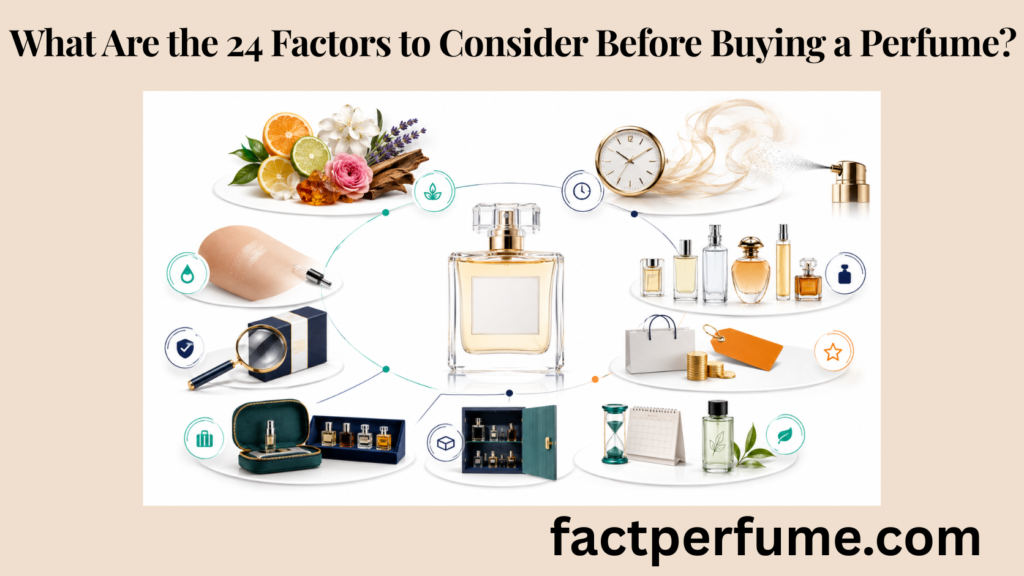
The 24 factors to consider before buying a perfume cover scent identity, personal preference, intended use, performance, application, price, safety, authenticity, packaging, storage, and the product’s likely condition over time. No single factor identifies the right perfume for every buyer because a fragrance can perform well in one area while remaining unsuitable in another.
This article evaluates all 24 factors in a controlled sequence and helps you decide whether to buy, sample, retest, choose a smaller format, or reject a perfume. The strongest decision combines personal enjoyment with realistic performance, comfort, purchase confidence, value, usability, and long-term care.
How Do Perfume Types Influence Your Fragrance Selection?
Perfume types influence fragrance selection by identifying the broad scent character a buyer is most likely to enjoy or reject.
Broad categories such as fresh, floral, woody, amber, fougère, chypre, and leather can make a large fragrance market easier to navigate. If you regularly dislike smoky, heavily sweet, powdery, or sharply green profiles, broad classifications may help you eliminate unsuitable options before testing.
Perfume classification is not completely universal. One fragrance may combine elements associated with several families, while brands, retailers, and fragrance references may classify the same composition differently.
A family name also does not predict exact sweetness, intensity, ingredient quality, projection, sillage, or longevity. Two perfumes described as woody may produce very different wearing experiences.
Use perfume type as an initial filter, then test the complete fragrance. Buyers who need a deeper classification framework can explore perfume types before testing individual fragrances.
How Should Personal Preference Guide Your Perfume Choice?
Personal preference should guide perfume choice because a fragrance is only suitable when its complete wearing experience remains enjoyable to the buyer.
Popularity, awards, compliments, advertising, and social-media attention cannot replace your own response to the fragrance. A widely admired perfume may still feel too sweet, dry, smoky, sharp, heavy, clean, powdery, or intrusive for you.
Evaluate the opening, heart, and drydown rather than deciding from the first few minutes. The opening is the initial impression, the heart is the middle development, and the drydown is the later character that remains after more volatile impressions fade.
A perfume that smells attractive on another person may not create the same experience when you wear it. Differences in dose, environment, application surface, routine, and individual perception can affect your judgment.
Preference can also change with setting, mood, repeated exposure, and intended use. A controlled purchase begins with personal preference rather than trends or approval from other people.
How Does the Occasion Dictate Your Perfume Choice?
The occasion shapes perfume choice by changing the acceptable intensity, formality, scent trail, and duration of wear.
An office, classroom, formal event, outdoor gathering, shared vehicle, close-contact meeting, religious setting, restaurant, and private leisure environment can create different practical requirements.
Consider the venue, ventilation, proximity to other people, event length, dress expectations, fragrance policies, and possibility of reapplication. A perfume that works in an open outdoor space may feel excessive in a small enclosed room.
Application dose can matter as much as fragrance style. A composition that feels controlled with light application may become disruptive when heavily applied.
Avoid rigid rules that assign one fragrance family to one occasion. The useful question is whether the perfume’s character, dose, duration, and social reach fit the specific environment.
Should Season and Climate Influence Your Perfume Selection?
Season and climate should influence perfume selection because temperature, humidity, airflow, clothing, and indoor conditions can change how a fragrance is perceived.
Warm conditions may increase diffusion or alter how quickly certain impressions evaporate. A perfume may therefore appear more expansive, brighter, sweeter, or heavier in heat than it does in cooler surroundings.
Colder conditions may reduce diffusion, although indoor heating, enclosed spaces, heavy clothing, and application amount can modify the result. Humidity and airflow may also affect how the fragrance develops and travels.
Seasonal categories are conventions rather than fixed laws. A fragrance marketed for winter may remain enjoyable in warm weather at a lower dose, while a fragrance marketed for summer may still work indoors during a colder period.
Test the perfume in conditions reasonably similar to its intended use. A brief test inside an air-conditioned shop may not predict the experience of wearing it outside in heat or humidity.
How Should Age Group Influence Your Perfume Choice?
Age group may influence perfume choice through lifestyle, experience, budget, and cultural association, but age does not determine which scents a person may wear.
Terms such as youthful, mature, old-fashioned, or age-appropriate are often marketing or cultural descriptions. They do not establish a reliable rule about which notes, families, or concentrations belong to a particular age group.
Focus on preference, intended use, comfort, application habits, and lifestyle. Two people of the same age may have completely different scent tastes and performance expectations.
Age should not be used to infer personality, confidence, maturity, health, or gender. A perfume should be evaluated through the wearer’s experience rather than a stereotype attached to the bottle.
When a fragrance is considered for a child, a responsible adult should review the product directions, ingredient information, application method, and appropriateness of use.
How Does Gender Influence Perfume Design and Fragrance Selection?
Gender influences perfume design mainly through branding, packaging, retail categories, and cultural expectations rather than through a rule that limits who may wear a fragrance.
Brands may use bottle colour, shape, naming, advertising, store placement, and scent descriptions to market a perfume toward men, women, or a broader audience.
These categories may help organize products, but they do not make floral, woody, sweet, smoky, fresh, musky, or powdery notes biologically exclusive to one gender.
Buyers may explore any marketed category according to preference, identity, comfort, and intended use. A label should not override a positive or negative personal wearing experience.
Treat gender positioning as commercial context rather than proof of suitability.
The 24-Factor Perfume Buying Matrix
| Decision group | Included factors | Main buying question |
|---|---|---|
| Personal scent fit | Perfume Types, Personal Preference, Age Group, Gender, Fragrance Notes | Do I enjoy the complete scent without relying on marketing labels or stereotypes? |
| Intended use | Occasion, Season and Climate, Perfume Layering | Does the fragrance fit where, when, and how I intend to wear it? |
| Performance and application | Longevity, Sillage, Concentration, Form, Application Method | Does the real wearing behaviour and delivery format meet my needs? |
| Commercial confidence | Brand, Price, Reviews, Authenticity and Batch Code | Is the transaction credible, appropriately priced, and supported by reasonable evidence? |
| Safety and formula | Skin Type, Allergies, Ingredient Quality | Have I considered comfort, available product information, and relevant sensitivities? |
| Ownership and care | Sustainability, Packaging and Usability, Storage, Shelf Life | Can I use, protect, store, and finish the product responsibly? |
Should Perfume Layering Influence Your Fragrance Buying Decision?
Perfume layering should influence a purchase when the buyer plans to combine the fragrance with other scented products, because each added scent can change balance and intensity.
Layering means wearing two or more scented products together. These may include perfumes, body lotions, soaps, deodorants, hair products, oils, or fragranced skin-care products.
A perfume that feels balanced alone may become sweeter, heavier, sharper, more diffusive, or less coherent when combined with another scent. The total application dose may also become excessive in enclosed settings.
Test intended combinations at a low dose before buying a large bottle. A note list may suggest possible compatibility, but it cannot guarantee how two complete formulas will interact.
Layering remains optional. A perfume does not need to combine successfully with other fragrances when it already meets the buyer’s needs on its own.
Why Should Longevity Guide Your Perfume Purchase Decision?
Longevity should guide a perfume purchase because the fragrance must remain perceptible for a duration that fits the buyer’s intended use and reapplication habits.
Longevity describes how long a fragrance remains perceptible. It is different from projection, which describes how strongly a scent radiates around the wearer, and sillage, which describes the trail it leaves in the air.
Actual wear may depend on formula construction, application amount, application surface, environmental conditions, skin condition, clothing, and individual perception.
A wearer may also become less aware of a familiar smell during extended exposure. Reduced personal awareness does not always prove that the fragrance has completely disappeared.
Use a full-wear test rather than judging longevity from the opening or a short store visit. Observe the development, the useful wear period, and whether reapplication would be practical.
Longer wear is not automatically better. A persistent perfume may reduce reapplication needs but can become tiring or unsuitable in settings where a shorter, quieter experience is preferred.
A full-wear test becomes easier to interpret when the buyer understands longevity and records the useful wear period.
How Does Sillage Influence Your Perfume Selection?
Sillage influences perfume selection by determining whether the scent trail left around the wearer suits the intended environment and social distance.
Sillage is the scented trail that remains as a wearer moves through a space. Projection is the fragrance’s radiation around the wearer at a particular stage, while longevity is its duration of perceptibility.
Strong sillage is not automatically better. A noticeable trail may fit an outdoor gathering or spacious event but feel intrusive in an office, classroom, clinic, shared vehicle, public transport, or close-contact environment.
Application amount can change the perceived trail. Testing with an unrealistic dose may therefore produce a misleading impression of normal wear.
Select a sillage level that matches your intended social reach. Some buyers prefer a private scent that remains close, while others want a more noticeable presence without overwhelming nearby people.
Why Does Concentration Matter When Choosing a Perfume?
Concentration matters because it helps identify the product format and formula category, but it does not guarantee one fixed level of strength, projection, or longevity.
Labels such as parfum, eau de parfum, eau de toilette, and eau de cologne provide useful product context. However, naming practices and formula construction can vary between brands, markets, and individual fragrances.
A higher concentration label does not independently prove that a perfume will project farther or last longer. Performance depends on the complete formula, materials, dose, application surface, and wearing conditions.
Different concentrations of a named fragrance may also emphasize different notes or produce a different balance. They are not always identical formulas diluted to different strengths.
Compare versions through direct wear instead of choosing from the label alone. The product description becomes more useful when you understand concentration without treating the label as a performance guarantee.
How Does Perfume Form Influence Your Fragrance Choice?
Perfume form influences fragrance choice by changing portability, application control, texture, diffusion, and the practical wearing experience.
Sprays distribute liquid over a relatively broad area. Rollerballs and dabbers provide localized application, while solid perfumes are transferred from a wax-like or balm format. Fragrance oils may also use rollers, droppers, or dab applicators.
Consider portability, leakage risk, texture, convenience, dose control, refill availability, and intended use. A compact rollerball may suit travel, while a spray may be easier when broader distribution is preferred.
Form does not prove ingredient quality, safety, naturalness, intensity, or longevity. These qualities depend on the complete product and how it is applied.
Inspect the container and follow the product directions. The most suitable form is the one that makes normal use practical without creating avoidable handling or storage problems.
How Should the Application Method Shape Your Perfume Selection?
The application method should shape perfume selection because spraying, rolling, dabbing, or applying a solid changes dose, distribution, portability, and intensity control.
A spray can distribute perfume quickly, but atomizers differ. One may produce a fine mist, while another releases a narrow stream, an uneven spray, or more liquid per press.
Rollerballs, dabbers, and solids allow localized application, although the transferred amount can still vary between products and users.
Inspect the atomizer, roller, cap, seal, or applicator whenever possible. Leakage, poor spray behaviour, a loose closure, or difficult handling can reduce the product’s practical value.
Application to skin or clothing should follow the product label and consider material compatibility. Avoid universal spray counts because formulas, applicators, settings, clothing, and wearer preferences differ.
Do Brand Reputations Help When Choosing the Right Perfume?
Brand reputation can help a buyer evaluate consistency, disclosure, distribution, customer service, and purchase support, but it cannot prove personal suitability.
A reliable brand presence may make official product details, samples, return conditions, authorized distribution, and customer assistance easier to find.
Brand heritage, awards, popularity, exclusivity, or prestige do not guarantee that every fragrance will suit the same buyer. An established house can still release a perfume whose scent, performance, or usability fails to meet your needs.
Evaluate both the company and the individual product. Clear information and dependable support can reduce transaction uncertainty, but direct testing remains necessary.
Avoid choosing solely for the status attached to a brand name. The perfume still needs to satisfy your scent, comfort, performance, application, and budget requirements.
How Should Price Shape Your Perfume Buying Decision?
Price should shape a perfume decision by setting the buyer’s budget and expected value, but price alone cannot prove quality, originality, performance, or suitability.
Calculate the full purchase cost rather than looking only at the displayed bottle price. Shipping, taxes, duties, sampling costs, return limitations, refill expenses, and bottle size can change the real value.
A large bottle may offer a lower price per millilitre, but it also requires more storage and a longer period of use. A smaller format may cost more per millilitre while reducing the risk of owning too much perfume.
An unusually low price should encourage stronger seller verification, but it does not automatically prove counterfeiting. Discounts can result from clearance, damaged presentation boxes, market differences, older stock, or other circumstances.
Luxury pricing may include packaging, exclusivity, distribution, marketing, and service. It is not objective proof that a perfume smells better or lasts longer.
Set a realistic budget and compare the price with likely usage. A sample, travel format, or smaller bottle may be the stronger value when preference or performance remains uncertain.
Should Reviews Influence Your Final Perfume Choice?
Reviews should inform a perfume choice by revealing recurring experiences and practical issues, but they should not determine the final decision.
Compare several reviews rather than relying on one highly positive or negative opinion. Repeated reports about leakage, damaged packaging, seller conduct, atomizer failure, or a significant product inconsistency may justify further checking.
Separate subjective scent descriptions from practical product concerns. Words such as synthetic, clean, mature, weak, loud, masculine, feminine, or luxurious depend heavily on the reviewer’s expectations and vocabulary.
Review context also matters. Climate, application amount, test duration, testing surface, experience level, sensory fatigue, and intended use may explain conflicting reports.
Use reviews to identify questions for your own test. They should guide observation rather than dictate what you must smell or experience.
Why Should Authenticity and Batch Codes Matter When Buying Perfume?
Authenticity and batch information matter because counterfeit, tampered, damaged, or misrepresented perfume can create financial, performance, and safety concerns. An OECD–EUIPO counterfeit report identifies perfumery and cosmetics among product categories commonly reported with health, safety, or environmental risks.
Evaluate seller credibility, purchase documentation, product condition, distribution information, packaging consistency, communication quality, price context, and return protection together.
A batch code or barcode may support production tracking, but neither proves authenticity by itself. Codes can be copied, reused, misread, or separated from their original product context.
Legitimate packaging can vary across bottle sizes, markets, production periods, distributors, and reformulations. One visual difference should not be treated as conclusive proof of counterfeiting.
Be cautious when a seller cannot explain the product’s origin, provides conflicting information, prevents reasonable inspection, or offers no meaningful purchase protection.
Purchase risk falls when buyers evaluate authenticity checks as part of a wider verification process.
How Does Skin Type Influence Your Perfume Selection?
Skin type and skin condition can influence fragrance comfort and perceived development, but they cannot predict exact performance from a simple dry-versus-oily label.
Hydration, dose, application surface, current skin condition, clothing, environment, and formula may all influence the wearing experience.
These variables do not support a universal rule that oily skin always extends longevity or dry skin always shortens it. Individual observations should not be treated as guaranteed outcomes.
Keep performance and safety separate. A fragrance that fades quickly is not necessarily unsafe, while a perfume that lasts for a long time is not necessarily comfortable for the wearer.
Where the label permits skin application, cautious testing on a small appropriate area may help you observe comfort and development. This observation is not a medical diagnostic test and cannot rule out every reaction.
Do not apply perfume to broken, inflamed, irritated, or recently damaged skin. Stop use when concerning discomfort develops.
Why Must Allergies Be Considered When Choosing a Perfume?
Allergies must be considered because fragrance materials can trigger reactions in sensitized individuals, and a pleasant smell does not establish suitability for every user.
Irritation, allergy, and scent dislike are not the same. Irritation may involve burning, stinging, or redness, while an allergic reaction involves an immune response requiring appropriate clinical assessment. Disliking a scent is not itself an allergy.
The FDA allergen guidance identifies fragrances as one of the common allergen categories found in some cosmetic products. This general information cannot determine whether an individual buyer is allergic to a particular perfume.
Ingredient and allergen labelling varies by market. The EU allergen labelling explains EU-specific cosmetic ingredient and fragrance-allergen disclosure requirements; those rules should not be presented as worldwide requirements.
Review the product label and available ingredient information, particularly when you already know that certain materials cause problems. Terms such as natural, clean, hypoallergenic, sensitive, or free from require context and do not guarantee universal suitability.
Consumer sampling may help reveal an obvious comfort problem, but it cannot diagnose an allergy or rule out every possible reaction. Buyers with known allergies should follow appropriate professional guidance.
Readers who need deeper safety context can review fragrance allergies before purchase.
Perfume Purchase Priority Ladder
- Safety and comfort: Review relevant product information and reject or stop using a perfume that causes concerning discomfort.
- Personal preference: Confirm that the opening, development, and drydown remain enjoyable.
- Intended use: Match the fragrance’s character, dose, trail, and duration to the expected setting.
- Performance: Test longevity, projection, sillage, and application under realistic conditions.
- Seller and authenticity confidence: Assess the seller, product condition, documentation, packaging, and purchase protection together.
- Value and ownership: Decide whether the price, format, bottle size, storage needs, usability, and likely usage justify the purchase.
Why Does Ingredient Quality Matter When Selecting a Perfume?
Ingredient quality matters because material identity, purity, stability, formulation, dosage, and manufacturing control can affect the finished perfume.
A fragrance note describes a scent impression and is not necessarily the name of one disclosed ingredient. A rose, leather, amber, or marine impression may be created through several materials working together.
Natural materials are not automatically safer, purer, or better. Synthetic materials are not automatically harmful, cheap, or inferior. Both require appropriate selection, assessment, dosage, handling, and formulation.
Ingredient quality should therefore be considered as part of the complete formula and manufacturing process rather than judged from a note pyramid, price, or naturalness claim.
The IFRA standards guidance form a fragrance-industry risk-management system that may prohibit, restrict, or specify conditions for certain fragrance materials. IFRA also states that conformity does not replace a full safety assessment or remove the need to follow applicable national, regional, or local regulations.
Use product labelling and manufacturer information for product-specific details. Smell, marketing copy, price, or a note list cannot reveal every ingredient or prove complete formula quality.
How Does Sustainability Impact Your Smart Perfume Decisions?
Sustainability should influence a perfume decision when environmental or social impact matters to the buyer, but the claim must be specific enough to evaluate.
Separate the areas being discussed. Refillability, packaging weight, material sourcing, transport, manufacturing energy, labour conditions, durability, and disposal are different sustainability questions.
One recyclable component does not prove that the entire product has a lower environmental impact. A refillable bottle also offers limited benefit when compatible refills are unavailable, impractical, or unlikely to be used.
Distinguish company-wide commitments from evidence about the individual perfume. A general sustainability policy may not explain the sourcing, packaging, transport, or manufacturing profile of one product.
Treat undefined language such as green, conscious, eco-friendly, clean, ethical, or planet positive cautiously. Stronger claims identify their scope, material, process, certification, comparison, or measurable change.
Do not declare one perfume environmentally superior without comparable evidence covering the relevant parts of its life cycle.
How Do Packaging and Usability Influence Your Perfume Buying Decision?
Packaging and usability influence perfume buying by affecting protection, portability, application control, leakage risk, accessibility, and storage.
Inspect bottle stability, cap fit, seal condition, label readability, weight, grip, atomizer function, refill design, and travel practicality.
Separate decorative presentation from functional packaging. A heavy box or complex bottle may create a premium impression without improving normal use or long-term protection.
Look for leakage, loose parts, damaged seals, residue around the closure, an unstable base, or poor atomization. These issues can reduce value even when the scent itself remains satisfactory.
Accessibility also matters. A stiff sprayer, slippery bottle, small cap, unclear label, or heavy container may make regular application difficult.
Packaging appearance cannot establish authenticity by itself. It must be assessed with seller credibility, documentation, market variation, and product condition.
How Should Storage Requirements Influence Your Perfume Purchase?
Storage requirements should influence a purchase because heat, strong light, repeated temperature change, air exposure, and poor closure can increase the risk of unwanted product change.
Confirm that you have a stable, shaded location where the bottle can remain upright and protected from frequent environmental changes.
A vehicle, sunny windowsill, area beside a heat source, or frequently changing environment may provide less stable conditions than a shaded storage space.
Bottle size affects the decision. A large bottle may remain in use for much longer than a travel size, increasing the importance of closure condition, careful handling, and suitable storage.
Inspect the cap, neck, atomizer, seal, and closure. Leakage or damage may increase product loss, air exposure, evaporation, or contamination risk.
Avoid prescribing one universal storage temperature and do not treat refrigeration as a standard requirement. Product directions and stable household storage should guide care. The FDA storage guidance notes that cosmetics exposed to high temperatures or sunlight may deteriorate before an indicated expiration date.
Bottle size and long-term value depend partly on whether the buyer can provide suitable perfume storage.
How Do Fragrance Notes Influence Your Perfume Selection?
Fragrance notes influence perfume selection by describing intended scent impressions, but they do not disclose the full formula or guarantee how the perfume will smell on every wearer.
Note pyramids commonly arrange descriptions into opening, heart, and base impressions. They help communicate expected development, although the stages and timing are not identical across every perfume.
The same named note can smell bright, dark, dry, creamy, smoky, sweet, medicinal, powdery, or abstract in different formulas. Its character depends on the materials surrounding it and the overall composition.
A note pyramid is a communication tool rather than a complete ingredient list. Materials that support texture, diffusion, stability, and structure may not appear as marketed notes.
Do not purchase solely because a perfume lists one favourite note. Test the full development to determine whether that note remains recognizable and whether the complete composition is enjoyable.
Why Should Shelf Life Be Considered When Buying a Perfume?
Shelf life should be considered because a perfume’s usable condition depends on formulation, packaging, opening history, storage, and product condition rather than one universal expiration period. The FDA shelf-life guidance explains that U.S. law does not require cosmetics to carry a specific shelf life or expiration date and places responsibility for determining shelf life on manufacturers.
An unopened bottle and a frequently used bottle may experience different levels of air exposure, handling, temperature change, evaporation, and contamination risk.
Review available date, batch, lot, or period-after-opening information without interpreting one marker as a complete prediction of condition. Labelling practices may differ across products and markets.
Changes in odour, clarity, colour, texture, leakage, or spray behaviour can provide context, but one sign alone may not prove that the perfume is unusable. Colour change by itself does not establish spoilage.
Bottle size should match the expected rate of use. A large bottle offers weak value when the buyer lacks suitable storage or is unlikely to use a meaningful amount.
Final Perfume Buying Checklist
Buy, Sample, Retest, or Reject Decision Matrix
| Decision | Conditions |
|---|---|
| Buy | Preference, comfort, intended use, real performance, seller confidence, value, and ownership requirements are sufficiently clear. |
| Sample | The fragrance appears promising, but full wear, comfort, development, or performance remains uncertain. |
| Retest | The first result may have been affected by dose, environment, sensory fatigue, an unsuitable testing surface, or insufficient test time. |
| Reject | The perfume causes concerning discomfort, remains unpleasant, does not fit the intended use, exceeds the budget, is impractical to own, or lacks reliable purchase evidence. |
Frequently Asked Questions
Safety and personal preference are the first filters because a perfume should be comfortable to use and enjoyable through its full development. Price, popularity, concentration, brand reputation, and packaging cannot override concerning discomfort or a scent that remains unpleasant to the buyer.
Testing is safer than blind buying because note lists, reviews, concentration labels, and brand descriptions cannot fully predict personal perception or wear. Samples, discovery sets, travel sizes, and smaller formats can reduce purchase risk when a complete test is not immediately available.
Expensive perfume does not automatically smell better because price may reflect branding, packaging, distribution, exclusivity, and commercial positioning as well as the product. Value depends on personal enjoyment, real performance, usability, bottle size, purchase support, and likely frequency of use.
Eau de parfum does not always last longer than eau de toilette because real performance depends on the complete formula, application amount, surface, environment, and wearer perception. Longevity must also remain separate from projection and sillage.
A batch code cannot prove authenticity by itself because codes can be copied, misread, reused, or separated from their original product context. Seller credibility, documentation, packaging, product condition, distribution information, and return protection should be evaluated together.
A perfume should be tested until the buyer understands its opening, development, drydown, comfort, and performance under conditions similar to intended wear. An expensive full bottle generally requires stronger evidence than a small sample, but no rigid testing number applies to every purchase.
Conclusion
The 24 factors to consider before buying a perfume work best as a coordinated decision system rather than as isolated rules. Begin with comfort and personal preference, then evaluate intended use, real performance, application, purchase confidence, value, packaging, storage, and likely ownership time.
Price, brand, concentration, reviews, packaging, and batch codes are supporting signals rather than guarantees, so the complete wearing experience should remain central to the decision. A careful perfume decision is not about finding a universally perfect fragrance; it is about choosing a product whose scent, comfort, performance, value, and ownership requirements fit the individual buyer.