
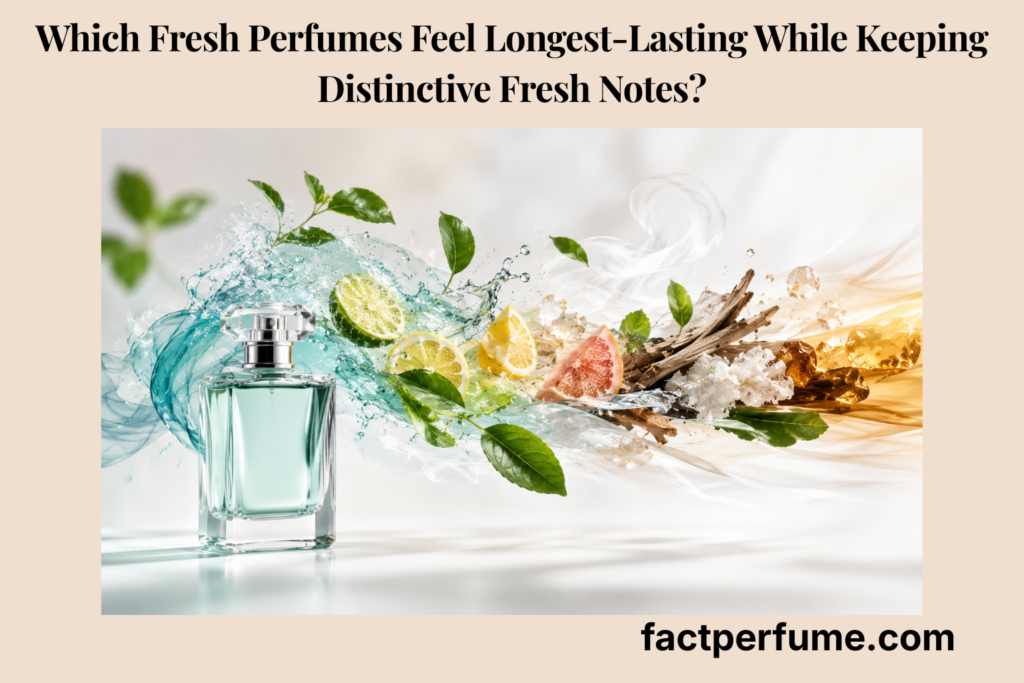
Which Fresh Perfumes Feel Longest-Lasting While Keeping Distinctive Fresh Notes?
Fresh perfumes may feel longest-lasting when their clean, bright openings are supported by musks, woods, vetiver, tea, mineral effects, or amber-style dry-down materials that help keep the scent noticeable without making it heavy.
This guide explains how long-lasting fresh perfumes work, which fresh profiles may feel more persistent, how to apply them carefully, what mistakes weaken their trail, and how to choose fresh scent structures without relying on brand rankings or fixed performance promises.
What Makes Some Fresh Perfumes Feel Longer-Lasting Than Simple Citrus Blends?
Some fresh perfumes feel longer-lasting than simple citrus blends because their bright openings are supported by musks, woods, tea, vetiver, amber-style effects, or mineral notes that create a more noticeable dry-down.
The useful rule is to look for fresh perfumes with base support rather than judging the scent only from the first spray. Citrus-heavy openings may feel vivid at the beginning, while citrus-musk, citrus-wood, tea-citrus, green-vetiver, and aquatic-amber styles can feel more structured after the opening softens.
Concentration can influence intensity, but formula design still matters. Eau de parfum, extrait, musk, woods, or amber-style support should not be treated as automatic proof that a fresh perfume will last longer on every wearer.
Freshness and longevity work together because clean openings, skin chemistry, and perceived wear depend on formula structure. A fresh perfume is also best understood through the fresh perfume definition: a clean, bright, airy scent character rather than one fixed ingredient group.
| Fresh Opening | Supportive Base | Scent Identity | Longevity Role | Boundary |
|---|---|---|---|---|
| Bright citrus | Clean musk | Sparkling but soft | Supports smoother perceived dry-down | Does not guarantee fixed wear |
| Citrus or tea | Vetiver or cedarwood | Fresh, dry, structured | Adds dry base character | Can change the scent if too dominant |
| Aquatic notes | Mineral or amber-style support | Airy, salty, modern | Helps preserve aquatic freshness | Formula-dependent |
| Green notes | Vetiver, mossy effects, leafy materials | Crisp, botanical, sharp | Gives freshness more structure | May feel bitter on some wearers |
| Clean/soapy opening | White musk or soft woods | Polished, close-wearing | Supports skin-like persistence | Not automatically skin-safe for everyone |
Evidence note: Molecular examples such as PubChem limonene and PubChem linalool support cautious discussion of fragrance-material properties, but this article treats them as examples rather than strict longevity rules.
How Do Perfumers Build Fresh Perfumes That Reduce Rapid Fading?
Perfumers can reduce rapid fading in fresh perfumes by pairing bright, volatile notes with supportive materials that may preserve the fresh character into the dry-down.
Woody support can come from vetiver, cedarwood, and soft woods that add dry structure beneath citrus, green, or aquatic notes. Musk support can make a fresh scent feel smoother, cleaner, and more close-wearing without necessarily making it loud.
Amber-style support may create airy, mineral, salty, musky, or skin-like depth depending on the formula. This should be understood as a scent effect, not one fixed ingredient or a universal longevity guarantee.
Tea and herbal support can extend the impression of freshness without making the scent heavy. Tea, mint, basil, rosemary, galbanum, mossy effects, vetiver, and leafy materials can keep the scent crisp, aromatic, or botanical as the top notes settle.
Citrus profiles need base support because citrus longevity notes often rely on supportive musk, tea, woods, vetiver, or amber-style structure to remain noticeable after the opening softens.
- Musk support can make freshness feel smooth, clean, and close to skin.
- Woody support can keep citrus, green, or aquatic freshness from feeling too thin.
- Tea and herbal support can preserve an aromatic fresh identity without making the scent sugary.
- Mineral or amber-style support can help aquatic freshness feel more dimensional when the formula is balanced.
Which Long-Lasting Fresh Perfume Profile Should You Choose Based on Your Preferred Notes?
The best long-lasting fresh perfume profile depends on whether the wearer prefers oceanic freshness, crisp greenery, bright citrus, or polished clean luxury.
If you prefer oceanic freshness, aquatic-mineral, marine-musk, or salty-woody profiles may feel more complete than watery notes alone. If you prefer crisp greenery, green-vetiver, herbal-musk, or mossy green fresh profiles can add dry botanical structure.
If you prefer bright citrus, citrus-musk, citrus-tea, citrus-wood, or citrus-aromatic profiles can keep the opening lively while giving the scent a stronger base. If you prefer clean luxury, soapy musk, soft aldehydic, tea-musk, or clean woody profiles often feel polished and close-contact friendly.
These are profile types, not product recommendations. No profile is best for every person, climate, skin condition, or setting.
| Preference | Fresh Profile | Supportive Notes | Best Setting | What to Avoid |
|---|---|---|---|---|
| Oceanic freshness | Aquatic-mineral, marine-musk, salty-woody | Mineral effects, clean musk, soft woods | Warm weather, casual daytime, clean styling | Expecting aquatic notes alone to last all day |
| Crisp greenery | Green-vetiver, herbal-musk, mossy green | Vetiver, basil, mint, mossy effects | Daytime, office, botanical scent preferences | Overly bitter green openings |
| Bright citrus | Citrus-musk, citrus-tea, citrus-wood | Clean musk, tea, cedarwood, vetiver | Summer, casual wear, uplifting routines | Citrus-only formulas when longer wear is desired |
| Clean luxury | Soapy musk, soft aldehydic, tea-musk, clean woody | White musk, aldehydic effects, tea, soft woods | Office, close-contact settings, polished style | Loud projection or dense sweetness |
How Can You Apply Long-Wearing Fresh Perfumes to Improve Their Scent Identity?
Long-wearing fresh perfumes can feel smoother and more controlled when applied to clean, moisturized skin, sprayed strategically, allowed to dry naturally, and refreshed lightly.
Clean, moisturized skin may support smoother perceived wear when irritation is not present. Pulse-adjacent areas, outer forearms, the back of the neck, and fabric-safe clothing can help distribute the scent without forcing it into a harsh cloud.
A longer fresh impression can be supported through fresh longevity boost habits such as moisturizer, careful spraying, and light reapplication. Skin testing also matters because fresh skin chemistry can change how a scent develops on dry, oily, warm, or recently moisturized skin. Projection should stay measured because fresh perfume sillage depends on formula, spray amount, skin, fabric, and environment.
Skin testing matters because fresh perfume skin chemistry can change how long the scent feels noticeable, and projection should be handled carefully because fresh perfume sillage depends on formula, spray amount, skin, fabric, and environment.
Application and Reapplication Protocol Checklist
- Start with clean skin before applying long-wearing fresh perfume.
- Apply unscented moisturizer when the skin feels dry and irritation is not present.
- Spray pulse-adjacent areas rather than overheating the scent on very hot pulse points.
- Spray clothing only when the fabric is safe for fragrance.
- Let the fragrance dry naturally without rubbing.
- Avoid heavy spraying directly under the chin or near the nose.
- Refresh lightly with a travel atomizer when the scent needs renewal.
Evidence note: Repeated odor exposure can reduce perceived intensity through olfactory adaptation, so heavy spraying near the nose may make the wearer notice the perfume less clearly even when others still detect it; see this olfactory adaptation review.
What Mistakes Weaken the Trail of Long-Lasting Fresh Perfumes?
The main mistakes that weaken long-lasting fresh perfumes are rubbing the scent, storing bottles poorly, spraying on sweaty skin, choosing unsupported citrus, and overspraying to force performance.
Rubbing wrists can add friction and heat after spraying, which may disturb the opening. Poor storage can also make a fresh scent seem less bright over time, especially when bottles face sunlight, heat, humid bathrooms, or frequent air exposure.
Sweat or unclean skin can distort a clean fresh profile, while citrus-heavy openings may feel short-lived if the base is weak. Overspraying often makes the opening sharper or more overwhelming instead of making the perfume feel naturally longer-lasting.
Storage affects freshness because fresh perfume storage habits can help protect a bottle from heat, light, humidity, and frequent air exposure. Citrus-heavy choices also need realistic expectations because citrus longevity notes often depend on supportive musk, tea, woods, vetiver, or amber-style structure.
Evidence note: Cosmetic stability testing commonly considers storage stressors such as light and environmental conditions, while fragrance allergy sources warn that sensitivity depends on formula and individual reaction; see IFSCC stability guidance, FDA fragrance guidance, and DermNet fragrance allergy.
| Mistake | Why It Hurts Performance | Better Action |
|---|---|---|
| Rubbing wrists forcefully | Friction and heat may disturb the opening | Let the fragrance dry naturally |
| Storing bottles in sunlight, heat, or humid bathrooms | Heat, light, humidity, and air exposure may affect scent quality | Store in a cool, dark, dry place |
| Spraying on sweaty or unclean skin | Sweat and skin odor can distort clean freshness | Apply on clean, dry skin |
| Choosing only bright citrus for long wear | Citrus-heavy openings may soften quickly if the base is weak | Choose citrus with musk, woods, tea, vetiver, or amber-style support |
| Overspraying to force longevity | The opening can become sharp, harsh, or overwhelming | Apply moderately and refresh later |
What Is the Ultimate Checklist for Selecting and Mastering Long-Lasting Fresh Perfumes?
The ultimate checklist for long-lasting fresh perfumes is to choose fresh profiles with base support, test them on skin, apply them carefully, store them correctly, and reapply lightly when needed.
- Check for supportive base notes such as musk, woods, vetiver, tea, or amber-style materials.
- Choose citrus-musk or citrus-wood if you want brightness with more structure.
- Choose aquatic-mineral or marine-musk if you want airy freshness with a longer dry-down.
- Choose green-vetiver or herbal-musk if you want crisp botanical freshness.
- Test on skin before judging perceived longevity because skin, heat, climate, and formula all affect wear.
- Moisturize before applying if your skin is dry and not irritated.
- Spray clothing only when the fabric is safe.
- Store fresh perfumes away from heat, sunlight, humidity, and frequent air exposure.
- Reapply lightly instead of over-spraying.
- Avoid expecting every fresh perfume to perform like heavy amber, oud, or gourmand fragrances.
Frequently Asked Questions
A fresh perfume may feel longer-lasting when its citrus, green, aquatic, or clean opening is supported by musks, woods, tea, vetiver, mineral effects, or amber-style dry-down materials.
Citrus fresh perfumes do not always fade quickly, but citrus-heavy openings can feel softer sooner if the formula lacks supportive base structure. Musk, tea, woods, vetiver, or amber-style effects may help preserve the fresh impression.
Eau de parfum is not always better for long-lasting fresh perfumes. Concentration can influence intensity, but formula design, materials, skin condition, climate, and application method also shape perceived longevity.
Application may support perceived longevity when the perfume is sprayed on clean, moisturized skin, allowed to dry naturally, placed away from excessive nose exposure, and refreshed lightly when needed.
You may stop smelling your fresh perfume because the opening has softened, the formula is light, heat has increased evaporation, or olfactory fatigue has reduced your awareness of the scent near your nose.
Long-lasting fresh perfumes are not automatically safe for sensitive skin. Suitability depends on the formula, ingredient list, application amount, skin condition, and personal reaction. Patch testing may be appropriate when sensitivity is a concern.
Conclusion
Long-lasting fresh perfumes work best when bright fresh notes are supported by thoughtful base structure, careful application, realistic expectations, and proper storage.
The strongest approach is to choose a fresh profile with musk, woods, vetiver, tea, mineral, or amber-style support, test it on skin, avoid performance-weakening habits, and refresh lightly when needed without turning the scent heavy.