
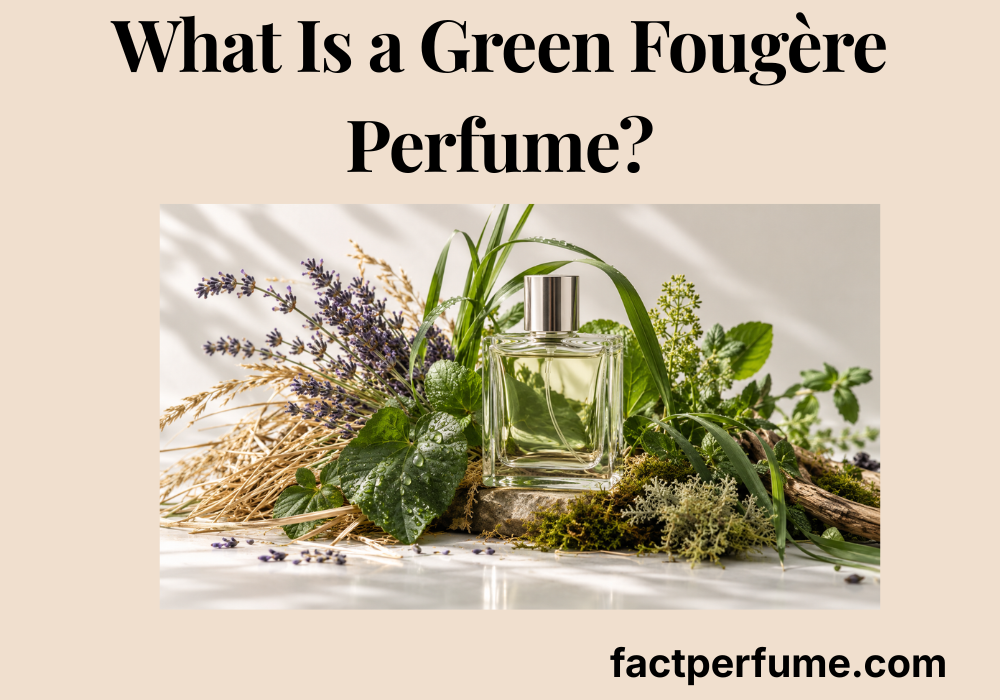
What Is a Green Fougère Perfume?
A green fougère is a fougère-style fragrance whose recognizable aromatic, coumarinic, and mossy foundation is meaningfully reshaped by leafy, grassy, bitter, dewy, sappy, or other vegetative effects. A fougère is a constructed fragrance concept rather than a perfume made from literal fern extract, while the word green describes the vegetation-like character modifying that underlying structure.
The fougère side may suggest lavender-like aromatic freshness, sweet or hay-like coumarinic character, and mossy depth. The green side may introduce leaves, grass, plant sap, bitterness, dew, stems, or cool vegetal freshness. For a perfume to read convincingly as a green fougère, those green effects should materially shape its identity rather than appearing as a minor decorative accent. This structural relationship also helps distinguish green fougères from traditional fougères, aromatic fougères, and green chypres. The broader Green perfume also includes leafy, grassy, sappy, herbal, and vegetal structures that do not necessarily follow fougère architecture.
Fragrance Note: “Fougère” means “fern” in French, but fougère perfumery is a constructed fragrance structure rather than a literal fern extract. In a green fougère, vegetation-like materials or accords modify that parent structure without replacing its fougère identity.
What Defines the Traditional Fougère Structure?
The classic fougère framework is traditionally associated with lavender-like aromatic freshness, coumarinic sweetness, and mossy or oakmoss-like depth, often supported by additional aromatic, herbal, or woody materials.
The word fougère refers to a fragrance family rather than a literal botanical extract. Its structure is an imaginative perfumery construction designed around relationships between aromatic freshness, sweet hay-like warmth, mossy depth, and supporting materials. This distinction matters because identifying a fougère requires looking at its complete architecture rather than searching for something that literally smells like a fern plant.
A traditional fougère framework often begins with aromatic freshness reminiscent of lavender or related herbal effects. This aromatic layer may feel clean, herbaceous, lightly floral, or brisk. Beneath it, coumarinic effects introduce sweetness and a recognizable hay-like quality. Mossy or oakmoss-like effects then contribute earthy, damp, textured depth and help give the structure its characteristic foundation.
These elements should not be treated as a mandatory three-material formula. A modern fougère does not have to contain literal lavender, coumarin, and oakmoss in a fixed combination. Perfumers can reproduce comparable aromatic, coumarinic, or mossy impressions through different materials and accords.
Coumarin is especially important to understand correctly. It is an aromatic compound associated with sweet, warm, hay-like, and tonka-like odor effects. Tonka bean is relevant because it naturally contains coumarin, but tonka bean and coumarin are not interchangeable terms. One refers to a natural material; the other refers to a specific aromatic compound.
The same distinction applies to mossy effects. A marketed fragrance pyramid may say “oakmoss,” but that wording does not automatically prove that literal oakmoss material appears in the exact formula. The perfume may instead contain a mossy accord, an oakmoss-like reconstruction, treated materials, or other ingredients producing a related sensory effect.
The key lesson is structural: the fougère framework establishes an aromatic, coumarinic, and mossy parent identity. A green fougère appears when pronounced vegetation-like freshness begins reshaping that foundation.
A green fougère keeps a fougère-style aromatic, coumarinic, and mossy backbone while vegetation-like effects become structurally important.
How Do Green Notes Transform a Classic Fougère Into a Green Fougère?
Green notes transform a classic fougère when leafy, grassy, bitter, sappy, dewy, or other vegetation-like effects become strong enough to reshape the aromatic and mossy fougère profile without replacing its underlying identity.
A green modifier is best understood by function rather than by ingredient list. It is any material or accord that gives the fougère a meaningful vegetation-like dimension. The effect might suggest crushed leaves, cut grass, wet stems, plant sap, bitter foliage, dew, or a cool green freshness.
This modification can make the fougère feel sharper, leafier, fresher, more vegetal, or more naturalistic. Those qualities are tendencies, however, not requirements. One green fougère may be intensely bitter and grassy, while another may emphasize watery leaves or a softer dewy character.
The distinction depends on how prominent the green effect becomes. A fougère containing a tiny leafy nuance is not automatically a green fougère. The greenness should influence the perfume’s overall identity, often remaining perceptible through the heart or interacting clearly with its aromatic and mossy framework.
Traditional fougères should not be reduced to stereotypes such as universally warm, soapy, or barbershop-like. Some later fougère styles developed strong groomed or barbershop associations, but the family is broader than that image.
A green fougère therefore represents modification rather than replacement:
Fougère backbone + meaningful vegetative green character = green fougère.
The exact result depends on which materials create the fougère side, which create the green side, and where the two overlap.
Which Materials and Accords Create a Green Fougère Scent Profile?
A green fougère combines a recognizable fougère foundation with materials or accords that add meaningful leafy, grassy, bitter, dewy, sappy, vegetal, or herbal-green character.
The materials are easiest to understand by structural function. Some help establish the fougère foundation, others create the vegetation-like modification, and some aromatic herbs can sit between the green and aromatic sides of the fragrance.
These are common compositional roles rather than a mandatory formula. The wider range of Green notes includes bitter, leafy, grassy, dewy, and sappy materials that can modify many fragrance structures beyond fougère.
Which Materials Form the Fougère Foundation?
The fougère foundation commonly combines lavender-like aromatic freshness, coumarinic sweetness, and mossy depth, with additional aromatic or woody support depending on the composition.
Lavender or lavender-like effects typically contribute an aromatic and herbaceous freshness. They can make the upper part of the structure feel clean, cool, floral-herbal, or brisk. Literal lavender material is not required in every fougère; comparable aromatic impressions can be created through other materials and accords.
Coumarin or coumarinic effects contribute sweetness and a recognizable hay-like quality. Depending on the surrounding materials, that sweetness may appear warm, soft, dry, powdery, or tonka-like.
Coumarin should not be confused with tonka bean itself. Coumarin is an aromatic compound; tonka bean is a natural material associated with coumarin, not a synonym for the molecule.
Mossy effects contribute earthy, damp, moss-like structural depth. In a note description, this effect might appear as oakmoss, moss, forest-floor accords, or another mossy impression.
It is important to separate three different ideas:
- literal oakmoss material;
- a reconstructed mossy accord;
- an oakmoss-like note or sensory effect.
A note pyramid cannot always tell the reader which one is actually present.
Together, aromatic freshness, coumarinic character, and mossy depth help establish the fougère identity that the green modifiers then reshape.
Which Materials Commonly Add the Green Character?
Green character can come from bitter resins, watery leaves, fresh-cut foliage effects, grassy accords, or other vegetation-like materials rather than from one mandatory green ingredient.
Galbanum is one of the clearest examples. It can contribute bitter, resinous, sharp, sappy, and strongly vegetal impressions. In a fougère structure, this type of material can sharpen the contrast between aromatic freshness and the deeper mossy base.
Galbanum can create a forceful green effect, but it is not required. Other materials and accords can provide equally meaningful greenness through different sensory routes.
Violet-leaf effects often move in a different direction. They may suggest watery greenery, cool leaves, metallic facets, cucumber-like freshness, or dew-covered vegetation. These qualities can make the fragrance feel more translucent and wet than the bitter resinous character associated with galbanum.
A marketed “violet leaf” note does not necessarily reveal whether literal violet-leaf material, an extraction, or a reconstructed accord is responsible. The note name should therefore be treated as a description of effect unless the actual material is independently known.
Cis-3-hexen-1-ol is another important reference point for green perfumery. Its odor is strongly associated with cut leaves, green stems, and fresh grass.
Cis-3-hexen-1-ol is one of the characteristic green leaf volatiles associated with cut or damaged vegetation. It can therefore contribute the vivid impression of freshly crushed foliage or cut grass.
It should not, however, be described as the single molecule responsible for the entire smell of grass. Natural vegetation odors are much more chemically complex.
A green fougère might use one of these effects, several of them, or completely different green materials. The unifying principle is not ingredient identity but vegetative function within the fougère structure.
When Do Aromatic Herbs Shift a Green Fougère Toward Aromatic Fougère Territory?
Aromatic herbs can reinforce green freshness, but when herbaceous, spicy, or aromatic character becomes the dominant emphasis, the fragrance may read more strongly as an aromatic fougère than as a primarily green fougère.
Mint, basil, sage, rosemary, thyme, and related herbal effects can sit close to the boundary between green and aromatic character. They can smell botanical and fresh while also producing unmistakably herbal or spicy aromatic qualities.
This creates natural overlap between green fougère and aromatic fougère.
A fragrance whose main freshness resembles leaves, stems, grass, dew, sap, or bitter vegetation tends to give a stronger green reading.
A fragrance whose main freshness comes from herbs, spices, camphoraceous facets, or aromatic plants may lean more strongly toward aromatic fougère territory.
The most useful rule is:
Classify by dominant olfactory emphasis and structural role, not by whether herbs are merely present.
One sprig of rosemary does not make a perfume an aromatic fougère, just as one leafy note does not make it a green fougère.
Both readings may also coexist. Classification is sometimes a matter of which effect dominates rather than which effect exists.
Common Structural Roles — Not Mandatory Formula Components
| Structural Role | Common Materials / Effects | Typical Sensory Contribution |
|---|---|---|
| Fougère foundation | Lavender / lavender-like aromatic effects | Aromatic, herbaceous freshness |
| Fougère foundation | Coumarin / coumarinic effect | Sweet, hay-like character |
| Fougère foundation | Mossy / oakmoss-like effects | Earthy, damp, mossy depth |
| Green modifier | Galbanum | Bitter, resinous, sharp greenness |
| Green modifier | Violet-leaf effects | Dewy, metallic, watery-green character |
| Green modifier | Cis-3-hexen-1-ol / leafy effects | Fresh-cut grass and leaf realism |
| Green / aromatic overlap | Mint, basil, sage, related herbs | Herbal-green freshness |
This table shows structural roles rather than compulsory ingredients. A green fougère does not need to contain every material listed, and an effect described as “oakmoss,” “violet leaf,” or another note should not automatically be interpreted as proof of a specific literal raw material.
Green modifiers can come from bitter resins, watery leaves, fresh-cut foliage effects, grassy accords, or herbal-green materials rather than one mandatory ingredient.
How Does a Green Fougère Differ From Traditional Fougères, Aromatic Fougères, and Green Chypres?
A green fougère differs from neighboring styles because pronounced vegetation-like character modifies a recognizable fougère backbone without replacing its underlying aromatic, coumarinic, and mossy identity.
These categories can overlap. A green fougère may contain herbs. An aromatic fougère may contain leafy materials. A green chypre may use galbanum or mossy effects that also appear in fougères.
The most reliable comparison rule is:
Classify by structural center of gravity and dominant olfactory emphasis, not by one ingredient.
The important questions are what parent structure the fragrance belongs to, which modifier dominates it, how the heart develops, and what kind of dry-down preserves the perfume’s overall identity.
How Does a Green Fougère Differ From a Traditional Fougère?
A green fougère retains the fougère framework but gives greater prominence to leafy, grassy, bitter, sappy, dewy, or other vegetal effects than a more traditional fougère treatment.
A traditional fougère generally keeps the aromatic, coumarinic, and mossy relationship at the center of the composition. Lavender-like freshness, sweet hay-like effects, and mossy depth may be joined by herbs, woods, or other supporting materials.
A green fougère preserves that architecture but makes vegetation-like effects much more important.
The fragrance may smell more distinctly of leaves, grass, crushed stems, bitter foliage, dew, or sap. Green materials can sharpen the opening, extend vegetative character into the heart, or alter the way the aromatic foundation is perceived.
The two categories are not opposites. A traditional-style fougère can contain green materials, and a green fougère still belongs to the larger fougère family.
The difference is one of emphasis.
In a green fougère, the vegetation-like character is strong enough to become part of the perfume’s identifying structure rather than a minor supporting nuance.
Barbershop character should not be used as the dividing line. It represents one stylistic expression associated with some fougères, not the universal definition of the family.
How Does a Green Fougère Differ From an Aromatic Fougère?
A green fougère emphasizes vegetation-like freshness more strongly, while an aromatic fougère gives greater weight to herbs, spices, aromatic plants, and related aromatic effects.
An aromatic fougère may emphasize rosemary, thyme, sage, lavender, spices, herbs, or other strongly aromatic effects. Its freshness can feel herbal, spicy, camphoraceous, aromatic, or medicinal depending on the materials used.
A green fougère puts more compositional weight on leaves, grass, stems, bitter greens, dew, sap, and similar vegetative impressions.
The difference can be subtle because many aromatic materials also smell green.
Mint may feel both herbal and green. Basil can be leafy and aromatic. Geranium-like effects may combine floral, leafy, and aromatic qualities. Lavender itself sits inside the traditional fougère framework while also providing an herbaceous impression.
That overlap makes ingredient counting unreliable.
If the dominant freshness resembles vegetation itself, the perfume tends to read greener.
If the dominant freshness resembles aromatic herbs and spices, the perfume tends to read more aromatic.
Some compositions legitimately occupy the territory between both styles.
How Does a Green Fougère Differ From a Green Chypre?
A green fougère retains a fougère-style aromatic, coumarinic, and mossy backbone, whereas a green chypre relies more strongly on chypre-style contrast between green upper facets and a deeper mossy, resinous, earthy, or patchouli-like foundation.
In a green fougère, greenness modifies an existing fougère framework. Lavender-like aromatic freshness, coumarinic or hay-like character, and mossy depth remain important to the way the fragrance is organized.
Leafy, grassy, bitter, dewy, or sappy effects reshape that framework without replacing it.
A green chypre follows a different architectural logic. Its identity depends more heavily on the relationship between pronounced green upper facets and a later mossy, resinous, earthy, woody, dry, or patchouli-like foundation.
Both styles may use galbanum. Both may contain mossy effects. Both may include vetiver, patchouli, herbs, or dry woods.
That is why the difference cannot be reduced to oakmoss, galbanum, coumarin, or any single material.
The central question is which parent architecture survives beneath the greenness.
If the perfume still reads as aromatic, coumarinic, and mossy in a recognizably fougère way, it leans toward green fougère.
If its identity depends more strongly on green-to-mossy, resinous, earthy, or patchouli-like chypre contrast, it moves toward Green chypre.
Common Structural Tendencies — Categories May Overlap
| Style | Structural Foundation | Dominant Green / Aromatic Emphasis | Typical Dry-Down Tendency | Key Distinction |
|---|---|---|---|---|
| Traditional Fougère | Classic fougère framework | Moderate aromatic freshness | Mossy, aromatic, coumarinic | Parent structure |
| Green Fougère | Fougère framework | Leafy, grassy, bitter, dewy vegetation | Mossy/aromatic with stronger green identity | Green modification reshapes fougère |
| Aromatic Fougère | Fougère framework | Herbs, spices, aromatic plants | Aromatic, woody, mossy | Aromatic emphasis |
| Green Chypre | Chypre-style structure | Bitter or leafy greens | Mossy, resinous, earthy, patchouli-like | Chypre architecture rather than fougère backbone |
These rows describe common tendencies rather than rigid universal taxonomy.
Overlap is expected, and none of these styles should be identified from one listed material alone. The dominant structure and the way the perfume develops provide stronger evidence.
Green fougère classification depends on which parent architecture remains underneath the greenness, not on one shared ingredient such as galbanum or moss.
How Can You Identify a Green Fougère From Its Notes and Dry-Down?
A likely green fougère is identified by combining evidence of a fougère-style foundation with pronounced vegetation-like modifiers and confirming that both remain structurally connected through the fragrance’s development.
A fragrance pyramid can provide useful clues, but it is a simplified description rather than a complete formula disclosure. It cannot reliably reveal every material, exact concentration, precise material form, or the complete construction of each accord.
For that reason, identification works best as a sequence rather than as ingredient matching.
Step 1 — Identify a Fougère-Style Foundation
First look for evidence that the perfume has a recognizably fougère-like backbone.
Possible clues include:
- lavender;
- lavender-like aromatic notes;
- coumarin;
- tonka-like or hay-like effects;
- mossy or oakmoss-like facets;
- an aromatic backbone.
These clues are stronger when several appear together and when the fragrance’s actual development supports them.
No single clue proves fougère classification.
A perfume containing lavender can belong to many fragrance families. Coumarin appears outside fougères. Mossy effects are also used in chypres and other structures.
Look for the relationship between the clues.
Step 2 — Identify Pronounced Green Modification
Next determine whether green character is important enough to shape the fragrance.
Possible clues include:
- galbanum;
- violet leaf;
- leafy accords;
- green leaves;
- grass;
- bitter-green effects;
- stems;
- sappy notes;
- watery-green facets;
- dewy vegetation.
The green component should feel meaningful rather than incidental.
If a leafy note disappears unnoticed behind a predominantly aromatic composition, the perfume may not read strongly as green fougère.
If leaves, grass, sap, bitterness, or vegetal freshness noticeably modify the fougère structure, the classification becomes more plausible.
Step 3 — Distinguish Green From Merely Aromatic
Now ask what kind of freshness dominates.
Does the fragrance primarily suggest:
- leaves;
- grass;
- stems;
- plant sap;
- dew;
- crushed vegetation;
- bitter greenery?
Or does it emphasize:
- herbs;
- spices;
- aromatic plants;
- camphoraceous effects;
- strongly herbaceous freshness?
The first pattern favors a greener reading.
The second may push the composition toward aromatic fougère territory.
The distinction should not be made by counting ingredients. One perfume may contain mint, sage, and green leaves while still smelling primarily vegetal. Another may contain galbanum but remain overwhelmingly aromatic.
Use the dominant-emphasis rule.
Step 4 — Distinguish Green Fougère From Green Chypre
Next determine which parent architecture remains underneath the green character.
Ask:
- Does the fragrance retain a recognizable aromatic, coumarinic, and mossy fougère foundation?
- Or does it depend more strongly on green-to-mossy, resinous, earthy, woody, or patchouli-like chypre contrast?
The first pattern supports green fougère.
The second pattern supports green chypre.
Do not use oakmoss or galbanum as the deciding factor. Both can appear in multiple structures.
The distinction comes from architecture.
Step 5 — Confirm Through the Dry-Down
The dry-down can reveal whether the initial green impression truly belongs to the fougère structure.
Observe whether:
- the green facets remain connected to the aromatic and mossy foundation;
- coumarinic or hay-like character becomes perceptible;
- the fougère backbone remains recognizable;
- aromatic herbs begin dominating the composition;
- or the fragrance shifts toward a deeper chypre-style pattern.
The green intensity does not need to stay identical from opening to finish.
A perfume can open very leafy and become more mossy or aromatic later while still remaining a green fougère, provided the vegetation-like character has meaningfully shaped its identity and the fougère backbone remains intact.
Step 6 — Treat the Note Pyramid as Evidence, Not Proof
Finally, evaluate the available clues together:
- marketed notes;
- fragrance-family classification where reliable;
- opening;
- heart;
- dry-down;
- dominant olfactory emphasis;
- overall structural impression.
Do not allow a single note to determine the classification.
A marketed pyramid can simplify or omit parts of a formula. “Oakmoss” may describe an effect rather than literal material. “Violet leaf” may refer to an accord rather than a specific extraction. A green note may also perform a supporting role without defining the perfume.
The strongest green-fougère identification appears when the fougère foundation, meaningful green modification, and actual development all support the same reading.
Green Fougère Recognition Checklist
Completing every item does not create an objectively universal classification. Fragrance-family boundaries can overlap, and different classification systems may describe borderline perfumes differently.
The checklist instead helps determine whether the fragrance behaves structurally like a green fougère rather than merely containing a few green notes.
Frequently Asked Questions
No. Fougère means “fern” in French, but fougère perfumery is a constructed fragrance structure rather than a perfume made from literal fern extract.
No. Those materials belong to the classic fougère vocabulary, but modern fougère structure can be created through different materials and accords that reproduce aromatic, coumarinic, and mossy effects.
The green character must materially reshape the fougère backbone through leafy, grassy, bitter, dewy, sappy, or other vegetation-like effects rather than appearing only as a minor accent.
A green fougère emphasizes vegetation-like freshness such as leaves, grass, stems, sap, dew, or bitter greenery, while an aromatic fougère gives greater weight to herbs, spices, aromatic plants, and related aromatic effects.
A green fougère retains a recognizably fougère aromatic, coumarinic, and mossy center of gravity. A green chypre depends more strongly on green-to-mossy, resinous, earthy, woody, or patchouli-like chypre contrast.
Conclusion
A green fougère is fundamentally a fougère whose aromatic, coumarinic, and mossy backbone has been meaningfully reshaped by leafy, grassy, bitter, dewy, sappy, or other vegetation-like effects. Its green character is substantial enough to alter the identity of the parent fougère structure, but it does not erase the aromatic freshness, coumarinic character, mossy depth, or related features that keep the fragrance recognizably fougère.
Aromatic and green territory can overlap, while green chypres may share materials such as galbanum or mossy effects. The distinction therefore depends on the complete structure: green fougères retain a fougère center of gravity, aromatic fougères emphasize herbs and related aromatic effects more strongly, and green chypres organize greenness around a different chypre-style foundation. No single ingredient is mandatory, and a fragrance pyramid should be treated as descriptive evidence rather than a full formula disclosure.
If the fragrance remains recognizably fougère in structure while vegetation-like effects materially reshape its overall scent identity, it is likely operating within green-fougère territory.