
How Does a Green Perfume Use Green Notes and Longevity to Define Its Identity?
A green perfume defines its identity through green-smelling materials, the accords surrounding them, and the way related effects persist or transform from the opening into the dry-down. Its character may feel leafy, grassy, bitter, dewy, herbal, resinous, or woody-green, but no single ingredient or evaporation pattern defines the entire category.
Some green effects make their strongest impression early, while others remain noticeable later in the fragrance. This means green perfume longevity is best understood through the whole composition: the materials used, how they interact, and whether later accords continue, soften, deepen, or transform the original green impression.
What Creates the Recognizable Identity of a Green Perfume?
A green perfume is defined by a recognizable leafy, grassy, vegetal, herbal, bitter, resinous, or verdant olfactory impression rather than by one required ingredient.
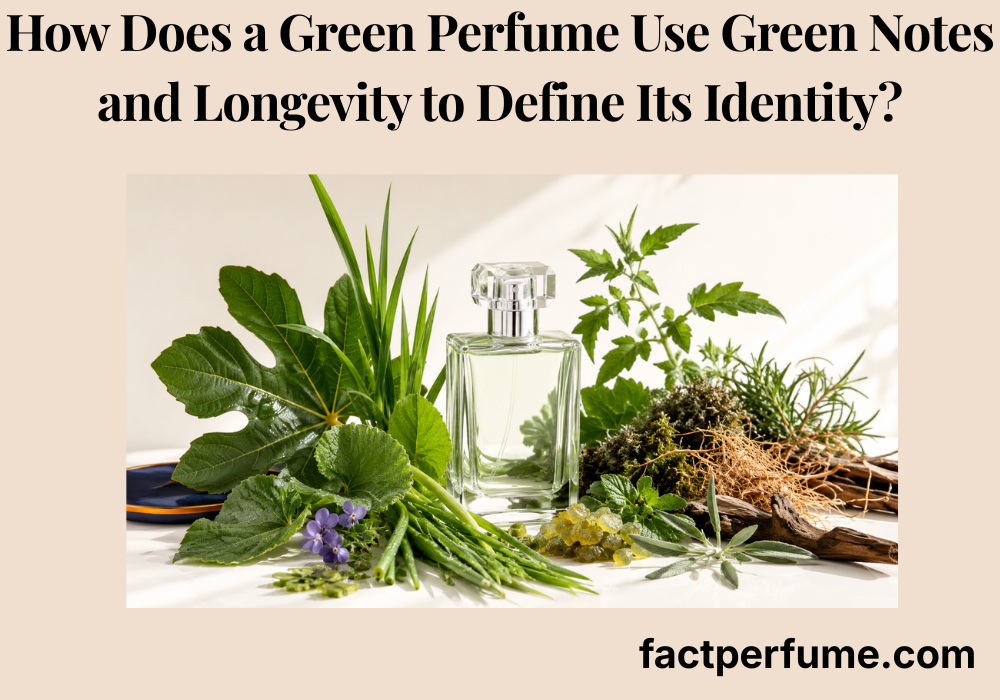
The easiest way to understand greenness is through familiar sensory references. Think of crushed leaves, snapped stems, freshly cut grass, aromatic herbs, plant sap, damp foliage, or the slightly bitter smell released when vegetation is disturbed.
Yet a green perfume does not have to reproduce the smell of grass literally.
Some compositions create realistic greenness, closely resembling leaves, stems, herbs, or garden vegetation. Others use green materials more abstractly, creating a crisp, cool, bitter, dewy, or botanical impression that suggests vegetation without copying one plant exactly.
A green note generally describes an individual material or recognizable odor effect that contributes greenness. A green accord, by contrast, is a combination of materials arranged to produce a unified green impression.
This distinction matters because a perfume’s green identity may survive even when one specific green note becomes less noticeable.
Green freshness should also be distinguished from other forms of freshness. Citrus freshness may emphasize sparkling peel-like brightness, while aquatic freshness can suggest watery or marine effects. Green freshness is more closely connected to vegetal references such as leaves, stems, herbs, grass, sap, and foliage.
Readers who want the broader classification first can review Green perfume before examining how its identity develops over time.
Green identity can come from leafy, grassy, herbal, bitter, resinous, or woody-green cues rather than from one required ingredient.
Why Do Some Green Fragrance Materials Fade Faster Than Others?
Some materials used for fresh leafy and grassy effects fade relatively quickly, while other green materials contribute more persistent resinous, aromatic, woody, or mossy effects.
The important concept is volatility.
Volatility describes how readily a material enters the air and becomes available to smell. A material can therefore create an immediate and powerful opening impression without necessarily remaining equally dominant through the entire wear cycle.
One representative example is cis-3-hexen-1-ol, commonly known as leaf alcohol. PubChem identifies cis-3-hexen-1-ol as (Z)-hex-3-en-1-ol and notes its association with green plants following mechanical damage. That connection helps explain why the material is so useful when perfumers want a vivid leafy or freshly disturbed vegetation effect.
But the behavior of cis-3-hexen-1-ol should not be generalized to every green material.
Galbanum, aromatic herbs, vetiver, mossy effects, woods, resins, and other materials can express different types of greenness and have different physical and sensory behaviors.
It is also important to separate material persistence from perfume longevity.
A perfume is a mixture rather than a collection of ingredients evaporating independently according to a rigid note pyramid. Research into perfume evaporation and diffusion shows that perceived fragrance development depends on factors including volatility, molecular interactions, odor intensity, odor threshold, diffusion, and the composition of the surrounding matrix.
So a rapidly changing leafy opening does not automatically mean that the entire perfume lacks longevity.
Likewise, a long-lasting perfume does not prove that its original leafy molecule remains unchanged or equally perceptible throughout the wear.
Which Materials Create Distinct Green Perfume Profiles?
Green perfume profiles can be built from many natural and synthetic materials, each contributing different leafy, bitter, watery, herbal, resinous, or botanical effects.
There is no single smell called “green.”
Instead, perfumers can construct greenness through multiple olfactory directions. Some materials recall freshly cut vegetation. Others feel bitter and resinous. Some suggest wet leaves, garden herbs, roots, forests, or cool botanical air.
These materials belong to the broader vocabulary of Green notes used throughout perfumery.
How Does Galbanum Create a Bitter, Resinous Green Character?
Galbanum contributes an intense bitter, resinous, sharp green character that differs from a simple fresh-cut grass effect.
Rather than smelling only like a tender leaf, galbanum can introduce a more forceful form of greenness. Its character is often perceived as bitter, resinous, penetrating, dry, or sap-like.
That makes it especially useful when a composition needs greenness with greater structure and tension.
In sensory terms, imagine the difference between smelling a soft young leaf and breaking a thick plant stem that releases bitter sap. The comparison is imperfect, but it illustrates why galbanum-style greenness can feel more severe and resinous than a fresh grassy effect.
Its role also demonstrates why “green” should never be treated as synonymous with “light” or “fleeting.” Green materials can occupy very different positions within a composition.
How Do Violet-Leaf Effects Create Watery or Metallic Greenness?
Violet-leaf effects can give green perfume a cool, watery, cucumber-like, or metallic character rather than a dry grassy one.
This type of greenness often feels dewy and translucent.
Instead of evoking sun-dried herbs or cut grass, a violet-leaf effect may suggest wet foliage, crushed watery stems, cool vegetation, or a subtle metallic freshness.
The phrase violet-leaf effect is useful because the perceived smell does not necessarily prove that literal violet-leaf extract is responsible for it. Perfumers can create recognizable botanical impressions through combinations of natural and synthetic materials.
Within a green accord, this direction can soften harsher bitter-green effects and connect naturally with floral or airy elements.
How Do Cis-3-Hexen-1-ol and Related Materials Create Fresh-Cut Leaf Effects?
Cis-3-hexen-1-ol creates an intense fresh green and grassy impression strongly associated with cut leaves and damaged plant tissue.
Often called leaf alcohol, it is one of the clearest examples of how perfumery can reproduce the sensory impression of freshly disturbed vegetation. PubChem identifies it as a naturally occurring plant volatile as well as a material used in fragrance contexts.
Its olfactory effect may suggest crushed leaves, snapped stems, freshly cut grass, wet vegetation, and vivid botanical freshness.
Its importance, however, should not turn it into a universal model for green perfume.
A perfume can smell strongly green without relying on this particular effect, and the persistence of one leafy aroma material does not determine the longevity of the complete composition.
How Do Fig-Leaf and Tomato-Leaf Effects Create Modern Botanical Greenness?
Fig-leaf and tomato-leaf effects introduce more specific milky, herbal, fuzzy, or garden-like botanical associations into green perfumery.
A fig-leaf direction may combine greenness with creamy, milky, woody, or slightly coconut-like botanical associations. The result can feel softer and broader than the smell of freshly cut grass.
A tomato-leaf effect often suggests a sharper garden character: leafy stems, herbs, slightly fuzzy vegetation, and the distinctive impression associated with handling a tomato plant.
These descriptions are best understood as olfactory effects, not proof that literal fig or tomato leaves were extracted and placed into a perfume.
They demonstrate how contemporary green perfumery can move beyond a generic “grass” impression and instead evoke recognizable botanical environments.
How Do Synthetic Materials Expand Green Perfume Effects?
Synthetic aroma materials expand green perfumery by allowing realistic, intensified, abstract, or carefully controlled green effects.
Synthetic does not automatically mean artificial-smelling.
A laboratory-created aroma material may create an extremely naturalistic leafy effect, while a natural material may smell abstract, resinous, earthy, or unfamiliar to someone encountering it in isolation.
Perfumers can use both natural and synthetic materials to build convincing green accords.
Synthetic materials can also make it possible to emphasize specific facets—watery, leafy, metallic, grassy, stem-like, bitter, or abstract—without requiring the composition to reproduce the complete smell of a botanical raw material.
Their origin alone does not establish that they are stronger, safer, more realistic, or longer-lasting. Those properties depend on the individual material and the complete formula.
Green perfumery can move from vivid cut-leaf effects toward bitter-resinous, watery, herbal, milky-botanical, rooty, or woody directions.
How Do Perfumers Sustain a Green Accord as the Fragrance Develops?
Perfumers sustain green identity by surrounding early green effects with materials that echo, bridge, or transform their character as the fragrance develops into the dry-down.
This is better understood as perceptual continuity than as one molecule simply remaining unchanged.
Suppose a fragrance begins with a vivid fresh-leaf effect. As that opening becomes less dominant, bitter herbs or mossy nuances might become clearer. Later, vetiver or dry woods may continue the earthy, vegetal side of the composition.
The exact smell has changed, but the fragrance can still feel logically green.
Another structure might move from a watery leaf effect toward floral-green notes and finally soft musks. A third might connect freshly cut grass with aromatic herbs before settling into dry, rooty vetiver.
This is also where the traditional perfumery term fixative requires care.
A fixative can refer broadly to a material or formulation strategy used to influence persistence, evaporation behavior, or the continuity of an accord. It should not be understood as something that literally locks every volatile top-note molecule in place.
Scientific modeling of perfume mixtures likewise shows that fragrance evaporation is more complex than a rigid sequence in which one set of ingredients simply disappears before another begins. Multiple fragrant species can evaporate simultaneously at different rates, while molecular interactions and the surrounding mixture affect what becomes perceptually dominant.
Green Material & Structural Continuity Matrix
The following pathways are representative compositional interpretations, not perfume formulas.
| Green Material or Effect | Typical Scent Character | Supporting Direction | Possible Development | Resulting Green Identity |
|---|---|---|---|---|
| Fresh-leaf effect | Crisp, leafy, grassy | Herbs, mossy effects, dry woods | Leafy → aromatic → woody | Vivid green character becomes drier and deeper |
| Galbanum | Bitter, resinous, sharp | Mossy accords, vetiver, woods | Bitter-green → mossy → dry | Structured, persistent perception of greenness |
| Violet-leaf effect | Watery, cool, metallic-green | Light florals, airy musks | Dewy → floral-green → musky | Softer, luminous green identity |
| Fig-leaf effect | Milky, botanical, leafy | Woods, soft florals, musks | Botanical → creamy-green → woody | Rounded botanical greenness |
| Tomato-leaf effect | Herbal, garden-like, stemmy | Aromatic herbs, dry woods | Garden-green → herbal → dry | Naturalistic aromatic greenness |
| Vetiver-supported greenness | Rooty, dry, earthy | Herbs, mossy effects, woods | Aromatic-green → rooty → woody | Earthy or woody-green identity |
The central principle is that continuity does not require sameness.
A fragrance can maintain a green perfume identity even while the specific material responsible for its opening becomes less prominent.
A coherent green fragrance can change from leafy freshness to aromatic, mossy, floral-green, earthy, musky, or woody effects while preserving a related botanical identity.
How Do Different Structures Create Sharp, Soft, Dewy, and Woody Green Identities?
Green perfumes can emphasize several stylistic directions, including sharp bitter greenness, soft dewy greenness, vivid leafy freshness, and earthy woody greenness.
These descriptions form a spectrum rather than an official set of fragrance families. One perfume may move through two or more of them during development.
Green Identity Comparison Framework
| Style | Common Olfactory Markers | Supporting Direction | Perceived Character | Dry-Down Clue |
|---|---|---|---|---|
| Sharp / bitter | Galbanum-like bitterness, herbs, dry vegetation | Vetiver, mossy effects, dry woods | Bracing, structured, austere | Greenness becomes drier or earthier |
| Soft / dewy | Watery leaves, cool green effects | Light florals, airy musks | Gentle, luminous, floral-green | Soft green-floral or musky connection remains |
| Fresh / leafy | Cut leaves, grass, stems | Aromatic herbs, botanical effects | Crisp, vivid, naturalistic | Leafiness may become aromatic or woody-green |
| Earthy / woody | Vetiver, roots, mossy effects | Dry woods, herbs | Rooty, forest-like, grounded | Woody or earthy structure preserves a green association |
What Creates a Sharp or Bracing Green Identity?
A sharp or bracing green identity often emphasizes bitter, dry, aromatic, mossy, or resinous facets.
Galbanum can provide pronounced bitter-green tension. Herbs may increase aromatic sharpness, while vetiver, mossy effects, and dry woods can carry that impression toward a more structured dry-down.
The result may be perceived as bitter, dry, cool, austere, or structured.
Some wearers may associate this style with formality because of its restrained and sharply defined character, but that is a sensory or cultural interpretation rather than an objective property of the materials themselves.
What Creates a Soft or Luminous Green Identity?
A soft or luminous green identity reduces bitter or aggressively grassy effects and places greater emphasis on watery foliage, delicate florals, musks, and airy textures.
Violet-leaf effects are particularly useful for understanding this direction because their watery or cool character can suggest vegetation without producing a dense grassy impression.
Light floral structures can continue the freshness as the initial leafiness softens. Musks may then provide an airy background in the later stages.
The result may feel dewy, airy, gentle, floral-green, or soft.
This is still recognizably green, but the identity is expressed through luminosity rather than bitterness or earthiness.
What Creates a Fresh Leafy or Grassy Green Identity?
A fresh leafy or grassy identity places the strongest emphasis on the immediate sensory impression of living or freshly cut vegetation.
Cis-3-hexen-1-ol and related green effects can contribute vivid cut-leaf realism. Stem-like nuances, grass effects, and aromatic herbs can expand that impression.
The style may feel vivid, crisp, freshly cut, botanical, or naturalistic.
Its opening can be especially distinctive, but that does not mean the complete perfume must preserve an identical grassy smell throughout its development.
Later aromatic, earthy, or woody elements can remain connected to the original botanical idea.
What Creates an Earthy or Woody Green Identity?
An earthy or woody green identity develops when the vegetal impression connects strongly with roots, soil-like nuances, mossy effects, vetiver, or dry woods.
Vetiver is particularly useful as a bridge because its dry, rooty, woody facets can sometimes reinforce the impression of vegetation while moving the perfume away from literal leaves.
Mossy accords can contribute a shaded, damp, forest-like quality, while dry woods may make the composition feel more structured.
The result can be earthy, rooty, dry, forest-like, or woody-green.
Not every fragrance containing vetiver, mossy effects, or woods is automatically green. These materials support green identity only when their role in the composition maintains a meaningful connection to the surrounding green accord.
How Can You Evaluate a Green Perfume’s Identity and Longevity on Skin?
Evaluate a green perfume by following how its green character changes from the opening through the transition and into the dry-down rather than by timing one opening note in isolation.
A useful evaluation follows five stages.
Step 1 — Identify the Opening
First decide what kind of greenness appears immediately.
Does it feel grassy, leafy, bitter, watery, herbal, resinous, or woody-green?
At this point, describe the smell rather than judging the entire perfume’s longevity.
A powerful leafy opening can be brief while the larger composition remains persistent and recognizably green.
Step 2 — Observe the Transition
Next, notice where the fragrance moves.
Does the original green impression become more floral, aromatic, woody, earthy, musky, or mossy?
The transition tells you whether the perfume is abandoning its green identity or simply expressing it through a different structure.
Step 3 — Read the Dry-Down
In the later stage, identify the relationship between what you smell now and what appeared at the opening.
The dry-down may echo the original greenness, soften it, deepen it, transform it, or replace it.
A leafy perfume that becomes dry and rooty, for example, may still maintain a coherent botanical identity even though the smell of freshly cut leaves is no longer dominant.
Step 4 — Judge Identity Continuity
A coherent green perfume does not need to smell identical from first spray to dry-down.
Instead ask: Does the later fragrance still feel meaningfully connected to the original green idea?
That connection may come from a shared bitterness, botanical freshness, herbal quality, mossy depth, rooty dryness, or another related olfactory feature.
This distinction prevents a common mistake: confusing the disappearance of one recognizable opening note with the disappearance of the entire green identity.
Step 5 — Match the Style to Your Preference
Finally, identify which green direction you actually enjoy.
Sharp / bitter: Look for bitter-green, mossy, vetiver, herbal, or dry structures.
Soft / dewy: Look for watery-green, floral, musky, and airy structures.
Fresh / botanical: Look for leafy, grassy, stem-like, and herbal effects.
Earthy / woody: Look for vetiver, mossy, rooty, and dry-wood effects.
Readers whose main concern is wear duration rather than green identity can separately explore Green wear on skin.
Green Perfume Evaluation Checklist
Frequently Asked Questions
Yes. Synthetic aroma materials can create highly realistic leafy, grassy, stem-like, watery, or botanical effects, as well as deliberately abstract forms of greenness. Whether an effect smells naturalistic depends on the individual material, its concentration, the surrounding accord, and how the complete perfume is constructed. A material’s natural or synthetic origin alone does not determine how realistic it smells.
No. A fragrance may remain recognizably green even after its first leafy or grassy effect becomes less prominent. Later aromatic, mossy, woody, floral, herbal, resinous, or rooty effects can maintain a meaningful relationship with the opening. In that case, the original green material may have changed in prominence while the green perfume identity remains coherent.
Conclusion
Longevity should be judged by how convincingly a green perfume carries or transforms its identity through development, not only by how long its first leafy effect remains unchanged.
Green materials establish different kinds of botanical character, but the surrounding structure determines how that character develops. Early leafiness may become herbal, mossy, floral-green, earthy, resinous, musky, or woody while still preserving a recognizable connection to the original idea.
The more useful question is therefore not “How long does the first green note last?” but “Does the fragrance continue to express a coherent green identity as it develops?”