
What Gives Green Floral Perfumes Their Signature Character?
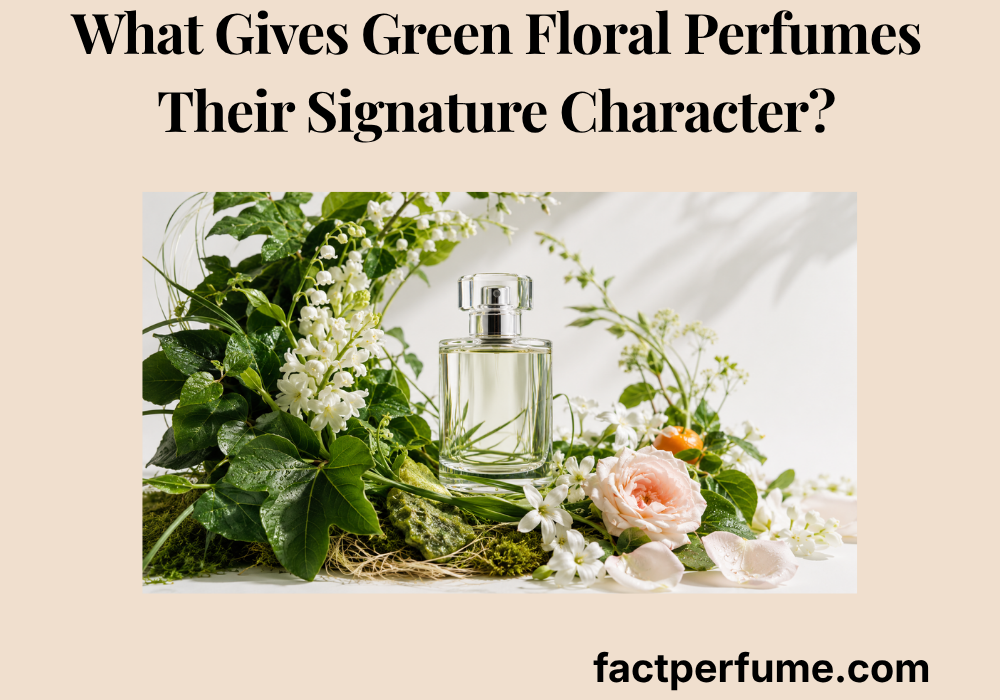
Green floral perfumes get their signature character from the interaction between a recognizable floral core, noticeable vegetative or leafy contrast, and supporting materials that keep both sides perceptually connected as the fragrance develops. A green floral perfume is a floral-centered composition in which leaves, stems, grass, sap, bitter greenery, dewy foliage, or related green effects materially change how the flowers are perceived.
The floral core may be built around muguet-style effects, hyacinth, rose, jasmine, or other floral accords. The green side may feel leafy, grassy, sappy, bitter, watery, dewy, herbal, or mossy. Together, these elements create a useful compositional model: green contrast + floral core + supporting structure → green-floral identity. No mandatory ingredient or fixed formula defines the style, so a green floral fragrance may feel realistic, stylized, classical, transparent, lush, or abstract. Understanding these relationships helps you read a note pyramid more intelligently and then confirm the predicted character through wear.
Fragrance Note: Green-floral character describes an olfactory relationship, not one fixed material formula. A named note may represent a natural material, a synthetic aroma material, a reconstructed accord, or a descriptive scent effect.
What Creates the Distinctive Identity of a Green Floral Perfume?
A green floral perfume differs from a petal-focused floral because leafy, grassy, sappy, bitter, dewy, or related vegetative effects actively reshape the floral character rather than appearing only as a minor accent.
A green floral accord is a composition in which a recognizable floral core remains important while green effects materially modify its sensory character. The flowers do not disappear. Instead, the green side changes how they are perceived. A soft floral may become sharper, a lush floral may feel more stemmy, or a transparent floral may become cooler and dewier.
The easiest way to understand the green side is through real vegetation. Crushed leaves can smell leafy and slightly bitter. Fresh grass can create vivid greenness. Snapped stems may suggest moist plant tissue and sap. Damp foliage can produce a softer, watery impression. These sensations give the floral core a stronger connection to leaves, stems, and living vegetation rather than petals alone.
The result does not need to reproduce an entire living plant. Some green florals smell convincingly botanical, while others use the same relationship in a more abstract way. What matters is that the green contrast remains important enough to alter the floral identity. The broader Green perfume also includes compositions where vegetative character dominates without a clearly floral core.
Green floral identity appears when a recognizable floral core remains important while green effects materially change how the flowers are perceived.
Which Green Materials Commonly Shape a Green Floral Perfume?
Green floral perfumes can obtain their vegetative contrast from bitter resins, watery leaves, fresh-cut foliage effects, herbal facets, or reconstructed accords rather than from one required green material.
A green material is a particular perfumery material capable of contributing recognizable green character. A green effect is the perceived smell of foliage, grass, stems, sap, or related vegetation, regardless of whether one natural extract, one aroma molecule, or a multi-material accord creates it. Galbanum, violet leaf, and cis-3-hexen-1-ol illustrate three different ways of creating green contrast, but they are not an exhaustive list. A broader guide to Green notes explains how leafy, grassy, bitter, dewy, and sappy forms of greenness differ beyond floral compositions.
How Does Galbanum Add Bitter, Resinous Green Contrast?
Galbanum adds a bitter, resinous, sappy, and dry type of greenness that can create strong contrast against a floral heart.
Its smell is more severe and resinous than the straightforward freshness of cut grass. Galbanum materials are well known in perfumery for powerful green character, and scientific literature describes galbanum oil and resinoid as important perfume raw materials with a characteristically harsh green odor.
This character can create tension against floral softness. A gentle floral accord may become more angular when placed beside bitter greenery. A richer floral heart may feel less plush and more botanical when dry resinous or sappy facets are introduced. The effect can suggest not only petals but also the stems and bitter plant material surrounding them.
Galbanum is associated with Ferula plants. Sources identify galbanum materials from species including Ferula gummosa and Ferula galbaniflua, and commercial natural-material documentation also identifies Ferula galbaniflua as a botanical source.
Galbanum also has an established place in the history of green perfumery and has been used prominently in well-known green compositions. Its historical importance does not make it mandatory. Modern perfumers can build green-floral contrast through many other natural materials, aroma molecules, and reconstructed accords.
How Does Violet Leaf Add Dewy or Metallic Greenness?
Violet-leaf effects add a cooler form of greenness that may appear watery, metallic, cucumber-like, earthy, or subtly leathery.
Natural violet-leaf absolute provides a useful reference for this style. IFF‘s violet-leaf absolute from Viola odorata is described as leafy-green and floral with watery facets, followed by warmer mossy and leathery aspects in its development. The material is produced from the leaves rather than the violet flowers.
The watery quality makes violet leaf particularly useful for understanding softer green contrast. Instead of the bitter resinous force associated with galbanum, violet-leaf effects can resemble damp foliage or cool leaves.
Cucumber-like and distinctly violet-leaf impressions can also be reproduced with aroma materials. Givaudan, for example, describes Folione as creating violet-leaf and cucumber notes, demonstrating how a recognizable violet-leaf effect can be constructed without relying only on literal violet-leaf absolute.
This distinction matters when reading note lists. “Violet leaf” may refer to a natural absolute, a reconstructed green effect, or the sensory idea intended by the perfumer. The exact material form cannot be determined from the note name alone.
Compared with galbanum-style greenness, violet leaf can therefore support a cooler, softer, or more transparent green floral profile without requiring every violet-leaf interpretation to smell identical.
How Can Cis-3-Hexen-1-ol Add Fresh-Cut Leaf or Grass Effects?
Cis-3-hexen-1-ol contributes a vivid fresh-cut leaf, grass, and stem effect that can make a floral accord feel more directly connected to vegetation.
Also known as (Z)-3-hexen-1-ol, this molecule belongs to the sensory territory associated with freshly disturbed plants. Think of mowing a lawn, tearing a leaf, or breaking a green stem: the resulting smell provides an intuitive reference for the effect.
Cis-3-hexen-1-ol is one of the compounds classified among green leaf volatiles, or GLVs. Plant research identifies cis-3-hexen-1-ol among green leaf volatiles emitted by cut grass, supporting its association with the smell of damaged vegetation.
In a floral accord, this fresh-cut character can make polished flowers feel surrounded by actual leaves and stems. It can therefore increase the sense of botanical realism without becoming the floral core itself.
Cis-3-hexen-1-ol should not be called the single molecule responsible for cut-grass odor. Green leaf volatiles comprise multiple compounds, and perfumers have many ways to construct grassy and leafy effects.
It is likewise not required in every green floral perfume. It represents one possible route to vivid leafy contrast rather than a definition of the category.
Which Floral Notes Commonly Reinforce a Green Floral Character?
Floral materials reinforce green-floral character when their freshness, transparency, stem-like facets, brightness, or surrounding accord allows the vegetative contrast to remain structurally important.
No flower is universally best for green floral perfumery. Floral behavior depends on the particular natural material or reconstruction, its proportion, and the surrounding composition.
This variability is important because flowers themselves are not one-dimensional perfume notes. Rose materials may contain fresh or green facets. Jasmine materials may combine floral richness with green and indolic aspects. Muguet-style accords may emphasize freshness and transparency. Hyacinth effects can combine floral and distinctly green qualities.
How Does a Muguet Accord Reinforce Dewy Green Freshness?
A muguet accord can reinforce green-floral freshness through a light, dewy, clean-floral character that integrates easily with leafy and watery-green effects.
Muguet is the French perfumery term for lily of the valley. Its scent is typically represented in perfumery through constructed floral accords rather than a conventional lily-of-the-valley essential oil.
IFF explains that lily of the valley historically could not be extracted by conventional natural-perfumery methods and that advances in fragrance chemistry allowed perfumers to reproduce its odor with fragrance molecules. Givaudan’s modern muguet materials likewise show how individual aroma molecules can create fresh, watery, lily-of-the-valley effects.
There is an important modern qualification. Specialized extraction technology has since produced commercial natural lily-of-the-valley extracts, so it is no longer accurate to say that extraction is absolutely impossible under all circumstances. Firmenich has described Muguet Firgood as a commercial extract obtained through newer technology. The conventional perfumery idea of muguet, however, remains strongly associated with reconstruction.
That reconstructed character can be particularly useful in a dewy green floral. Light floral freshness can sit beside violet-leaf effects, watery greenery, soft musks, or light woods without overwhelming them.
The result can feel like flowers surrounded by cool foliage rather than a dense floral bouquet.
How Does Hyacinth Reinforce Bitter or Stemmy Floral Greenness?
Hyacinth can reinforce green-floral character through floral intensity combined with stem-like, earthy, spicy, or bitter-green nuances depending on the material or accord.
Hyacinth is particularly useful conceptually because the floral and green dimensions can feel closely connected. Instead of placing a completely neutral flower beside an unrelated green note, a hyacinth-style accord can already point toward the smell of flowers surrounded by stems and foliage.
Commercial perfumery materials support this association. DSM-Firmenich describes Jacintheme as a floral material with both floral and green descriptors and specifically characterizes it as reminiscent of the green-floral heart of hyacinth.
Placed beside galbanum-style bitterness, hyacinth can contribute to a sharper and more structured green floral. Used with softer leafy materials, it may read differently.
That variability is why hyacinth should not be described as universally bitter, stemmy, or green. The material form and surrounding accord determine which facets become most noticeable.
How Can Rose Contribute Fresh or Leafy Facets to a Green Floral?
Rose supports green-floral character when its fresh or bright floral qualities are placed within a surrounding leafy, stem-like, or bitter-green structure.
Rose materials vary significantly in their odor profiles. Natural rose materials can contain green facets alongside familiar rosy, petal-like, fruity, spicy, or honeyed qualities. IFF, for example, describes one Bulgarian rose oil as floral and rosy with fresh and green facets, while another rose extract is described with leafy-green nuances.
Givaudan similarly describes Turkish rose absolute as a complex floral rose material that includes green character among its descriptors.
This means rose does not need to function as a completely soft counterpoint to greenery. Some rose materials already contain facets that can connect naturally with leafy surroundings.
The surrounding accord still matters. Bitter green materials may make rose feel sharper and more structured. Dewy leaves can make it seem fresher. Stem-like effects can shift attention from petals toward the complete botanical impression.
Rose therefore has no single fixed green expression. The result depends on the material, dosage, and everything surrounding it.
How Can Jasmine Work Within a Green Floral Structure?
Jasmine can support green-floral compositions through brighter, fresher, leafy, tea-like, or less-indolic presentations depending on the material, dosage, and surrounding accord.
Indolic refers to an odor facet associated with indole and with the rich character of several floral materials. In jasmine, indolic aspects can contribute warmth, depth, and an animalic or heady quality, but jasmine materials also contain other facets.
IFF describes Jasminum grandiflorum absolute from India as having a green top facet alongside fruity, spicy, floral, and warm indolic characteristics. Its jasmine sambac absolute is likewise described as floral with powerful fruity and green top facets together with characteristic indolic character.
Givaudan also describes jasmine sambac absolute as having a strong green-fruity facet alongside its floral and more animalic dimensions.
Green-floral jasmine therefore does not require perfumers to somehow remove one isolated “indolic part.” Instead, the material and surrounding accord change the balance of perception.
Leafy effects may bring jasmine’s greener facets forward. Vetiver and dry woods can produce greater structure. Lighter materials can make the composition appear fresher and more transparent.
Richer flowers such as tuberose, jasmine, or ylang-ylang can still appear in green floral compositions. The decisive factor is whether green contrast remains substantial enough to shape the floral identity.
Galbanum-style bitterness, violet-leaf effects, fresh-cut foliage, muguet, hyacinth, rose, and jasmine illustrate several green-floral directions without one mandatory formula.
How Do Perfumers Balance Green and Floral Elements Into One Coherent Accord?
Perfumers create a coherent green-floral accord by controlling contrast, proportion, transition, and support between vegetative and floral effects rather than simply placing green top notes over a floral base.
Contrast determines how clearly the two sides interact. Bitter greenery can sharpen a soft floral. Leafy effects can make flowers feel more botanical. Watery-green material can soften a dry floral structure, while dry woods can give an airy combination more definition.
Other contrasts are equally important. A sharp effect can be rounded. A rich floral can be given transparent surroundings. Dewy foliage can be placed against dry woods. The goal is not necessarily to remove contrast but to make the contrast feel intentional.
Green and floral materials also do not belong to fixed volatility classes. Some green materials have strong early impact; others can remain perceptible later. Floral materials vary in the same way. IFF’s ingredient compendium explicitly treats top, heart, and base impact as material-dependent behavior and notes that the classification is a general reflection of how an ingredient may evolve within a full fragrance.
Transitional effects can make contrasting materials feel more connected. Neroli, bergamot, aromatic materials, or lighter florals may sometimes help a perfumer move between fresh greenery and a floral heart. These are compositional roles rather than members of a formal universal category called “bridge notes.”
A supporting structure is the surrounding framework that helps the green and floral relationship remain coherent throughout development. Vetiver, cedar, other woods, musks, mossy accords, aromatics, or resinous effects may support different versions of that framework.
This can produce perceptual continuity. The exact green sensation may change during the dry-down, but related dry, earthy, woody, mossy, aromatic, or botanical cues can preserve the overall relationship.
Supporting materials do not physically stop more volatile green molecules from evaporating. Instead, they may echo, complement, or replace earlier sensory cues as the fragrance develops.
Supporting woods, musks, vetiver, mossy effects, aromatics, and related materials can preserve perceptual continuity as green and floral facets evolve through the dry-down.
How Do Different Green Floral Styles Create Distinct Sensory Profiles?
Green floral perfume spans several stylistic directions, from bitter and structured compositions to dewy, leafy, lush, woody, or mossy floral profiles.
These directions are practical ways of describing dominant balances. They are not an official or exhaustive industry taxonomy, and one perfume can combine more than one direction.
What Creates a Sharp or Classical Green Floral Profile?
A sharp or classical green floral profile emphasizes bitter, dry, and structured contrast between a floral heart and assertive green materials.
Galbanum is a representative route to this effect. Its intensely green and slightly bitter character has historically been used with floral accords, including hyacinth, iris, violet, and related floral structures.
Hyacinth-style floral character can reinforce the relationship because its floral identity can itself contain noticeable greenness.
Dry support from vetiver, woods, or mossy effects can then extend the structure deeper into the fragrance.
The words formal and classical are stylistic interpretations, not scientific classifications. They describe the disciplined, bitter, dry impression this combination can create.
What Creates a Dewy or Transparent Green Floral Profile?
A dewy or transparent green floral profile emphasizes watery leaves, light floral accords, soft musks, and airy support rather than strongly bitter green contrast.
Violet-leaf effects provide a useful green foundation. Natural violet-leaf absolute can combine leafy greenness with watery facets, while reconstructed violet-leaf materials can also emphasize cucumber-like freshness.
Muguet-style accords can reinforce that sense of transparency because their fresh floral character combines naturally with watery and leafy effects.
Soft musks or light woods can give the structure greater continuity without necessarily creating the dryness associated with a sharper green floral profile.
Terms such as dewy, airy, and transparent describe sensory impressions. They are not objective statements about concentration, projection, or longevity.
What Creates a Lush Leafy-Floral Profile?
A lush leafy-floral profile combines noticeable foliage or stem effects with greater floral volume, allowing the perfume to remain richly floral without losing botanical contrast.
The green side may emphasize leaves, stems, fresh-cut foliage, or other plant-like effects. Unlike a very transparent composition, however, these cues sit beside a fuller floral heart.
Rose and jasmine are representative partners because both can provide significant floral volume while still working with green surroundings.
Some rose materials naturally contain fresh or green facets, while jasmine materials can combine floral richness with green top facets. That gives perfumers several ways to maintain continuity between foliage and a richer floral core.
Richness should not be equated automatically with sweetness. A floral can be rich because it is dense, voluminous, or highly expressive without becoming especially sugary.
The profile remains green floral only while the foliage or stem effect continues to shape the floral identity.
What Creates a Woody or Mossy Green Floral Profile?
A woody or mossy green floral profile carries the floral-green relationship into a drier, earthier structure through materials such as vetiver, cedar, mossy effects, or dry woods.
The floral-green heart establishes the initial relationship. Leaves, stems, bitter greenery, or other vegetative effects modify the flower before the composition moves toward its supporting structure.
Vetiver, cedar, woods, and mossy effects can continue the fragrance in a more rooted or earthy direction. The original fresh vegetation may become less prominent, but related dry or earthy cues can preserve perceptual continuity.
This structure can overlap sensorially with chypre territory without making every woody or mossy green floral a chypre. A Green chypre may share floral, green, mossy, and dry effects, but its broader structural logic remains distinct from green floral perfume as a whole.
Green Floral Style Comparison Framework
| Style | Green Direction | Floral Direction | Supporting Effects | Likely Sensory Impression |
|---|---|---|---|---|
| Sharp / Classical | Bitter, resinous, dry | Hyacinth or structured floral core | Vetiver, mossy effects, dry woods | Bitter, structured, bracing |
| Dewy / Transparent | Watery, leafy | Muguet-style or light florals | Musks, light woods | Dewy, airy, transparent |
| Lush Leafy-Floral | Leafy, stemmy | Rose, jasmine, richer florals | Musks, light woods | Lush, vivid, botanical |
| Woody / Mossy | Dry, earthy-green | Green floral heart | Vetiver, cedar, mossy effects | Rooted, dry, structured |
These four profiles are overlapping descriptive directions, not standardized fragrance classifications. A single composition may combine, for example, dewy foliage in the opening with a woody or mossy green-floral dry-down.
How Do Common Green and Floral Pairings Influence the Final Profile?
Common green-and-floral pairings can suggest likely scent directions, but proportion, material form, dosage, supporting structure, and the complete formula determine the final character.
A pairing is not a formula. Seeing galbanum and hyacinth listed together does not tell you their concentrations, exact raw-material forms, or how other components reshape them.
The same applies to violet leaf and muguet, or leafy effects and rose. Two perfumes can publish apparently similar note lists and still smell substantially different.
Several variables influence the result:
- Proportion: how strongly one effect is perceived relative to another.
- Material form: whether the effect comes from a particular natural material, molecule, base, or reconstruction.
- Dosage: how much of a specific material is used within the formula.
- Concentration: the wider concentration and architecture of the composition.
- Supporting accord: the woods, musks, aromatics, mossy effects, resins, or other structures around the main pairing.
- Surrounding notes: everything else that changes how the nose interprets the central green-floral relationship.
The following matrix should therefore be read as a directional prediction tool, not as formulation guidance.
Green Floral Pairing Matrix
| Green Element | Floral Partner | Supporting Structure | Likely Sensory Direction |
|---|---|---|---|
| Galbanum | Hyacinth | Dry woods / mossy effects | Sharp, bitter, structured |
| Violet leaf | Muguet-style accord | Soft musks / light woods | Dewy, transparent, soft |
| Fresh leafy effect | Rose | Musks / light woods | Crisp, fresh floral-green |
| Herbal-green effect | Jasmine | Vetiver / dry woods | Aromatic, vivid, structured |
| Leafy accord | Rich floral heart | Musks / woods / mossy facets | Lush, botanical, layered |
These combinations suggest probable directions rather than guaranteed outcomes.
Complexity also does not prove quality. A relatively simple green-floral relationship can be coherent, while a composition with many listed notes can still feel poorly integrated.
How Can You Recognize a Green Floral Perfume From Its Note Pyramid?
A note pyramid suggests green-floral character when a recognizable floral core appears alongside meaningful green effects and supporting materials that plausibly reinforce their relationship.
A fragrance pyramid is a model for describing how a scent is perceived through top, heart, and base stages. IFF describes this structure as an olfactory journey in which notes rise, blend, and settle during wear. Ingredient documentation also shows that individual materials can contribute differently across top, heart, and base rather than belonging to one universal category.
A published pyramid should therefore be used as a descriptive guide, not as a complete formula disclosure. It cannot tell you the exact concentration of a listed note, guarantee that the named botanical material is literally present, identify the precise material form, or reveal the complete architecture of the perfume.
Use five steps to evaluate it.
Step 1 — Identify the Floral Core
Look for a recognizable floral center, such as:
- muguet-style accord;
- hyacinth;
- rose;
- jasmine;
- other clearly floral materials or accords.
One flower alone does not establish green-floral identity.
A rose note surrounded mainly by fruit and amber may point somewhere very different from rose surrounded by foliage, stems, or bitter greenery.
The first question is simply:
Does the note structure contain a meaningful floral core?
Step 2 — Identify Green Counterparts
Next, look for elements that could materially change that floral core.
Possible clues include:
- galbanum;
- violet leaf;
- leafy accords;
- grass-like effects;
- green stems;
- herbal-green facets.
Their presence alone is not enough.
The green effects need to be meaningful to the composition rather than a tiny decorative accent. Stronger evidence appears when several parts of the note structure point toward foliage, grass, stems, bitter greenery, or related vegetation.
Step 3 — Evaluate Supporting Structure
Now examine the materials surrounding the floral and green sides.
Look for:
- vetiver;
- cedar;
- woods;
- musks;
- mossy effects;
- aromatics.
These elements may help predict the direction of development.
Vetiver, cedar, or dry woods may suggest a drier structure. Musks and lighter woods may support transparency. Mossy effects may point toward a more earthy continuation.
These clues remain predictions. A note pyramid does not disclose how strongly each material is used.
Step 4 — Predict Direction
Combine the floral core, green counterpart, and supporting structure.
Galbanum + hyacinth + dry or mossy support → likely sharper and more structured.
Violet leaf + muguet + musks → likely dewier and more transparent.
Leafy effects + rose or jasmine + lighter woods → likely fresher, lush, or botanical.
These relationships are probabilistic.
A perfumer can change the result by altering material forms, proportions, surrounding notes, or the rest of the formula.
Step 5 — Confirm on Skin
Finally, test whether the predicted relationship survives actual wear.
Ask:
- Do the floral and green facets remain connected?
- Does the green character meaningfully change the floral core?
- Does the fragrance become almost purely floral after the opening?
- Does it develop toward woody, mossy, aromatic, sharp, dewy, or lush green-floral territory?
Testing on skin matters because fragrance development is a sensory process, not merely a list of note names. IFF likewise notes that perfumes can present differently on skin and emphasizes experiencing fragrance on skin rather than relying only on another smelling medium.
The strongest evidence of green-floral character is therefore not simply “rose + green leaves” written in a pyramid. It is the actual perception that the vegetation-like effect continues to alter how the floral center smells.
Green Floral Recognition Checklist
This checklist is a diagnostic framework rather than a numerical test. Completing the items does not prove that every fragrance taxonomy will classify the perfume identically.
Frequently Asked Questions
A green floral perfume keeps a recognizable floral core while leafy, grassy, sappy, bitter, dewy, or related green effects materially reshape how that floral core is perceived.
No. Galbanum is one route to bitter, resinous green contrast, but green floral character can also be built with violet-leaf effects, fresh-cut foliage effects, herbal facets, reconstructed accords, and other materials.
Yes. A violet-leaf listing may refer to natural violet-leaf absolute, a reconstructed effect, or the intended sensory idea. The exact material form cannot be determined from the note name alone.
No. Green and floral materials do not belong to fixed volatility classes. Some green effects have strong early impact, while others remain perceptible later, and supporting materials can preserve green-floral continuity during the dry-down.
Look for a meaningful floral core, prominent green counterparts, and supporting woods, musks, mossy effects, vetiver, cedar, or aromatics. Then confirm on skin whether the green facets continue to reshape the floral center during wear.
Conclusion
The simplest way to recognize green floral character is to determine whether green facets actively reshape a recognizable floral core rather than functioning as a minor decorative accent. The floral side may be light, lush, transparent, bright, rich, or stemmy, while the green side may be bitter, leafy, grassy, sappy, dewy, herbal, or mossy. No single flower or green ingredient defines the style.
Supporting woods, musks, vetiver, mossy effects, aromatics, or related materials can help the relationship remain coherent as the perfume develops. Depending on the balance, that relationship may produce sharp and structured, dewy and transparent, lush leafy-floral, or woody and mossy interpretations.
If the green facets materially change how the floral heart smells and remain structurally meaningful as the perfume develops, the fragrance is operating within green-floral territory.