
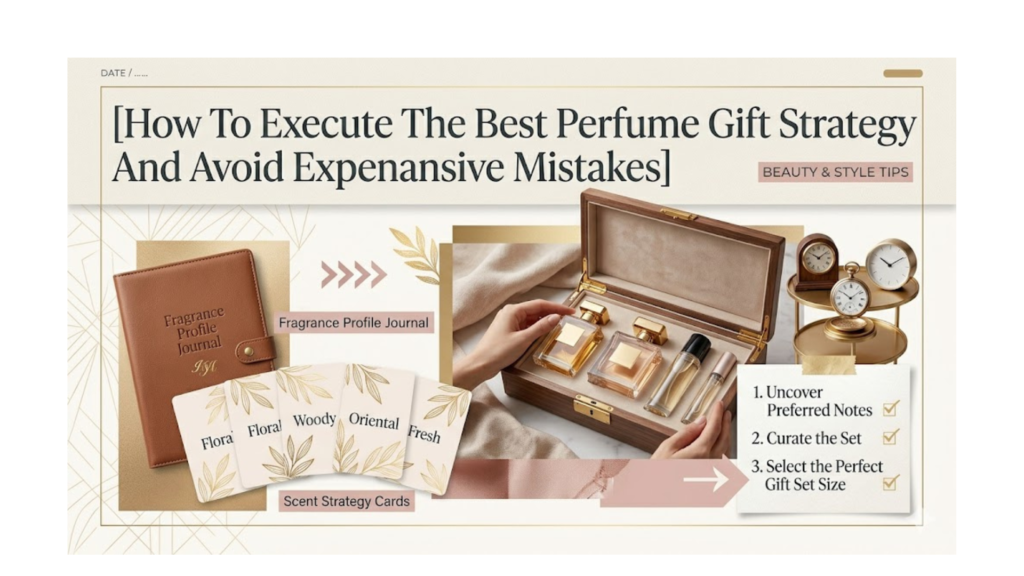
How To Execute The Best Perfume Gift Strategy And Avoid Expensive Mistakes
Executing the best perfume gift strategy requires conducting a covert audit of the recipient’s current collection and deploying a foolproof sampling method before breaking the retail packaging.
This guide equips holiday shoppers and partners with a strategic decision matrix to navigate targeted fragrance purchases, mitigate skin chemistry clashes, and ensure easy, penalty-free returns. Perfume gifting has historically been treated as an emotional gamble—a high-risk scenario where well-meaning buyers purchase an expensive designer bottle solely because they liked the bottle design or the marketing campaign. This approach is mathematically flawed.
Fragrance is a highly personal, biologically reactive chemical compound. Skin Chemistry Clash is the biological event where a beautifully blended luxury fragrance reacts poorly with a recipient’s natural skin pH, causing the scent to turn sour or fade rapidly. When this happens, a $300 bottle becomes completely unwearable. By treating perfume gifting as a calculated investment rather than an emotional guess, you empower yourself with a foolproof methodology to completely eliminate financial waste.
The 4 Perfume Gifting Mistakes
- The Fake Happiness Reaction: Recipients feign excitement to protect the giver’s feelings, spraying the perfume once before permanently pushing it to the back of the closet.
- Ignoring Skin Chemistry: A scent that projects flawlessly on a neutral paper tester strip can smell entirely different when interacting with human skin oils.
- Blind Buying Without Context: Purchasing a highly marketed, expensive fragrance without first checking which specific scent profiles the recipient actually wears and depletes.
- Breaking The Cellophane Seal: Ripping the plastic wrapping off a primary retail box before the recipient tests the scent, instantly destroying the store’s return policy.
Why do consumer psychology and skin chemistry dictate your perfume gifting strategy?
Consumer psychology and skin chemistry dictate your perfume gifting strategy because subjective emotional guessing completely ignores the high failure rates of luxury blind buys.
Understand the psychology behind the fake happiness reaction
You must strategically engineer the unboxing experience to remove the recipient’s psychological pressure to pretend they love an incompatible scent. When presented with an expensive, unvalidated fragrance, social decorum dictates the recipient will feign excitement to avoid seeming ungrateful. The psychological weight of receiving a luxury item places immense social pressure on the recipient to express immediate, overwhelming joy.
This phenomenon is not merely anecdotal; it is a measurable behavioral metric. Statistical tracking reveals that 73% of consumers explicitly fake their happiness and lie about liking a received gift strictly to protect the giver’s feelings during holiday exchanges. (Source) When this occurs, the fragrance is sprayed exactly once on Christmas morning, then permanently vaulted into a dark drawer, never to be worn again. The buyer loses their capital, and the recipient is burdened with an item they despise.
Rule You must strategically engineer the gift presentation to eradicate the pressure of fake happiness.
Reason Social compliance dictates the recipient will fake excitement during unboxing, followed by permanent vaulting of the perfume to avoid confronting the giver.
Example A recipient profusely thanking a partner for a heavy floral scent, spraying it once, and hiding it indefinitely because the profile actually triggers headaches.
Differentiate smelling on paper from real skin chemistry
You must absolutely refuse to purchase a full bottle of fragrance based solely on how it smells on a sterile paper tester strip in the store. A paper tester strip is an inert, biologically dead medium designed specifically by retail stores to present the fragrance in its most perfect, stable condition. Human skin, conversely, is an aggressive biological engine.
The epidermis regulates a naturally acidic physiological pH between 4.1 and 5.8, functioning as an active chemical barrier. This acidity, combined with the heat-radiating properties of the vascular system and the presence of lipophilic (oil-loving) sebum, actively alters how volatile fragrance oils evaporate. Evaporation Curve is the defined timeline and sequence in which a perfume’s top, heart, and base notes burn off the skin and enter the air. An expensive fragrance that smells aquatic and fresh on paper can immediately hit a recipient’s acidic skin and mutate into an acrid, sour disaster within thirty minutes.
Rule You must absolutely refuse to purchase a full bottle based solely on a paper tester.
Reason A paper strip is neutral, whereas human skin contains active oils, heat, and acidic pH levels that rapidly alter fragile fragrance notes.
Example Authorizing the purchase of a pristine marine scent based on its paper projection, only for the recipient’s natural skin pH to immediately turn the top notes sour or metallic upon contact.
How does existing fragrance data alter your perfume gift strategy?
Existing fragrance data alters your perfume gift strategy by forcing you to map the recipient’s actual wearing habits before initiating a retail transaction.
Execute the covert vanity audit to find their signature scent
Executing a covert vanity audit bypasses risky guesswork by empirically identifying the specific fragrance profiles the recipient has historically favored. A nearly empty perfume bottle is the ultimate, undeniable proof of daily wearability and skin compatibility. Before setting foot inside a boutique, you must physically observe the recipient’s bathroom counter or dressing vanity.
Consumer behavior demonstrates profound allegiance to specific chemical formulations. Approximately 45% of American perfume users actively repurchase one or two highly favored signature scents, demonstrating intense, verifiable loyalty to specific biochemical profiles. (Source) By locating the bottles with the lowest liquid levels, you bypass the trap of buying what is trendy and instead rely on hard data proving exactly what aligns with their olfactory receptors.
Parameter The Covert Vanity Audit.
Mechanism Bypasses subjective guesswork by visually identifying the exact scent profiles the recipient already trusts.
Execution Visually inspect the recipient’s bathroom or vanity counter and document the exact names of 2 to 3 bottles that are heavily depleted or almost empty.
Mitigate the risks of the blind buy vector
Mitigating the risks of a blind buy requires utilizing fragrance databases to cross-reference their empty bottles and identify their preferred primary notes. Blind Buy is the highly risky financial act of purchasing a full-sized luxury fragrance without the recipient ever having tested it on their own skin. The financial casualties of this practice are profound.
Blind-buying fails European consumers massively, resulting in a staggering 73% of fragrances going unworn and creating a €780 million graveyard of unused perfume. (Source) Once you have collected the data from the vanity audit, input the names of the depleted bottles into digital fragrance databases (such as Fragrantica or Parfumo) to extract their core chemical accords. If both empty bottles heavily feature “Vanilla” and “Sandalwood,” you have successfully mapped their biophysical preference.
Parameter The Fragrance Profiling Matrix.
Mechanism Utilizes digital databases to cross-reference the recipient’s empty bottles, isolating their favorite core ingredients (like vanilla, cedar, or bergamot).
Execution Present these specific core ingredients to the retail associate to prevent them from upselling a trendy, incompatible perfume that will ultimately go unworn.
How do you isolate retail variables to execute your fragrance gift strategy?
Isolating retail variables to execute your fragrance gift strategy requires navigating the store’s return policy based entirely on how much data you gathered from their vanity.
Establish strict boundaries for full bottle purchases
Establishing strict boundaries for full bottle purchases ensures you secure a luxurious gift while maintaining a critical financial safety net in case the scent clashes with their skin. You must strictly purchase retail bottles from stores that offer a zero-penalty return policy for unopened boxes. Retail return statistics highlight the vulnerability of modern consumers.
Total retail returns reached a staggering $890 billion in 2024, representing 16.9% of all annual sales, proving that consumers need secure, penalty-free return options for luxury goods. (Source) Never surrender your capital to boutique stores operating on “All Sales Final” policies when purchasing a highly subjective chemical product for a third party.
If The vanity audit yielded clear proof of the recipient’s favorite fragrance notes (like vanilla or sandalwood).
Do Execute the “Targeted Purchase.” Buy a full retail presentation of a highly correlated fragrance from a vendor with a flawless return policy.
Result You secure a highly personalized gift while maintaining a critical safety net in case the scent profile fails.
Deploy the fragrance discovery set strategy for unknown profiles
Deploying the fragrance discovery set strategy completely bypasses the risk of a disastrous blind buy when shopping for someone whose tastes are entirely unknown. Discovery Set is defined as a curated box of 5 to 10 miniature perfume samples that allows the user to test multiple profiles in real-world conditions before committing to a full bottle.
By allowing the recipient to wear a 2ml sample for several days, you afford their specific skin biochemistry the opportunity to validate the evaporation curve organically. Ecommerce platforms report an 86% reduction in purchase regret when utilizing sample-first models, and consumers are 3.2 times higher or more likely to purchase the full bottle after sampling. (Source) You are no longer gifting a gamble; you are gifting a curated sensory experience.
If The vanity audit failed, or you are buying for a new partner whose fragrance tastes are entirely unmapped.
Do Execute the “Discovery Vector.” Buy a premium brand’s Discovery Set and pair it with a gift card covering the cost of a full bottle.
Result You empower the recipient to conduct their own skin chemistry tests at home, ensuring the final full-bottle choice is a 100% perfect match.
How do you validate the gift to ensure it wasn’t a mistake?
Validating the perfume gift equips you with the exact unboxing method required to encourage honest feedback and prevent the bottle from gathering dust.
Architect the sealed unboxing and sample decant protocol
Architecting the sample decant protocol provides the recipient with a safe testing mechanism, flawlessly preserving the primary bottle so it can be returned for a full refund. You cannot test a fragrance without spraying it, but breaking the cellophane seal on luxury retail packaging instantly voids the consumer warranty and permanently nullifies the return policy at major luxury department stores. This structural dilemma is solved by demanding a mirrored sample.
Phase The Safe Unboxing Protocol.
Action Demand a free 2ml sample vial of the exact same perfume at the checkout counter. Give the gift with the sample taped to the outside of the fully sealed box.
Outcome The recipient can test the 2ml sample on their skin for two days, keeping the main retail box pristine and 100% returnable if it clashes.
Establish guilt-free validation via the psychological liberation script
Establishing guilt-free validation via a simple verbal script instantly removes the awkwardness of returning an incompatible gift. You must proactively sever the emotional attachment between the gift and the recipient’s perceived obligation to love it. A seamless, authorized return experience fundamentally builds loyalty and trust, reducing the negative anxiety associated with receiving high-pressure luxury goods.
Phase The Guilt-Free Liberation Script.
Action While they open the gift, explicitly say: “Skin chemistry is tricky. Use the little sample vial outside the box for a few days. If it doesn’t settle well on your skin, I included the receipt so we can swap the sealed box for something you love.”
Outcome You instantly transfer their focus away from polite social compliance and give them absolute permission to be honest about the scent.
The Fragrance Profiling Engine
The Gift Strategy & Risk Assessment Matrix
Input the depleted bottles identified during your covert vanity audit to instantly generate their primary scent accord, evaluate the blind-buy risk, and lock in safe gifting alternatives.
| No. | Depleted Bottle Name | Primary Accord | Key Ingredient | Blind Buy Risk | Safe Gift Alternatives |
|---|
Your Bespoke Execution Plan
Strategic Verdict
Conclusion: Mastering The Art Of Perfect Perfume Gifting
True bespoke fragrance gifting is not an emotional guessing game, but a calculated strategy of observation, sampling, and risk mitigation.
Gifting failure is a completely preventable mistake. By executing a strict covert vanity audit, leveraging the undeniable security of discovery sets, and demanding exterior decant samples to protect the retail return policy, you systematically dismantle the risks of the blind buy. The days of purchasing perfumes solely because of the marketing campaign and crossing your fingers are permanently over.
The Safe Gifting & Validation Checklist
Frequently Asked Questions
By engineering a guilt-free unboxing experience and prioritizing skin chemistry over packaging, you ensure your fragrance gift becomes their daily signature, rather than an expensive closet decoration.