
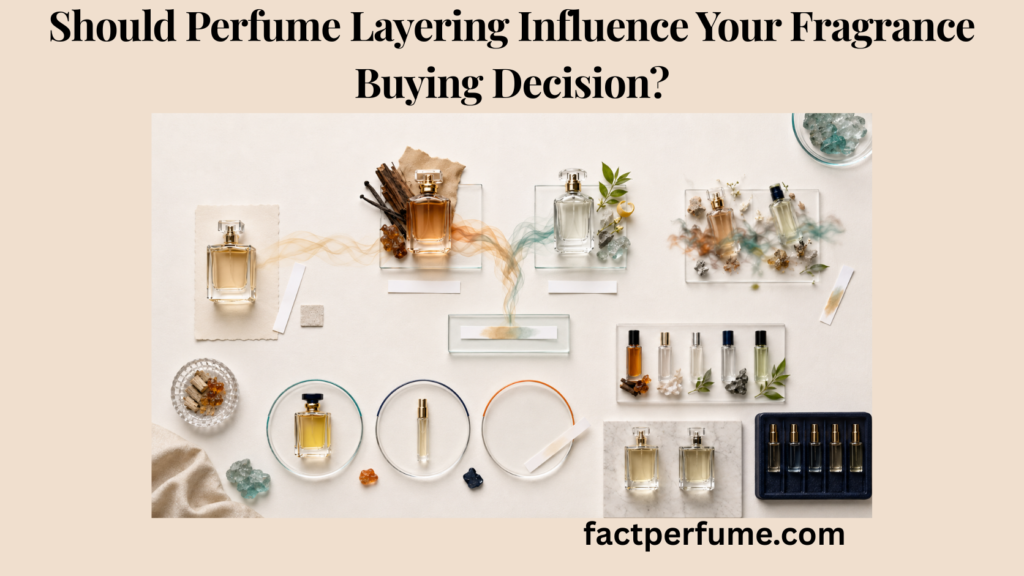
Should Perfume Layering Influence Your Fragrance Buying Decision?
Perfume layering should influence your fragrance buying decision only when the perfume works well alone, fills a genuine collection gap, and creates several useful combinations at a controllable dosage. Layering versatility can increase practical wearability, but it should not rescue a fragrance that you dislike, find uncomfortable, or would never choose to wear by itself.
This guide explains how to assess layering value, audit your current perfume collection, identify anchor and modifier gaps, test combinations before buying, control application, troubleshoot weak results, and make a final Buy, Sample Longer, or Skip decision.
When Should Perfume Layering Capability Influence Your Fragrance Purchase?
Perfume layering capability should influence a fragrance purchase when the candidate is enjoyable alone, fills a verified collection role, works in several tested combinations, and creates enough additional use to justify its price. Layering remains a secondary purchase advantage, not a replacement for standalone smell, comfort, performance, collection fit, and affordability.
It should be considered alongside other buying factors. A perfume promoted as layer-friendly may still be redundant, difficult to control, or unpleasant when worn independently. One successful pairing offers limited evidence, while several repeatable combinations provide stronger proof of practical versatility.
Standalone Enjoyment
A fragrance bought for layering should still provide meaningful value when worn alone. Independent enjoyment gives the perfume more wearing opportunities and prevents another product from becoming a permanent requirement.
Evaluate the opening, heart, dry-down, comfort, projection, and possible independent uses. A narrowly focused modifier may be intentionally subtle, but it should still perform that function clearly and comfortably.
A perfume that repeatedly feels unpleasant, incomplete, or difficult to wear alone is usually a weak purchase. Layering can create variation, but it should not function as compulsory repair.
Collection Fit
Layering value increases when the candidate fills a function that the current collection cannot already perform. That function might involve adding brightness, warmth, dryness, softness, freshness, contrast, or structure.
A candidate may also create useful seasonal, mood, or intensity flexibility. That value disappears when an owned perfume already produces the same result.
Audit existing bottles before shopping. The relevant question is not whether the candidate has an attractive layering story, but whether it solves a verified collection need.
Practical Versatility
A layer-friendly purchase should work in several repeatable combinations rather than one fragile pairing. Compatibility breadth gives the fragrance more practical use and reduces dependence on one specific partner.
A useful candidate should respond to changes in application amount, placement, order, or timing without consistently becoming muddy or overpowering. Its dry-down should also remain coherent after the opening changes.
One successful combination may justify further sampling. Stronger full-bottle value appears when the perfume works with multiple owned fragrances and the results can be recreated.
Price-to-Use Value
Layering should justify additional cost only when it creates realistic wearing opportunities. A full bottle may be unnecessary when a sample, travel size, or decant can perform the same limited modifier role.
Consider how often the perfume would be worn alone, how often it would be layered, and whether the useful combinations require purchasing other products. A supposedly versatile perfume may become expensive when it only works after several additional purchases.
The strongest value appears when one candidate works independently, fills a missing role, and extends the use of fragrances already owned.
The perfume-layering purchase decision matrix below converts standalone value, collection fit, compatibility, control, comfort, price, and redundancy into a direct Buy, Sample First, or Skip decision.
| Purchase criterion | Buy when | Sample first when | Skip when |
|---|---|---|---|
| Standalone enjoyment | The perfume remains enjoyable and useful alone | Independent wear is promising but uncertain | Another fragrance is always needed to make it tolerable |
| Collection fit | It fills a specific missing anchor or modifier role | Its role partly overlaps with an owned fragrance | It duplicates an existing function without adding meaningful use |
| Compatibility breadth | It works in several repeatable combinations | Only one promising pairing has been tested | It works in one fragile or accidental combination |
| Dosage control | Its dominance can be adjusted conservatively | Small adjustments produce inconsistent results | It overwhelms pairings even at restrained application |
| Dry-down | The later stages remain clear and pleasant | The opening works, but the dry-down needs more testing | The combination repeatedly becomes muddy, harsh, or unpleasant |
| Comfort | Standalone and layered testing remain comfortable | Comfort varies by placement, climate, or amount | Discomfort or a concerning reaction develops |
| Price-to-use value | Independent and layered uses justify the price | A smaller format may provide sufficient value | Extra purchases are required before it becomes useful |
| Redundancy | It adds a new practical function | Similar bottles exist, but actual results may differ | An owned fragrance already performs the same role |
Practical caption: Buy only when standalone value, collection fit, controllable application, repeatable compatibility, dry-down, comfort, and realistic use support the price together.
What Makes a Fragrance Suitable for Perfume Layering?
A fragrance is more suitable for perfume layering when it has a clear role, controllable strength, a compatible dry-down, and enough standalone identity to remain useful without another perfume. Clarity may make a candidate easier to evaluate, but it does not guarantee compatibility.
Complex perfumes can layer successfully, while apparently simple perfumes can still dominate or conflict. Family labels, note lists, and concentration terms should create testing directions rather than final conclusions. Complete formula behaviour, application amount, placement, skin, climate, and personal perception remain more important.
How Does a Clear Dominant Profile Support Layering?
A clear dominant profile makes a fragrance’s possible role easier to identify. A woody, musky, resinous, creamy, vanilla-led, or amber-like profile may be tested as an anchor, while a citrus, green, aromatic, fruity, mineral, smoky, or transparent profile may be tested as a modifier.
These roles remain flexible. A soft woody fragrance might anchor a citrus pairing but modify a dense leather-style perfume by adding smoothness.
Understanding broad perfume types can help create a testing shortlist, but family labels cannot guarantee that two complete formulas will layer successfully.
How Does Manageable Complexity Affect Layering?
A fragrance with manageable complexity may be easier to adjust at a low application level. When its main effects remain recognizable, the wearer can identify which perfume dominates and whether the intended contrast is working.
Complexity is not a defect. A multi-layered perfume may combine successfully when its structure remains coherent beside another fragrance. Problems are more likely when two dense formulas introduce too many competing effects at once.
Public fragrance notes may suggest an intended profile, but they do not reveal every material, proportion, strength, or interaction within the complete formula. Actual testing must override note-list assumptions.
How Does Adjustable Strength Improve Layering Value?
A useful layering fragrance remains pleasant when applied conservatively. Low-dose testing reveals whether the perfume can brighten, soften, deepen, dry, warm, or reshape another scent without erasing its identity.
Relative strength matters more than general product labels. A subtle modifier may disappear beside a dense anchor, while a diffusive fresh fragrance may dominate despite appearing lighter in its note description.
Although concentration can influence the wearing experience, parfum, eau de parfum, eau de toilette, and similar labels do not independently determine dominance, projection, diffusion, longevity, or layering success.
Why Does a Compatible Dry-Down Matter?
A successful opening has limited purchase value if the dry-down becomes unpleasant or incoherent. Early citrus, fruit, or aromatic effects may fade while woody, musky, sweet, smoky, or resinous effects become more noticeable.
Evaluate whether the combination remains clear after the opening develops. Watch for accumulated sweetness, increased dryness, excessive density, sharpness, or one perfume completely swallowing the other.
Skin, temperature, humidity, placement, and dosage may change the later result. A full-bottle decision should rely on extended testing rather than the first moments of a blotter test.
Why Does Useful Standalone Identity Matter?
Useful standalone identity protects the buyer from purchasing a product with only one narrow function. A fragrance that works independently creates more wearing opportunities and remains valuable when the intended pairing partner is unavailable.
A minimalist modifier can still be a legitimate purchase when its narrow purpose is intentional, frequently useful, and difficult to reproduce with an owned perfume. It does not need to behave like a large or dramatic composition.
The purchase becomes weak when the candidate lacks enjoyable independent use, performs one replaceable function, and requires another fragrance every time it is worn.
How Do You Identify Whether Your Collection Needs an Anchor or Modifier Fragrance?
Your collection needs an anchor or modifier only when existing fragrances cannot already perform the intended layering function with acceptable balance and comfort. An anchor provides the main body, identity, warmth, softness, depth, or structure of a specific combination.
A modifier changes that structure by adding freshness, contrast, dryness, sweetness, softness, brightness, or another targeted effect. These are flexible roles, and the same perfume may anchor one combination while modifying another.
Audit what your bottles already accomplish, record successful pairings, and define the exact missing function before evaluating a new purchase. Marketing language alone does not prove that a collection gap exists.
How Do You Identify Existing Anchor Fragrances?
Existing anchors are perfumes that provide the main identity or structural body in successful combinations. Woody, musky, vanilla-led, amber-like, resinous, creamy, or soft skin-scent profiles may perform this role.
Darkness, sweetness, density, or longevity alone does not make a perfume an effective anchor. It must remain pleasant, controllable, and recognizable after another scent is introduced.
List the perfumes that have already worked as stable bases. Record which modifiers they accept and whether their dry-down remains balanced. This prevents purchasing another anchor that repeats an existing function.
How Do You Identify Existing Modifier Fragrances?
Existing modifiers are perfumes that successfully change another fragrance’s brightness, sweetness, dryness, warmth, freshness, softness, contrast, or mood. Citrus, green, fruity, aromatic, floral, smoky, mineral, aquatic, and dry profiles may perform this role.
A modifier can be powerful or persistent. Its function depends on what it changes within a particular combination rather than whether it smells light or disappears quickly.
Record which bottles already brighten, soften, dry, deepen, warm, or refresh other perfumes. A new candidate that produces the same effect may add little practical value.
How Do You Identify a Genuine Functional Gap?
A genuine functional gap exists when you can name an effect your current collection cannot reproduce reliably. You might need a brighter modifier for dense fragrances, a dry contrast for accumulated sweetness, or a soft profile that rounds a sharp composition.
A warm modifier may extend the use of a very light fragrance, while a green or aromatic contrast may produce a fresher variation. A quieter profile may also create a subtler version of a scent for restrained environments.
Keep the need specific. “I want something for layering” is not a functional gap. “None of my current perfumes can reduce the perceived density of this sweet fragrance” is testable.
How Do You Prevent a Redundant Purchase?
A redundant purchase is prevented by comparing the candidate with every owned fragrance that performs a similar role. Ask whether the new perfume creates a genuinely different result or merely repeats an existing profile.
Consider whether a sample would solve the need. A small amount may be sufficient when the candidate will only be used occasionally as a modifier.
Before purchasing, ask:
- Does an owned perfume already perform this role?
- Is the candidate genuinely different during actual wear?
- Would a sample or travel size provide enough product?
- Am I buying a new function or another version of the same profile?
The collection gap audit below identifies what your current perfumes already accomplish, what function remains missing, and whether a new anchor or modifier would solve a real need rather than duplicate an existing bottle.
| Fragrance currently owned | Dominant profile | Possible role | Successful pairings | Missing function | Purchase needed: Yes or No |
|---|---|---|---|---|---|
| Fragrance A | Woody and warm | Anchor | Works with citrus and soft musk | Lacks a dry modifier | No new anchor needed |
| Fragrance B | Bright citrus | Modifier | Brightens warm woods | Disappears beside dense sweet perfumes | Possibly test a more persistent bright modifier |
| Fragrance C | Vanilla-led | Anchor or warm modifier | Softens aromatic perfumes | Adds too much sweetness to gourmands | Test a dry contrast before buying |
| Fragrance D | Green aromatic | Modifier | Refreshes florals and woods | Does not soften sharp structures | A soft modifier may fill the gap |
| Fragrance E | Clean musk | Anchor or softener | Rounds several combinations | Already performs the intended softening role | No duplicate purchase needed |
| Candidate | Record after testing | Proposed role | Record actual results | Must solve the named gap | Decide after comparison |
Practical caption: Complete the audit with actual bottles and tested results, then purchase only when the candidate solves a named function that existing fragrances cannot perform.
Which Anchor and Modifier Fragrance Combinations Should You Test Before Buying?
The best anchor and modifier combinations to test are pairings chosen for one intended effect, such as adding brightness, warmth, dryness, softness, or contrast to a perfume already owned. Every suggestion is a test direction rather than a guaranteed family rule.
Two perfumes with apparently compatible descriptions may behave differently because public note lists do not disclose complete formulas, relative strength, diffusion, or dry-down. Test one intended effect at a time, begin with two products, and evaluate both the opening and later development.
A pairing should influence a purchase only when the result remains useful, controllable, comfortable, and repeatable.
How Can You Brighten Dense Woody or Amber-Like Fragrances?
Dense woody or amber-like fragrances can be tested with brighter modifiers when the goal is to increase freshness or warm-weather flexibility. Citrus, green, aromatic, or light fruit profiles may add lift and perceptual contrast.
The main risks are a sharp opening, a modifier that disappears quickly, or a contrast that feels disconnected from the anchor’s dry-down. Test whether the brighter effect remains useful after the opening changes.
Skip the candidate when it produces only a brief attractive opening and leaves an unpleasant or unchanged later structure.
How Can You Add Warmth to Fresh Fragrances?
Fresh fragrances can be tested with soft warm profiles when the buyer wants greater depth or a rounder dry-down. Restrained vanilla, amber-like warmth, soft musk, sandalwood-style effects, or a light gourmand profile may provide that direction.
The warm layer may accumulate sweetness, reduce freshness, or dominate the original fragrance. Begin conservatively and observe whether the fresh identity remains recognizable.
The combination adds purchase value when it creates a genuinely useful variation rather than converting every fresh perfume into the same sweet result.
How Can You Add Contrast to Sweet Gourmands?
Sweet gourmands can be tested with dry or aromatic contrasts when the goal is to reduce perceived density. Dry woods, tea, aromatic herbs, smoke, leather-style accords, or mineral profiles may create a clearer edge.
The contrast can become harsh, smoky, bitter, or overly dominant. A dry modifier should reshape the sensory balance rather than erase the gourmand identity.
Buy only when the candidate produces a controlled contrast across several sweet fragrances or provides strong independent value. One difficult pairing supports longer sampling rather than an immediate purchase.
How Can You Refresh Powdery or Traditional Florals?
Powdery or formal florals can be tested with transparent modifiers when the buyer wants a fresher or more contemporary variation. Citrus, green effects, soft fruit, clean musk, or light woods may introduce brightness and space.
Too much fruit can increase sweetness, while sharp citrus or green effects may reduce floral clarity. Clean musk may also make an already powdery composition feel denser.
A useful candidate preserves the floral identity while creating a repeatable variation that the wearer would realistically use.
How Can You Soften Sharp or Aggressive Fragrances?
Sharp or highly projecting fragrances can be tested with softer profiles or greater spatial separation. Soft musk, creamy woods, restrained vanilla, or a compatible moisturizer may produce a rounder perceived effect.
Added sweetness, a competing lotion fragrance, and excessive total dosage can make the result heavier rather than softer. A quieter application may solve the problem more effectively than purchasing another fragrance.
A candidate that remains harsh alone should not be purchased merely because another product can occasionally soften it.
The anchor and modifier compatibility matrix below limits each test to one intended effect, one main risk, and one starting application method so the candidate can be evaluated without fake compatibility guarantees.
| Anchor profile | Modifier to test | Intended effect | Main compatibility risk | Starting application method | Test result |
|---|---|---|---|---|---|
| Dense woody or amber-like | Citrus, green, aromatic, or light fruit | Brightness and lift | Sharp opening or disappearing modifier | Separate blotters, then spatial separation | Record after dry-down |
| Fresh or aquatic | Soft musk, restrained vanilla, amber-like warmth, or creamy wood | Added depth and roundness | Warmth dominating freshness | More anchor presence with restrained modifier | Record whether freshness survives |
| Sweet gourmand | Dry woods, tea, aromatic herbs, smoke, leather-style, or mineral profile | Reduced perceived density | Harsh or overly dry contrast | Separate areas before closer layering | Record sweetness and clarity |
| Powdery or formal floral | Citrus, green effect, soft fruit, clean musk, or light wood | Fresher interpretation | Loss of floral clarity | Conservative spatial separation | Record whether floral identity remains |
| Sharp or highly projecting | Soft musk, creamy wood, restrained vanilla, or compatible moisturizer | Softer perceived structure | Added sweetness or excessive dosage | Reduce the strong perfume before adding another product | Record comfort and dominance |
Practical caption: Treat every row as a testing shortlist, then reject the direction when dry-down, clarity, comfort, control, or repeatability fails.
How Do You Test Perfume-Layering Potential Before Purchasing a Full Bottle?
You should test perfume-layering potential by evaluating each perfume alone, comparing the pair on separate blotters, confirming promising results on skin, and recording how application balance and dry-down affect the outcome.
Independent testing prevents layering from disguising a weak purchase. Separate blotters make dominance easier to control, while skin confirmation reveals how the perfumes behave during real wear.
Test more than one conservative balance and change only one variable at a time. Do not make a full-bottle decision from the opening, one accidental combination, or a note-list prediction.
Why Should You Test Each Perfume Alone First?
Each perfume must be tested alone first because layering cannot prove whether the candidate provides enough standalone value to justify its purchase. Record the opening, heart, dry-down, perceived projection, comfort, independent uses, and personal enjoyment.
A candidate that feels attractive briefly but becomes unpleasant later requires further evaluation. A perfume that repeatedly causes discomfort or needs another fragrance to become tolerable should be deprioritized.
Independent testing creates the baseline against which every layered result can be judged.
How Should You Use Separate Blotters?
Separate blotters let you compare two perfumes at different distances and relative strengths while preserving each fragrance’s individual behaviour. Apply each perfume to its own labeled strip and smell both independently before bringing them together.
Hold the strips at different distances. Move the stronger strip farther away to simulate a lower relative presence, then record which perfume dominates.
Recheck the strips after the opening changes. Do not press wet strips together, because doing so removes some of the control that separate testing is designed to provide.
When Should You Test a Shared Blotter?
A shared blotter should be tested only after the separate-blotter comparison produces a promising and controllable result. Use small applications and allow the first area to begin drying before applying the second nearby or with limited overlap.
Compare the shared result with the separate strips. Closer placement may improve integration, but it may also reduce clarity or make accumulated sweetness and density more obvious.
Paper remains a comparison medium. It does not reproduce the complete skin experience or establish skin safety.
How Should You Confirm the Pairing on Skin?
Skin confirmation determines whether the pairing remains pleasant, controllable, and comfortable during real wear. Test the perfumes on separate suitable skin areas first and use restrained amounts.
Observe the opening and dry-down before considering closer placement on a later wear. Application amount, skin condition, heat, sweat, and environment may change the perceived result.
The American Academy of Dermatology identifies fragrance as a common contact dermatitis trigger for some people. Avoid irritated or broken skin and stop using the combination if burning, rash, swelling, breathing discomfort, or persistent irritation develops. Do not continue testing or attempt to diagnose the cause yourself. AAD dermatitis guidance
How Many Application Balances Should You Test?
Test more than one conservative application balance because the useful role of an anchor or modifier may appear only after its relative presence changes. One unsuccessful balance does not automatically prove that the combination has no value.
Compare similar light applications, more anchor with less modifier, and more modifier with less anchor. You can also compare separate application areas, sequential application, and carefully tested same-area placement.
Avoid universal ratios. The useful balance depends on the complete formulas, method, environment, and wearer perception.
When Should You Buy, Sample Longer, or Skip?
Buy when the fragrance works alone and in several useful combinations, sample longer when results remain inconsistent, and skip when layering is required to repair a redundant or unpleasant perfume.
Buy when:
- It works alone.
- It fills a verified collection gap.
- It works in several tested combinations.
- It responds to application adjustments.
- It remains comfortable.
- Independent and layered use justify the price.
Sample longer when:
- The candidate is promising but inconsistent.
- Skin differs substantially from blotter.
- The dry-down requires further evaluation.
- Climate or application changes the result.
- Only one pairing has been tested.
Skip when:
- It consistently requires repair.
- It duplicates an existing perfume.
- It works in one fragile pairing only.
- It becomes uncomfortable.
- It requires several extra purchases before becoming useful.
The pre-purchase testing protocol below confirms that the candidate has been evaluated independently, on paper, on skin, at different conservative balances, and against owned alternatives before a final purchase decision is recorded.
Practical caption: A full bottle deserves consideration only after independent wear, controlled paper comparison, comfortable skin confirmation, dry-down evaluation, and repeatable results support the purchase.
How Should You Apply Multiple Fragrances for a Balanced Result?
Apply multiple fragrances with a conservative total amount and choose spatial separation, sequential application, or careful same-area layering according to how closely you want the scents to combine. No universal order works for every formula.
Count every fragranced product as part of the total application, including scented lotions. Placement and timing are adjustable variables rather than fixed laws.
Expanded placement and routine choices belong to the broader application method decision, while this section focuses only on controlling a pre-purchase layering test.
When Should You Use Spatial Separation?
Use spatial separation when you want the perfumes to mingle in the surrounding air while preserving enough distinction to control dominance. Suitable tests may place one perfume on the torso and another on a wrist, or use different arms.
Clothing and skin can also be tested separately when product directions and fabric suitability permit. Spatial separation makes it easier to identify which perfume dominates and reduce one without disturbing the other.
The main error is treating separate areas as permission to apply more fragrance. Total application can still become excessive.
When Should You Use Sequential Application?
Use sequential application when you want to observe how the first perfume develops before gradually introducing the second. Allow the initial application to settle enough for its early character to become understandable, then add the other fragrance conservatively.
No fixed waiting period works for every formula. Timing is one testing variable, and the second perfume may behave differently when introduced earlier or later.
Adjust one factor at a time and stop before the combination becomes saturated or difficult to evaluate.
When Should You Use Same-Area Layering?
Use same-area layering only when restrained amounts have already produced a comfortable and promising result during separate testing. This method creates a more closely integrated local scent impression but gives the wearer less control if one perfume becomes dominant.
Allow the first application to begin drying before adding a small amount of the second. Avoid placing two heavy wet applications directly over each other.
Stop immediately if the skin becomes uncomfortable. Do not continue simply to evaluate the dry-down.
Can Moisturizer Support Perfume Layering?
A fragrance-free or otherwise compatible moisturizer can be tested as an application medium, but it does not guarantee longer wear or safer layering. It may improve comfort on dry-feeling skin, yet it may also change how the perfume develops.
A strongly scented lotion functions as another fragrance profile and may compete with both perfumes. The FDA explains that some products labeled “unscented” may still contain fragrance ingredients used to mask the odour of other ingredients. FDA fragrance guidance
Check the moisturizer’s label, test it independently, and do not assume that every application medium improves every fragrance.
How Should You Control Total Dosage?
Total dosage should remain below the amount that makes the complete combination distracting, uncomfortable, or unsuitable for the surrounding environment. Count all perfumes and fragranced products together rather than evaluating each application separately.
Begin conservatively and assess the result before adding more. Heat, humidity, enclosed transport, close seating, workplace policies, and nearby fragrance-sensitive individuals may make the same combination feel more intense.
A perfume that cannot be controlled at a practical application level has limited layering purchase value.
The anchor-to-modifier starting application table below provides conservative starting methods while keeping amount, order, timing, placement, comfort, and environmental suitability adjustable for the formulas being tested.
| Combination type | Conservative starting method | What to assess | How to adjust | When to stop adding fragrance |
|---|---|---|---|---|
| Anchor with bright modifier | Separate areas or different arms | Whether brightness lifts without becoming sharp | Reduce or distance the brighter perfume | When sharpness or total intensity rises |
| Fresh anchor with warm modifier | Sequential application with restrained warmth | Whether depth increases without erasing freshness | Reduce the warm layer or increase separation | When sweetness or density accumulates |
| Sweet anchor with dry contrast | Separate areas before closer testing | Whether perceived sweetness falls while identity remains | Reduce the dry profile if harshness develops | When smoke, dryness, or bitterness dominates |
| Floral anchor with transparent modifier | Light spatial separation | Whether freshness improves without losing floral clarity | Reduce fruit, citrus, or green intensity | When the floral structure becomes unclear |
| Strong fragrance with softener | Reduce the strong perfume before adding the softener | Whether softness improves without creating overload | Increase separation or wear the original alone | When the combination remains too strong |
| Promising tested pair | Careful same-area application after separate tests | Integration, comfort, and dry-down | Change one variable during a later wear | When discomfort, muddiness, or overload appears |
Practical caption: Start with the method that offers the greatest control, then move toward closer integration only after clarity, comfort, and total intensity remain acceptable.
The execution checklist below keeps the experiment limited, sequential, repeatable, and relevant to the buying decision while preventing several variables from changing at the same time.
- Confirm that each perfume works alone.
- Choose one intended effect.
- Start with two fragranced products only.
- Use a conservative total application.
- Select spatial or sequential application first.
- Evaluate the opening and dry-down.
- Record dominance, clarity, projection, and comfort.
- Adjust one variable at a time.
- Stop when the result becomes uncomfortable or excessively intense.
- Save combinations that can be reproduced reliably.
Practical caption: A useful layering method is one that can be repeated without guesswork, excessive application, discomfort, or dependence on several additional products.
How Do You Fix Muddy, Overpowering, or Uncomfortable Perfume Combinations?
Fix a weak perfume combination by identifying the dominant problem, reducing one variable at a time, and retesting at a lower total application before rejecting or purchasing the candidate.
Most ordinary failures reflect dosage imbalance, competing complexity, accumulated sweetness, excessive dryness, placement, environment, or perception. They do not prove that the perfumes created a toxic new substance.
Return to two perfumes, remove or reduce one layer instead of adding another, and compare the result with each perfume worn alone. Skin discomfort is different from aesthetic incompatibility, so stop exposure when discomfort develops.
The troubleshooting table below connects each common failure to a likely cause, controlled correction, prevention step, and purchase implication without confusing an unpleasant smell with a diagnosis or toxic chemical reaction.
| Problem | Likely cause | Correction | Prevention | Purchase implication |
|---|---|---|---|---|
| One fragrance dominates | Relative strength or application imbalance | Reduce or separate the dominant fragrance | Begin with lower amounts | Sample longer if balance remains difficult |
| Combination smells muddy | Competing complex profiles | Remove one product and simplify | Test two perfumes only | Skip if clarity cannot be achieved consistently |
| Combination becomes too sweet | Sweet effects accumulate | Reduce the sweeter layer or test a dry contrast | Evaluate the dry-down before adding more | Avoid buying another redundant sweet modifier |
| Combination becomes too sharp | Dry, citrus, aromatic, mineral, smoky, or woody effects dominate | Reduce the sharp modifier or increase separation | Add one contrast at a time | Skip if the candidate remains harsh alone |
| White florals become overwhelming | Rich floral, sweet, creamy, or indolic effects reinforce one another | Lower the total application and simplify | Test independently and on separate blotters first | Sample rather than buying immediately |
| Combination becomes too strong | Total application exceeds a comfortable level | Stop adding fragrance and reduce future application | Count all fragranced products together | Reject a candidate that cannot be controlled |
| Skin becomes uncomfortable | Irritation or sensitivity may be occurring | Stop use and follow product guidance | Avoid irritated skin and excessive exposure | Do not purchase it for skin layering until the issue is understood |
| Purchase feels redundant | An existing perfume performs the same role | Return to the collection audit | Define the missing function before shopping | Skip the duplicate |
Practical caption: Correct the simplest variable first, then treat repeated failure, poor control, discomfort, or redundancy as evidence against an immediate full-bottle purchase.
What Should You Check Before Purchasing a Fragrance for Layering?
Before purchasing a fragrance for layering, confirm that it works alone, fills a genuine collection gap, succeeds in several tests, remains controllable, and creates enough practical value to justify its cost.
The final decision must come from actual wear rather than note lists, family assumptions, brand language, or one attractive opening. Review standalone use, collection fit, repeatable compatibility, application control, comfort, price, and format size together.
Choose Buy when the evidence is consistently positive, Sample Longer when uncertainty remains, and Skip when the candidate duplicates an owned role, requires repair, or creates more problems than useful combinations.
Does the Candidate Have Standalone Value?
The candidate has standalone value when it remains enjoyable, comfortable, and useful without another fragrance.
Does the Candidate Fit the Collection?
The candidate fits the collection when it adds a function that existing bottles cannot already perform.
Is the Compatibility Tested and Repeatable?
The compatibility is meaningful when the candidate succeeds with more than one owned perfume and the result can be recreated.
Is the Application Controllable?
The application is controllable when dominance and total intensity can be adjusted without an unnecessarily complicated routine.
Does the Candidate Create Practical Value?
The candidate creates practical value when layering adds realistic use without requiring unnecessary products.
Did Testing Remain Comfortable and Label-Compliant?
Testing supports the purchase when it remains comfortable, conservative, and consistent with product directions.
The final Buy, Sample Longer, or Skip checklist below converts standalone value, collection fit, repeatability, control, comfort, price, and redundancy into a completed purchase decision.
Buy
Choose Buy when all or nearly all of these statements are true:
- The fragrance works well alone.
- It fills a verified collection gap.
- It succeeds in several useful pairings.
- Its role remains clear through the dry-down.
- Dominance can be adjusted.
- Testing remains comfortable.
- The result can be repeated.
- Independent and layered use justify the full-bottle price.
Sample Longer
Choose Sample Longer when one or more uncertainties remain:
- The fragrance is promising but inconsistent.
- Only one pairing has been tested.
- Blotter and skin results differ substantially.
- The dry-down needs further evaluation.
- Climate or placement changes the result.
- A smaller format may provide sufficient value.
- The candidate partly overlaps with an owned perfume.
- Application control has not been confirmed.
Skip
Choose Skip when one or more problems persist:
- The perfume is consistently unpleasant alone.
- Another fragrance is required to repair it.
- It duplicates an existing function.
- It succeeds in only one fragile pairing.
- It repeatedly becomes muddy or overpowering.
- It cannot be controlled at a practical application level.
- It causes discomfort.
- Several extra purchases are required before it becomes useful.
- Its realistic use does not justify the price.
Practical caption: The strongest buying decision is supported by repeatable evidence, while unresolved uncertainty supports a smaller sample and repeated failure supports skipping the bottle.
Frequently Asked Questions
A perfume that only becomes enjoyable after another fragrance repairs it is usually a weak purchase. Sample longer or skip it unless you intentionally need a narrow modifier and have confirmed that its function is repeatable, comfortable, genuinely missing from your collection, and worth the price.
An anchor does not have to be stronger. The anchor provides the main identity or structure of a specific combination, while the modifier changes that identity. Either fragrance may project more strongly, so application amount, placement, and dominance must be adjusted through testing.
A heavier perfume does not always need to be applied first. Application order is one controllable variable rather than a universal rule. Test sequential application, spatial separation, and conservative amounts to determine which method produces the clearest, most comfortable, and most repeatable result.
Fragrance notes can suggest useful testing directions, but they cannot guarantee compatibility. Public note lists simplify complete formulas and may not reveal material proportions, diffusion, strength, or dry-down behaviour, so independent wear, separate blotters, and skin confirmation remain necessary.
Using two finished perfumes together is not automatically evidence of a dangerous chemical interaction, but it increases total fragrance exposure and may increase perceived intensity or skin contact. Use conservative amounts, follow product directions, avoid irritated skin, and stop if discomfort or a concerning reaction develops.
Begin with two perfumes because fewer variables make dominance, clarity, balance, and discomfort easier to identify. Add another fragranced product only after the first pairing is clear, repeatable, comfortable, useful, and controllable at an appropriate total application.
Conclusion
Perfume layering capability should influence a purchase only when it adds tested versatility to a fragrance that already provides standalone enjoyment, comfort, collection fit, and reasonable value. Auditing the current collection prevents redundancy, while independent wear, separate blotters, skin confirmation, and dry-down evaluation reveal whether a candidate creates genuine pairing value.
Dosage, order, timing, and placement may require adjustment, but repeated weak results support longer sampling or skipping rather than buying another bottle to repair the fragrance. A successful purchase creates practical combinations that remain clear, comfortable, controllable, and repeatable. The right layering purchase expands a collection through tested versatility, while the wrong one merely adds another bottle that needs something else to work.