
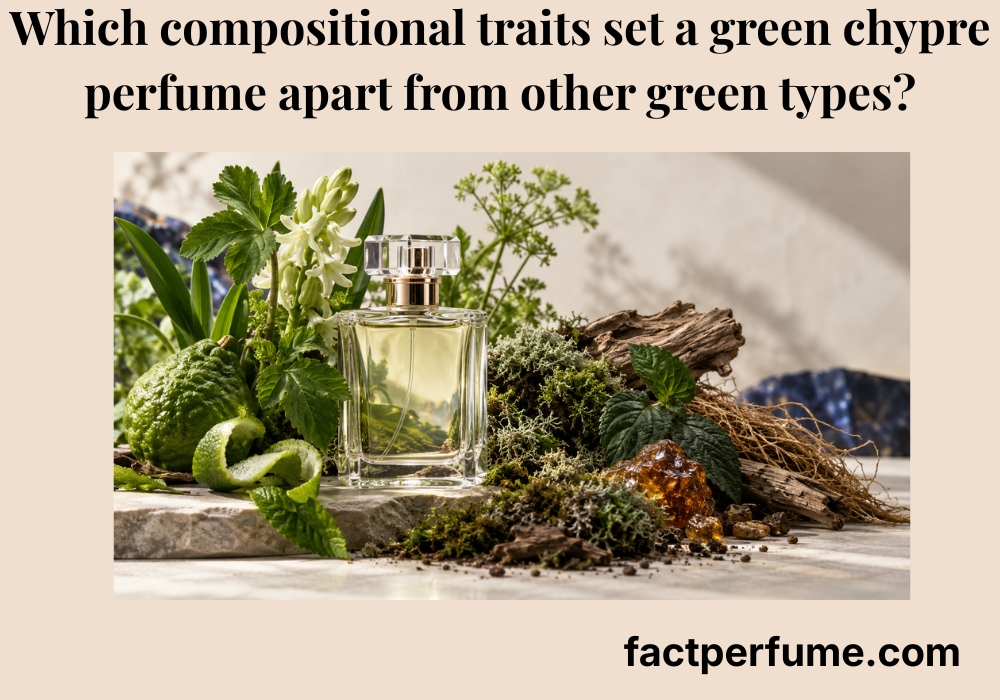
Which Compositional Traits Set a Green Chypre Perfume Apart From Other Green Types?
A green chypre perfume is set apart by the combination of pronounced leafy, bitter, or bracing green character with a chypre-style structure that develops toward a drier, mossier, resinous, earthy, patchouli-like, or woody foundation. A green chypre perfume is therefore a green fragrance whose identity depends not only on green-smelling notes, but on how those effects interact with the deeper structural contrast associated with chypre perfumery.
The distinction comes from the complete composition rather than from one ingredient. Bergamot, galbanum, oakmoss, labdanum, patchouli, vetiver, and related materials can provide useful structural clues, but none should be treated as a universal requirement. A green chypre commonly moves from brighter, sharper, or bitter-green upper facets toward greater mossy, resinous, earthy, or dry depth as it develops. This separates it from green florals, aromatic greens, and softer transparent-green styles whose structural emphasis may develop differently. The broader Green perfume includes leafy, grassy, herbal, sappy, and vegetal structures that do not necessarily follow chypre architecture.
What Defines the Traditional Architecture of a Chypre Accord?
Traditional chypre perfumery is commonly associated with contrast between brighter upper facets and deeper mossy, resinous, woody, or earthy effects rather than with one universally mandatory ingredient formula. A chypre accord is best understood as a compositional relationship in which brighter elements are set against a deeper, drier foundation.
Historically, citrus brightness—especially bergamot—has been strongly associated with this architecture. Bergamot can provide a fresh, bitter-citrus lift at the top of the fragrance, while the lower structure moves toward mossy, woody, resinous, or earthy territory. The effect is less about simply listing notes in a pyramid and more about creating contrast between different parts of the composition.
Deeper chypre effects have traditionally been associated with materials such as oakmoss, labdanum, patchouli, woods, and related earthy or resinous elements. Oakmoss, botanically known as Evernia prunastri, has particular historical importance because of its characteristic mossy, earthy, woody, and forest-like odor profile. Labdanum can contribute resinous depth, while patchouli may reinforce earthiness and woods can strengthen dryness and structure.
This relationship creates olfactory tension. In this context, olfactory tension means perceptual contrast between brighter, fresher, or sharper facets and deeper, drier, darker, or more textured ones. It describes a sensory effect rather than a chemical interaction between ingredients.
Bergamot, labdanum, oakmoss, patchouli, and related materials belong to the classic vocabulary of chypre perfumery, but that historical framework should not be converted into a mandatory modern formula. A contemporary perfume can display chypre architecture without reproducing one traditional ingredient combination exactly.
Modern treatment of oakmoss makes this distinction particularly important. Oakmoss itself is not simply “banned.” IFRA standards regulate oakmoss extracts through restrictions and specifications, including concentration limits that depend on the product category and requirements concerning particular sensitizing constituents.
As a result, contemporary perfumers may use compliant treated or fractionated oakmoss materials, reconstructed mossy effects, aroma chemicals, or combinations of patchouli, vetiver, woods, resins, and other materials to support related structural depth. There is no single universal material that replaces oakmoss in every modern chypre.
The defining principle is therefore architectural. A chypre establishes contrast between a brighter upper region and a deeper mossy, resinous, woody, earthy, or dry foundation. A green chypre develops that architecture further by making the green dimension especially pronounced.
A green chypre combines pronounced green contrast with a deeper mossy, resinous, earthy, woody, or dry chypre-style foundation.
How Do Bitter and Bracing Green Notes Transform a Chypre Structure?
A chypre becomes recognizably green when leafy, bitter, sappy, herbal, floral-green, or otherwise bracing effects materially intensify the contrast above its drier mossy or resinous foundation. These effects function as green modifiers, meaning that they change the sensory direction of the underlying structure by making greenness a major part of the fragrance’s identity.
No single material is responsible for this transformation. Galbanum is one of the most recognizable examples, but perfumers can also work with bitter leafy effects, crushed-stem impressions, herbs, hyacinth-like notes, geranium, iris-related dryness, and other green or green-floral materials.
What matters is the role these effects play in the composition. A trace of something leafy does not automatically turn a perfume into a green chypre. The green character must be prominent enough to shape the relationship between the brighter opening, the heart, and the deeper chypre foundation. The wider range of Green notes includes leafy, bitter, grassy, sappy, dewy, and herbal forms of greenness beyond chypre compositions.
How Does Galbanum Intensify Green-Chypre Contrast?
Galbanum can intensify green-chypre character through bitter, resinous, sappy, sharp, dry, and vegetal facets that contrast strongly with deeper mossy, woody, or resinous materials.
Its smell is more complex than simple fresh greenery. Depending on the material and how it is used, galbanum can suggest crushed stems, bitter plant sap, dry vegetation, resin, earthiness, or sharply green foliage. These qualities can give the opening of a perfume an unusually defined green edge.
That edge becomes especially effective when contrasted with deeper materials. Against oakmoss-like effects, patchouli, dry woods, vetiver, or resins, galbanum can make the difference between the upper and lower parts of the fragrance feel more pronounced. The opening may seem greener and sharper because the base feels earthier and drier, while the base can seem darker or more textured because of the brightness above it.
This is a sensory relationship rather than a fixed chemical rule. Galbanum does not chemically “create” chypre structure simply by being present.
Galbanum has a strong historical association with many classic green fragrances and green-chypre compositions, but it is not mandatory. A fragrance can create pronounced bitter or leafy greenness through other materials, and a perfume containing galbanum can belong to another fragrance family entirely.
Classification therefore depends on what galbanum is doing within the full structure rather than on its name appearing in a fragrance pyramid.
How Can Green-Leaning Florals Connect the Opening to the Chypre Base?
Green-leaning floral materials can extend vegetative character into the heart while connecting brighter or bitter green effects with the deeper chypre-style base.
Hyacinth-like effects are particularly useful because they can combine floral character with watery, leafy, stem-like, or distinctly green impressions. Instead of allowing the initial greenery to disappear once the opening softens, this type of floral character can help maintain a vegetative thread through the middle of the fragrance.
Iris can perform a different function. Depending on the accord, iris-related effects may introduce dry, cool, powdery, root-like, or slightly earthy qualities that sit comfortably beside a dry chypre structure. Geranium can combine floral, leafy, aromatic, and herbal facets, allowing it to participate in both the floral heart and the green dimension.
Other flowers may also appear. A green chypre does not stop being a chypre because it contains rose, jasmine, narcissus, or another richer floral material. The important issue is whether the floral heart becomes the main structural center or remains part of a broader green-to-chypre progression.
These materials are sometimes described informally as connecting or bridging different parts of a fragrance, but bridge note should not be treated as a rigid scientific category. Their importance comes from compositional function: they can help the green identity persist while the fragrance transitions from its brighter opening toward its deeper foundation.
That transition becomes particularly revealing during the dry-down.
How Does the Dry-Down of a Green Chypre Differ From Other Green Fragrances?
A green chypre often becomes easiest to distinguish in the dry-down, where earlier green or bright facets develop toward stronger mossy, resinous, earthy, patchouli-like, woody, or dry structural depth.
The dry-down is the later stage of a fragrance’s development, when the initial volatile impression has diminished and more persistent parts of the composition become increasingly noticeable. It is especially useful when identifying a green chypre because two perfumes can initially smell equally green while developing into very different structures.
Mossy effects are among the most recognizable dry-down clues. Historically, oakmoss has played an important role in chypre perfumery, contributing earthy, woody, mossy, and damp-forest-like nuances. Modern formulas may create comparable structural impressions through compliant oakmoss materials, reconstructed accords, or alternative combinations.
Labdanum can add resinous depth and may introduce warm, balsamic, leathery, or amber-like nuances depending on the formula. Patchouli can reinforce earthiness and woody darkness. Vetiver may contribute dry, root-like, grassy, earthy, or woody facets. Dry woods can further sharpen the structural outline of the base.
Some compositions may also develop leathery nuances, but leather is not required for green-chypre identity.
The resulting sensory direction commonly becomes drier, mossier, earthier, more resinous, or more structurally defined than the opening. The sharpest leafy effects may soften, but the composition can retain a trace of bitterness or green tension against its deeper base.
A green chypre does not have to become uniformly dark, warm, heavy, severe, cool, leathery, or vintage-smelling. Those qualities may occur in particular fragrances, but they are possible aesthetic outcomes rather than defining requirements.
Other green fragrance types can develop differently.
A green floral may allow its floral heart to become increasingly central. Flowers can remain the principal structural focus even when leafy or bitter-green materials are present.
An aromatic green may continue emphasizing herbal, aromatic, or crisp plant-like freshness. Woods, vetiver, musks, and other supporting materials may appear without producing a predominantly chypre-style base.
A softer or dewy green fragrance may emphasize watery-green facets, tea-like effects, violet-leaf impressions, delicate florals, musks, sheer woods, or transparent supports as it settles.
These are tendencies rather than universal formulas. There is no single “standard green base” shared by all non-chypre green perfumes.
The stronger clue is development. Many green chypres create a meaningful contrast between an initially bright, bitter, leafy, sappy, or bracing impression and a later mossy, resinous, earthy, woody, or dry foundation. Other green perfumes may evolve substantially as well, but their evolution is organized around a different structural center.
Illustrative Structural Tendencies — Not Fixed Formulas
| Stage | Common Green-Chypre Direction | Common Softer Non-Chypre Green Direction |
|---|---|---|
| Opening | Bergamot or other bright facets; galbanum or bitter-green effects | Violet leaf; fresh leafy effects; tea-like or watery-green facets |
| Heart | Green florals; dry floral or herbal transitions | Florals; aromatics; soft leafy effects |
| Dry-Down | Mossy effects; patchouli; labdanum; vetiver; dry woods | Musks; sheer woods; light vetiver; transparent supports |
These patterns represent illustrative tendencies rather than fixed formulas. Modern compositions can combine elements from both directions, and the softer pattern should not be interpreted as a formula for every non-chypre green perfume.
The important difference is not simply which ingredients appear, but which structural relationship dominates as the fragrance develops.
The dry-down is a key diagnostic clue: green-chypre structure commonly deepens toward mossy, resinous, earthy, patchouli-like, vetiver, or dry-wood effects.
How Does a Green Chypre Differ From Green Florals, Aromatic Greens, and Softer Green Styles?
Green chypres differ from neighboring green types primarily through stronger chypre-style structural contrast and a later mossy, resinous, earthy, or dry emphasis rather than through one exclusive green ingredient.
Green fragrance categories can overlap considerably. Galbanum may appear in a green floral. Geranium may appear in both aromatic and chypre structures. Vetiver can support numerous fragrance families. Mossy effects can also appear outside perfumes officially classified as chypres.
For that reason, the most useful comparison rule is:
The question is not merely what the perfume contains. The question is which compositional relationship becomes dominant from opening through dry-down.
How Does a Green Chypre Differ From a Green Floral?
A green chypre places greater emphasis on mossy, resinous, earthy, or dry structural contrast, while a green floral places a recognizable floral core at the center of its green identity.
In a green chypre, the opening may feature galbanum, bitter leaves, bergamot, or other bracing effects before moving through a green-floral heart toward a deeper base. Mossy effects, patchouli, labdanum, vetiver, dry woods, or related materials may then become increasingly important.
The floral component can still be substantial, but it does not necessarily become the fragrance’s primary structural focus. Instead, flowers participate in the transition between the green opening and the chypre-style foundation.
A green floral organizes the composition differently. Violet leaf, green stems, galbanum, hyacinth, leafy accords, or similar materials can give flowers a distinctly green setting, but the floral heart remains central.
Rose, jasmine, muguet-style accords, hyacinth, or other floral effects may provide the main identity, while musks, woods, or other materials support them underneath.
This does not mean green florals must be soft, delicate, romantic, feminine, or naturalistic. Some can be sharp, bitter, abstract, dry, dense, or highly structured.
The boundary is also not absolute. A perfume can contain a substantial floral heart and still behave like a green chypre if the later mossy, earthy, resinous, or dry architecture remains structurally dominant. Conversely, the presence of oakmoss, patchouli, or galbanum does not automatically turn a floral composition into a chypre.
A Green floral places the floral core at the center of the composition, whereas a green chypre derives more of its identity from chypre-style structural contrast.
How Does a Green Chypre Differ From an Aromatic Green?
An aromatic green fragrance places greater emphasis on herbaceous or aromatic freshness, whereas a green chypre derives more of its identity from mossy, resinous, earthy, or chypre-style structural contrast.
Aromatic-green compositions may feature basil, mint, sage, rosemary, geranium, or blended herbal effects. Their greenness may feel crisp, herbaceous, leafy, camphoraceous, or aromatic rather than primarily mossy or bitter-resinous.
Woods, vetiver, musks, and other materials can support these compositions without automatically creating chypre architecture.
The presence of herbs alone does not determine classification. A green chypre can contain herbal materials, and an aromatic green can include mossy, woody, or earthy elements.
The distinction appears in the center of gravity of the fragrance.
If aromatic freshness continues organizing the perfume as it develops, the composition is more likely operating in aromatic-green territory.
If those herbs or leafy effects eventually become part of a stronger transition toward mossy, resinous, earthy, patchouli-like, or dry depth, the structure begins to resemble green chypre more closely.
Neither category should be associated automatically with gender, lifestyle, age, occasion, or personality. Their distinction is compositional.
How Does a Green Chypre Differ From a Soft or Dewy Green?
A soft or dewy green fragrance usually emphasizes transparent leafy, watery, floral, musky, or tea-like freshness with less pronounced mossy-resinous contrast than a typical green chypre.
Violet leaf can produce a cool leafy impression. Watery-green effects may suggest moist stems, dew, crushed leaves, or translucent vegetation. Tea-like facets can add airy bitterness without necessarily creating the structural depth associated with chypre perfumery.
Soft florals, clean musks, sheer woods, and light vetiver may support this transparent green character.
A green chypre typically places more emphasis on contrast. Its leafy or bitter upper effects are set against a deeper mossy, earthy, resinous, woody, or dry foundation, producing a more noticeable relationship between the opening and the dry-down.
That does not mean a soft or dewy green perfume is simple or linear. Transparent fragrances can use sophisticated construction and undergo substantial development. Their difference lies in the dominant direction of that development.
A soft green may remain airy and translucent while becoming musky or woody. A green chypre more often uses its dry-down to strengthen the tension between pronounced greenness and chypre-style structural depth.
Common Structural Tendencies — Categories May Overlap
| Green Style | Defining Structural Tendency | Common Green Facets | Typical Supporting Structure | Likely Sensory Direction |
|---|---|---|---|---|
| Green Chypre | Strong green-to-mossy/resinous contrast | Galbanum, bitter greens, dry florals | Mossy effects, patchouli, labdanum, vetiver, woods | Dry, mossy, bitter, structured |
| Green Floral | Floral core shaped by green facets | Violet leaf, green stems, galbanum, hyacinth | Florals, musks, light woods | Floral, leafy, dewy, or sharp |
| Aromatic Green | Herbal or aromatic emphasis | Basil, mint, sage, geranium | Woods, vetiver, musks | Herbal, crisp, aromatic |
| Soft / Dewy Green | Transparent leafy freshness | Violet leaf, tea-like or watery-green facets | Musks, sheer woods, light florals | Airy, soft, dewy |
These are common structural tendencies, not universal taxonomic rules.
The categories can overlap, ingredients are not exclusive to one family, and classification systems may place borderline compositions differently. Dominant structure and actual development provide more useful evidence than ingredient matching alone.
The next step is therefore to test whether an individual fragrance actually develops according to the same structural pattern.
Green-chypre classification depends on dominant structure and development, not on one ingredient that may also appear in green florals, aromatic greens, or softer green styles.
How Can You Identify a Likely Green Chypre From a Fragrance Pyramid and Dry-Down?
A likely green chypre is identified most reliably by combining note-pyramid clues with the fragrance’s actual transition from bright, bitter, leafy, or bracing upper facets into a drier mossy, resinous, earthy, woody, or chypre-style dry-down.
A fragrance pyramid is a simplified descriptive tool that organizes a perfume into perceived top, heart, and base notes. It can help identify possible structural clues, but it should not be mistaken for the complete formula.
A marketed pyramid cannot reliably disclose every ingredient, exact concentration, material form, aroma chemical, reconstructed accord, or interaction used in the composition.
Identification should therefore combine what the note list suggests with what the fragrance actually does during wear.
Step 1 — Look for Chypre-Style Structural Clues
Begin by examining the listed base notes and family description.
Possible clues include:
- oakmoss;
- mossy accords;
- labdanum;
- patchouli;
- vetiver;
- dry woods;
- earthy accords;
- chypre accord.
These materials or descriptors can suggest a mossy, resinous, earthy, or dry foundation.
They should not be converted into a mandatory checklist.
Modern perfumers can create chypre-like depth using different combinations of natural materials, treated materials, aroma chemicals, reconstructed accords, woods, resins, patchouli, vetiver, and related effects.
The marketed note list may omit materials, simplify accords, or describe an effect rather than disclose how that effect was formulated.
Step 2 — Look for a Strong Green Modifier
Next, determine whether the perfume contains a meaningful green dimension.
Possible clues include:
- galbanum;
- bitter-green accords;
- green leaves;
- crushed-stem effects;
- hyacinth;
- geranium;
- herbs;
- sharp green facets;
- sappy or vegetal effects.
The important word is meaningful.
A single leafy note hidden inside a complex perfume is weaker evidence than a clearly perceived green character that shapes the fragrance from its opening through its development.
A perfume without galbanum can still achieve pronounced green-chypre character through other materials or accords.
Step 3 — Examine Opening-to-Dry-Down Contrast
Next, smell the fragrance over time rather than judging it immediately after spraying.
Ask:
- Does the fragrance open bright, bitter, leafy, sappy, or bracing?
- Does it later become mossier, drier, earthier, resinous, woody, leathery, or patchouli-like?
- Is that transition an important part of the perfume’s identity?
This stage provides stronger structural evidence than one isolated note name.
A fragrance pyramid might list both galbanum and patchouli, for example, but that does not explain their relative prominence or how the perfume develops.
The actual scent may reveal that the floral heart dominates everything else, that the herbal character remains central, or that the mossy dry-down becomes the main organizing structure.
Development gives the listed notes context.
Step 4 — Compare the Structural Center of Gravity
Ask what the perfume is fundamentally organized around.
Is it primarily:
- floral + green;
- aromatic + green;
- transparent/dewy + green;
- or green over a mossy/resinous/dry foundation?
If flowers remain the central identity, the perfume may sit closer to green floral territory.
If herbs and aromatic freshness dominate, aromatic green may be the stronger description.
If leafy freshness remains transparent over musks, tea-like effects, or sheer woods, the perfume may fit a softer green direction.
If pronounced green character sits above and develops into a distinctly mossy, resinous, earthy, woody, patchouli-like, or dry base, the evidence for green-chypre structure becomes stronger.
This structural center of gravity is more useful than asking whether one particular ingredient appears.
Step 5 — Treat the Note Pyramid as Evidence, Not Proof
A final classification should consider several forms of evidence together:
- the marketed note list;
- the stated fragrance-family classification where available;
- the opening;
- the heart;
- the dry-down;
- the dominant structural relationship;
- the overall scent development.
No single clue should determine classification automatically.
A marketed description can be incomplete. An ingredient may perform a different function than expected. Family terminology can also vary between perfume houses, writers, retailers, and classification systems.
The strongest indication of a green chypre therefore appears when the note clues and the fragrance’s actual development point toward the same green-over-chypre architecture.
Green Chypre Recognition Checklist
Use the following checklist as a recognition aid rather than a scoring system:
- ☐ The fragrance has a clear leafy, bitter, green, sappy, or bracing character.
- ☐ Its later structure contains mossy, resinous, patchouli-like, earthy, woody, or dry depth.
- ☐ A meaningful contrast exists between the opening and the dry-down.
- ☐ The structural center of gravity feels more chypre-like than purely floral, aromatic, musky, or transparent-green.
- ☐ The actual scent development supports the marketed note clues.
- ☐ The fragrance pyramid is being treated as evidence rather than a complete formula.
Checking these characteristics does not prove a universal classification. Fragrance taxonomy contains overlap, and different classification systems may treat borderline perfumes differently.
The checklist instead helps determine whether a fragrance displays the combination of green character, structural contrast, and chypre-style development expected from a likely green chypre.
Green Chypre Recognition Checklist
Checking these characteristics does not prove a universal classification. Fragrance taxonomy contains overlap, and different classification systems may treat borderline perfumes differently.
The checklist instead helps determine whether a fragrance displays the combination of green character, structural contrast, and chypre-style development expected from a likely green chypre.
Frequently Asked Questions
No. Oakmoss has historical importance in chypre perfumery, but a green chypre is better identified by its architecture and development. Modern formulas can use compliant treated or fractionated oakmoss, reconstructed mossy effects, aroma chemicals, or other materials to create related structural depth.
No. Galbanum is a recognizable route to bitter, resinous, sappy green contrast, but it is not mandatory. Other leafy, bitter, herbal, floral-green, or reconstructed effects can make greenness structurally important.
A strong clue is the development from bright, bitter, leafy, sappy, or bracing upper facets toward a drier mossy, resinous, earthy, patchouli-like, woody, or chypre-style foundation.
A green floral keeps a recognizable floral core at the center of its identity, while a green chypre places more structural emphasis on the contrast between pronounced greenness and a later mossy, resinous, earthy, or dry chypre-style foundation.
No. A note pyramid is useful evidence, but it is a simplified descriptive tool rather than a complete formula. Classification is stronger when the note clues and the perfume’s actual opening, heart, dry-down, and dominant structural relationship point in the same direction.
Conclusion
The compositional traits that most clearly set a green chypre perfume apart are pronounced green contrast, a chypre-style mossy or resinous foundation, and a distinct structural transition from brighter upper facets into a drier, earthier, woody, or patchouli-like dry-down. The defining relationship combines a chypre foundation with sufficiently prominent leafy, bitter, sappy, herbal, or floral-green modification to make greenness central to the fragrance’s identity.
The dry-down often provides the clearest distinction. Green florals place greater structural emphasis on their floral core, aromatic greens emphasize herbaceous or aromatic freshness, and softer green styles tend toward more transparent leafy, watery, musky, floral, or tea-like effects. These categories can overlap, however, and no single ingredient determines classification. The complete structure and its development matter more than matching one name in a note pyramid.
If pronounced green character develops over a distinctly mossy, resinous, earthy, woody, or dry chypre-style foundation, the fragrance is likely operating within green-chypre territory.