
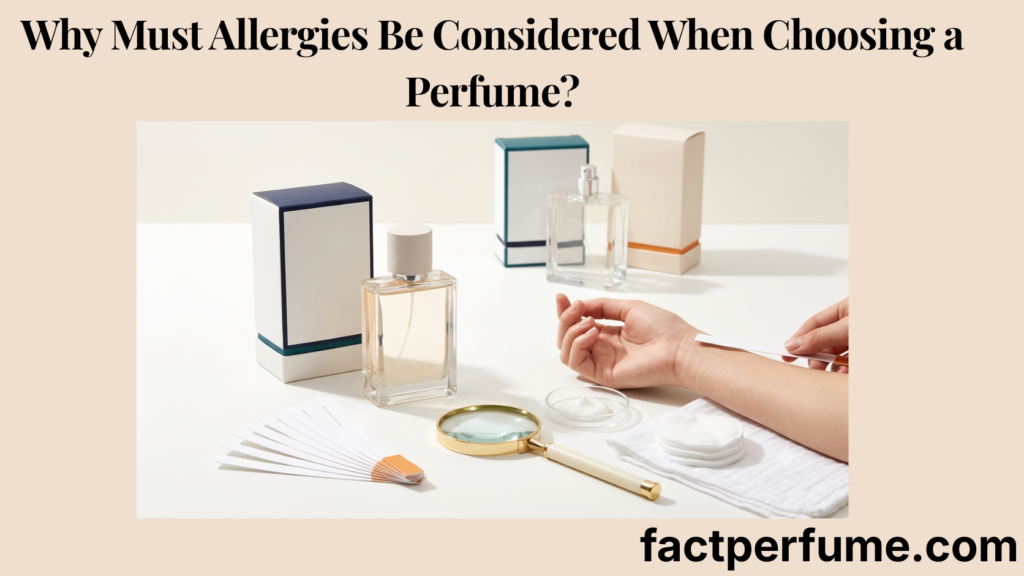
Why Must Allergies Be Considered When Choosing a Perfume?
Perfume allergies must be considered before scent profile, price, popularity, or performance because a suspected or confirmed reaction changes whether a product should be avoided, medically evaluated, or tested at all. Confirmed allergens and serious previous reactions must take priority, although irritation, headache, breathing discomfort, scent intolerance, and simple dislike should not automatically be labelled as allergy.
This article explains how to distinguish allergy from irritation and intolerance, recognise urgent warning signs, understand professional diagnosis, check known allergens, assess marketing claims, respond after a reaction, identify no-test conditions, and make a safer fragrance decision. It also separates cautious ordinary product use from medical testing and provides six clear safety-led outcomes.
When Should Perfume Allergies Influence Your Fragrance Choice?
Perfume allergies should control the fragrance decision when an allergen is confirmed, a previous reaction was serious, symptoms recur, or product compatibility cannot be established.
Allergy risk is one of the most important safety buying factors. It deserves greater weight than fragrance style, concentration, packaging, price, popularity, reviews, performance, or convenience whenever exposure may create a significant health risk.
Confirmed Fragrance Allergy
A confirmed fragrance allergy should directly shape product avoidance.
The buyer should follow the exact allergen names, synonyms, related substances, and exposure instructions provided by the diagnosing clinician. A product should not be treated as suitable merely because it is described as natural, clean, alcohol-free, solid, hypoallergenic, lightly scented, or suitable for sensitive skin.
Current ingredient information must be checked for the exact concentration, format, and version being considered.
Clinician-Provided Avoidance Plan
A clinician-provided avoidance plan deserves more weight than general online advice.
The plan may identify exact allergens, alternative names, related substances, or product categories requiring caution. It should not be simplified into broad assumptions such as avoiding only synthetic materials or choosing only essential-oil perfumes.
When available product information is insufficient to follow the plan confidently, avoiding the perfume is safer than guessing.
Previous Breathing Difficulty
Previous breathing difficulty after fragrance exposure requires appropriate medical assessment and creates a strong boundary against casual re-exposure.
Breathing symptoms do not automatically prove delayed fragrance contact allergy. They may involve a different respiratory or systemic mechanism, but they still deserve attention according to their severity.
A person with a previous serious breathing response should not deliberately reapply the suspected product at home.
Previous Facial or Airway Swelling
Significant swelling of the lips, tongue, mouth, face, or throat can be serious.
Sudden throat or tongue swelling, difficulty swallowing, hoarseness with airway symptoms, wheezing, difficulty breathing, confusion, dizziness, faintness, or collapse are recognised emergency signs.
Another intentional exposure should not be used to confirm what caused the previous event.
Repeated Unexplained Rash
A rash that repeatedly follows perfume or fragranced-product exposure warrants professional evaluation.
Its timing, location, appearance, recurrence, and the other products used can guide investigation. These observations cannot independently identify the responsible ingredient.
The suspected product should be stopped while the reaction is being evaluated.
Mild Isolated Irritation
Mild isolated burning, stinging, redness, or dryness may reflect direct irritation rather than allergy.
Possible contributors include damaged or inflamed skin, recent exfoliation, another skincare product, repeated exposure, or the perfume formula. Irritant contact dermatitis and allergic contact dermatitis can overlap in appearance, so persistent or recurrent symptoms may require professional assessment.
Scent Dislike Without Physical Symptoms
Disliking a perfume is not an allergy.
An unpleasant odour, negative memory, or dislike of sweetness, smoke, musk, florals, powder, or another characteristic belongs to personal preference when no physical symptoms occur.
The perfume may still be skipped, but the reason should not be medically mislabelled.
Unknown Allergen After a Significant Reaction
When the responsible ingredient remains unknown after a significant reaction, uncertainty becomes a meaningful purchase restriction.
The buyer should not deliberately try several perfumes to identify the trigger. Professional history-taking, examination, and patch testing may be needed when delayed allergic contact dermatitis is suspected.
Insufficient Product Information
Insufficient current ingredient information can prevent safe use of a confirmed avoidance plan.
Front-label claims such as clean, natural, hypoallergenic, dermatologist-tested, alcohol-free, or fragrance-conscious cannot replace the current ingredient declaration and clinician-provided guidance.
Safety and known-allergen avoidance must outweigh fragrance style, performance, prestige, popularity, price, reviews, or convenience.
Perfume Allergy Purchase and Safety Decision Matrix
| Reaction or risk context | Possible category | Safety boundary | Verification or medical step | Product decision |
|---|---|---|---|---|
| Breathing difficulty or airway swelling | Potential serious systemic reaction | No further exposure | Seek emergency help | Avoid and Seek Urgent Care |
| Faintness, confusion, or collapse | Potential circulation or systemic involvement | No home testing | Seek emergency help | Avoid and Seek Urgent Care |
| Hives with breathing or circulation symptoms | Possible severe allergic reaction | No re-challenge | Emergency assessment | Avoid and Seek Urgent Care |
| Persistent or recurrent itchy rash | Possible allergic contact dermatitis | Stop suspected exposure | Seek medical evaluation | Stop Use and Seek Medical Advice |
| Blistering or significant swelling | Significant skin reaction | Stop use | Prompt medical assessment | Stop Use and Seek Medical Advice |
| Several fragranced products cause reactions | Unclear allergy, irritation, or intolerance | Avoid experimental exposure | Professional evaluation | Stop Use and Seek Medical Advice |
| Confirmed allergen appears on current label | Known exposure risk | Do not use | Follow avoidance plan | Avoid the Product |
| Confirmed allergen cannot be ruled out | Material uncertainty | Do not guess | Seek clarification without exposure | Avoid the Product |
| Clinician has advised fragrance avoidance | Medical contraindication | Follow medical advice | No consumer challenge | Avoid the Product |
| Previous serious reaction remains unexplained | Significant unresolved risk | Do not re-expose | Await professional evaluation | Do Not Test Yet |
| Active eczema, broken skin, or inflammation | Unsuitable application area | Do not apply perfume | Wait or seek advice | Do Not Test Yet |
| Mild past irritation with no severe history | Possible irritant response | Use only if ordinary use is appropriate | Review product and skin condition | Test Cautiously or Skip |
| No adverse history and intact skin | Ordinary consumer context | Follow intended-use directions | Conservative ordinary evaluation | Test Cautiously |
| Exact product tolerated appropriately | No known contraindication identified | Continue normal caution | Recheck information at repurchase | Buy |
| Marketing claim is the only reassurance | Compatibility remains unverified | Do not assume safety | Review current ingredients | Verify or Avoid |
| Product formula or packaging has changed | New exposure uncertainty | Previous tolerance may not transfer | Recheck current label | Verify Further or Avoid |
Practical caption: Rank emergency symptoms, persistent reactions, confirmed allergens, unresolved risk, ordinary cautious use, and purchase suitability before considering scent style, price, popularity, or performance.
What Is the Difference Between Fragrance Allergy, Irritation, Sensitivity, and Scent Dislike?
Fragrance allergy, direct irritation, scent intolerance, skin sensitivity, and simple dislike describe different experiences and require different responses.
Using allergy as a general label for every unwanted fragrance experience can obscure emergencies, encourage inappropriate testing, or lead to an unnecessarily broad avoidance plan.
Allergic Contact Dermatitis
Allergic contact dermatitis is a delayed immune-mediated skin reaction.
Possible symptoms include itching, rash, swelling, excessive dryness, cracking, tenderness, burning, stinging, or blistering. A reaction can appear hours or days after skin contact with an allergen.
A delayed rash may be consistent with allergic contact dermatitis, but symptoms and timing cannot identify the responsible ingredient by themselves.
Irritant Contact Dermatitis
Irritant contact dermatitis results from direct irritation or damage rather than sensitisation to one specific allergen.
It may produce burning, stinging, redness, dryness, cracking, or tenderness. Repeated washing, harsh products, damaged skin, or direct chemical irritation can contribute.
A person may have irritation, allergy, or both, so persistent symptoms should not be self-diagnosed.
Immediate Potentially Allergic or Systemic Symptoms
Immediate symptoms may include hives, rapid swelling, wheezing, difficulty breathing, faintness, or wider systemic illness.
These require severity-based assessment. Airway, breathing, or circulation symptoms should be treated as urgent rather than investigated through another exposure.
Immediate systemic reactions should remain separate from delayed allergic contact dermatitis.
Fragrance Sensitivity or Intolerance
Fragrance sensitivity or intolerance may describe headache, nausea, dizziness, respiratory discomfort, or other scent-associated symptoms.
These experiences can be important and may justify avoidance or medical advice. They do not automatically establish a skin contact allergy or identify a particular allergen.
Scent Dislike
Scent dislike is an unpleasant sensory or emotional reaction without physical symptoms.
It may involve finding a perfume too sharp, heavy, sweet, smoky, powdery, medicinal, or unpleasant. It belongs to personal preference rather than allergy classification.
Skin Sensitivity
Skin sensitivity is a broad tendency towards discomfort or reactivity.
It is not a fragrance-allergy diagnosis. Temporary skin condition can affect irritation and comfort, but it remains separate from diagnosed allergy and broader skin-type testing.
Symptoms alone cannot reliably identify the responsible ingredient.
Fragrance Allergy, Irritation, Sensitivity, and Dislike Comparison Table
| Experience | Usual pattern | Possible symptoms | What it may represent | Appropriate response |
|---|---|---|---|---|
| Allergic contact dermatitis | Often delayed | Itching, rash, swelling, dryness, cracking, blistering | Possible delayed immune reaction | Stop use and seek assessment if persistent or recurrent |
| Irritant contact dermatitis | May be immediate or develop with exposure | Burning, stinging, redness, dryness | Direct irritation or skin damage | Stop use and review exposure |
| Immediate systemic reaction | Rapid or escalating | Hives, swelling, breathing difficulty, faintness | Potentially serious allergic or other systemic reaction | Seek severity-based urgent care |
| Respiratory discomfort | During or after airborne exposure | Coughing, wheezing, chest tightness, breathlessness | Requires assessment, not automatically contact allergy | Leave exposure and seek appropriate advice |
| Fragrance intolerance | Variable | Headache, nausea, dizziness, general discomfort | Scent-associated intolerance | Reduce exposure and seek advice if recurrent |
| Skin sensitivity | Variable | Stinging, redness, discomfort | Broad reactivity rather than diagnosis | Use caution and obtain advice when persistent |
| Scent dislike | Sensory judgement | No physical symptoms | Personal preference | Skip the perfume |
| Confirmed fragrance allergy | Clinically assessed and exposure-linked | Depends on allergen and exposure | Identified sensitisation with clinical relevance | Follow exact avoidance plan |
Practical caption: Separate delayed allergic contact dermatitis, direct irritation, immediate systemic symptoms, fragrance intolerance, skin sensitivity, and scent dislike because each requires a different response.
Which Symptoms and Timing Patterns May Indicate an Allergic Perfume Reaction?
A delayed itchy rash that repeatedly follows similar fragrance exposure may be consistent with allergic contact dermatitis, while immediate burning may reflect irritation, damaged skin, or another product interaction.
Timing can support triage and clinical history, but it cannot identify the exact cause.
Delayed Itchy Rash
Possible interpretation: A recurring delayed rash may be consistent with allergic contact dermatitis.
Limitation: Another cosmetic, cleanser, textile, medication, workplace exposure, or skin condition may be responsible.
Action: Stop the suspected perfume and seek advice when the rash persists, returns, or spreads.
Immediate Burning or Stinging
Possible interpretation: Direct irritation, damaged skin, another product interaction, or an allergic response may be involved.
Limitation: Immediate discomfort alone does not distinguish the mechanism.
Action: Stop use. Do not scrub, apply more perfume, or deliberately repeat the exposure.
Redness
Possible interpretation: Irritation, allergy, heat, friction, or another inflammatory process may cause redness.
Limitation: Appearance alone is not diagnostic.
Action: Stop exposure and seek advice if redness persists or worsens.
Local Swelling
Possible interpretation: Local swelling may occur with dermatitis, hives, irritation, or another inflammatory reaction.
Limitation: Location, timing, severity, and progression matter.
Action: Facial, lip, tongue, mouth, or throat swelling deserves greater urgency, particularly when breathing or swallowing is affected.
Dry or Cracked Skin
Possible interpretation: Dryness and cracking may appear with contact dermatitis.
Limitation: Weather, frequent washing, other products, or an existing skin condition can look similar.
Action: Stop the suspected product and seek assessment if the problem continues.
Blistering
Possible interpretation: Blistering may occur in significant contact dermatitis or another serious skin reaction.
Limitation: It cannot be safely classified from timing or appearance alone.
Action: Stop use and seek medical advice. Widespread blistering or skin peeling requires urgent assessment.
Hives
Possible interpretation: Raised itchy welts may occur in allergic and non-allergic conditions.
Limitation: Isolated hives do not automatically establish anaphylaxis.
Action: Seek emergency help when hives occur with breathing difficulty, throat or tongue swelling, faintness, confusion, collapse, or rapidly worsening symptoms.
Headache or Nausea
Possible interpretation: Headache or nausea may reflect scent intolerance, migraine-associated sensitivity, anxiety, or another response.
Limitation: Neither symptom alone proves contact allergy.
Action: Leave the exposure and seek advice when symptoms are severe, recurrent, or difficult to manage.
Wheezing or Chest Tightness
Possible interpretation: A respiratory response requiring assessment may be occurring.
Limitation: These symptoms do not automatically establish delayed skin allergy.
Action: Significant or rapidly worsening breathing symptoms require urgent medical help.
Recurrence
Possible interpretation: Repetition after similar exposures increases the need for professional investigation.
Limitation: Recurrence still does not identify the ingredient.
Action: Preserve product names, labels, timing, photographs, and information about simultaneous exposures.
Spread Beyond the Application Site
Possible interpretation: A more extensive skin reaction or another process may be involved.
Limitation: Spread does not determine the mechanism.
Action: Stop use and seek advice, especially when the reaction is widespread, blistering, or accompanied by systemic symptoms.
Record the product, current ingredient list, symptoms, timing, location, recurrence, and other simultaneous exposures; stop use and seek professional advice when reactions are persistent, severe, recurrent, or unclear.
Reaction Timing and Symptom Guide
| Timing or pattern | Symptoms | Possible interpretation | Important limitation | Action |
|---|---|---|---|---|
| Immediate local burning | Burning, stinging, redness | Irritation, damaged skin, product interaction, or allergy | Timing does not identify cause | Stop use |
| Delayed local rash | Itching, redness, dryness, swelling | Possible allergic contact dermatitis | Other exposures may be involved | Seek advice if persistent |
| Rash hours or days later | Itching, cracking, blistering | Delayed contact reaction may be possible | Cannot identify ingredient | Preserve product details |
| Rapid isolated hives | Raised itchy welts | Allergic or non-allergic urticaria | Not automatically anaphylaxis | Seek medical advice |
| Hives with breathing or faintness | Hives plus systemic symptoms | Potential severe reaction | Requires urgent assessment | Emergency help |
| Facial or airway swelling | Lip, tongue, mouth, face, or throat swelling | Angioedema or serious reaction | May escalate quickly | Emergency help if airway affected |
| Headache or nausea | Neurological or gastrointestinal discomfort | Possible intolerance | Not proof of contact allergy | Reduce exposure |
| Wheezing or chest tightness | Respiratory discomfort | Possible respiratory reaction | Different from delayed dermatitis | Urgent assessment if significant |
| Recurrent rash with several products | Repeated dermatitis | Possible shared allergen or several triggers | Needs clinical investigation | Seek medical advice |
| Widespread blistering or peeling | Severe skin involvement | Serious dermatological reaction | Not suitable for home testing | Urgent assessment |
Practical caption: Use timing only as context: immediate burning, delayed rash, hives, airway symptoms, headache, nausea, recurrence, and spread still require severity-based action.
Which Perfume Reactions Require Urgent Medical Attention?
Breathing difficulty, airway swelling, faintness, confusion, collapse, or a rapidly worsening systemic reaction requires emergency medical attention.
NHS emergency guidance identifies emergency warning signs including sudden swelling of the throat or tongue, difficulty breathing or swallowing, wheezing, hoarseness with airway symptoms, confusion, severe dizziness, faintness, or collapse.
Urgent Warning Signs Checklist
Seek emergency help when any of the following occur:
Checklist instruction: Tick each item only after it has been reviewed for the exact reaction history, product, current label, and medical context.
Isolated hives should not automatically be labelled as anaphylaxis. They become more urgent when accompanied by airway, breathing, circulation, or rapidly worsening systemic symptoms.
Stop exposure, seek emergency help, and do not perform another home test.
How Is Fragrance Contact Allergy Properly Diagnosed?
Fragrance contact allergy is diagnosed through clinical history, examination, and professionally interpreted patch testing rather than self-directed perfume reapplication.
Patch testing is used to investigate substances that may cause delayed allergic contact dermatitis. It involves controlled application of standardised allergens and professional reading and interpretation of the reactions.
Clinical History
A clinician may review:
- Symptoms
- Timing
- Affected body areas
- Recurrence
- Exact products
- Household or occupational exposure
- Other products used
- Previous skin conditions
- Previous advice or treatment
History may suggest possible causes but cannot confirm the allergen alone.
Product Review
Preserve:
- Exact product name
- Current packaging
- Current ingredient list
- Concentration and format
- Product version
- Application site
- Other simultaneous products
- Photographs where appropriate
An old online ingredient list may not represent the current formulation.
Physical Examination
The appearance and distribution of a rash may guide investigation.
They do not identify the ingredient independently because different causes can produce similar-looking skin changes.
Diagnostic Patch Testing
Diagnostic patch testing is a healthcare procedure for investigating delayed allergic contact dermatitis.
It is not the same as applying perfume to the wrist, inner arm, or another area at home. Ordinary use must not be described as diagnostic patch testing.
Baseline Screening Series
A baseline series contains common and important contact allergens.
patch-testing guidance explains that baseline testing identifies many common causes, but it does not detect every possible allergen. Additional substances may need to be selected according to the person’s history and exposures.
Result Interpretation
A positive patch-test result identifies sensitisation to the tested substance.
A clinician must then determine whether the finding is relevant to the person’s actual product exposure and symptoms. A positive result does not mean every fragranced product will cause a reaction.
Avoidance Plan
A clinician may provide:
- Exact allergen names
- Synonyms
- Related substances
- Product categories to avoid
- Label-reading guidance
- Exposure-reduction instructions
Diagnostic Pathway
| Stage | Purpose | Information needed | Limitation | Product consequence |
|---|---|---|---|---|
| Reaction history | Identify exposure patterns | Product, timing, symptoms, recurrence | Cannot diagnose alone | Stop suspected product |
| Clinical examination | Assess rash and distribution | Current or documented signs | Not ingredient-specific | Continue evaluation |
| Product review | Identify possible exposures | Package, label, version, other products | Label may be incomplete | Preserve evidence |
| Professional patch testing | Investigate delayed allergy | Standardised allergens | Does not cover every allergen | Follow clinical interpretation |
| Expanded assessment | Investigate unresolved cases | Additional allergens or products | Requires professional judgement | Avoid uncertain products |
| Relevance assessment | Connect result to real exposure | History and test findings | Positive test may not explain every event | Follow targeted plan |
| Ongoing label checking | Prevent future exposure | Current labels and exact names | Formulas can change | Recheck every purchase |
Practical caption: Diagnosis combines clinical history, examination, exact-product review, professionally administered patch testing, relevance assessment, and a personalised avoidance plan.
Home testing cannot confirm or exclude fragrance allergy.
How Should You Read Perfume Labels After Identifying a Known Fragrance Allergen?
After a fragrance allergen is confirmed, label checking should use the exact clinician-provided name, synonyms, and avoidance instructions rather than general marketing claims.
A confirmed plan is easier to follow when ingredient information is evaluated beyond front-label wording.
Use Exact Names and Synonyms
Record the exact allergen name supplied by the clinician.
Check recognised alternative names and related substances included in the avoidance plan. Do not create a medical avoidance list from unverified apps or social-media posts.
Review the Current Ingredient List
Use the current physical package where possible.
Confirm that the label belongs to the same concentration, format, size, and market version being considered.
Recheck After Repurchase
Previous tolerance does not guarantee that the current product is identical.
Formulas, suppliers, product versions, and labelling can change.
Understand Collective Fragrance Terms
In the United States, a fragrance mixture may be declared collectively as “fragrance.” Some products labelled “unscented” may still contain fragrance ingredients used to mask other odours. These US rules should not be applied automatically to every jurisdiction.
Contact the Manufacturer When Necessary
A manufacturer may clarify current product information, but complete composition details may not always be available.
Do not assume that absence of information proves absence of the allergen.
Avoid the product when a confirmed allergen cannot be ruled out and the avoidance plan requires certainty.
Known-Allergen Label Cross-Check Table
| Clinician-provided information | Current label entry | Synonym checked? | Exact version confirmed? | Information sufficient? | Decision |
|---|---|---|---|---|---|
| Confirmed allergen name | |||||
| Alternative allergen name | |||||
| Related substance | |||||
| Collective fragrance term | |||||
| Relevant natural extract or essential oil | |||||
| Concentration | |||||
| Product format | |||||
| Current formula or package | |||||
| Manufacturer clarification | |||||
| Final compatibility status |
Practical caption: Match the clinician-provided allergen name, reliable synonyms, related substances, collective fragrance wording, exact concentration, format, current package, and manufacturer information before deciding.
Possible outcomes:
- Avoid: A confirmed allergen is listed.
- Avoid: Required exclusion cannot be established.
- Verify Further: More information may be obtained without exposure.
- Consider Ordinary Use: Only when no contraindication remains.
Why Can Natural, Synthetic, Clean, and Hypoallergenic Fragrance Claims Be Misleading?
Natural, synthetic, clean, hypoallergenic, dermatologist-tested, alcohol-free, solid, or water-based claims do not independently establish suitability for a person with allergy concerns.
Natural
Natural extracts and essential oils can contain allergens or irritants.
Ingredient origin does not establish individual safety. The FDA advises that natural or organic origin should not be assumed to make a cosmetic safer.
Synthetic
Synthetic aroma materials may also trigger allergy or irritation in susceptible individuals.
Synthetic origin does not make a material automatically dangerous. Suitability depends on the exact substance and the person’s confirmed medical context.
Clean
Clean does not have one universal medical definition of allergy safety.
Each company may use the term differently. It cannot replace allergen checking.
Hypoallergenic
Hypoallergenic does not mean allergy-proof.
The FDA describes hypoallergenic products as products whose manufacturers claim they cause fewer allergic reactions than other products. The claim does not guarantee that no individual will react.
Dermatologist Tested
Dermatologist-tested may indicate some kind of testing or professional involvement.
It may not disclose the tested population, protocol, participant number, allergens assessed, results, or relevance to a confirmed individual allergy.
Phthalate-Free
Phthalate-free addresses a specific ingredient category.
It does not prove that the product is free from fragrance allergens.
Alcohol-Free
Removing ethanol does not remove the fragrance composition.
An oil, solid, or water-based perfume may still contain a confirmed allergen.
Solid, Oil, or Water-Based Perfume
Changing the carrier changes application and texture.
It does not guarantee allergy safety or prevent airborne exposure.
Single-Molecule Perfume
One aroma material can itself be an allergen or irritant.
A single-molecule marketing concept should not be treated as medical clearance.
Unscented and Fragrance-Free
Unscented usually describes the lack of a noticeable smell and may still involve masking fragrance. Fragrance-free is generally more useful for reducing added fragrance exposure, but it still does not guarantee compatibility with every avoidance plan.
Fragrance Marketing Claims Versus Safety Reality Table
| Claim | What it may describe | What it does not prove | Safer evaluation rule |
|---|---|---|---|
| Natural | Plant-derived materials | Allergy safety | Check exact ingredients |
| Synthetic | Manufactured aroma materials | Harm or safety | Follow allergen guidance |
| Clean | Brand-defined standard | Medical compatibility | Review definition and label |
| Hypoallergenic | Claimed lower reaction potential | Allergy-proof status | Do not rely on claim alone |
| Dermatologist tested | Some form of testing | Relevance to confirmed allergy | Ask what was tested |
| Phthalate-free | Absence of specified phthalates | Allergen-free formula | Check full label |
| Alcohol-free | Absence of ethanol | Fragrance-free product | Evaluate complete formula |
| Solid perfume | Solid carrier | Lower allergy risk | Check fragrance substances |
| Oil perfume | Oil carrier | Universal tolerance | Follow avoidance plan |
| Water-based perfume | Water-centred carrier | Allergy safety | Check composition |
| Single-molecule | Focus on one aroma material | Allergy-proof formula | One substance may be a trigger |
| Unscented | No noticeable scent | No masking fragrance | Review ingredients |
| Fragrance-free | No added fragrance claim | Universal compatibility | Match avoidance plan |
| Sensitive-skin formula | Intended audience | Individual safety | Verify allergen status |
| Ingredient-app approval | Database match | Medical suitability | Use only as organisational aid |
| Short home test | Brief ordinary exposure | Exclusion of delayed allergy | Do not treat as diagnosis |
Practical caption: Treat natural, synthetic, clean, hypoallergenic, dermatologist-tested, alcohol-free, solid, oil, water-based, single-molecule, unscented, and fragrance-free claims as product descriptions rather than allergy clearance.
Which Fragrance-Exposure Options May Reduce Risk After a Confirmed Allergy?
After a confirmed fragrance allergy, the most reliable risk-reduction approach is to avoid the identified allergen and follow the clinician-provided exposure plan.
Targeted Avoidance
Avoid the confirmed allergen using the exact names and synonyms supplied by the clinician.
Recheck Current Labels
Check the current physical package at every repurchase.
Previous tolerance does not guarantee that the formula remains unchanged.
Choose Products With Sufficient Information
A product with clearer current information may be easier to assess.
Missing information must not be treated as proof that a confirmed allergen is absent.
Reduce Background Exposure When Appropriate
Reducing fragranced skincare, laundry, home fragrance, and other personal-care exposure may make avoidance easier when recommended or when multiple products complicate the reaction history.
Broader avoidance should not be prescribed universally. It should reflect reaction severity and personalised medical advice.
Recognise Airborne Exposure
Avoiding direct skin application may reduce skin contact, but it does not guarantee that breathing symptoms or scent intolerance will not occur.
The application method changes exposure, but spraying on clothing, spraying into the air, or asking another person to wear the perfume is not automatically safe.
Exposure-Control Options
| Option | Potential benefit | Limitation | Appropriate use |
|---|---|---|---|
| Avoid confirmed allergen | Targets known trigger | Requires accurate current labels | Confirmed allergy |
| Check synonyms | Prevents missed label matches | Must use reliable list | Following avoidance plan |
| Recheck each purchase | Detects changes | Label may remain incomplete | Ongoing use |
| Choose fragrance-free alternatives | Reduces added fragrance exposure | Does not guarantee compatibility | Background reduction |
| Reduce number of fragranced products | Simplifies exposure history | May not identify trigger | Recurrent unclear reactions |
| Avoid skin application | Reduces one route | Airborne exposure remains possible | Only if medically appropriate |
| Broader fragrance avoidance | May reduce serious unclear exposure | Can be restrictive | Clinician-directed situations |
| Contact manufacturer | May clarify information | Full details may remain unavailable | Label uncertainty |
| Avoid uncertain product | Prevents deliberate exposure | Limits product choice | Allergen cannot be excluded |
Practical caption: Prioritise targeted allergen avoidance, synonym checking, current-label review, clearer product information, proportionate background-fragrance reduction, and clinician-directed broader avoidance when necessary.
When Should You Avoid Testing a New Perfume at Home?
Home perfume testing is inappropriate after a serious fragrance reaction, on actively damaged skin, when a confirmed allergen cannot be excluded, or when a clinician has advised avoidance.
No-Test Conditions Checklist
Do not test a new perfume at home when:
Checklist instruction: Tick each item only after it has been reviewed for the exact reaction history, product, current label, and medical context.
Do not perform a self-directed challenge; seek appropriate professional guidance.
How Can You Evaluate a Perfume Cautiously When No Allergy Has Been Diagnosed?
When no allergy has been diagnosed, there is no history of a serious reaction, and ordinary use is appropriate, follow the product’s intended-use instructions conservatively on intact skin with clear stop rules.
This is ordinary consumer evaluation. It is not diagnostic patch testing.
Screen
Confirm that:
- There is no previous severe fragrance reaction
- No clinician-directed avoidance applies
- No confirmed allergen concern remains unresolved
- The current product information has been reviewed
- The skin is intact
Prepare
Avoid broken, inflamed, infected, sunburned, or recently over-exfoliated skin.
Do not introduce several new fragranced products simultaneously.
Use Conservatively
Follow the product’s directions.
Use a conservative ordinary-use amount. No universal number of sprays or fixed test duration can guarantee tolerance.
Observe and Stop
Stop use if burning, itching, redness, swelling, hives, delayed rash, breathing symptoms, or significant discomfort occurs.
Absence of symptoms during one use does not prove permanent future tolerance.
Cautious Ordinary-Use Checklist
Checklist instruction: Tick each item only after it has been reviewed for the exact reaction history, product, current label, and medical context.
Which Perfume-Allergy Myths Can Lead to Unsafe Buying Decisions?
Perfume-allergy myths become unsafe when they encourage re-exposure, replace medical evaluation, or treat marketing language as proof of tolerance.
Myth: Natural Perfume Is Always Safer
Natural materials may contain allergens or irritants.
Better rule: Check exact ingredients against the avoidance plan.
Myth: Synthetic Perfume Cannot Cause Allergy
Synthetic materials may also trigger allergy or irritation.
Better rule: Ingredient origin does not determine individual safety.
Myth: Single-Molecule Perfume Is Allergy-Proof
One material can itself be the relevant allergen or irritant.
Better rule: Evaluate the exact substance and complete product.
Myth: Solid, Oil, or Water-Based Perfume Is Safer
Changing the carrier does not remove fragrance substances.
Better rule: Product format is not an allergy guarantee.
Myth: Hypoallergenic Means No One Can React
Hypoallergenic does not guarantee tolerance.
Better rule: Match the current product to the individual avoidance plan.
Myth: Dermatologist Tested Means Safe for a Confirmed Allergy
The claim may not reveal the protocol, population, allergens assessed, or relevance to the individual.
Better rule: General testing is not personalised medical clearance.
Myth: A Reaction Must Appear Immediately
Allergic contact dermatitis may appear hours or days after exposure.
Better rule: Record delayed symptoms and recurrence.
Myth: A Short Home Test Proves Safety
Ordinary home use cannot diagnose or exclude allergy.
Better rule: Diagnostic patch testing belongs to healthcare professionals.
Myth: Medication Makes Deliberate Retesting Safe
Reducing symptoms does not remove the trigger.
Better rule: Do not deliberately re-expose yourself after a significant reaction.
Myth: Ingredient Apps Diagnose Allergy
Apps may organise label data but cannot establish personal medical safety.
Better rule: Use clinician-provided allergen information and current labels.
Myth: Reviews Prove Tolerance
Another person’s experience cannot establish medical safety for the buyer.
perfume reviews may describe personal tolerance, but testimonials cannot replace medical assessment.
What Should You Check Before Buying or Avoiding a Perfume Because of Allergy Concerns?
Before buying or avoiding a perfume because of allergy concerns, review the reaction type, severity, emergency history, diagnostic status, known allergens, current label information, clinician guidance, and whether ordinary use is appropriate.
Final Allergy-Safety Decision Checklist
Reaction Category
Checklist instruction: Tick each item only after it has been reviewed for the exact reaction history, product, current label, and medical context.
Severity and Emergency History
Checklist instruction: Tick each item only after it has been reviewed for the exact reaction history, product, current label, and medical context.
Diagnostic Status
Checklist instruction: Tick each item only after it has been reviewed for the exact reaction history, product, current label, and medical context.
Product Information
Checklist instruction: Tick each item only after it has been reviewed for the exact reaction history, product, current label, and medical context.
Testing Suitability
Checklist instruction: Tick each item only after it has been reviewed for the exact reaction history, product, current label, and medical context.
Avoid and Seek Urgent Care
Choose Avoid and Seek Urgent Care when:
- Breathing difficulty occurs
- Tongue, throat, mouth, or significant facial swelling affects breathing or swallowing
- Faintness, confusion, or collapse occurs
- Hives occur with serious airway, breathing, circulation, or systemic symptoms
- The reaction worsens rapidly
- Severe widespread blistering or skin peeling develops
Stop Use and Seek Medical Advice
Choose Stop Use and Seek Medical Advice when:
- A rash persists
- Blistering occurs
- Significant swelling develops
- Itching recurs
- Several fragranced products cause reactions
- Symptoms remain unexplained
- Breathing symptoms occur without current emergency signs
- The reaction affects daily life or causes concern
Avoid the Product
Choose Avoid the Product when:
- A confirmed allergen is present
- A confirmed allergen cannot be ruled out
- A clinician has advised avoidance
- Information remains insufficient after a serious reaction
- Previous severity makes uncertainty unacceptable
Do Not Test Yet
Choose Do Not Test Yet when:
- Skin is broken or inflamed
- Active eczema, infection, or sunburn is present
- A previous reaction was serious
- The suspected allergen remains unidentified
- Professional evaluation is pending
- A clinician has advised avoiding exposure
Test Cautiously
Choose Test Cautiously only when:
- There is no severe-reaction history
- Skin is intact
- No known contraindication exists
- No confirmed allergen concern remains unresolved
- No clinician-directed avoidance applies
- The current label has been reviewed
- The product is used as directed
- Clear stop rules are followed
- The process is not treated as medical diagnosis
Buy
Choose Buy only when:
- No known contraindication exists
- Any clinician-provided avoidance plan is satisfied
- Current product information is sufficient
- The exact current product has been tolerated through medically appropriate ordinary use
- No serious history is being ignored
- The decision does not rely only on natural, clean, hypoallergenic, dermatologist-tested, alcohol-free, solid, oil, single-molecule, or water-based claims
- Professional advice is followed where relevant
- The fragrance is also personally enjoyable
When allergy risk is material, avoiding uncertainty is more important than preserving access to a particular scent.
Frequently Asked Questions
Yes. Allergic contact dermatitis can appear hours or days after exposure, but timing alone cannot identify the exact allergen.
No. Immediate burning or stinging may reflect irritation, damaged skin, another product interaction, or allergy. Stop using the product and seek advice when symptoms are severe, persistent, or recurrent.
No. Breathing symptoms require appropriate assessment, but they do not automatically confirm delayed fragrance contact allergy. Emergency breathing difficulty or airway swelling requires urgent medical help.
No. Natural materials may contain allergens or irritants, and ingredient origin does not establish individual safety.
No. Hypoallergenic does not mean allergy-proof and cannot guarantee compatibility with a confirmed allergen.
No. Diagnostic patch testing is a professionally administered and interpreted procedure. Ordinary consumer use cannot confirm or exclude allergy.
Yes. Under US labelling practice, an unscented cosmetic may contain fragrance ingredients used to mask other odours. Labelling rules can differ by jurisdiction.
Conclusion
Perfume allergies must take priority over scent preference, price, prestige, popularity, or performance whenever a reaction is serious, recurrent, confirmed, or insufficiently understood. Allergy, irritation, respiratory discomfort, intolerance, sensitivity, and scent dislike require different responses, while emergencies must be addressed before label checking or product testing.
The final action may be Avoid and Seek Urgent Care, Stop Use and Seek Medical Advice, Avoid the Product, Do Not Test Yet, Test Cautiously, or Buy. A perfume should be chosen only when its expected enjoyment does not require ignoring a known allergen, a serious previous reaction, insufficient current product information, or professional medical advice. When safety remains uncertain, avoiding the product and seeking appropriate guidance is a stronger decision than testing through risk.