
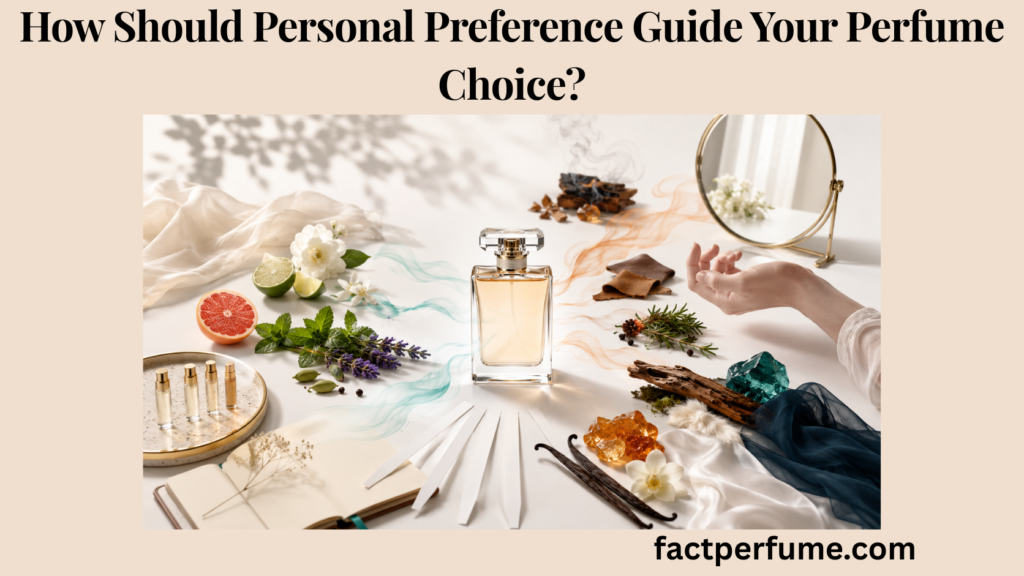
How Should Personal Preference Guide Your Perfume Choice?
Personal preference should guide your perfume choice by helping you identify the scent families, textures, emotional associations, intensity levels, and wearing experiences you genuinely enjoy. Trends, price, packaging, reviews, popularity, and compliments may offer context, but none can replace your own evaluation of how a fragrance smells, develops, and feels during wear.
This article explains how scent memory, emotion, sensory tolerance, fragrance families, environment, descriptive vocabulary, marketing pressure, bias-reduced testing, and full-wear observation can clarify personal scent preference. It also provides practical tables, scripts, checklists, and decision outcomes for confidently choosing whether to buy, sample, retest, or reject a perfume.
Why Does Personal Scent Preference Rely on Memory, Emotion, and Personal Wear Response?
Personal scent preference can be influenced by remembered smells, emotional associations, previous fragrance experiences, sensory tolerance, and how a perfume feels during wear. These influences offer clues rather than permanent rules. A familiar smell may create comfort, curiosity, indifference, or avoidance depending on the person and context.
Preference becomes clearer when the first association is separated from the complete wearing experience. A fragrance may recall a garden yet become too sweet or intrusive later. Another may feel unfamiliar initially but become enjoyable through repeated wear. The useful question is whether its full development repeatedly matches your taste and comfort, not what it supposedly reveals about you.
How Does Scent Memory Shape Personal Scent Preference?
Scent memory shapes personal scent preference by connecting current fragrance impressions with remembered places, people, foods, fabrics, plants, weather, and earlier experiences. Clean laundry may suggest soft musk, while rain may recall wet soil or green leaves.
Odours can cue autobiographical memories and emotional associations, but responses vary. A review of odor-evoked autobiographical memory also emphasizes that individual differences and context matter. The same incense, flower, or wood may comfort one person and repel another. Memory can suggest what to explore, yet it cannot determine whether the complete perfume will remain enjoyable through later wear.
How Does Emotion Shape Personal Scent Preference?
Emotion shapes personal scent preference by influencing whether a perfume feels calming, fresh, nostalgic, elegant, comforting, intimate, energetic, or overwhelming to the wearer. These descriptions are subjective associations, not guaranteed outcomes.
Vanilla may feel comforting to one person and tiring to another. A green scent may feel lively in one setting and sharp in another. Context, expectation, mood, and experience can alter the response. Use emotional language to describe the wearing experience you seek, but never treat perfume as therapy or a promise of a fixed feeling.
How Does Personal Wear Response Shape Personal Scent Preference?
Personal wear response shapes scent preference because skin condition, warmth, sweat, application amount, other scented products, environment, and projection can change the experience. These observable variables are more useful than vague body-chemistry claims.
A perfume may smell appealing on paper but become sweeter, drier, quieter, or sharper on skin. Fragrance-molecule and skin properties may contribute to evaporation differences, but one skin label cannot predict exact performance. An in-vivo fragrance evaporation study found measurable variation associated with fragrance molecules and skin properties. Development also differs from irritation: an unwanted drydown is preference, while burning, rash, swelling, or breathing discomfort is not.
How Does Sensory Tolerance Shape Personal Scent Preference?
Sensory tolerance shapes personal scent preference by determining how much sweetness, smoke, musk, spice, powder, floral density, or projection a wearer finds comfortable. Someone may enjoy a trace of incense but reject dense smoke, while another may like soft vanilla but dislike syrupy sweetness.
Tolerance can vary with setting, weather, applied amount, fatigue, and surrounding scents. It may also expand or narrow through experience. Greater tolerance is not superior taste, and ordinary dislike is not the same as allergy, irritation, migraine, asthma, or another medical concern. Physical symptoms should be treated separately from preference.
The following table directly converts remembered smells into possible fragrance directions while preserving uncertainty. It is a starting point for testing, not a rule that one memory determines the perfume you should choose.
| Memory or smell association | Possible fragrance direction | Possible scent references | Associated feeling | What to test |
|---|---|---|---|---|
| Fresh laundry may feel familiar. | It may suggest clean musk or airy florals. | Test soft musk, aldehydes, or iris. | It may feel orderly or quiet. | Check whether the drydown becomes too powdery. |
| Pencil shavings may suggest dry wood. | They may point toward woody fragrances. | Test cedar, vetiver, or sandalwood. | They may feel grounded or natural. | Check whether the wood becomes sharp or smoky. |
| Rainy gardens may suggest green scents. | They may point toward green or earthy styles. | Test violet leaf, moss, or galbanum. | They may feel fresh or reflective. | Check whether the green effect stays pleasant. |
| Familiar desserts may suggest gourmands. | They may point toward spiced amber or gourmand styles. | Test vanilla, coffee, or cardamom. | They may feel warm or nostalgic. | Check whether the sweetness exceeds your tolerance. |
Takeaway: A remembered smell can reveal a useful direction, but repeated paper and skin evaluation must confirm whether the complete perfume remains enjoyable.
Which Fragrance Families Match Your Personal Scent Preference and Aesthetic?
The fragrance families that match personal scent preference are those whose character, texture, sweetness, freshness, and weight repeatedly align with the wearer’s desired expression. Terms such as minimalist, bold, classic, or fresh can organize a search, but they are not personality diagnoses.
Families also overlap. One perfume may be floral and woody, fresh and musky, or ambered and gourmand. Readers can translate their likes after understanding perfume types. Use family names as broad directions, then assess each composition independently because balance and drydown can make perfumes within one family feel very different.
Which Fragrance Families May Suit a Minimalist Personal Scent Preference?
A minimalist personal scent preference may align with clean musk, citrus, tea, transparent florals, soft woods, skin-scent structures, or restrained woody amber. These styles may feel airy, dry, quiet, or close-wearing.
“Clean” describes a scent effect, not safety or hygiene. Low projection is not automatically better. Test whether the drydown stays clear or becomes too soapy, powdery, musky, or faint. Minimalism should describe your desired experience, not a universal standard of strength or quality.
Which Fragrance Families May Suit a Bold Personal Scent Preference?
A bold personal scent preference may align with amber, spice, leather, oud, smoky woods, dense florals, tuberose, or rich gourmands. These styles may offer contrast, darker materials, or dramatic development.
Bold character does not guarantee projection. A fragrance can smell rich while staying close, and a powerful composition can be applied lightly. Test whether it remains balanced rather than excessively sweet, smoky, leathery, or heavy. Bold taste does not prove confidence, status, or maturity.
Which Fragrance Families May Suit a Classic Personal Scent Preference?
A classic personal scent preference may align with chypre, fougère, lavender, iris, rose, mossy woods, aldehydic florals, or refined woody structures. “Classic” refers to established styles and recognizable construction.
It does not mean old-fashioned. Modern versions may use lighter woods, cleaner musks, softer moss effects, or transparent florals. Test whether you enjoy the structure itself rather than its prestige. You may prefer a traditional version, a modern reinterpretation, or a hybrid of both.
Which Fragrance Families May Suit a Fresh Personal Scent Preference?
A fresh personal scent preference may align with citrus, green, aquatic, aromatic, mint, neroli, clean musk, fresh floral, or light woody directions. Freshness may feel sparkling, watery, leafy, herbal, breezy, or crisp depending on the materials and composition.
A fresh smell is not proof of cleanliness or safety. Fresh perfumes also vary in longevity, projection, sweetness, and drydown. Some begin with vivid citrus and become musky or woody, while others develop aquatic, floral, or herbal facets. Test beyond the opening so you know whether the later stages preserve the kind of freshness you enjoy.
The following matrix directly links desired personal style with possible fragrance directions, useful textures, and realistic test contexts. It supports exploration without claiming that an aesthetic requires one correct family.
| Desired personal style | Possible fragrance families | Useful scent textures | Appropriate test context | Potential mismatch |
|---|---|---|---|---|
| A minimalist style may suit musk, citrus, tea, or soft woods. | These families can feel restrained. | Test airy, dry, or smooth textures. | Test them during ordinary close-contact wear. | Dense sweetness may feel mismatched. |
| A bold style may suit amber, leather, spice, or rich florals. | These families can create contrast. | Test smoky, resinous, or creamy textures. | Test them during realistic social wear. | A tiring drydown may become a mismatch. |
| A classic style may suit chypre, fougère, iris, or rose. | These families can feel structured. | Test polished, mossy, or powdery textures. | Test them during work or formal wear. | Excessive powder may feel unsuitable. |
| A fresh style may suit citrus, green, aquatic, or aromatic families. | These families can feel crisp. | Test watery, leafy, or breezy textures. | Test them in active or warm conditions. | Metallic freshness may become a mismatch. |
Takeaway: Personal style can narrow the search, but the fragrance must still earn its place through comfortable, repeated, and context-aware wear.
How Should Personal Scent Preference Adapt to Different Environments?
Personal scent preference should adapt to different environments by preserving the wearer’s core direction while adjusting density, sweetness, projection, and application. Adaptation means choosing an interpretation that fits temperature, ventilation, proximity, activity, and shared-space expectations, not abandoning the notes you enjoy.
A wood lover might choose sheer cedar for an office and richer resinous wood for an open evening setting. A vanilla lover might prefer an airier musky version in heat. A core preference can be adapted after considering season and climate, without adopting rigid rules about what must be worn.
How Can Personal Scent Preference Adapt to Office Settings?
Personal scent preference can adapt to office settings by choosing a quieter interpretation of the same direction and controlling applied intensity. An oud lover may prefer sheer woods, soft leather, or restrained woody amber in a shared room.
Consider proximity, ventilation, meeting spaces, public transport, and fragrance-free policies. No perfume is universally office-safe. The goal is not weak performance, but a presence that supports personal enjoyment without dominating the environment or distracting others during prolonged contact.
How Can Personal Scent Preference Adapt to Hot Weather?
Personal scent preference can adapt to hot weather by using fresher, greener, more transparent, or less densely sweet interpretations of preferred notes. Warmth may increase perceived diffusion, making rich sweetness, spice, musk, or resin feel more noticeable.
Humidity, outdoor activity, sweat, ventilation, and indoor cooling can also change the experience. A rich perfume is not automatically unsuitable for heat, but it may require a lighter structure, restrained application, or realistic testing. Judge whether it remains comfortable in the conditions where you will wear it rather than following a fixed seasonal ban.
How Can Personal Scent Preference Adapt to Cold Weather?
Personal scent preference can adapt to cold weather by exploring warmer, woodier, ambered, spicier, creamier, or more resinous versions of a preferred direction. A citrus wearer might enjoy citrus over woods or amber, while a floral wearer might explore creamy petals, musk, spice, or sandalwood.
Cold conditions do not guarantee that dense perfume will perform better or feel more appealing. Indoor heating, clothing, proximity, and personal tolerance still matter. Preference remains the primary filter. The adaptation succeeds only when the richer version stays enjoyable, balanced, and practical within the wearer’s actual routine.
How Can Personal Scent Preference Adapt to Formal or Evening Events?
Personal scent preference can adapt to formal or evening events by selecting a smoother, deeper, more polished, or more sustained interpretation of the wearer’s usual scent style. A fresh preference might become a refined neroli-wood composition, while a floral preference might shift toward smoother rose, iris, or jasmine.
Formality does not require strong projection. Close-contact dinners, ceremonies, theatres, and crowded rooms may reward restraint. A subtle perfume can feel formal through texture, balance, and finish rather than volume. Test whether the fragrance supports the setting without overwhelming your comfort or the people nearby.
The following matrix directly shows how to preserve a core preference while changing scent weight, presence, or texture for the environment. It avoids fixed application counts because formulas and settings vary.
| Environment | Core preference | Possible adaptation | Application consideration | Mistake to avoid |
|---|---|---|---|---|
| A shared office requires restraint. | A woody preference can remain central. | Choose sheer cedar or soft woody musk. | Consider proximity and ventilation. | Do not assume every light scent is office-safe. |
| Hot outdoor conditions may increase diffusion. | A gourmand preference can remain central. | Choose an airier vanilla or citrus gourmand. | Test it in realistic warmth. | Do not ignore dense sweetness. |
| Cold weather may support richer textures. | A fresh preference can remain central. | Try citrus over amber or aromatic woods. | Observe development under clothing. | Do not abandon freshness because of rigid rules. |
| A formal dinner may involve close seating. | An amber preference can remain central. | Choose smooth resin or polished woody amber. | Respect the shared space. | Do not equate formality with maximum projection. |
Takeaway: The most useful adaptation keeps the scent identity you enjoy while adjusting weight, texture, and presence for realistic environmental conditions.
How Can You Communicate Your Personal Scent Preference When Asking for Recommendations?
You can communicate personal scent preference clearly by describing fragrance family, texture, sweetness, freshness, weight, projection, drydown, and dealbreakers instead of relying on vague praise. Words such as “nice,” “clean,” “strong,” and “expensive-smelling” mean different things to different people.
A useful request combines attraction with limitation. “I enjoy airy citrus and green tea, but dislike sharp aquatic notes and heavy musk” gives more direction than “I want something fresh.” Precise language also improves comparison because it identifies which feature created the positive or negative response. You can then request a scent direction rather than expecting someone else to infer your taste.
How Should You Describe Personal Scent Preference by Fragrance Family?
Personal scent preference can be described by naming the families a reader repeatedly enjoys, such as fresh, floral, woody, amber, gourmand, chypre, fougère, leather, aromatic, or musk-centred directions. One or two main directions are usually clearest.
Hybrid preferences are normal. A useful request is: “I enjoy dry woody and aromatic fragrances, especially cedar and herbs, but not smoky or heavily sweet drydowns.” This states both the search direction and the boundary without treating family labels as a universal taxonomy.
How Should You Describe Personal Scent Preference by Texture?
Personal scent preference becomes clearer when the reader describes texture with words such as dry, creamy, airy, watery, powdery, smoky, resinous, dense, sharp, clean, soft, or smooth. Texture is perceptual, so pair it with a family or note.
“I want creamy sandalwood” is clearer than “I want warmth.” A useful script is: “I want a soft, dry woody fragrance with smooth musk, not a creamy or powdery base.” This explains the exact treatment you prefer.
How Should You Describe Personal Scent Preference by Projection?
Personal scent preference can be described by stating whether the wearer wants a close skin scent, moderate projection, noticeable sillage, or longer perceptibility. Projection, sillage, and longevity are different.
Projection is radiation near the wearer, sillage is the scent trail, and longevity is duration. A useful script is: “I want moderate projection without a large trail, and a drydown that remains noticeable to me.” Application and environment affect all three, so avoid fixed distances or hours.
How Should You Describe Notes and Scent Qualities You Dislike?
Disliked notes and scent qualities should be described as specific dealbreakers, such as heavy rose, sharp patchouli, dense smoke, powder, animalic musk, syrupy sweetness, or metallic freshness. Specific wording prevents a recommender from excluding an entire note you might enjoy in another form.
“I dislike rose” may really mean “I dislike dense, sweet, jammy rose.” You may still enjoy green, watery, dry, or citrus-led rose. A practical request is: “I enjoy soft florals, but I avoid powdery iris, syrupy rose, and dense white florals.” This separates a broad category from the treatment that causes rejection.
The following table directly converts vague recommendation language into precise sensory wording and reusable scripts. Each example states the desired direction, performance preference, or dealbreaker without recommending a specific product.
| Intended meaning | Weak phrase | More precise wording | Example request | Recommendation benefit |
|---|---|---|---|---|
| The wearer wants freshness without aquatics. | “I want something fresh” is vague. | Specify crisp citrus, herbs, or tea. | “Suggest a dry citrus-aromatic direction without marine notes.” | This excludes an unwanted freshness style. |
| The wearer wants subtle cleanliness. | “I want a clean perfume” is vague. | Specify airy musk and soft woods. | “I want soft musk that stays close and avoids powder.” | This clarifies texture and presence. |
| The wearer wants warmth without sweetness. | “I want something warm” is vague. | Specify resin, spice, or dry wood. | “I enjoy warm resins but avoid syrupy vanilla.” | This separates warmth from gourmand sweetness. |
| The wearer wants controlled presence. | “I want a strong perfume” is vague. | Specify moderate projection and manageable sillage. | “I want noticeable fragrance without dominating a shared room.” | This separates presence from excessive reach. |
Takeaway: The clearest recommendation request names the preferred family, texture, performance profile, and dealbreakers in one concise, practical description for comparison.
Which Marketing Traps Distract From Personal Scent Preference?
Marketing traps distract from personal scent preference when compliments, virality, gender labels, prestige, packaging, reviews, or blind-buy urgency become more influential than repeated testing. External information is not automatically harmful. Reviews may explain development, and social feedback may reveal noticeability.
The problem begins when those signals replace the wearer’s response. A perfume can be popular, costly, or highly praised and still feel tiring or impractical to you. A preference-led buyer uses external signals as context, then checks whether the fragrance remains enjoyable through its opening, development, drydown, and realistic wear.
How Does Compliment Chasing Distort Personal Scent Preference?
Compliment chasing distorts personal scent preference when the buyer selects perfume mainly for other people’s reactions rather than personal enjoyment and comfort. Compliments may provide useful social information about noticeability or appeal in a specific setting.
They do not prove that a perfume is suitable. Responses vary with distance, environment, familiarity, culture, and individual taste. It is reasonable to value compliments, but the fragrance should remain enjoyable when nobody comments on it. Personal comfort and full-wear satisfaction provide a more reliable basis for repeated use than unpredictable approval alone.
How Does Influencer Hype Distort Personal Scent Preference?
Influencer hype distorts personal scent preference when repeated praise creates purchase urgency before the reader evaluates the perfume’s scent, drydown, comfort, and suitability. Educational reviews may teach vocabulary, comparisons, or testing ideas, but enthusiasm can also shape expectations.
The corrective action is not to reject every recommendation. Sample before committing when practical, and record your impressions before consuming many detailed opinions. A fragrance that works well for a reviewer may develop differently in your conditions or simply fall outside your preferred texture, sweetness, projection, or later-stage character.
How Does Gender Marketing Limit Personal Scent Preference?
Gender marketing limits personal scent preference when readers avoid fragrances solely because packaging or categories are labelled masculine, feminine, or unisex. These labels may reflect commercial positioning, design traditions, or cultural expectations. Experimental research on scent-gender labels found that semantic labels can alter perceived gender associations.
They do not restrict who can enjoy a smell. Readers can explore beyond categories after understanding gender marketing. Gender expression may still matter personally, but the label should support chosen expression rather than overrule direct enjoyment.
How Does Blind-Buy Pressure Override Personal Scent Preference?
Blind-buy pressure overrides personal scent preference when urgency, scarcity, reviews, discounts, or prestige replace direct evaluation. Buying without smelling carries greater uncertainty because note lists and verbal descriptions cannot reproduce the complete fragrance experience.
Samples and decants are lower-risk formats when available. They let the wearer observe opening, development, drydown, projection, and comfort before committing to a larger amount. A discount does not create value when the bottle remains unused, and prestige cannot correct a repeated scent dealbreaker. When uncertainty remains, sampling or retesting is the more preference-led decision.
The following checklist directly identifies whether external pressure is replacing personal evaluation. A pattern of uncertain answers indicates that sampling, comparison, or another full wear may be more useful than an immediate purchase.
Takeaway: Marketing becomes useful context only when it supports repeated personal testing instead of replacing the wearer’s own response and final judgement.
How Should You Test Fragrances to Validate Personal Scent Preference?
Fragrances should be tested through a structured, bias-reduced process that compares broad directions, limits external cues, evaluates personal wear, tracks the drydown, and records repeated patterns. This process cannot create perfect objectivity because memory, context, and experience still influence perception.
Screen fragrances on paper to remove unsuitable openings, then evaluate promising finalists on suitable, non-irritated skin according to product directions. Observe development, comfort, projection, and texture under realistic conditions. Record the response before revealing detailed brand, price, popularity, or review information. The goal is to reduce selected cues, not prove one universal result.
How Should Blind Sampling Reveal Personal Scent Preference?
Blind sampling can reveal personal scent preference more clearly by reducing visible brand, price, bottle, gender-category, and popularity cues during the first evaluation. Research on odour labels indicates that semantic information and cultural context may influence evaluation, so concealing selected information can reduce some expectation effects. A study of semantic context and odor perception found that identical odorants could be perceived differently under different word labels.
Blind sampling does not eliminate all bias. Recognition, memories, sample presentation, testing order, and the environment may still shape judgement. Record the initial family impression, texture, comfort, and preference before revealing the product. Treat the result as a less externally framed comparison, not objective truth.
How Should Skin Evaluation Confirm Personal Scent Preference?
Skin evaluation confirms personal scent preference by showing whether the fragrance remains enjoyable and comfortable during actual wear. Paper helps compare openings, but it cannot reproduce the effects of applied amount, warmth, moisture, other products, clothing, and environment.
Use suitable, non-irritated skin and follow product directions. This is observational wear testing, not a medical patch test. Some fragrance components may cause reactions or sensitivities, so physical discomfort must not be dismissed as ordinary dislike.
How Should Drydown Tracking Confirm Personal Scent Preference?
Drydown tracking confirms personal scent preference by revealing whether the fragrance remains balanced after the opening changes into its middle and later stages. A bright citrus opening may become woody or musky, while a light sweetness may develop into dense vanilla or amber.
Observe the opening, development, and later wear without imposing rigid checkpoints. Record changes in sweetness, powder, smoke, freshness, texture, projection, and comfort. A perfume should not be judged solely by its most volatile opening if most of the wearing experience occurs after those materials recede.
How Should Scent Journaling Confirm Personal Scent Preference?
Scent journaling confirms personal scent preference by recording repeated reactions to fragrance family, texture, emotion, projection, drydown, dealbreakers, and real-life wearability. A useful entry can remain concise while capturing the information needed for comparison.
Record the testing context, weather, application amount, paper or skin use, opening, development, comfort, and final decision. Note whether your response changes on another wear. One day’s mood may affect judgement, while repeated entries can reveal more stable patterns. The journal should clarify preference, not produce a numerical personality score or claim clinical certainty.
The following checklist directly supports bias-reduced fragrance comparison by limiting selected external cues and separating paper screening from personal wear. It should be used as a practical routine, not an objective scientific test.
Takeaway: Bias-reduced testing makes repeated likes and dislikes easier to observe while acknowledging that complete objectivity is not possible in personal fragrance evaluation.
What Final Checklist Should Confirm Personal Scent Preference Before Buying?
A final personal scent preference checklist should confirm that the perfume remains enjoyable through full wear, fits the reader’s lifestyle, avoids major dealbreakers, and would still be chosen without hype. Preference is central, but it is not the entire purchase decision.
Price, authenticity, ingredients, packaging, storage, concentration, form, and intended use may also matter. Personal preference should be combined with the other buying factors. This section confirms genuine scent fit and directs the reader toward buying, sampling, retesting, or rejecting without duplicating the complete purchase framework.
Does the Perfume Match Your Personal Scent Preference?
A perfume matches personal scent preference when its family, texture, sweetness, freshness, intensity, and drydown align with patterns the reader repeatedly enjoys. Every feature does not need to be perfect.
Focus on what determines realistic use. One unusual note may still fit your overall taste. If the opening is appealing but the drydown becomes tiring, or the reverse, retest to learn whether the conflict is acceptable or remains a repeated obstacle.
Does the Perfume Fit Your Real Lifestyle?
A perfume fits the reader’s lifestyle when its intensity, form, cost, context, climate suitability, and reapplication needs remain practical. Consider office conditions, social life, climate, budget, travel, storage, and daily routines.
Lifestyle fit has no universal budget or performance rule. A loved fragrance may still be impractical in a large format or common setting. Sampling, choosing another form, or delaying purchase can preserve preference while reducing waste. Base the decision on real circumstances, not an idealized collection.
Does the Perfume Avoid Your Personal Dealbreakers?
A perfume avoids personal dealbreakers when its notes, texture, sweetness, smoke, powder, performance, and projection remain within the reader’s comfort range. Brief hesitation is not always a dealbreaker, but repeated dislike matters.
Check later development because an acceptable opening may become the exact quality you reject. Separate sensory dislike from physical symptoms. An unwanted powdery drydown may justify rejection, while burning, rash, swelling, breathing discomfort, or worsening irritation should never be treated as ordinary preference.
Would You Still Choose the Perfume Without Hype?
A perfume passes the hype test when the reader would still choose it without influencer praise, prestige, gender positioning, bottle design, trend status, or expected compliments. Branding and presentation may contribute to enjoyment, but the scent should still justify the purchase.
Imagine evaluating it from an unmarked sample. Ask whether you would want to wear the smell regularly and whether you can explain what you enjoy about it. When the answer depends mainly on reputation, urgency, or imagined approval, sample or retest before buying. Uncertainty is a reason to gather more evidence, not proof of failure.
The following checklist directly confirms whether a perfume fits your personal scent preference across scent, comfort, context, and independence from hype. Unclear answers should lead to sampling or retesting rather than forced certainty.
The final decision directly follows the clarity, consistency, and comfort shown by the checklist. Use the outcome that best matches your evidence instead of treating uncertainty as permission to rush.
| Checklist result | Recommended decision |
|---|---|
| Preference remains clear across repeated wear and no major dealbreaker appears | Consider buying |
| The perfume is enjoyable but full wear or context remains uncertain | Sample first |
| The opening is attractive but the drydown or comfort is unclear | Retest |
| A repeated dealbreaker, strong dislike, or concerning discomfort appears | Reject |
Takeaway: A purchase is easier to justify when enjoyment remains clear after brand cues, opening excitement, social pressure, and uncertainty have been separated from the scent.
Frequently Asked Questions
Personal scent preference can change as exposure, lifestyle, climate, memory, tolerance, and fragrance experience change. A person may gradually appreciate an unfamiliar note or stop enjoying a style that no longer suits daily life. Change does not make earlier preferences false. It shows that fragrance taste can remain flexible, contextual, and learnable.
A favourite perfume does not reliably reveal personality because fragrance choice reflects taste, context, memory, marketing, experience, and intended self-expression. One wearer may choose different perfumes for different roles without changing personality. Fragrance can support a desired aesthetic, but it cannot reliably diagnose character, confidence, intelligence, maturity, or identity.
Compliments can provide useful social feedback, but they should not replace personal enjoyment, comfort, and full-wear testing. Other people’s responses vary with preference, distance, environment, and familiarity. Compliments may remain one consideration, but the wearer should still enjoy the perfume when no external approval is offered.
Blind perfume testing is not completely objective because personal memories, expectations, context, and previous experience can still influence evaluation. It reduces selected cues such as brand, price, bottle design, gender positioning, and popularity. Its purpose is to create a less externally framed first comparison, not a universally correct judgement.
Perfume should first be screened on paper and then evaluated on suitable skin when personal development and full-wear comfort need to be understood. Paper helps compare openings and remove unsuitable options. Skin evaluation helps reveal later development, perceived projection, comfort, and interaction with the wearer’s actual environment. It is not medical patch testing.
A perfume should be tested until the reader understands its opening, later development, comfort, context fit, and recurring preference response. One universal number cannot cover every perfume or buyer. Greater caution is sensible when the purchase is expensive, large, difficult to return, or intended for several different environments.
Conclusion
Personal preference should guide perfume choice by giving the wearer a repeatable way to identify meaningful scent directions, communicate taste, resist external pressure, and confirm enjoyment through full wear. Memory and emotion can suggest what to explore, while fragrance family, texture, context, vocabulary, dealbreakers, and drydown tracking show what remains genuinely wearable.
Preference is personal, flexible, and strengthened by repeated observation rather than popularity, gender labels, price, prestige, or one attractive opening. The right perfume is not the one that receives the most hype or approval; it is the one the wearer continues to enjoy, understand, and choose after careful personal testing.