
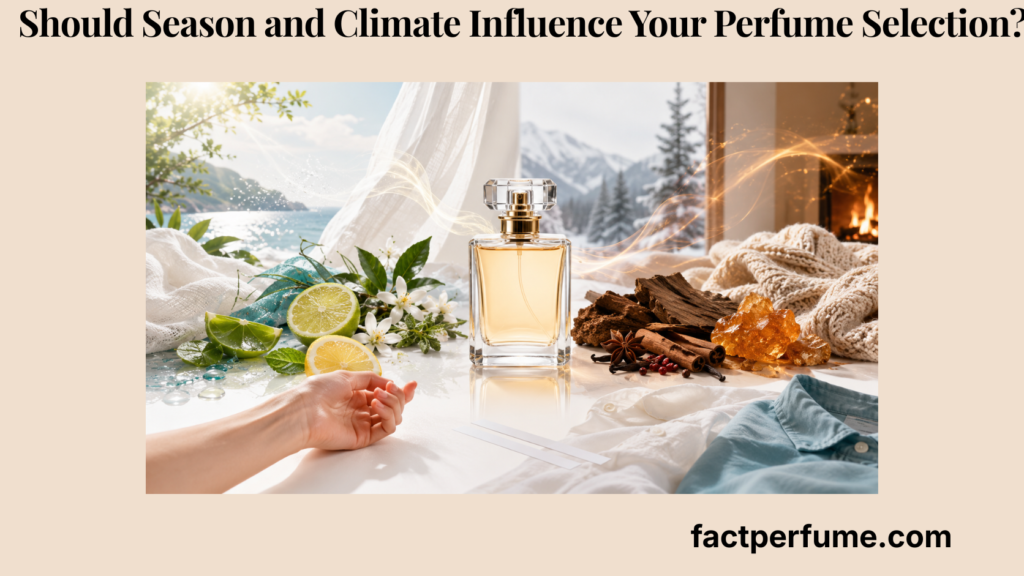
Should Season and Climate Influence Your Perfume Selection?
Season and climate should influence perfume selection because temperature, humidity, airflow, sunlight, skin condition, and clothing can change how a fragrance develops, feels, and projects. Calendar seasons offer a useful starting point, but the day’s actual weather, indoor conditions, planned setting, and the perfume’s tested behaviour matter more than rigid summer and winter rules.
This article explains heat, cold, humidity, dry air, tropical conditions, fragrance-family direction, weather-related mistakes, application control, skin comfort, sunlight, clothing, and a final forecast-aware checklist. It helps readers decide whether to wear a perfume as planned, reduce its application, retest it, relocate application to a suitable area, choose another fragrance, or avoid application for the day.
Why Does Seasonal Perfume Selection Change With Temperature and Humidity?
Seasonal perfume selection changes with temperature and humidity because fragrance release, evaporation, perspiration, airflow, skin interaction, clothing, and personal perception work together during wear. Temperature describes environmental heat or cold, while humidity describes moisture in the surrounding air and is not the same as skin hydration. Fragrance materials differ in volatility, meaning their tendency to evaporate, so they do not leave a surface at identical rates. Projection describes radiation near the wearer, sillage describes the trail left during movement, and longevity describes duration. No single weather variable predicts all three outcomes.
How Does Heat Affect Seasonal Perfume Selection?
Heat can affect seasonal perfume selection by changing fragrance release and perceived diffusion, which may make an opening feel brighter or dense facets more noticeable. Fragrance molecules have different physical properties, and controlled evaporation research treats temperature as an important measurement variable. That evidence does not establish one summer rule for complete perfumes. A vivid opening does not prove longer total wear, and quicker loss of volatile facets does not prove the whole scent disappears early. Dose, perspiration, airflow, formula, and movement still require realistic testing. (temperature-control study)
How Does Cold Weather Affect Seasonal Perfume Selection?
Cold weather can affect seasonal perfume selection when cold air, wind, and clothing layers reduce the perceived lift of some formulas. A sheer citrus or aquatic fragrance may feel quieter outdoors yet become clearer in a heated room. Rich amber, wood, leather, or gourmand perfume is not automatically stronger or longer-lasting in winter. Heating, close seating, layers, and formula density can make an outdoor application feel much fuller inside, so the complete temperature path still matters.
How Does Humidity Affect Seasonal Perfume Selection?
Humidity affects seasonal perfume selection as one important contextual variable interacting with temperature, perspiration, airflow, clothing, indoor climate, and personal perception. No universal fine-fragrance rule shows that humid air always makes perfume sweeter, stronger, more projecting, or longer-lasting. Atmospheric humidity also differs from skin hydration. Dense sweetness may feel less comfortable when heat and still air coincide, while another formula may remain balanced. Air-conditioned interiors can change the experience again, so test both environments before adding more.
How Does Dry Winter Air Affect Seasonal Perfume Selection?
Dry winter air can affect seasonal perfume selection when cold conditions and indoor heating leave skin uncomfortable, rough, cracked, chapped, or unsuitable for normal application. Fragrance-molecule properties and skin-related variables may influence evaporation profiles, but they do not allow exact predictions from a broad skin label. (skin-evaporation study) Unscented moisturizer may create a more comfortable application surface for some readers, without guaranteeing longer wear. Personal wear should also consider skin type without treating it as a fixed predictor.
The following table compares possible fragrance behaviour across warmer and colder conditions. Every outcome remains dependent on formula, dose, surface, clothing, airflow, skin condition, and perception.
| Weather condition | Possible fragrance behaviour | Facets that may feel more noticeable | Facets that may recede | Practical adjustment | Main uncertainty |
|---|---|---|---|---|---|
| Warm, still air | Release may feel faster or denser. | Bright openings, sweetness, musk, or spice | Volatile opening facets | Start conservatively; reassess indoors. | The drydown may differ. |
| Warm, windy air | Presence may shift with movement. | Near-wearer facets | A light outdoor trail | Do not increase automatically. | Nearby people may still notice it. |
| Cold, calm air | Some formulas may feel quieter. | Woods, resins, or spice indoors | Sheer citrus outdoors | Test before adding more. | Heated rooms may increase presence. |
| Cold with heavy layers | Clothing may redirect release. | Base facets indoors | The outdoor opening | Check fabric and layers. | Fabric may alter reach. |
Takeaway: Weather changes fragrance release and perception, but no temperature or humidity rule can predict every perfume’s complete performance under all conditions.
Which Perfume Types Support Seasonal Perfume Selection in Hot Weather?
Hot-weather seasonal perfume selection often works well with fresh, aromatic, green, light woody, musky, or soft floral directions when the actual formula remains comfortable and controlled. These styles may offer brightness, dryness, transparency, or structure without excessive density, but a family label does not guarantee low projection or short wear. Climate choices become clearer after readers understand perfume types. Evaluate the complete formula, especially its drydown, sweetness, atomizer output, personal comfort, social reach, and tested behaviour during transitions from outdoor heat to enclosed, cooled spaces.
Which Fresh Perfume Types Support Seasonal Perfume Selection in Summer?
Fresh perfume types may support summer selection through citrus, aquatic, green, neroli, tea, or clean musk directions that create a bright or transparent impression. Fresh does not mean weak, universally subtle, or suitable for every wearer. Some citrus, aquatic, and musky formulas project clearly, while their later stages may become woody, sweet, metallic, or powdery. Test the opening and drydown in realistic warmth, then check whether the perfume remains comfortable after entering vehicles, offices, restaurants, or other enclosed spaces.
Which Aromatic Perfume Types Support Seasonal Perfume Selection in Summer?
Aromatic perfume types may support summer selection through mint, basil, rosemary, lavender, sage, and related herbal directions that feel dry, green, or structured. Cooling should be understood as a sensory description, not a physiological effect on body temperature. Aromatic formulas can also become sharp, medicinal, camphoraceous, or strongly projecting for some wearers. Test whether the herbal structure remains balanced after the opening and whether its social reach suits the day’s heat, activity, ventilation, and proximity to other people.
Which Woody Perfume Types Support Seasonal Perfume Selection in Summer?
Light woody perfume types may support summer selection when vetiver, cedar, dry woods, or restrained sandalwood provide structure without excessive smoke, resin, creaminess, or sweetness. Light woody and dense woody perfumes can behave very differently. A dry vetiver may feel crisp, while a smoky cedar or creamy sandalwood composition may feel much fuller. No wood is universally suitable for heat, so formula density, application level, airflow, and later development should be tested before the fragrance is selected.
Which Perfume Types Require Extra Restraint in High Heat?
Dense oud, thick amber, syrupy gourmand, heavy vanilla, smoky resin, and animalic floral directions require extra restraint in high heat because their weight may feel uncomfortable or intrusive. These families are not universally forbidden. A controlled evening application in moving air may work, while the same formula may feel excessive during a close daytime commute. Formula, preference, occasion, ventilation, and dose determine suitability. A lighter interpretation or conservative start can preserve the direction without a rigid seasonal ban.
The following matrix matches hot-weather conditions with useful perfume directions and controlled starting approaches. Each recommendation remains conditional on tested formula behaviour and the setting.
| Hot-weather condition | Possible perfume directions | Useful scent references | Desired formula character | Potential mismatch | Starting application approach |
|---|---|---|---|---|---|
| Dry daytime heat | Green, aromatic, tea, woods, or musk | Vetiver, herbs, tea, cedar | Dry and structured | A brief opening | Minimal or restrained |
| Humid daytime heat | Citrus, neroli, green, aquatic, aromatic, or musk | Citrus, leaves, tea, watery florals | Transparent and controlled | Dense sweetness | Restrained; reassess indoors |
| Warm evening | Soft amber, floral, woods, musk, or controlled gourmand | Resins, petals, sandalwood, vanilla | Smooth and balanced | Excess density | Formula-dependent |
| Hot active day | Citrus, aromatic, green, or light musk | Herbs, tea, dry woods | Comfortable in movement | Masking perspiration | Minimal or avoid |
Takeaway: Hot-weather selection works best when freshness, structure, density, and application are judged from the formula rather than the family label.
Which Perfume Types Support Seasonal Perfume Selection in Cold Weather?
Cold-weather seasonal perfume selection often supports amber, woody, gourmand, spicy, leather, chypre, or richer aromatic directions when the actual formula suits the wearer and setting. Cooler air and clothing may make some perfumes feel quieter outdoors, but richer perfume does not automatically last longer or project farther. Indoor heating can turn a comfortable outdoor application into a dense presence around colleagues, passengers, or dinner guests. Select fragrance for the full day, including wind, layered clothing, transport, heated rooms, social proximity, and the possibility that its presence increases after warming indoors.
Which Amber Perfume Types Support Seasonal Perfume Selection in Winter?
Amber perfume types may support winter selection through resinous, balsamic, vanilla-like, incense, benzoin, labdanum, or warm spicy directions. Warmth is a sensory impression, not a change in body temperature. Amber formulas range from transparent and close-wearing to dense and expansive. Heated rooms, transport, offices, and close dining may make resin or sweetness feel fuller, so test the drydown and social reach instead of assuming every amber perfume is powerful or ideal for cold weather.
Which Woody Perfume Types Support Seasonal Perfume Selection in Winter?
Woody perfume types may support winter selection through sandalwood, cedarwood, patchouli, oud, vetiver, or dry woods that provide structure and depth. Woody styles can be creamy, smoky, dry, earthy, resinous, or musky. Persistence cannot be promised from the wood label alone. Clothing may trap or delay release, while indoor proximity can make smoke or resin feel denser. Test both the outdoor and heated-room phases before setting the application level.
Which Gourmand Perfume Types Support Seasonal Perfume Selection in Winter?
Gourmand perfume types may support winter selection through vanilla, tonka, caramel, coffee, almond, chocolate, or honey directions when sweetness and application remain controlled. Descriptions such as cozy or comforting express subjective associations, not guaranteed emotional effects. Heated interiors can make syrupy sweetness feel cloying even when the outdoor air is cold. Choose a formula whose later stages remain balanced, and consider whether woods, spice, musk, bitterness, or dryness provide enough contrast for the venue and duration.
Which Light Perfume Types May Feel Too Quiet in Cold Weather?
Very sheer aquatic, citrus, or airy green perfumes may feel too quiet in cold, windy, or heavily layered conditions when noticeable presence is expected. This does not mean the family fails in winter or every light perfume lacks persistence. Some last while projecting gently. Test before rejecting the style, and consider structured fresh alternatives such as citrus over woods, aromatic herbs, musk-supported tea, or green notes with a clearer base instead of automatically applying more.
The following matrix connects cooler conditions with richer or more structured directions without promising projection, persistence, or seasonal superiority. Indoor heat remains part of every decision.
| Cold-weather condition | Possible perfume directions | Useful scent references | Desired formula character | Suitable setting | Potential mismatch |
|---|---|---|---|---|---|
| Cold outdoor day | Woods, aromatics, amber, spice, or structured fresh | Cedar, herbs, resin, citrus-wood | Defined, not dense | Outdoor movement | Overapplication before indoor heat |
| Heated indoor day | Musk, iris, soft woods, restrained amber, or floral | Woods, iris, quiet resins | Controlled and close | Office or dining | Dense sweetness or smoke |
| Formal winter evening | Amber, chypre, rose, woods, spice, or leather | Resin, moss, florals, leather | Refined and tested | Formal event | Equating formality with projection |
| Windy layered conditions | Structured citrus, aromatic woods, musk, or amber | Citrus-wood, herbs, vetiver | Controlled presence | Mixed settings | Rejecting after one test |
Takeaway: Cold-weather perfume should suit outdoor quietness and indoor warmth together, not an assumption that richer always means better or longer-lasting.
How Should Seasonal Perfume Selection Change in Dry Heat, Humid Heat, Winter Dryness, and Tropical Climates?
Seasonal perfume selection should change according to the combination of temperature, humidity, airflow, skin comfort, sunlight, and indoor climate rather than temperature alone. Dry heat may combine intense sun and wind with lower atmospheric moisture. Humid heat often combines perspiration with limited airflow and changing indoor cooling. Winter dryness can involve both cold outdoor air and heated interiors, while tropical climates may require repeated movement between sustained heat, rainfall, and air conditioning. Each climate creates a different daily selection problem, so scent direction and application should remain flexible and condition-led.
How Should Seasonal Perfume Selection Change in Dry Heat?
Dry heat may favour fresh fragrances with additional structure, such as green aromatic, tea, vetiver, light wood, or musk-supported directions. Extremely sheer openings may recede earlier in some formulas when sun, wind, and open air combine, but dry heat does not always weaken citrus or every volatile facet. Choose a perfume whose drydown remains satisfying after the bright opening changes. Direct sunlight also requires label- and ingredient-specific caution, so exposed skin should not be treated as automatically suitable.
How Should Seasonal Perfume Selection Change in Humid Heat?
Humid heat often favours less dense, less syrupy, and more controlled fragrance when high temperature, perspiration, and limited airflow make heavy formulas uncomfortable. Citrus, green, tea, neroli, aquatic, aromatic, and clean musk are possible directions, not guaranteed solutions. Humidity does not chemically make every sweet perfume cloying or every fragrance stronger. Outcomes vary with formula, temperature, airflow, clothing, perspiration, current skin condition, and personal perception. Test the perfume through transitions into air-conditioned buildings before deciding whether more is needed.
How Should Seasonal Perfume Selection Change in Winter Dryness?
Winter-dryness selection should prioritize comfortable skin, tested formula support, and restrained application rather than automatically increasing perfume. An unscented moisturizer may help create a more comfortable surface for some wearers, but it cannot guarantee stronger projection or longer wear. Avoid cracked, chapped, irritated, sunburned, or otherwise damaged areas. If skin application is uncomfortable, consider another label-compliant, previously tested area or compatible fabric only after discreet material testing and review of product guidance.
How Should Seasonal Perfume Selection Change in Tropical Climates?
Tropical-climate selection should account for sustained heat, humidity, perspiration, strong sunlight, rainfall, and movement between outdoor conditions and air-conditioned interiors. Control density and sweetness, but do not limit the wardrobe to fresh-only perfume. Light woods, controlled amber, soft florals, musk, aromatics, and restrained gourmand directions may work when tested. Rain, wet clothing, transport, wind, and cold indoor air can alter perception during one day, so balanced formulas and conservative application are more useful than universal family bans.
The following table directly distinguishes dry heat, humid heat, tropical conditions, and winter dryness. Humidity rows state uncertainty because outcomes vary across formulas and wearers.
| Climate condition | Primary challenge | Possible fragrance direction | Application or skin-comfort adjustment | Mistake to avoid | Evidence limitation |
|---|---|---|---|---|---|
| Dry heat | Sun and wind may alter balance. | Green aromatic, tea, vetiver, woods, or musk | Start conservatively; check sun guidance. | Assuming citrus always weakens | Formula, airflow, skin, and dose vary. |
| Humid heat | Heat, perspiration, and still air may reduce comfort. | Citrus, green, neroli, aquatic, aromatic, or musk | Start restrained; reassess indoors. | Claiming universal strength | Temperature, perspiration, airflow, clothing, formula, and perception vary. |
| Tropical climate | Heat and rain alternate with cooling. | Fresh, aromatic, woody, floral, musk, or controlled amber | Plan for rain, sun, and transitions. | Treating it as fresh-only | No family fits every setting. |
| Winter dryness | Cold and heating may reduce comfort. | Woods, amber, musk, iris, gourmand, spice, or fresh | Use intact skin; moisturize if suitable. | Adding perfume automatically | Comfort and performance vary. |
Takeaway: Climate type becomes useful only when temperature, atmospheric moisture, skin comfort, airflow, sunlight, clothing, and indoor transitions are evaluated together.
How Should Seasonal Perfume Selection Change Your Application Level and Placement?
Seasonal perfume selection should change application by adjusting the starting level, placement, timing, clothing use, and need for reapplication according to weather and formula strength. Atomizers release different amounts, so one universal count cannot govern every bottle. Climate-aware restraint becomes easier when the application method. Follow product labelling, test fabric compatibility, and remember that some formulas may stain, discolor, or affect materials. Sun-exposure caution is ingredient-, formula-, and label-dependent. Application should be reduced, delayed, or relocated only after the original area, formula, and setting have been assessed, and any new area must be label-compliant and previously tested.
How Should Seasonal Perfume Selection Adjust Application in Hot Weather?
Hot-weather application should begin conservatively because heat, perspiration, and close indoor spaces may increase fragrance’s perceived impact. This does not create one universal reduction or body-zone rule. Avoid heavy application near the face before expected perspiration, and consider transitions into cars, offices, restaurants, and transport. Apply before entering shared spaces when permitted, then let the formula develop. Reassess its social reach rather than reacting only to a bright opening or personal scent adaptation.
How Should Seasonal Perfume Selection Adjust Application in Humid Weather?
Humid-weather application should use a restrained starting level and a formula whose sweetness, density, and projection remain comfortable after perspiration and environmental changes. The result depends on temperature, airflow, clothing, skin condition, atomizer output, formula, and perception. Avoid spraying into surrounding air or following universal body-zone rules. Test the perfume outdoors and after entering cooling, then wait before adding more. Reduced personal awareness does not prove that the fragrance has disappeared from the area around the wearer.
How Should Seasonal Perfume Selection Adjust Application in Cold Weather?
Cold-weather application should account for clothing layers, indoor heating, formula strength, and the possibility that fragrance becomes clearer in a warm room. Do not increase automatically because it feels quiet outdoors. Fabric may retain, delay, or concentrate scent differently from skin, and some materials may stain. Avoid casual application to delicate fabric, leather, suede, jewellery, or untested surfaces. If clothing traps the scent, relocate future application only to another label-compliant, previously tested area.
How Should Seasonal Perfume Selection Adjust Application in Dry Winter Air?
Dry-winter application should prioritize comfortable, intact skin and a conservative formula-dependent approach rather than compensating with excessive perfume. Unscented moisturizer may improve application comfort for some people, but it does not guarantee longer wear. Avoid cracked, chapped, irritated, or sunburned skin. Fabric support is an option only after compatibility testing and review of product guidance. Where winter sunlight is strong, follow label and ingredient-specific instructions. Relocate application only to a label-compliant, previously tested area when the original location is unsuitable.
The following checklist directly controls weather-based application before fragrance is used. Change the plan whenever skin, fabric, sunlight, formula behaviour, or setting creates uncertainty.
Takeaway: Weather-based application begins conservatively and changes only after formula, skin, clothing, sunlight, airflow, and setting have been checked together.
What Checklist Should Guide Seasonal Perfume Selection Before You Leave Home?
A final seasonal perfume selection checklist should confirm that fragrance direction, application, skin condition, clothing, sunlight, and setting fit the day’s actual weather. Season and climate are only two parts of the complete buying and wearing decision. Personal preference, occasion, concentration, form, comfort, authenticity, price, ingredients, and storage may also matter. Season and climate should therefore be combined with the perfume buying factors. This final check confirms climate suitability and directs the wearer toward wearing, reducing, retesting, relocating, changing, or avoiding application before leaving home that day.
Does the Perfume Match Today’s Temperature?
A perfume matches the temperature when its tested weight, sweetness, freshness, and social reach remain comfortable in the day’s heat or cold. Avoid assuming light always suits heat or rich always suits winter. Consider the full temperature path, including outdoors, vehicles, offices, heated rooms, air conditioning, and evening changes. A scent that feels quiet at departure may become fuller indoors, while a vivid opening in heat may settle into a balanced drydown.
Does the Perfume Match Today’s Humidity?
A perfume matches the humidity when its density, sweetness, projection, and comfort remain suitable after accounting for temperature, perspiration, airflow, clothing, and indoor climate. No universal humidity outcome applies consistently to every formula or wearer. Rain and high atmospheric moisture may coincide with cool air, while a humid outdoor day may lead into strong air conditioning. Judge the fragrance across the actual sequence of environments and reduce or retest when the formula’s response remains uncertain.
Does the Perfume Match Your Skin Condition Today?
A perfume matches the day’s skin condition when application remains comfortable on intact skin without relying on irritated, sunburned, cracked, chapped, or damaged areas. Check dryness, moisture, perspiration, and discomfort before applying. Skin condition is not the same as a fixed skin-type label and should not predict exact performance. When no comfortable skin area is suitable, avoid skin application or relocate only to a label-compliant, previously tested alternative that does not conflict with fabric or sunlight guidance.
Does the Perfume Match the Day’s Setting?
A perfume matches the setting when its climate suitability also works for the office, outdoor activity, formal event, travel, close contact, or long indoor wear planned for the day. The setting can override seasonal preference. Strong sunlight, clothing layers, weak ventilation, shared transport, food-focused occasions, and close social distance may require reduction, relocation, another perfume, or no application. Choose for the most restrictive environment rather than the most open or comfortable part of the day.
The following checklist directly confirms whether fragrance, application, skin, clothing, sunlight, and setting fit the actual day. Any unresolved practical conflict should change the plan.
The final decision should follow the checklist’s strongest uncertainty or safety boundary.
| Checklist result | Recommended decision |
|---|---|
| Climate, formula, skin comfort, application, and setting align | Wear as planned |
| Formula strength or weather response remains uncertain | Reduce application or retest |
| The perfume fits the weather, but the current area conflicts with clothing, sunlight, or skin comfort | Relocate application to a label-compliant, previously tested area |
| Skin is irritated, sunburned, cracked, chapped, or uncomfortable | Avoid skin application |
| Label guidance, fabric compatibility, or sun-exposure suitability remains unclear | Choose another tested placement, another perfume, or avoid application |
Takeaway: The final seasonal decision should reflect today’s complete weather, skin, clothing, sunlight, and setting rather than a fixed calendar rule.
Frequently Asked Questions
The same perfume can work across several seasons when its application, setting, placement, and social reach can be adjusted, but its behaviour should be tested under different conditions. Sunlight, skin comfort, clothing, venue, or policy may still require a different plan, another fragrance, or no application.
Heat may cause some volatile fragrance materials to evaporate or recede earlier, but total wear depends on the complete formula, application, skin, clothing, airflow, and perception. A faster-changing opening does not prove that the entire perfume will disappear sooner or lose all later-stage presence.
Humidity does not make every perfume stronger because perceived intensity also depends on temperature, perspiration, airflow, formula density, application, clothing, context, and individual sensitivity. Treat humidity as context, not a guarantee of projection, sweetness, sillage, or longevity across every formula.
Winter does not automatically require more perfume because rich formulas, heated rooms, clothing layers, and atomizer output can make additional application unnecessary. Test the fragrance outdoors and indoors, begin conservatively, and reassess before adding more. A scent that feels quiet outside may become much fuller after warming indoors.
Unscented moisturizer may create a more comfortable and consistent application surface for some people, but it does not guarantee longer perfume performance. Use it only when suitable for your skin, avoid irritated or damaged areas, and keep fragrance testing separate from medical treatment or assumptions about exact longevity.
Perfume can sometimes be applied to compatible clothing after discreet testing, but some formulas may stain, discolor, or affect delicate materials. Follow product and fabric guidance, and avoid casual application to silk, leather, suede, jewellery, or untested surfaces. Clothing application does not replace restraint or guarantee longer wear.
Conclusion
Season and climate should influence perfume selection by helping the wearer align fragrance weight, sweetness, freshness, application, skin comfort, clothing, and setting with the day’s actual conditions. Temperature, humidity, airflow, sunlight, hot weather, cold weather, dryness, and tested formula behaviour matter more than rigid calendar rules.
Application may be reduced, retested, relocated, changed, or avoided when skin, fabric, sunlight, or setting creates a conflict. The best seasonal perfume choice is the fragrance that remains comfortable, balanced, and appropriate for the day’s real climate, skin condition, clothing, sunlight, and setting.