
How Does the Occasion Dictate Your Perfume Choice?
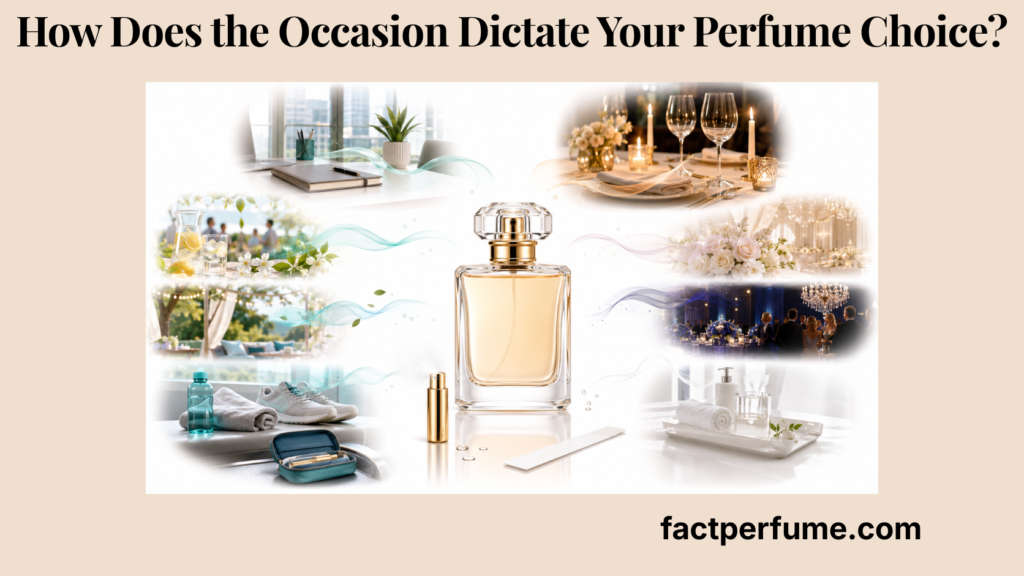
The occasion dictates your perfume choice by determining how much scent presence, warmth, freshness, formality, and restraint the setting can comfortably support. The right decision depends on venue purpose, room size, ventilation, social distance, exposure duration, crowd density, temperature, food and drink, published policies, and the perfume’s tested performance.
This article explains spatial scent etiquette, professional settings, dates, parties, outdoor gatherings, weddings, galas, dining, gyms, healthcare spaces, travel, application control, and the final occasion check. It helps readers decide whether to wear a fragrance as planned, reduce its application, retest it under realistic conditions, or choose no perfume before leaving home.
Why Does Perfume Occasion Matching Require Spatial Awareness and Etiquette?
Perfume occasion matching requires spatial awareness because projection and sillage can extend beyond the wearer and affect people sharing the same room, table, vehicle, workplace, or venue. Projection is how strongly fragrance radiates near the wearer, while sillage is the trail left during movement. Longevity is different because it describes duration, not social reach. Room size, ventilation, crowd density, proximity, and exposure time all influence how noticeable a scent becomes. Social reach becomes easier to assess when readers understand sillage, but etiquette still depends on the actual venue and people present.
How Does Sillage Affect Perfume Occasion Matching?
Sillage affects perfume occasion matching by determining how noticeably a fragrance follows the wearer or remains after movement. A clear trail may suit a spacious reception or open gathering where people are not continuously close. The same trail may feel intrusive in an office, restaurant, vehicle, clinic, or aircraft cabin. Sillage is not projection, because a perfume may radiate strongly at first yet leave little trail. It is also not longevity, because a long-lasting fragrance can remain close to the wearer.
How Does Room Size Affect Perfume Occasion Matching?
Room size affects perfume occasion matching because a fragrance that feels restrained outdoors may become concentrated in a small enclosed space. Cars, elevators, interview rooms, classrooms, compact restaurants, and meeting rooms give scent less space to disperse. Ventilation must be judged separately. A large hall with weak air exchange may retain fragrance, while a smaller room with active airflow may disperse it more quickly. Large rooms do not automatically permit stronger perfume because seating, crowd density, and event duration still affect exposure.
How Does Social Distance Affect Perfume Occasion Matching?
Social distance affects perfume occasion matching because dates, shared desks, interviews, dinners, and travel place people within prolonged fragrance range. Close-contact occasions generally need lower social reach than spacious events with freer movement. Exposure duration matters as much as proximity. A scent that seems pleasant during a brief greeting may become tiring during a long meal, meeting, ceremony, or journey. Greater restraint is especially appropriate when nearby people cannot easily change seats, leave the room, or avoid the shared air.
How Does Etiquette Affect Perfume Occasion Matching?
Etiquette affects perfume occasion matching by requiring consideration of professional boundaries, food aromas, healthcare vulnerability, scent policies, and people who cannot easily leave the space. Odour responses can vary with sensitivity, exposure level, duration, age, and health, so restraint can reduce avoidable discomfort without implying that ordinary perfume is toxic. ATSDR odour guidance supports this variability principle. A published scent-free policy overrides personal preference, and choosing no perfume is a valid decision when policy or vulnerability makes fragrance unsuitable.
The following table connects perceived scent-trail level with venue conditions and proximity. It offers qualitative guidance without fixed distances, universal application counts, or rigid fragrance-family rules.
| Perceived scent-trail level | Practical social reach | Potentially suitable settings | Higher-risk settings | Application approach |
|---|---|---|---|---|
| Very low | The scent stays close. | It may suit permitted close settings. | It still fails scent-free rules. | Choose none or begin minimally. |
| Restrained | Nearby people may notice it. | It may suit some offices or meals. | It may still affect transport or clinics. | Test it and apply with restraint. |
| Moderate | Movement creates a clear trail. | It may suit open events. | It risks intrusion in enclosed spaces. | Use it only with adequate space. |
| Noticeable | The trail remains after movement. | It may suit selected spacious events. | It risks dominating shared environments. | Reduce it or wear none. |
Takeaway: Appropriate sillage depends on space, airflow, proximity, and exposure duration rather than any fixed distance or universal application number alone.
How Should Perfume Occasion Matching Work for Office and Professional Settings?
Perfume occasion matching for professional settings should prioritize restraint, controlled social reach, and compliance with workplace or educational scent policies. Offices, interviews, meetings, classrooms, presentations, and client spaces often involve prolonged proximity and limited control over shared air. A “clean” scent describes a style, not a safety guarantee. Fresh citrus or musk may project strongly, while some woody or floral formulas remain quiet. Professional suitability must therefore rely on tested performance, ventilation, seating, and policy. Fragrances may cause or trigger work-related asthma in some occupational exposures, so local rules and reported discomfort should be taken seriously. (workplace asthma guidance)
Which Perfume Styles Work Best for Office Occasion Matching?
Office occasion matching often works well with soft musk, sheer woods, light vetiver, tea, iris, restrained citrus, neroli, subtle florals, or quiet aromatic structures. These directions may feel transparent, dry, smooth, or close-wearing. No family is automatically office-safe, however. A citrus formula may project strongly, while a soft wood may last for hours without spreading far. Test the actual perfume before work and confirm that it remains comfortable during seated proximity rather than relying on its family name or concentration label.
Which Perfume Styles Require Extra Restraint for Office Occasion Matching?
Dense oud, heavy gourmand, smoky leather, animalic florals, syrupy sweetness, and resinous amber require extra restraint in offices because their perceived weight or reach may exceed the setting. These styles are not universally forbidden. Formula strength, application level, atomizer output, ventilation, and policy determine suitability. A sheer woody interpretation, softer amber, dry spice, or transparent floral may preserve the preferred direction with less social reach. If performance remains uncertain, test outside work or choose no perfume for that day.
How Much Sillage Is Appropriate for Office Occasion Matching?
Office fragrance should generally remain close to the wearer and should not fill a meeting room or remain strongly after the wearer leaves. Shared desks, conference tables, classrooms, and elevators can expose others for extended periods, so even pleasant fragrance may become intrusive. Appropriate office sillage is qualitative rather than measured by a fixed distance. A scent-free policy requires no perfume, including light or concealed fragrance. Where perfume is allowed, begin conservatively and never spray or reapply inside the shared workplace.
How Should Perfume Occasion Matching Change for Interviews and Meetings?
Perfume occasion matching for interviews and important meetings should use the most restrained version of the wearer’s normal style or no fragrance when policy and sensitivity are uncertain. Perfume should not dominate a first impression, presentation, negotiation, or client conversation. A familiar, tested scent is easier to control than an untested event-day choice. Apply before arrival when permitted, and avoid spraying in elevators, shared washrooms, vehicles, or meeting areas. Fragrance does not prove confidence, professionalism, or competence.
The following matrix matches professional settings with possible restrained directions, desired social reach, starting application level, and the policy check that should govern the final choice.
| Professional setting | Possible fragrance direction | Desired social reach | Starting application level | Policy or mismatch check |
|---|---|---|---|---|
| Shared office | Soft musk, tea, or sheer woods may work. | Keep it close. | Begin minimally. | Check policy and ventilation. |
| Interview | A familiar quiet scent or none may work. | Keep it very close. | Use minimal scent or none. | Choose none when uncertain. |
| Client meeting | Iris, soft woods, or mild florals may work. | Keep it controlled. | Use restraint. | Keep scent secondary. |
| Classroom | Mild citrus, vetiver, or musk may work. | Keep it low. | Begin minimally. | Consider long exposure. |
Takeaway: Professional fragrance should remain secondary to the work, stay within close social reach, and disappear completely whenever a scent-free policy applies.
How Should Perfume Occasion Matching Work for Dates and Social Events?
Perfume occasion matching for dates and social events should balance personal expression with conversation distance, food, crowd density, airflow, temperature, and movement. Fragrance may express warmth, freshness, polish, or playfulness, but it cannot guarantee attraction or approval. Context should come before family labels. A smooth amber may suit a spacious evening gathering but overwhelm a small table. A bright citrus may feel easy outdoors yet become sharp indoors. Venue transitions also matter because an outdoor event may continue in a vehicle, restaurant, tent, or enclosed room, so advance testing remains useful.
How Should Perfume Occasion Matching Work for Dinner Dates?
Dinner-date occasion matching should favour close-wearing, smooth, and controlled fragrance that supports the setting without dominating food, drink, or conversation. Soft amber, skin musk, restrained vanilla, light woods, clean warmth, or subtle florals are possible directions. Reduced fragrance around food is an etiquette principle, not a claim that one family always interferes with taste. Table distance, ventilation, dining format, and duration matter. Apply before arrival when permitted, and do not spray or reapply at the table or inside the dining room.
How Should Perfume Occasion Matching Work for Casual Daytime Dates?
Casual daytime dates may suit fresh, green, tea, citrus, neroli, clean musk, light floral, or soft woody directions when the formula remains comfortable at close range. These are possibilities rather than gendered or romantic rules. Freshness does not guarantee subtlety, and some citrus, aquatic, or aromatic perfumes project strongly in warmth. Consider whether the date takes place indoors, outdoors, on public transport, or across several venues. Test the perfume under similar conditions before depending on it for a long day.
How Should Perfume Occasion Matching Work for Clubs and Parties?
Clubs and parties may support more noticeable sweet, amber, spicy, woody, floral, or aromatic fragrance, but crowd density does not justify uncontrolled application. Heat, movement, noise, and ventilation can change how the perfume is perceived. Being noticeable is different from filling the venue. A fragrance may project moderately yet leave a broad trail as the wearer moves through a crowd. Test the formula before the event, especially if its drydown becomes sweeter, smokier, or heavier than the opening suggests.
How Should Perfume Occasion Matching Work for Outdoor Social Events?
Outdoor social events may favour fragrance that remains coherent in open air, but application still depends on temperature, humidity, wind, movement, and proximity. Fresh, aromatic, green, woody, musky, or citrus directions may work, yet delicate perfume does not always disappear outdoors. Open air also does not justify heavy application. Guests may gather closely, enter vehicles, sit under shelter, or move indoors later. Outdoor occasion matching should also consider season and climate.
The following matrix directly matches common dates and social events with possible scent directions, desired reach, placement considerations, and the main situational error to avoid.
| Social occasion | Possible scent direction | Desired social reach | Placement consideration | Mistake to avoid |
|---|---|---|---|---|
| Dinner date | Soft amber, musk, or light woods may work. | Keep it close. | Apply before arrival. | Avoid table reapplication. |
| Daytime date | Tea, citrus, green, or musk may work. | Keep it controlled. | Consider venue changes. | Do not equate fresh with subtle. |
| Club or party | Amber, spice, florals, or aromatics may work. | Keep it noticeable but controlled. | Test it with movement. | Do not overspray for crowds. |
| Outdoor gathering | Citrus, green, woods, or musk may work. | Let the formula decide. | Plan for indoor transitions. | Do not increase automatically. |
Takeaway: Social fragrance works best when its character supports the event and its reach remains proportionate to conversation, movement, food, and airflow.
How Should Perfume Occasion Matching Work for Weddings, Galas, and Formal Events?
Perfume occasion matching for formal events should align scent character with the wearer’s role, event duration, venue, dining format, clothing, social distance, and ceremony expectations. Formality may support polished, layered, or personally meaningful fragrance, but it does not require strong projection. A principal participant may choose a scent connected to the event, while a guest may prioritize restraint around greetings, photographs, ceremonies, and shared meals. Close family members may spend long periods in preparation rooms, cars, and receiving lines. A successful formal scent remains balanced throughout the event rather than demanding attention.
Which Perfume Styles Work Best for Wedding Occasion Matching?
Wedding occasion matching often favours smooth, elegant, personally meaningful fragrance that remains controlled around ceremonies, photographs, greetings, and shared dining. The wearer’s role matters because principal participants, close family, and guests experience different levels of proximity and movement. No family belongs to one gender or wedding role. Florals, woods, musks, ambers, aromatics, or fresh structures may all work when the formula fits the venue. Guests should avoid turning their fragrance into a dominant part of the shared sensory environment.
Which Perfume Styles Work Best for Gala Occasion Matching?
Gala occasion matching may support amber, chypre, iris, rose, refined woods, restrained leather, or polished spice when the formula complements rather than overwhelms the venue. Luxury is not the same as density, and elegance does not depend on a wide scent trail. Consider ventilation, assigned seating, reception movement, dinner service, and transport. A perfume that feels balanced in a large entrance hall may become intrusive at a tightly arranged table. Test the complete drydown before treating it as formal-event ready.
How Should Concentration Affect Formal Perfume Occasion Matching?
Concentration should affect formal-event planning only as one formula clue because EDT, EDP, parfum, and extrait labels do not guarantee exact projection, sillage, or longevity. Different formulas with the same label may behave very differently, and atomizers may release unequal amounts. Test the actual fragrance instead of assuming parfum is best for long events or EDT is automatically lighter. A concentrated formula may last while staying close, while a lighter-labelled perfume may project noticeably. Application level should therefore remain formula-dependent.
How Can a Formal Occasion Scent Feel Memorable Without Overpowering Others?
A formal-occasion scent can feel memorable when it is distinctive and personally meaningful while remaining balanced through ceremonies, greetings, photographs, and meals. Memorability should describe the wearer’s association and satisfaction, not a promise that everyone else will remember the perfume. Test it before the event, including the later drydown and any suitable clothing interaction allowed by product guidance. A beautiful opening cannot compensate for a tiring trail, intrusive sweetness, or distracting reapplication during the event.
The following matrix supports polished formal selection without treating concentration, richness, or projection as proof of elegance. Every option still requires realistic wear testing before the event.
| Formal context | Possible scent profile | Concentration consideration | Desired social reach | Application restraint |
|---|---|---|---|---|
| Wedding guest | Smooth florals, woods, musk, or amber may work. | Test the formula. | Keep it close to moderate. | Avoid dominating shared moments. |
| Principal participant | A meaningful floral, wood, or amber may work. | Test longevity and drydown. | Keep it controlled. | Consider greetings and transport. |
| Gala reception | Iris, rose, spice, or refined woods may work. | Check diffusion. | Keep it moderate. | Adjust before dining. |
| Formal dinner | Quiet amber, floral, wood, or musk may work. | Long wear may remain close. | Keep it close. | Apply before arrival. |
Takeaway: Formal fragrance feels polished when the role, venue, duration, and social reach align, not when concentration or projection is maximized.
How Can Perfume Occasion Matching Prevent Situational Scent Mistakes?
Perfume occasion matching prevents situational mistakes by identifying settings where fragrance should be reduced, relocated, delayed, or avoided. The decision depends on purpose, policy, airflow, vulnerability, exposure duration, heat, and whether people can move away. Etiquette must remain separate from diagnosis. Sensory discomfort is not automatically allergy, asthma, migraine, or dermatitis, but breathing difficulty, rash, swelling, burning, or another concerning reaction should not be dismissed. Venue policy controls the setting, and choosing no perfume may be the most respectful response in food-focused, exercise, healthcare, or travel environments before any application.
How Can Perfume Occasion Matching Prevent Fine-Dining Mistakes?
Fine-dining mistakes can be reduced by choosing low-interference fragrance, applying it conservatively before arrival, or choosing no perfume when tasting and aroma are central. Restaurant size, table distance, ventilation, menu format, and venue policy determine the suitable level. Avoid prominent application near the face shortly before dining because it may remain noticeable to the wearer and nearby guests. Do not spray or reapply inside the restaurant. Rich, sweet, or floral perfume is not automatically inappropriate, but its tested social reach must remain controlled.
How Can Perfume Occasion Matching Prevent Gym Mistakes?
Gym occasion matching usually favours no perfume because exercise increases warmth, movement, perspiration, and breathing in shared air. A fragrance may diffuse more strongly during activity, while equipment areas and changing rooms limit other people’s ability to avoid it. Perfume does not replace bathing, clean clothing, antiperspirant, or deodorant, and it should never be applied over perspiration to mask odour. If the gym permits fragrance and the wearer chooses it, only a highly restrained, previously tested approach should be considered.
How Can Perfume Occasion Matching Prevent Hospital and Healthcare-Space Mistakes?
Healthcare-space occasion matching should prioritize facility policy and generally favour no perfume when medically vulnerable people, close contact, or uncertain scent rules are involved. Hospitals, clinics, rehabilitation centres, dental offices, and care homes may follow different restrictions, so one policy should not be presented as universal. Some fragrance components may cause reactions or sensitivities in some individuals, which supports caution without diagnosing anyone. (FDA fragrance guidance) When rules are unknown and patient contact is expected, no perfume is the lower-risk etiquette decision.
How Can Perfume Occasion Matching Prevent Travel and Public-Transport Mistakes?
Travel and public-transport occasion matching should use minimal or no fragrance because passengers may remain close together and may be unable to leave the shared air. Aircraft, buses, trains, taxis, and ride-sharing vehicles combine enclosure with prolonged exposure and changing ventilation. Providers do not all prohibit fragrance, but permission does not remove the need for restraint. Apply before travel only when appropriate, and never reapply inside a cabin, vehicle, waiting area, or crowded boarding line.
The following troubleshooting table directly converts common situational errors into context-aware choices. It clearly separates etiquette, policy, and health boundaries without prescribing universal application counts.
| Situation | Common mistake | Why it creates a mismatch | Better decision | Application or no-scent guidance |
|---|---|---|---|---|
| Fine dining | The wearer applies prominent scent. | Food and conversation are central. | Choose low-interference scent or none. | Apply before arrival. |
| Gym | The wearer masks perspiration with perfume. | Heat and movement increase exposure. | Prioritize hygiene and rules. | Prefer no perfume. |
| Healthcare | The wearer assumes light scent is acceptable. | Policies and vulnerability vary. | Check the facility. | Default to no perfume. |
| Transport | The wearer reapplies during travel. | Passengers share enclosed air. | Wait until travel ends. | Use minimal scent or none. |
| Small venue | The wearer treats it like open space. | Proximity amplifies fragrance. | Choose a quieter formula. | Never spray near others. |
Takeaway: Situational mistakes are prevented by checking purpose, policy, airflow, vulnerability, and exposure before deciding whether to reduce, delay, or avoid fragrance.
How Should Perfume Occasion Matching Change Your Application Level and Placement?
Perfume occasion matching should change application by adjusting the starting level, placement, timing, and need for fragrance according to venue size, ventilation, social distance, temperature, and formula strength. A starting level may be no perfume, minimal, restrained, moderate, or formula-dependent. Reassess before adding more because the wearer may become accustomed to the scent while others still notice it. Contextual restraint becomes easier through the right application method. Follow product labelling, avoid irritated skin, and remember that some formulas may stain or alter fabrics. Application should remain conservative until its effect is known.
How Should Perfume Occasion Matching Adjust Application for Small Rooms?
Small rooms require minimal or restrained application because limited air volume, low ventilation, and close seating can amplify fragrance’s social impact. Offices, cars, elevators, meeting rooms, classrooms, and compact dining spaces leave little distance between the wearer and others. Apply before arrival when fragrance is permitted, then allow it to settle. Do not spray inside the room, vehicle, elevator, or shared washroom. If the venue is scent-free or vulnerability is central, choose no perfume rather than trying to conceal it.
How Should Perfume Occasion Matching Adjust Application for Outdoor Spaces?
Outdoor settings may support moderate application when the formula is subtle, but airflow, heat, humidity, movement, and proximity still determine the appropriate level. Wind can disperse fragrance unevenly, while warmth and activity may increase diffusion near the wearer. Test the formula outdoors before using it for an important event. Do not automatically increase application because the event begins in open air. Guests may cluster under shelter, enter vehicles, move into tents, or continue inside a building.
How Should Perfume Occasion Matching Adjust Application for Close-Contact Events?
Close-contact events require restrained application and placement that keeps fragrance near the wearer rather than directly within another person’s breathing space. Dates, shared tables, interviews, ceremonies, and travel create prolonged unavoidable exposure. Avoid universal pulse-point rules because formulas, skin condition, clothing, and product instructions vary. Less exposed placement may soften immediate presence when the label permits it and the surface is suitable. Do not apply immediately before close contact, and never spray perfume near another person.
How Should Perfume Occasion Matching Adjust Application for Scent-Free Spaces?
Scent-free spaces require no perfume because the setting’s policy overrides the wearer’s normal preference. Workplace, school, healthcare, event, household, or transport rules may define fragrance expectations for that location. Light fragrance is still fragrance, and concealing it beneath clothing does not comply with a no-scent requirement. Do not substitute strongly scented body products when the policy clearly covers them for everyone.
The following checklist controls application by occasion without universal spray counts. Complete every field before applying, then reassess the actual formula instead of relying on its label.
Takeaway: Occasion-based application begins conservatively, follows product and venue rules, and changes only after the actual formula and setting are reassessed.
What Checklist Should Guide Perfume Occasion Matching Before You Leave Home?
A final perfume occasion matching checklist should confirm that fragrance direction, social reach, application, venue conditions, and scent policy all support the planned occasion. Occasion is one factor within the wider buying and wearing decision. Personal preference, climate, concentration, application method, comfort, authenticity, price, and storage may also matter. Occasion should therefore be combined with the perfume buying factors. This final section confirms only whether the scent suits the planned space, people, purpose, duration, and policy. It does not replace the complete purchase assessment.
Does the Perfume Match the Occasion?
A perfume matches the occasion when its scent character, intensity, and social meaning support the event without distracting from its purpose. Offices often require restraint, dinner dates protect conversation and food, weddings balance personal meaning with shared space, and formal events favour polish without excess. Gyms, healthcare settings, travel, and scent-free venues may require minimal or no fragrance. No family is universally correct or forbidden. The event’s purpose, policy, and tested social reach should remain central.
Does the Perfume Match the Room Size?
A perfume matches the room size when its tested projection and sillage remain proportionate to the venue’s space, airflow, seating, and density. Small enclosed rooms usually require greater restraint, while spacious or outdoor settings still require attention to crowding and movement. Consider the whole event route. A gathering may begin outdoors, continue in a tent, move into a dining room, and end in shared transport. Match the perfume to the most restrictive environment you expect to enter.
Does the Perfume Match the Social Distance?
A perfume matches the social distance when it remains comfortable for people who will sit, travel, dine, work, exercise, or speak near the wearer. Close-contact settings usually require lower social reach than open receptions or spacious outdoor gatherings. Exposure duration increases the need for restraint. A colleague, passenger, patient, dinner guest, or interviewer may remain within the fragrance range for a long time and may not be able to move away.
Does the Perfume Match the Event Duration?
A perfume matches the event duration when it remains suitable throughout the occasion without disruptive reapplication or excessive initial application. Longevity describes duration, while projection and sillage describe social reach, so a long-lasting perfume does not need to be loud. Test formal or long-event fragrance before the day itself. Carry a sample only where private reapplication is permitted and necessary. Never reapply in meeting rooms, restaurants, clinics, vehicles, aircraft cabins, or other shared spaces.
The following checklist confirms occasion suitability across space, policy, application, and social reach. Any unresolved high-risk item should lead to reduction, retesting, or no perfume.
The final decision should follow the strongest constraint in the checklist. Policy, vulnerability, enclosed shared air, and uncertainty should outweigh habit or the desire for greater noticeability.
| Checklist result | Recommended decision |
|---|---|
| Fragrance character, social reach, placement, and policy fit | Wear as planned |
| Formula strength or venue conditions remain uncertain | Reduce application or retest |
| The setting is enclosed, food-focused, or highly sensitive | Choose minimal application or no perfume |
| A scent-free policy applies or medical vulnerability is central | Do not wear perfume |
Takeaway: The final decision should protect the event’s purpose and shared environment while allowing personal expression only at a proportionate, tested level.
Frequently Asked Questions
The same perfume can work across several occasions when its application and social reach can be adjusted, but no fragrance suits every environment. A versatile formula may fit work, social, and formal settings after testing. Scent-free workplaces, healthcare spaces, vulnerable settings, or enclosed travel may still require no perfume.
Fresh perfume is not always best for the office because some fresh formulas project strongly, while some woody, floral, or musky fragrances remain quiet and restrained. Tested performance, ventilation, seating, exposure duration, and workplace policy matter more than the family label. No scent direction is automatically office-safe.
Perfume should usually be avoided when a hospital or clinic has a scent-free policy or when medically vulnerable people and close contact are involved. Policies vary, so check the specific facility. When guidance is unavailable and patient contact is expected, choosing no perfume is the more considerate decision.
Choosing no perfume is usually the most considerate gym decision because heat, perspiration, movement, and shared air can intensify the wearing experience. Venue rules control what is permitted. Perfume should not be used as deodorant, applied over perspiration, or sprayed inside changing rooms or exercise areas.
Parfum does not automatically work better for formal events because concentration labels do not guarantee exact projection, sillage, or longevity. The formula, atomizer output, application level, venue, and seating determine suitability. Test the fragrance before the event rather than assuming concentration makes it more elegant or appropriate.
The appropriate application level depends on the formula, atomizer, venue, ventilation, social distance, temperature, event purpose, and scent policy. Begin conservatively, observe the tested social reach, and avoid adding more in shared air. Choose no perfume whenever policy, vulnerability, or the setting’s purpose requires it.
Conclusion
The occasion should dictate perfume choice by determining how much fragrance presence, warmth, freshness, formality, and restraint the shared setting can support. Spatial awareness, social distance, ventilation, offices, dates, formal gatherings, dining, healthcare, travel, application control, and the final checklist all shape the decision.
A tested fragrance may be worn, reduced, or retested, while scent-free policies and vulnerable settings may require no perfume. The best occasion match is the fragrance decision that expresses the wearer without taking control of the space shared with everyone else.