
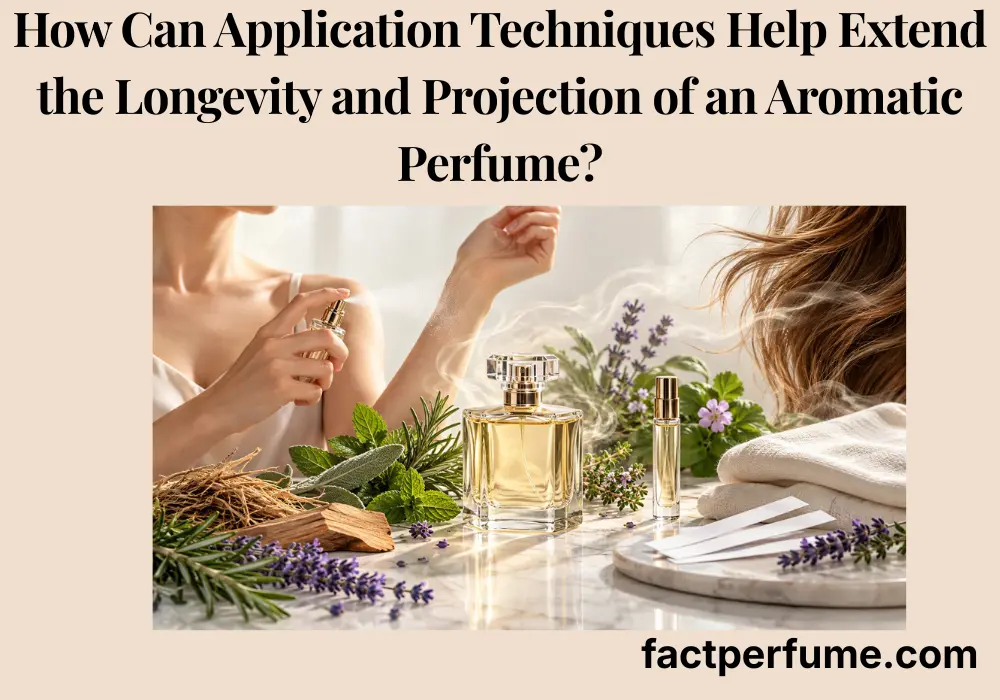
How Can Application Techniques Help Extend the Longevity and Projection of an Aromatic Perfume?
Application techniques can support the longevity and projection of an aromatic perfume by improving placement, distribution, surface choice, and performance evaluation, but they cannot override the fragrance formula. Longevity describes how long the scent remains perceptible. Projection describes how strongly it radiates around you at a particular stage. Sillage is the scent trail associated with your movement and presence.
A useful routine begins with comfortable skin, suitable placement, and deliberate distribution. Clothing and hair require separate decisions, while rubbing, unnecessary reapplication, and changing conditions can make results harder to interpret. The aim is to establish a repeatable application method that suits your perfume and circumstances, then evaluate early presence and later wear separately rather than assuming that a stronger opening means longer longevity.
Why Must Longevity and Projection Be Treated as Separate Performance Goals?
Longevity and projection must be treated as separate performance goals because a perfume can radiate strongly early in wear yet remain close to the skin later, while another can remain perceptible without projecting widely.
Longevity is the duration for which fragrance remains perceptible. When evaluating it, ask whether recognizable scent remains later in wear. Record whether you notice it naturally or only when checking the application area closely. Both involve detecting perfume, but they describe different wearing experiences.
Projection is how strongly fragrance radiates around the wearer at a particular stage. A noticeable opening tells you about that stage. It does not establish how the fragrance will behave during its later development, commonly called the drydown. A quiet drydown can remain perceptible without creating a strong surrounding presence.
Sillage is the scent trail associated with movement and presence. Someone noticing fragrance as you pass is commenting on a trail. Someone noticing it while sitting beside you is describing a different encounter. Neither observation establishes total wear duration.
Understanding aromatic perfumes helps prevent another misunderstanding: aromatic identifies scent character, rather than guaranteed strength, weakness, freshness, or endurance. Aromatic perfumes do not share one standard performance profile.
Define your goal before changing application. You might want recognizable scent later in wear, a more noticeable early presence, or comfortable close wear in a shared room. Stronger projection is not automatically more useful when other people will be nearby.
The formula remains the foundation. Application changes where fragrance is deposited and encountered; it does not replace its materials or their properties. Questions about composition and longevity therefore belong alongside application testing. Fragrance concentration can also matter, but a concentration label alone cannot guarantee longevity or projection.
How Should You Prepare and Apply an Aromatic Perfume for Balanced Longevity and Projection?
A balanced aromatic perfume application routine should begin with comfortable intact skin, deliberate placement, controlled distribution, and an application level adjusted to the actual formula, atomizer, environment, clothing, and setting.
1. Start with comfortable intact skin.
Choose an application area permitted by the product instructions. Avoid irritated, damaged, cracked, sunburned, or uncomfortable skin. If an area feels sensitive after shaving or another grooming step, choose a different suitable area or postpone application.
There is no need to turn perfume preparation into a complicated skin-treatment routine. The useful starting point is a comfortable application surface that you can reproduce on another wear day. Skin comfort takes priority over experimenting with performance.
2. Treat moisturizer as an optional personal test variable.
Human-skin research by Hadjiefstathiou and colleagues found relationships between skin properties and the evaporation of particular fragrance molecules. The effects varied with the compounds studied. This supports the importance of individual skin variation, but it does not establish that applying moisturizer before perfume extends consumer-perceived longevity. skin study
If a suitable unscented moisturizer is already part of your routine, allow it to settle before fragrance application. Compare that routine with a wear without moisturizer on otherwise comfortable skin. Do not omit a product needed for skin comfort merely to complete a comparison.
Record any difference as a personal observation. Moisturizer should not be described as a fixative, a substance that locks perfume into skin, or a scientifically proven universal longevity technique.
3. Select suitable application areas.
Depending on product guidance and comfort, practical options may include the forearms, upper chest, neck, or another suitable exposed or partly covered area. Consider clothing coverage, sunlight exposure and label precautions, washing, and the setting in which you will wear the fragrance. Keep spray away from the eyes and face.
An area repeatedly washed or rubbed by clothing creates a different wear condition from one left relatively undisturbed. Choose locations that fit your routine rather than following a universal body-zone ranking.
There is no established pulse-point hierarchy that guarantees better performance. Schwarzenbach and Bertschi identified temperature and ventilation as important variables in perfume diffusion from skin. Their findings do not demonstrate that warmer application areas necessarily provide longer longevity. PubMed study
4. Distribute application deliberately.
Where appropriate, spread the chosen total application across suitable areas rather than repeatedly wetting one small spot. Placement can change where the wearer and other people encounter the scent, but distribution does not guarantee longer wear.
Keep approximately the same total dose when comparing placement patterns. If you add perfume to several new locations without reducing the original application, you are testing both distribution and increased quantity.
5. Let the perfume dry without rubbing when testing technique.
Rubbing moves freshly applied liquid and changes its distribution. Leaving the application undisturbed provides a simpler condition to repeat.
This is practical comparison guidance. It is not evidence that rubbing destroys fragrance molecules, chemically breaks the perfume, or predictably shortens total longevity. If you want to evaluate rubbing itself, treat it as the single variable in a separate comparison.
6. Adjust total application to the actual perfume.
Atomizers release different amounts, so an application count learned with one bottle does not translate reliably to another. Consider previous wear experience, formula, clothing, temperature, airflow, indoor or outdoor use, and social proximity.
Begin with an application level you already know is comfortable when possible. Do not repeatedly add product before evaluating how the opening develops. More product increases the applied scent load without guaranteeing proportionally longer useful wear.
Broader decisions about fragrance format and application can be considered through the application factor.
7. Reassess before adding more.
Allow the fragrance to develop before deciding whether reapplication is needed. Reduced self-perception may reflect fading, adaptation, changed surroundings, or several factors together.
Consider the setting as well as your own awareness. A fragrance that feels quiet to you may still be noticeable to someone nearby, but that possibility should be checked rather than assumed.
When Can Clothing Support Longer Perceptibility?
Clothing can retain fragrance compounds differently from skin, but analytical persistence on fabric does not prove that every perfume will smell stronger or last longer to the wearer.
Gherghel and colleagues examined transferred fragrance volatile organic compounds, or VOCs, on textiles for forensic reconstruction. Fabric and temperature influenced their recovery. This is indirect evidence for everyday perfume wear: laboratory equipment detecting fragrance compounds does not establish that people still perceive a recognizable perfume. PubMed study
Clothing therefore offers a surface to evaluate, rather than a guaranteed longevity improvement. Consider whether the retained scent remains recognizable, whether the drydown is pleasant, and whether it is perceptible during ordinary wear.
Compatibility is equally important. Research by Krishnamoorthi and Jagannathan examined perfume-related colourfastness testing on silk, including conditions involving perspiration. The study supports caution about textile appearance; it does not establish a universal list of safe fabrics. textile study
Follow applicable product and garment instructions, and test an inconspicuous area first. Allow it to dry and inspect for marks or colour changes before considering visible application. Treat delicate or easily marked garments cautiously. A small test cannot guarantee compatibility under every later wearing condition.
Avoid broad claims that natural fibres always outperform synthetics or that one material is always best. Fibre, construction, dye, finish, perfume, and wearing conditions can differ.
Clothing is useful only when both its sensory result and material compatibility justify including it. A persistent trace that changes the desired fragrance character or marks the garment may offer no practical advantage.
When Can Hair Be Used as a Supplementary Fragrance Surface?
Hair can be treated as an optional supplementary fragrance surface when product guidance permits, but direct evidence that ordinary perfume application to hair improves projection or longevity is limited.
Hair moves, but movement alone does not establish a measurable performance advantage. Follow the specific product label. A product intended for hair may provide clearer instructions for that use, although its intended use does not itself guarantee better scent performance.
Keep application away from the eyes and face, avoid an irritated scalp, and do not compensate for uncertain results with repeated heavy application.
Fragrance ingredients can cause reactions in susceptible individuals. Pham and colleagues identified fragrance allergens among reported causes of scalp contact dermatitis in their systematic review of scalp-applied products. This evidence concerns tolerance, rather than improved projection or longevity. PubMed study
Ordinary perfume is not a hair-care treatment. Equally, blanket claims that every alcohol-based perfume inevitably damages hair are unwarranted. Product instructions, individual tolerance, and the actual result should guide the decision.
Combining scents introduces another variable. A differently scented hair product or lotion can change the overall impression; aromatic layering is a separate decision from improving basic application technique.
Application Surface and Goal Matrix
Use this matrix to choose a comparison that fits your goal. Each option needs its own comfort and compatibility check; none is ranked as the best surface for every aromatic perfume.
| Application option | Practical goal | Evidence boundary and decision |
|---|---|---|
| Comfortable intact skin | Establish a repeatable baseline | Skin properties vary; comfortable skin does not guarantee longer wear. |
| Skin after suitable unscented moisturizer | Compare an existing routine | Personal test variable, not proven universal longevity technique. |
| Distributed skin application | Change where scent is encountered | Keep total dose similar; distribution does not guarantee endurance. |
| Compatible clothing | Evaluate recognizable scent on fabric | Analytical fabric persistence does not equal sensory longevity. Test for marking and colour changes. |
| Hair, when product guidance permits | Evaluate an optional supplementary surface | Direct performance evidence limited. Instructions and comfort take priority. |
Which Application Mistakes Can Undermine Performance or Make It Harder to Judge?
Application mistakes can undermine aromatic perfume evaluation by changing dose, surface distribution, scent load, self-perception, or the conditions under which one technique is compared with another.
Mistake 1: Rubbing freshly applied perfume.
Rubbing changes the physical distribution of liquid, making a rubbed application different from one left to dry. If you rub on one test day and leave the perfume untouched on another, record that difference.
For a straightforward baseline, use natural drying consistently. There is insufficient direct evidence here to claim that rubbing chemically destroys perfume or inevitably reduces total longevity. The practical concern is an altered application condition.
Mistake 2: Concentrating excessive application in one area.
A dense deposit may create an overwhelming local opening, which can be mistaken for improved overall performance. It also changes the dose if the comparison routine used less perfume.
Choose an amount appropriate to the formula and setting, distribute it deliberately where suitable, and evaluate later perceptibility separately. An intense opening alone cannot demonstrate a useful duration advantage.
Mistake 3: Reapplying immediately because you stop noticing the perfume.
Repeated or prolonged exposure can reduce perceived odour intensity, as discussed by Pellegrino and colleagues in their review of olfactory habituation and adaptation. This makes adaptation a possible explanation for reduced self-awareness. PubMed study
However, not every quiet wear experience is adaptation. The perfume may also have faded or become less noticeable under different conditions. Wait, reassess, and seek trusted feedback when useful. Neither reduced self-awareness nor another person’s detection proves strong external projection.
Mistake 4: Confusing projection with longevity.
A vivid opening can dominate your memory of a fragrance even when its later presence is modest. Conversely, a scent noticeable only close to the application surface may still have lasted.
Keep separate notes for early presence and later detectability. Decide which outcome matters for the occasion before calling a technique successful. Comfortable close wear can be appropriate even when projection is restrained.
Mistake 5: Comparing application techniques under different conditions.
A cool indoor day and a warm, windy outdoor day provide different exposure conditions. Humidity, clothing coverage, activity, skin condition, and applied dose can also complicate the comparison.
Record these differences rather than assigning the entire result to moisturizer or placement. If several conditions changed, treat the outcome as an observation that needs repeating under more similar circumstances.
Mistake 6: Treating clothing as automatically superior.
Fabric retention may be noticeable, but application can also change fragrance character or affect textile appearance. A trace remaining on a garment does not establish stronger projection during wear.
Compare recognizable scent on a compatible material. Stop using that material if its appearance changes. Protecting the garment takes priority over completing a performance experiment.
Mistake 7: Treating hair as a proven projection technique.
An appealing explanation about moving hair is not direct evidence of improved performance. Adding hair application also changes the total dose unless another application is removed.
Follow product-use instructions, preserve scalp comfort, and leave hair out of the routine if it offers no clear, repeatable benefit. Supplementary application should serve an observed purpose.
Mistake 8: Applying to uncomfortable skin.
Irritation makes a routine unsuitable regardless of its apparent scent performance. Avoid damaged or irritated areas and stop using a product if a concerning reaction develops.
The FDA notes that some fragrance ingredients can cause sensitivity or allergic reactions in susceptible individuals. Product instructions and individual tolerance take priority over experimentation. FDA guidance
How Can You Test Whether an Application Technique Actually Improves Performance and Know Its Limits?
The most reliable way to judge an application technique is to compare the same perfume under similar conditions while changing one main application variable at a time. This provides a more useful personal result than relying on one memorable wear.
1. Use the same perfume.
Ideally, use the same bottle and atomizer throughout. Comparing different perfumes cannot isolate technique because their formulas differ.
If you switch to a decant or replacement atomizer, note the change. Its output may alter the amount deposited even when your application count stays the same. Keep the perfume and delivery method consistent wherever practical.
2. Choose one main variable.
Compare your usual skin routine with the same routine after a suitable moisturizer, or compare two placement patterns. Skin versus compatible clothing is another possible comparison.
Do not introduce moisturizer, extra perfume, new clothing, and different distribution together. If the outcome changes, you will not know which change contributed. If you test rubbing, change that habit alone without interpreting the result as proof of chemical damage.
3. Keep approximate total dose similar.
Home application is not exact measurement. Aim for repeatable actuation and similar total application rather than pretending that different atomizers dispense equal quantities.
When comparing distribution, move the existing application across suitable areas instead of adding more areas and more perfume. When comparing surfaces, avoid adding fabric application on top of the full skin baseline.
If you deliberately test a larger dose, identify dose as the variable. Do not attribute the result solely to placement.
4. Record the conditions.
Note temperature, humidity, air movement, activity, indoor or outdoor setting, clothing, skin condition, and moisturizer use. Ordinary descriptions such as “warm outdoors with a breeze” remain useful if instruments are unavailable.
Record washing, heavy perspiration, garment changes, and reapplication too. These events can affect interpretation. A comparison involving an undisturbed application and one repeatedly washed or rubbed by clothing needs that context.
5. Evaluate early projection separately.
Observe the opening after application has settled and again as the fragrance develops. Does the scent remain comfortable? Is it naturally noticeable nearby, or excessive for the setting?
Ask a willing, trusted person for feedback during normal interaction. Their observations can add context, but avoid converting them into an exact distance claim or a universal projection rating.
Use comparable circumstances for feedback where possible. A person encountering you outdoors in moving air is not assessing the same situation as someone beside you in a still room.
6. Evaluate later longevity separately.
Use comparable points in your routine to check whether recognizable fragrance remains. Distinguish naturally noticing it from detecting it only close to skin or fabric.
Note whether the drydown still resembles the experience you want. Residual scent and satisfying fragrance wear are related but separate judgments.
You may record observation times for your personal comparison. Those records describe that wear under those conditions; they do not establish guaranteed performance hours for others.
7. Account for self-perception changes.
If you stop noticing the perfume, pause before reapplying. Move away from continuous exposure where practical and check again later.
External feedback can help, but observer sensitivity, proximity, and expectations vary. Someone detecting the scent means it was perceptible to that person during that encounter. It does not establish continuous strong projection, and it cannot by itself determine whether adaptation caused your reduced awareness.
8. Repeat the comparison.
Test both routines on more than one suitable occasion. Separate wear days can make individual routines easier to judge than wearing several competing conditions simultaneously, although day-to-day variation remains.
If practical, vary which routine you test first. Avoid carrying residual perfume on previously scented clothing into what you intend to be a fresh baseline. Record exceptions rather than treating imperfect conditions as identical.
9. Classify the result.
Decide whether the change appears to improve projection, longevity, both, or neither. Include comfort and social suitability in the decision.
A routine that creates excessive early intensity but no later advantage has not necessarily improved useful wear. A quieter routine may suit your needs even when it produces less noticeable early presence.
For example, distributing the same approximate dose may change where scent is encountered without producing a repeatable later-duration difference. That would support a placement preference rather than a longevity claim.
10. Judge the strength of the observation.
Ask whether the difference repeated, conditions and dose were reasonably similar, and clothing or climate could explain it.
A repeated personal result can justify your own routine without establishing a universal recommendation. If results alternate unpredictably, record uncertainty rather than selecting the best day as proof.
Distinguish direct research support from practical inference. Evidence that skin properties influence evaporation does not prove that a particular moisturizer improved your perfume. Your comparison addresses that narrower personal question.
11. Recognize formula limits.
Fragrance composition and material properties remain fundamental. Application cannot guarantee that an intrinsically quiet formula becomes widely projecting or that every aromatic perfume maintains a recognizable scent throughout an intended occasion.
When careful comparisons show no meaningful advantage, stop escalating application. The useful finding may be that the technique adds complexity without improving your experience. A simple, comfortable routine with predictable results can be the better choice.
Application Performance Test Checklist
Use this checklist during repeated wears, then interpret the result with the outcome table. It helps distinguish a repeatable personal difference from an impression caused by changed dose, surroundings, or perception.
- Use the same perfume and record any bottle or atomizer change.
- Change one main application variable at a time.
- Keep approximate total dose similar and note output differences.
- Record skin condition and whether moisturizer was used.
- Record clothing and any residual scent on it.
- Note temperature, humidity, airflow, and indoor or outdoor setting.
- Record activity, washing, and any reapplication.
- Evaluate early projection and excessive intensity separately.
- Evaluate later longevity and recognizable drydown separately.
- Record declining self-perception without assuming its cause.
- Use trusted external feedback when useful, acknowledging observer variation.
- Repeat both conditions before drawing a personal conclusion.
- Classify the outcome as longevity, projection, both, or neither.
- Recognize when formula limits or inconsistent conditions prevent a stronger conclusion.
Final Performance Outcome Table
| Test result | Recommended interpretation |
|---|---|
| Later perceptibility improves repeatedly without excessive early intensity | The technique may support longevity for that perfume under those conditions. |
| Early radiation improves but later wear does not | Projection may have changed more than longevity. |
| Self-perception declines while another person detects the scent | Adaptation may contribute; continued strong projection is not proven. |
| Clothing retains scent but changes its character or risks staining | Use selectively or avoid that material. |
| Hair use gives no clear benefit or causes discomfort | Do not rely on hair as a performance technique. |
| Moisturizer produces a repeatable personal difference | Record a wearer-specific result, not a universal rule. |
| No repeatable improvement appears | The application change may not be meaningful. |
| Performance remains limited despite controlled application | Formula limitations may dominate. |
Evidence verification: Retained research records and official guidance checked on 21 October 2026. The comparison instructions are practical personal-testing guidance, not a claim that the complete routine has undergone a clinical performance trial.
Frequently Asked Questions
No. There is no established pulse-point hierarchy that guarantees better performance. Choose application areas according to comfort, product guidance, clothing, washing, sunlight exposure, and the setting.
No. Moisturizer is best treated as a personal test variable. Skin properties can influence fragrance evaporation, but current evidence does not establish moisturizer as a universal fixative or guaranteed longevity technique.
For controlled comparison, leaving the application undisturbed is simpler and more repeatable. Rubbing changes distribution, but this does not establish chemical destruction or inevitable longevity loss.
No. Fragrance compounds can persist differently on fabric, but analytical persistence does not guarantee stronger or more recognizable sensory longevity. Fabric compatibility and staining risk must also be considered.
Hair can be an optional supplementary fragrance surface when product guidance permits, but direct evidence that ordinary perfume application to hair improves projection or longevity is limited.
Use the same perfume and atomizer where practical, change one main variable at a time, keep approximate total dose similar, record environmental conditions, evaluate early projection and later longevity separately, and repeat the comparison before drawing a personal conclusion.
Conclusion: Which Application Routine Best Supports Aromatic Perfume Performance?
The best aromatic perfume application routine is to begin with comfortable intact skin, choose suitable application areas, distribute fragrance deliberately, use supplementary surfaces only when appropriate, let the perfume develop without unnecessary manipulation, and evaluate longevity and projection separately. Treat moisturizer as a personal test variable, check fabric compatibility, and recognize the limited hair-performance evidence. Avoid rubbing myths and reactive reapplication when self-perception declines. Repeated comparisons provide the useful personal check.
Application can support aromatic perfume longevity and projection, but the most reliable routine is the one that performs consistently under the wearer’s real skin, clothing, environment, and social conditions without exceeding the fragrance formula’s natural limits.