
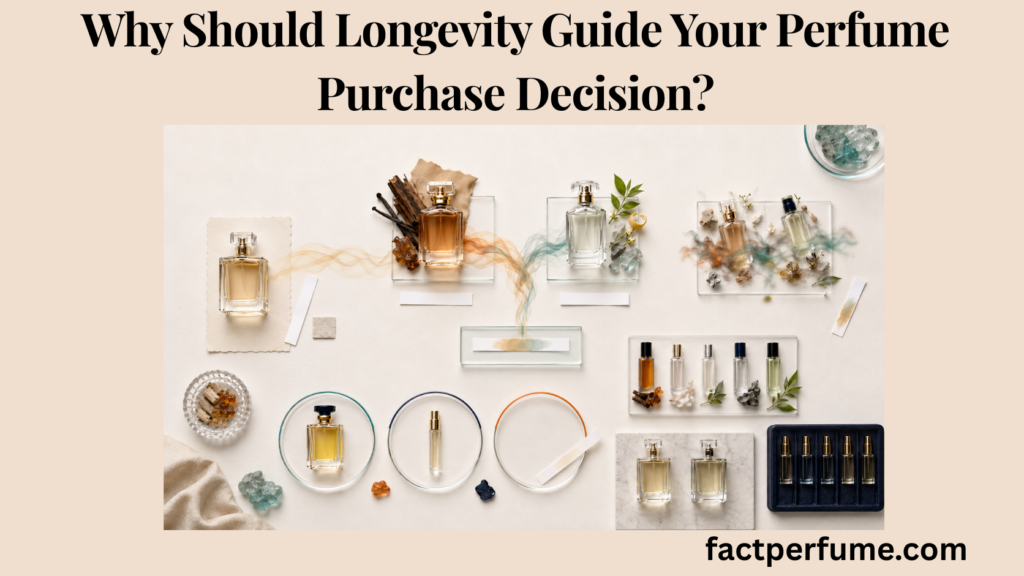
Why Should Longevity Guide Your Perfume Purchase Decision?
Perfume longevity should guide your purchase decision when the fragrance must remain detectable through the intended routine, reapplication is inconvenient, and the dry-down remains enjoyable and appropriate. Longer wear is not automatically better if the scent becomes uncomfortable, unsuitable, or unpleasant later.
This guide explains how to separate longevity from other performance metrics, test realistic wear duration at separate detectability levels, diagnose apparent fading, and choose whether to buy, sample longer, select a travel size, or skip.
When Should Perfume Longevity Influence Your Fragrance Purchase?
Perfume longevity should influence a fragrance purchase when the required wearing period is long, reapplication is inconvenient, and the later dry-down remains comfortable, enjoyable, and appropriate for the setting. It should still be weighed alongside other buying factors, including scent preference, projection, comfort, occasion fit, price, and portability.
Match Longevity to the Wearing Schedule
Longevity matters most when the perfume must remain perceptible through a long routine without convenient reapplication. A long workday, extended travel, wedding, formal event, or lengthy appointment can make stable wear useful because the wearer may not have a private or appropriate moment to reapply.
Short outings create a different requirement. A perfume does not need extreme persistence when it comfortably covers a brief social visit, dinner, errand, or evening activity. Some wearers also prefer changing fragrance between daytime and evening, so excessive persistence can reduce flexibility rather than add value.
Evaluate the Dry-Down
Total hours add value only when the later scent remains pleasant and recognizable. A fragrance may remain detectable for a long time yet become harsh, flat, overly sweet, repetitive, or disconnected from the opening that attracted the buyer.
The late dry-down should therefore be judged as a separate purchase criterion. Ask whether you still enjoy the scent, whether it remains comfortable, and whether its quieter character still resembles the experience you intended to buy.
Consider Reapplication Convenience
Reapplication reduces the need for extreme longevity when a portable format solves the duration gap. A sample, decant, or travel spray can make a shorter-wearing but more enjoyable perfume practical without forcing the buyer to choose a less appealing formula solely because it lasts longer.
Reapplication must remain considerate. Shared offices, vehicles, restaurants, clinics, and event spaces may not be suitable places for another full application. Portability solves only the carrying problem, not the need to control total dosage and respect other people.
Compare Longevity With Projection Needs
Longevity should not be confused with the need for stronger projection. A perfume may project clearly during the opening, become quieter, and still remain detectable close to the skin for much longer.
That pattern can be useful in professional, intimate, or crowded settings where a persistent skin scent is preferable to continuous room-filling diffusion. Conversely, a fragrance can produce a powerful opening but fade below useful detectability before the routine ends.
Compare Performance With Price
Longer wear justifies a higher price only when the complete scent experience creates greater practical value. The buyer should consider scent quality, dry-down comfort, frequency of use, reapplication cost, bottle size, and whether the perfume suits enough real situations to be worn regularly.
Longevity alone is a weak reason to pay more. A less expensive or shorter-wearing perfume may offer better value when it smells better, feels more comfortable, suits more settings, or can be maintained with one controlled reapplication.
The following matrix shows when longevity deserves high, moderate, or low purchase weight.
| Purchase criterion | High longevity priority | Moderate longevity priority | Low longevity priority | Purchase implication |
|---|---|---|---|---|
| Wearing schedule | Long routine with limited access to the bottle | Medium routine with one possible reapplication | Short outing or planned fragrance change | Require tested wear only for the actual schedule |
| Dry-down quality | Later scent stays enjoyable and coherent | Later scent is acceptable but less distinctive | Later scent becomes unpleasant or tiring | Do not reward hours you dislike |
| Reapplication convenience | Reapplication is impractical | Travel spray is manageable | Reapplication is easy and appropriate | Portability can reduce the need for extreme wear |
| Projection requirement | Quiet persistence is acceptable | Some observer detectability is needed | Strong projection is the main goal | Test projection separately from duration |
| Comfort | Extended wear remains comfortable | Comfort varies by dosage | Long exposure becomes cloying or irritating | Comfort can outweigh persistence |
| Setting suitability | Long wear remains appropriate | Performance needs careful dosage | Persistent presence conflicts with the setting | Setting fit limits the value of longevity |
| Price-to-use value | Frequent use and stable performance justify cost | Value depends on size and reapplication | Longevity is the only meaningful advantage | Buy for complete use value, not endurance alone |
Practical caption: This map balances schedule length, dry-down quality, reapplication convenience, projection needs, comfort, setting, and price before longevity receives high purchase weight.
How Should You Distinguish Perfume Longevity From Projection, Sillage, Intensity, and Dry-Down?
Perfume longevity measures total detectability over time, while projection measures radiating distance, sillage describes the scent trail, intensity measures momentary strength, and dry-down describes the later scent character. Measuring the wrong performance characteristic can lead to the wrong purchase decision.
Perfume Longevity
Perfume longevity measures how long the fragrance remains detectably present after application. Practical evaluation can separate four observations: noticeable by the wearer during normal movement, detectable by a willing observer from a reasonably consistent conversational position, detectable only close to the application area, and no longer reliably detectable.
These categories support personal comparison. They are not laboratory endpoints, and they should not be converted into universal distance or hour claims.
Projection
Projection measures how far the perfume radiates from the wearer at a particular stage. It often changes as the fragrance develops, so opening projection should not be used as proof of total wear.
For purchase purposes, ask whether the projection level fits the setting at the stages that matter. Strong early projection can be useful or excessive, while quiet later projection can be appropriate even when the perfume remains present.
Sillage
Sillage describes the scent trail perceived as the wearer moves or leaves an area. It reflects movement, airflow, dosage, and the formula’s behavior at a given stage, but it does not reveal how long the scent remains detectable overall.
A noticeable trail can disappear earlier than expected, and a fragrance with restrained sillage can continue as a close skin scent. Judge sillage according to social setting rather than using it as a longevity score.
Intensity
Intensity describes how strong the fragrance feels at a particular moment. A sharp, forceful opening may create high intensity without producing a long or pleasant dry-down.
The useful purchase question is not simply, “How strong is it?” It is, “Does the strength remain comfortable and appropriate while the scent develops?”
Dry-Down Quality
Dry-down quality measures how pleasant and coherent the later scent remains. It must be assessed separately from duration because detectability alone does not tell you whether the remaining scent is attractive.
A perfume that lasts quietly with a smooth, recognizable base may offer more value than one that remains loud but becomes harsh, cloying, or monotonous.
The comparison below separates the five performance concepts.
| Performance metric | What it measures | How to assess it | Common mistake | Purchase question |
|---|---|---|---|---|
| Longevity | Detectability over time | Record wearer, observer, and close-range detectability through the routine | Treating quiet wear as disappearance | Does it remain detectable long enough? |
| Projection | Radiating reach at a stage | Observe how easily it is noticed without approaching the application area | Treating opening reach as total performance | Is its reach suitable for the setting? |
| Sillage | Scent trail during movement or recent presence | Assess movement-based trail under similar conditions | Treating a trail as proof of endurance | Is the trail appropriate and comfortable? |
| Intensity | Momentary strength | Record strength at opening, development, and dry-down | Equating power with quality or longevity | Is the strength useful rather than excessive? |
| Dry-down | Later scent character | Smell the developed fragrance and assess comfort and coherence | Rewarding persistence despite an unpleasant base | Do I enjoy what remains? |
Practical caption: This map separates longevity, projection, sillage, intensity, and dry-down so one performance feature is not mistaken for another.
Which Factors Influence How Long a Perfume Remains Detectable?
Perfume longevity depends on the finished formula, application amount, skin, environment, test surface, activity, and perception rather than one isolated factor. Laboratory research on fragrance evaporation also shows that individual materials and different surfaces can release fragrance at different rates, which supports testing the finished perfume on the surface where it will actually be worn. (surface research; engineering review)
Formula Composition and Volatility
Finished perfume formulas contain materials with different volatility and persistence. Volatility describes a material’s tendency to enter the air, but a perfume’s behavior depends on the interaction of many materials, the solvent system, proportions, and surface rather than one molecule or note.
The practical effect is that bright opening effects may become less prominent while quieter materials remain. Test the full formula instead of predicting total wear from a public note list or one supposedly heavy ingredient.
Formula Structure
Formula structure affects how clearly the perfume moves from opening to dry-down. Some compositions change gradually, while others lose their most recognizable effects quickly and leave a simpler base.
A smooth transition can make moderate longevity feel satisfying. A fragmented transition can make a technically persistent perfume feel as though the scent you bought disappeared early.
Concentration and Dosage
Concentration category and application amount may influence detectability, but neither guarantees a specific wear time. A larger application can raise early intensity or make the scent easier to notice, yet it does not promise a proportional increase in useful duration.
Changing both dosage and placement between tests makes comparison unreliable. Keep the application reasonably consistent before deciding whether the formula itself meets your requirement.
Skin Characteristics
Skin condition and individual wear can change how the perfume is released and perceived. Differences should not be reduced to pH, dryness, oiliness, or temperature alone because multiple surface and environmental factors may interact.
Treat your own repeated results as the purchase evidence. The skin type page is the better place for deeper skin-specific selection guidance.
Climate and Temperature
Climate can change diffusion and perception without producing a fixed longevity result. Warm conditions, clothing, airflow, humidity, perspiration, and activity can alter how quickly a perfume develops and how strongly it is noticed.
Compare tests in conditions that resemble real use. A single air-conditioned store test should not be treated as proof of performance during outdoor heat, travel, or an active workday. Broader environmental selection belongs under season and climate.
Application Surface
Skin, hair, paper strips, and fabrics hold and release perfume differently. Experimental fragrance work has found meaningful differences between skin and model surfaces, so blotter persistence should not replace a skin wear test. (evaporation research)
Fabric may retain odor for longer, but that does not prove equivalent skin longevity. Important or delicate textiles should be treated cautiously because perfume and cosmetics can soil or affect fabrics, and garment-care instructions should take priority. (textile-care guidance)
Olfactory Adaptation
Continuous exposure may reduce wearer awareness before the fragrance fully disappears. Olfactory adaptation is a documented reduction in perceived odor response after repeated or prolonged exposure, but it is only one possible explanation for apparent fading. (adaptation study; olfactory adaptation review)
Consider adaptation when the scent becomes noticeable again after time in unscented air or when a controlled observer detects it while you do not. Do not assume that every weak result is adaptation or that other people can still smell the perfume strongly.
The framework below shows how each variable should affect testing and purchase interpretation.
| Variable | Possible influence | What it cannot guarantee | How to test | Purchase relevance |
|---|---|---|---|---|
| Finished formula | Changes development, diffusion, and dry-down persistence | Exact wear time from a note list | Wear the exact product through its full development | Highest relevance because the formula is what you buy |
| Application amount | Alters initial and later detectability | Proportionally longer useful wear | Repeat a consistent, appropriate dosage | Determines whether the test reflects intended use |
| Skin and surface condition | Changes release and personal perception | Universal behavior by skin category | Repeat on clean, intact skin under similar conditions | Shows personal fit |
| Climate and airflow | Alters diffusion, comfort, and awareness | A fixed heat or cold rule | Test in realistic environments | Reveals routine-specific performance |
| Activity and clothing | Changes movement, perspiration, and coverage | One result for every routine | Record activity and clothing | Explains day-to-day variation |
| Fabric or blotter | May retain scent differently | Equivalent skin wear | Keep a separate surface record | Useful only as supplementary evidence |
| Perception and adaptation | May reduce wearer awareness | Continued strong observer detectability | Reassess after fresh air and use structured feedback | Prevents premature rejection or false confidence |
Practical caption: This framework shows how formula, dosage, skin, climate, activity, surface, and perception can change detectability without creating universal hour guarantees.
How Much Can Concentration Labels Predict Perfume Longevity?
Concentration labels can suggest broad wearing tendencies, but they cannot predict a perfume’s exact longevity, projection, dry-down, or value. The finished formula, dosage, surface, and wearing conditions still determine whether the exact product satisfies the buyer. IFRA describes terms such as cologne, Eau de Toilette, and Eau de Parfum as general label descriptors that are not strictly defined by international standards and may vary by region and market segment. (IFRA label guidance)
Eau de Cologne
Eau de Cologne often emphasizes freshness and convenient reapplication rather than maximum persistence. That positioning can suit short routines, warm conditions, or wearers who prefer a lighter experience, but the exact formula still needs testing.
Eau de Toilette
Eau de Toilette often emphasizes lift and diffusion, but formulas can remain detectable for very different periods. Do not reject an EDT because of the label or assume its brightest effects describe the entire dry-down.
Eau de Parfum
Eau de Parfum often creates a fuller wearing experience, but the label does not guarantee stronger projection or all-day wear. An EDP can be quiet, bright, dense, soft, or short-lived depending on its formulation and use.
Parfum or Extrait
Parfum or Extrait may contain a higher aromatic-material proportion and may wear closer to the skin. A richer concentration still does not guarantee that the scent will project more, remain pleasant longer, or justify a higher price.
Brand-Specific Interpretation
Concentration terminology should be interpreted product by product because label descriptors are not governed by one universal international definition. Different versions sharing a fragrance name may also use different formulas rather than behaving like simple strength adjustments, so test the exact bottle, concentration, and release you intend to purchase.
Although concentration can influence the wearing experience, the label should remain a starting clue rather than a performance verdict.
The matrix below converts label expectations into testing questions without assigning universal hours.
| Concentration label | Common wearing tendency | Possible advantage | Possible limitation | What must be tested | Suitable buying context |
|---|---|---|---|---|---|
| Eau de Cologne | Fresh, light, easy to refresh | Flexible and low commitment | May require planned reapplication | Full routine coverage and comfort after reapplying | Short wear or portable refresh use |
| Eau de Toilette | Lifted, diffusive opening | Airy presence and versatility | Brightness may decline before the routine ends | Remaining base, observer detectability, reapplication need | Daytime use when moderate wear is enough |
| Eau de Parfum | Fuller or more sustained development | Potentially richer mid-wear and dry-down | Can still be quiet, short, or cloying | Exact formula, dosage, comfort, and setting fit | Longer routines when testing confirms suitability |
| Parfum or Extrait | Dense or close-wearing presentation | Small application may feel substantial | Higher price or close projection may not suit the goal | Projection pattern, dry-down, comfort, and value | Buyers prioritizing refined close wear over reach |
| Brand-specific wording | Product-defined interpretation | May communicate a distinct version | Name may create unsupported expectations | Exact version against the intended routine | Only after direct testing |
Practical caption: This guide treats Cologne, EDT, EDP, Parfum, and brand-specific wording as broad clues that still require direct testing of the exact product.
Which Fragrance Profiles May Support Longer Wear?
Woody, amber-like, resinous, musky, gourmand, leather-style, and tobacco-style profiles may support persistent dry-downs, but the finished formula must still be tested. Profile labels are useful testing directions, not performance guarantees.
Woody Profiles
Woody effects may support a persistent dry-down, but a woody label does not reveal the balance or quality of the finished formula. Assess whether the later scent remains dimensional or collapses into a flat, dry base.
Amber-Like and Resinous Profiles
Amber-like and resinous effects may remain noticeable, but warmth and sweetness can become tiring. Test extended comfort, especially in shared spaces or warm conditions.
Musky Profiles
Some musky effects may support close-to-skin persistence, but musk style and adaptation vary. A clean, soft musk may remain present without obvious projection, while another may become difficult for the wearer to assess after continuous exposure.
Gourmand Profiles
Gourmand effects may create a noticeable dry-down, but accumulated sweetness can reduce comfort. The relevant purchase question is whether the edible or creamy effect remains balanced for the full routine.
Leather-Style and Tobacco-Style Profiles
Leather-style and tobacco-style accords may create a substantial later presence, but their character may be unsuitable for some settings. Test social fit and comfort rather than rewarding density alone.
Fresh Citrus, Aquatic, and Green Profiles
Fresh profiles may become quieter in their brightest stages while retaining a softer supporting base. The fading of a citrus, watery, or green opening should not automatically be recorded as complete disappearance.
Balanced Hybrid Profiles
Hybrid profiles may combine a bright opening with a more persistent woody, musky, amber-like, or mossy dry-down. Test whether the transition feels coherent and whether the late stage still represents the fragrance you wanted.
The following guide identifies what to examine rather than ranking families.
| Dominant profile | Possible wear tendency | Main advantage | Main risk | What to assess after dry-down |
|---|---|---|---|---|
| Woody | Persistent dry or creamy base | Stable close wear | Flatness or excessive dryness | Texture, balance, and recognizability |
| Amber-like or resinous | Warm, dense later presence | Strong late-stage identity | Heaviness or sweetness fatigue | Comfort and setting fit |
| Musky | Soft close-to-skin persistence | Discreet endurance | Adaptation or indistinctness | Observer check and personal comfort |
| Gourmand | Sweet, creamy, roasted, or edible base | Noticeable dry-down | Cloying accumulation | Sweetness balance over time |
| Leather-style or tobacco-style | Substantial, distinctive base | Character and depth | Social or seasonal mismatch | Appropriateness and wearability |
| Fresh citrus, aquatic, or green | Bright opening that may quiet early | Freshness and easy wear | Mistaking opening loss for total fading | Whether a supporting base remains |
| Hybrid | Bright opening with persistent support | Balanced development | Disconnected stages | Coherence from opening to finish |
Practical caption: This guide compares woody, amber-like, musky, gourmand, leather-style, tobacco-style, fresh, and hybrid profiles without ranking them or promising fixed longevity.
How Should You Match Perfume Longevity to Your Lifestyle and Occasion?
Perfume longevity should match the length, setting, reapplication options, and social conditions of the routine in which it will be worn. The right duration is therefore personal and situational rather than a universal number.
Short Casual Outings
Short outings do not require extreme longevity when the perfume remains enjoyable for the intended period. A lighter fragrance may offer enough value when it covers the activity without lingering into an unwanted later plan.
Office and Professional Settings
Controlled projection may matter more than extreme longevity in professional settings. A quiet scent that remains close after the opening can be more suitable than a long-lasting fragrance that projects strongly throughout shared work areas.
Long Workdays
Consistent wear becomes more valuable when reapplication is inconvenient during a long workday. Test the fragrance through the actual work pattern, including commuting, indoor climate, clothing, and activity.
Weddings and Long Events
Longevity can be highly valuable for long events when the perfume develops smoothly and remains appropriate. The dry-down should still feel comfortable during meals, close conversation, photographs, dancing, and travel between venues.
Hot Climates
Hot conditions can increase diffusion and intensity, making dosage control as important as total wear. Do not assume that stronger early diffusion proves shorter or longer total duration.
Cold Climates
Cold conditions may reduce diffusion, but they do not automatically increase total longevity. Clothing coverage and reduced scent movement can make the fragrance seem quieter even when it remains near the application area.
Travel
Travel increases the value of persistence only when portability, climate changes, and shared spaces also fit the routine. A travel spray may be more useful than buying a persistent but less enjoyable fragrance.
The required duration also depends on the occasion, because a short visit, office day, formal event, and overnight journey create different performance needs.
How Do You Test Perfume Longevity Before Purchasing a Full Bottle?
You should test perfume longevity by wearing it alone, standardizing application, recording several wear stages, comparing detectability at controlled levels, and repeating the test under relevant conditions. A single blotter, store visit, review, or unusually strong day is not enough evidence for a full-bottle decision.
Why Should You Test the Perfume Alone?
Test the perfume alone so other fragranced products do not distort its performance. Strongly scented soap, lotion, hair products, deodorant, laundry products, or another perfume can change what you perceive and make the dry-down difficult to identify.
Use a neutral routine where practical, but do not change personal care in a way that causes discomfort. The goal is comparison, not a clinical test.
How Should You Standardize Application?
Standardizing application amount and placement makes repeated wear tests easier to compare. Use the same general number of sprays or dabs, the same application area, and a similar distance or technique on each test day.
A consistent application method improves the reliability of the result because changing dosage and placement together can hide whether the difference came from the perfume or the test.
What Should You Record During the Opening?
The opening record should capture initial intensity, immediate projection, comfort, and the first recognizable scent character. Do not decide at this stage whether the perfume has good longevity.
Record whether the opening is pleasant, overwhelming, weak, sharp, or balanced, then allow the perfume to develop without repeated close smelling.
How Should You Record Development?
Record the perfume at consistent practical stages so changes in character and detectability remain separate. Use the opening, early development, mid-wear, late dry-down, and end of the intended routine rather than universal clock-time targets.
At each stage, note both what the perfume smells like and how it is detected. A changed character is not the same as a disappeared fragrance.
How Should You Test Detectability?
Detectability should be recorded separately for wearer awareness, observer awareness, and close-to-skin persistence. First, note whether you detect the scent during normal movement without repeatedly smelling the application area.
Second, ask the same willing observer, where practical, whether the perfume is detectable from a reasonably consistent conversational position. Third, check whether it remains only close to the application area. Record “no longer reliably detectable” only when neither normal awareness nor a controlled check finds a remaining scent.
How Should You Compare Skin and Fabric?
Skin and fabric must be tested separately because they hold and release perfume differently. Skin testing should remain the primary evidence when skin is the intended wearing surface.
For fabric, follow product directions and garment-care guidance, avoid delicate or valuable materials unless suitability is known, and spot-test an inconspicuous area where appropriate. Keep the fabric result in its own field because longer textile persistence does not prove better skin performance. (textile-care guidance)
Why Should You Repeat the Test?
Repeated testing reduces the risk of buying from one unusually strong or weak wear. Repeat under reasonably similar conditions first, then under another realistic condition if climate, activity, or clothing normally changes.
Consistency matters more than producing an average hour count. If the result repeatedly covers the intended routine and the dry-down stays enjoyable, the performance is purchase-relevant.
When Should You Use Observer Confirmation?
Observer confirmation is useful when wearer awareness may have declined, but it must remain structured and subjective. Use a willing observer, a similar assessment position, a similar wear stage, and a clear question such as, “Can you detect my fragrance from here?”
One response is not objective measurement. More than one observation under comparable conditions can add context without turning personal feedback into laboratory data.
How Should the Test Determine the Purchase?
Buy when the perfume meets the required routine and remains enjoyable, sample longer when results vary, choose a travel size when reapplication solves the gap, and skip when performance or dry-down repeatedly fails.
The following log creates a repeatable pre-purchase record.
| Test field | Record |
|---|---|
| Fragrance | Exact name and concentration tested |
| Date | Test date |
| Weather | General temperature, humidity, wind, or indoor climate |
| Activity | Sedentary, commuting, walking, event, work, travel |
| Skin condition | Clean and intact, plus any relevant surface comparison |
| Application amount | Number of sprays, dabs, or measured use |
| Application location | Exact areas used |
| Opening observation | Intensity, projection, comfort, recognizable character |
| Early development | Character change and wearer detectability |
| Mid-wear observation | Character, projection, comfort, observer result |
| Late dry-down | Remaining character and close-to-skin detectability |
| End of intended routine | Whether useful detectability remained |
| Wearer detectability | Normal movement result |
| Observer detectability | Willing observer result and approximate setup |
| Close-to-skin detectability | Present, weak, or absent |
| Fabric result | Separate material, result, and any visible effect |
| Comfort | Pleasant, tiring, cloying, irritating, or neutral |
| Decision | Buy, Sample Longer, Travel Size, or Skip |
Practical caption: This testing map standardizes fragrance, weather, activity, skin, dosage, placement, wearer awareness, observer feedback, fabric results, comfort, and the final decision.
Which Application Habits Can Distort Perceived Perfume Longevity?
Perceived longevity can be distorted by inconsistent dosage, excessive application, competing scented products, repeated close smelling, and changing test conditions. Correcting these habits improves comparison without relying on perfume myths.
Applying Too Little
An application that is too light for the intended setting may become difficult to detect earlier than expected. Correct the test by using a realistic but considerate amount consistently, not by assuming the perfume is defective.
Do not conclude that more is always better. The correct amount is the lowest practical dosage that allows the perfume to be assessed and worn comfortably for its intended use.
Applying Too Much
Excessive application can increase discomfort and may make self-assessment less reliable. A very strong scent can encourage adaptation, obscure development, and create an unrealistic test that you would not repeat in normal life.
Reduce to a wearable dosage and repeat before judging the formula.
Rubbing the Wrists
Rubbing makes controlled comparison less consistent by spreading the application and changing the contact between skin areas. The relevant problem is test inconsistency, not the myth that rubbing mechanically destroys fragrance molecules.
Apply in the same way on each test day and allow the perfume to settle without unnecessary manipulation.
Competing Scented Products
Scented lotions, soaps, oils, and hair products can alter perceived performance. They may add another odor, change the background, or make it difficult to recognize the perfume’s actual dry-down.
Keep the surrounding scent routine reasonably consistent and record any product that cannot be removed from normal use.
Testing Only the Opening
Testing only the opening can make the loss of bright effects seem like complete disappearance. The correction is to assess development, late dry-down, and close-to-skin persistence before making a decision.
Do not treat a quieter stage as failure unless it falls below the detectability level your routine requires.
Repeated Close Smelling
Repeated close smelling can reduce the reliability of wearer assessment. It can also make a fragrance seem stronger at the wrist than it is during normal movement.
Allow time between checks, use fresh-air reassessment cautiously, and add structured observer feedback when necessary.
Ignoring Climate and Activity
Changing weather, activity, clothing, or airflow can make repeated results difficult to compare. Record these variables instead of forcing every result into one universal wear score.
Repeat the test when an unusual condition clearly affected the day.
Poor Storage
Poor storage may affect product condition over time, but weak wear alone does not prove degradation. Fragrance-stability research recognizes that light, heat, and oxygen can contribute to unwanted changes in volatile fragrance materials during processing or storage, yet a consumer wear test cannot identify the cause of a change by itself. (stability review)
Compare the scent’s appearance, opening, development, and consistency with previous known results before drawing a conclusion. Do not use suspected storage problems to explain every disappointing test; detailed preservation guidance belongs to the perfume storage topic.
How Can You Test Methods That May Support Longer Perceived Wear?
You can compare skin condition, application placement, fabric use, and controlled reapplication, but no method guarantees longer wear or an unchanged fragrance character. Each method should be tested as a personal comparison rather than promoted as a universal hack.
Use a Neutral Skin and Scent Background
Clean, intact skin and a neutral scent background create a more consistent testing surface. Follow the fragrance label and avoid application to irritated or broken skin.
The goal is to reduce competing variables, not to claim that freshly washed skin automatically extends performance.
Compare Untreated and Moisturized Skin
Comparing untreated and moisturized skin can show whether surface condition changes perceived performance for that wearer. Apply the same perfume amount to comparable areas and record character, detectability, and comfort separately.
A difference on one wearer does not prove a universal longevity increase.
Use a Fragrance-Free or Compatible Moisturizer
A fragrance-free or compatible moisturizer may create a more consistent surface for some wearers. Check the product label carefully because “fragrance-free” and “unscented” do not necessarily mean the same thing; dermatology guidance notes that products labeled unscented may contain ingredients that neutralize or mask other odors. (AAD skin guidance)
Do not promise extra hours or assume that every moisturizer leaves the perfume unchanged.
Compare Application Placement
Different application areas can change movement, heat exposure, clothing interaction, and personal detectability. Compare one placement variable at a time while keeping dosage and conditions similar.
Choose areas allowed by the product directions and appropriate for your skin and routine.
Test Fabric Carefully
Some fabrics may retain perfume differently from skin, but material suitability and staining must be checked first. Use garment-care instructions and an inconspicuous spot test where appropriate, and avoid assuming that all textiles tolerate direct fragrance application. (textile-care guidance)
Keep fabric performance separate from the skin purchase decision.
Use a Travel Spray
A travel spray can solve a practical duration gap without forcing the reader to choose a less enjoyable perfume. It can also reduce the commitment of buying a large bottle before performance is fully understood.
Reapply conservatively and only where the setting permits.
Control Total Dosage
Total dosage should increase only after the current application has been fully assessed. Add one controlled change rather than doubling or repeatedly topping up without recording the result.
The table below compares conservative methods and their limitations.
| Method | Possible benefit | Main limitation | Controlled testing approach | Safety or garment consideration |
|---|---|---|---|---|
| Consistent application | Improves comparison reliability | Does not reproduce every real-life variation | Repeat the same amount and placement first | Follow label directions |
| Neutral scent background | Reduces competing odors | Normal routines may still contain fragrance | Keep surrounding products stable | Do not compromise necessary skin care |
| Moisturizer comparison | Tests whether surface condition changes perception | Does not guarantee improvement | Compare matched areas with equal perfume dosage | Use a tolerated product on intact skin |
| Placement comparison | Reveals differences in movement and personal awareness | Multiple simultaneous changes confuse results | Change one area at a time | Avoid irritated or restricted areas |
| Fabric test | May reveal separate textile persistence | Can soil, stain, or affect material | Spot-test and record fabric separately | Follow garment care and avoid delicate items |
| Fresh-air reassessment | May reduce adaptation bias | Does not prove observer detectability | Step into unscented air, then reassess once | Avoid repeated compulsive checking |
| Observer check | Adds another perspective | Remains subjective | Use the same willing person and setup | Respect consent and sensitivity |
| Travel spray | Makes one planned reapplication practical | Adds cost and total dosage | Record original wear and one controlled refresh | Reapply considerately in shared spaces |
Practical caption: This methods board compares consistent application, neutral scent background, moisturizer, placement, fabric, fresh-air reassessment, observer checks, and travel-spray use.
How Do You Troubleshoot Perfume That Seems to Fade Too Quickly?
Troubleshoot apparent fading by checking whether a quiet dry-down remains, whether wearer awareness changed, whether projection declined, and whether test conditions stayed consistent. The purpose is to distinguish true short wear from a measurement problem before buying or rejecting the perfume.
The Opening Disappears Quickly
A disappearing opening does not prove the complete perfume has vanished. Check whether the bright character changed into a quieter heart or base that remains detectable during movement or close to the application area.
Purchase implication: reject the perfume only if the remaining stage fails your scent preference or required detectability, not merely because the opening changed.
The Wearer Cannot Smell It but an Observer Can
Reduced wearer awareness may indicate adaptation, but one observer report is not objective proof. Reassess after time in unscented air and repeat a structured observer check at a similar stage. Research supports adaptation as a plausible response to prolonged odor exposure, not as an automatic explanation for every weak result. (adaptation study; olfactory adaptation review)
Purchase implication: sample longer until wearer and observer results are reasonably consistent.
The Perfume Is Detectable Only Close to Skin
Close-to-skin persistence indicates reduced projection rather than complete disappearance. Decide whether that quieter level still serves the routine.
Purchase implication: buy when discreet persistence is suitable, but skip or sample longer when observer detectability is necessary.
Performance Changes Between Days
Differences in weather, activity, clothing, skin condition, or dosage can produce inconsistent results. Compare the log and repeat under similar conditions before blaming the formula.
Purchase implication: variable results usually support Sample Longer rather than an immediate Buy or Skip.
The Blotter Lasts Longer Than Skin
Longer blotter persistence reflects surface differences and should not replace skin testing. Fragrance evaporation studies demonstrate that skin and model surfaces do not behave identically. (evaporation research)
Purchase implication: prioritize the surface on which you actually intend to wear the perfume.
The Perfume Lasts but Becomes Unpleasant
Long wear has little purchase value when the dry-down becomes unpleasant. Record the exact problem, such as harshness, sweetness fatigue, flatness, or discomfort, and confirm it on another wear.
Purchase implication: skip when the negative dry-down repeats, even if detectability is excellent.
The Concentration Label Created Unrealistic Expectations
Concentration labels cannot substitute for testing the exact formula. Reset the assessment around actual detectability, dry-down, and setting fit rather than the category name.
Purchase implication: compare the exact version again or choose Sample Longer.
Reapplication Is Required
Reapplication does not automatically make the perfume a poor purchase. One controlled refresh can be practical when the scent is excellent, the setting allows it, and the total cost and dosage remain reasonable.
Purchase implication: choose a travel size when portability solves the gap more sensibly than a full bottle.
The following matrix converts symptoms into controlled checks and purchase actions.
| Symptom | Diagnostic question | Controlled check | Possible explanation | Correction | Purchase implication |
|---|---|---|---|---|---|
| Bright opening fades | Is a quieter base still present? | Check normal movement, observer level, then close range | Normal development or genuinely short wear | Record stages separately | Buy only if the remaining stage meets the routine |
| Wearer notices nothing | Can a structured observer detect it? | Fresh-air break and repeated observer setup | Possible adaptation or true fading | Repeat without constant close smelling | Sample Longer |
| Only close-range scent remains | Is close wear sufficient for the setting? | Compare skin check with observer position | Projection decline | Judge against routine needs | Buy for discreet wear or skip for reach needs |
| Results vary by day | Which conditions changed? | Repeat dosage, placement, activity, and environment | Testing variability | Standardize and log | Sample Longer |
| Blotter outlasts skin | Which surface is the intended use? | Parallel but separate skin and blotter record | Surface-dependent release | Prioritize intended surface | Do not buy from blotter alone |
| Long but unpleasant dry-down | Does the problem repeat? | Full second wear at normal dosage | Formula preference mismatch | Confirm once, do not mask it | Skip |
| EDP or Extrait feels weak | Was the exact formula tested properly? | Ignore label and repeat controlled wear | Label-based expectation | Judge actual performance | Sample Longer or Skip |
| One reapplication is needed | Is a portable refresh practical? | Test one planned refresh | Moderate duration with manageable gap | Use travel size and control total dosage | Travel Size |
Practical caption: This map distinguishes opening loss, adaptation, close-to-skin persistence, variable conditions, surface differences, unpleasant dry-down, label expectations, and practical reapplication.
What Should You Check Before Buying a Perfume for Longevity?
Before buying a perfume for longevity, confirm that its tested duration, dry-down, detectability pattern, comfort, setting fit, and reapplication needs create enough practical value. The final decision should be Buy, Sample Longer, Travel Size, or Skip.
Required Wear Duration
Required wear duration is met when the perfume remains usefully detectable through the routine you actually intend to cover.
Dry-Down Quality
Dry-down quality supports purchase only when the later scent remains enjoyable, balanced, and recognizable.
Performance Metric Match
Performance is correctly matched when you know whether you need longevity, projection, sillage, or a combination.
Real-World Testing
Real-world evidence is adequate when the fragrance has been worn more than once under recorded, relevant conditions.
Concentration Expectations
Concentration expectations are controlled when the exact formula, not the EDP, EDT, Parfum, or Extrait label, determines the decision.
Comfort and Setting
Comfort and setting fit are confirmed when extended wear remains pleasant and socially appropriate.
Fragrance ingredients can cause sensitivity or allergic reactions in some people, and current FDA guidance advises stopping use when a cosmetic causes a reaction or other problem. (FDA fragrance guidance; FDA reaction guidance)
Reapplication Practicality
Reapplication is practical when a portable format and one controlled refresh cover the routine without excessive dosage or inconvenience.
Value
Value is present when scent quality, comfort, realistic use, and performance justify the cost together.
Use the final decision checklist below.
Checklist instruction: Tick a statement only when it is true after realistic testing.
| Decision | Choose it when | Do not choose it when |
|---|---|---|
| Buy | Repeated tests meet the required routine, the dry-down remains enjoyable, performance suits the setting, comfort is acceptable, and price-to-use value is convincing | You are relying on one wear, one review, a label, or longevity alone |
| Sample Longer | Results vary, adaptation is possible but unconfirmed, climate or dosage changed, or the late dry-down needs another full wear | Repeated tests have already shown a clear mismatch |
| Travel Size | The scent is excellent, one controlled reapplication solves the duration gap, portability is useful, and a full bottle is unnecessary | Reapplication is impractical, uncomfortable, or likely to create excessive total dosage |
| Skip | The perfume repeatedly fades before the required routine, becomes unpleasant, feels uncomfortable, conflicts with the setting, or offers poor value | The only problem is an untested assumption that a category should last longer |
Practical caption: This final decision board converts repeated wear, dry-down quality, comfort, setting fit, detectability, portability, and value into Buy, Sample Longer, Travel Size, or Skip.
Frequently Asked Questions
Eau de Parfum does not always last longer than Eau de Toilette because formulas, application amount, skin, and environment vary. Test the exact product rather than relying on the label.
Perfume may remain detectable after wearer awareness declines, but this should be checked rather than assumed. Reassess after time in unscented air and use repeated observer feedback under comparable conditions.
A long-lasting perfume is not automatically better. Longevity adds value only when the dry-down remains enjoyable, projection suits the setting, extended wear remains comfortable, and the price is justified.
A larger application may increase detectability, but it does not guarantee proportionally longer wear. Excessive application can become uncomfortable and harder to assess consistently.
Test primarily on the surface where you intend to wear the perfume. Skin and fabric release fragrance differently, and fabric may retain scent longer while presenting staining or material-care risks.
Reapplication does not automatically make a perfume poor value. A travel size may be practical when the fragrance smells excellent and one controlled reapplication covers the intended routine.
Conclusion
Perfume longevity should guide a purchase only when tested wear duration, dry-down quality, detectability, comfort, and reapplication needs align with the reader’s actual routine. Longevity differs from projection, sillage, and intensity, concentration labels are not guarantees, and controlled repeated testing is required to judge the complete wear.
Reapplication can be practical, a travel size can be the most sensible option, and long wear alone does not justify a full bottle. The best longevity purchase is the fragrance whose complete wear fits your routine, not simply the perfume that remains detectable for the greatest number of hours.