
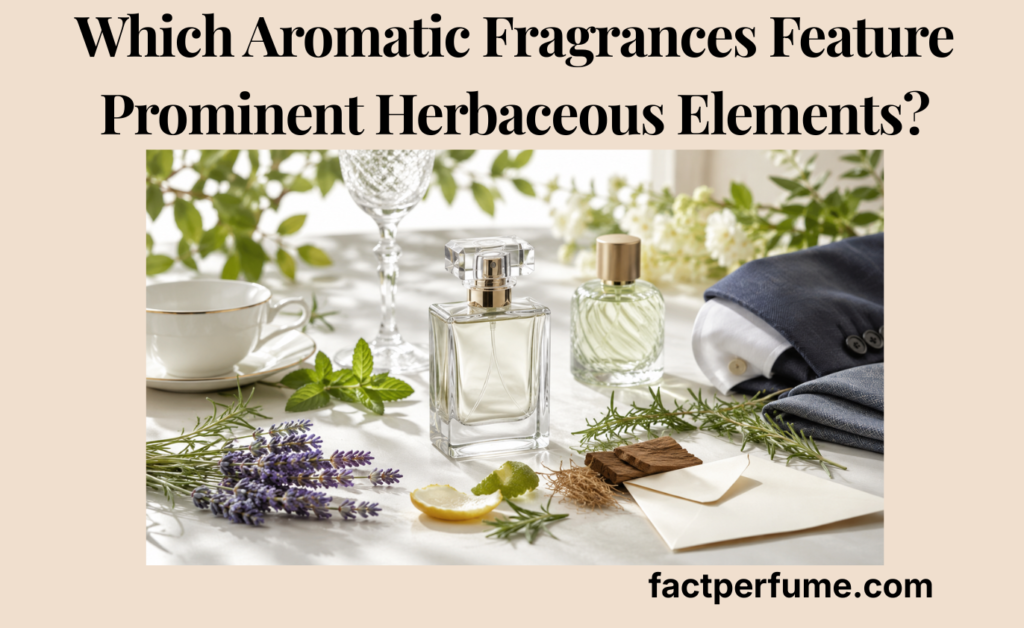
Which Aromatic Fragrances Feature Prominent Herbaceous Elements?
Aromatic fragrances with prominent herbaceous elements place recognisable herbs—such as mint, basil, rosemary, thyme, clary sage, lavender, fennel, or sagebrush—near the centre of their scent identity. Their herbal effects may smell cooling, savoury, camphoraceous, dry, bitter, tea-like, anisic, medicinal, or warm. “Aromatic-herbaceous fragrance” is a practical editorial descriptor rather than one universally standardised perfume family.
This guide separates herbaceous perfume from generic green and citrus freshness, compares six current fragrances, and helps the reader choose two or three contrasting samples. The selection covers cooling mint and tea, basil and rosemary, lavender-rosemary structure, dry thyme and sagebrush, bright multi-herb citrus, and modern clary-sage freshness without ranking one profile above the others.
What Distinguishes Herbaceous Aromatic Fragrances From Green, Citrus, Aquatic, Woody, and Fougère Styles?
Herbaceous aromatic fragrances are defined by recognisable herbal or aromatic-plant effects rather than freshness, greenery, or woods alone.
The wider aromatic perfumes may contain herbs, lavender, geranium, spices, woods, citrus, moss, watery effects, and other botanical impressions. Only part of that category is strongly herbaceous.
An aromatic-herbaceous fragrance qualifies when one or more identifiable herbs meaningfully shape its olfactory identity. The presence of a single herbal note in a long list is not sufficient. The plant should influence how the fragrance smells, how it develops, or how a buyer compares it with alternatives.
Herbaceous Versus Green
Herbaceous and green effects often overlap, but they are not identical.
Green fragrance may evoke:
- crushed leaves;
- grass;
- stems;
- cucumber;
- sap;
- galbanum;
- violet leaf;
- or broad vegetal freshness.
Herbaceous fragrance more specifically recalls identifiable aromatic plants such as mint, basil, rosemary, thyme, sage, lavender, fennel, or artemisia. It may smell savoury, camphoraceous, bitter, tea-like, medicinal, warm, dusty, or anisic rather than simply leafy.
A perfume can therefore be both herbaceous and green. Readers who need a broader explanation of leafy, grassy, and vegetal effects can compare them with green perfume notes.
Herbaceous Versus Citrus
Lemon, bergamot, mandarin, yuzu, orange, or petitgrain may support herbs by making a fragrance brighter, sharper, or more diffusive. Citrus alone does not establish herbaceous prominence.
A citrus aromatic becomes meaningfully herbaceous when recognisable plants such as basil, mint, rosemary, lavender, or fennel remain important to its identity.
Tacit and Buongiorno illustrate this overlap. Both use citrus structures, but their officially disclosed herbs create more specific botanical profiles.
Herbaceous Versus Aquatic
Marine, ozonic, watery, salty, melon-like, or abstract blue effects are not inherently herbaceous.
An aquatic aromatic qualifies as herbaceous only when an independent herbal character is present. Mint, sage, rosemary, lavender, or another aromatic plant must shape the fragrance rather than merely decorate a predominantly watery accord.
A fragrance can smell fresh without smelling herbal. A herbaceous fragrance can also feel dry, warm, dusty, savoury, or bitter rather than conventionally fresh.
Herbaceous Versus Woody Aromatic
Cedar, sandalwood, vetiver, patchouli, rosewood, moss, and amber woods often support aromatic herbs. They may add dryness, warmth, structure, persistence, or contrast.
Those materials alone do not prove herbaceous identity. A woody aromatic qualifies only when the herbs remain decision-relevant rather than disappearing into a broadly woody composition.
Cowboy Grass combines thyme, sagebrush, and basil with grass and vetiver. H24 Eau de Toilette places clary sage beside rosewood, narcissus, and a metallic-smelling effect. In both cases, the supporting structure modifies the herbality without removing the botanical direction.
Herbaceous Versus Fougère
Fougère is a broader structural tradition rather than a synonym for herbaceous perfume.
A fougère may involve:
- lavender or lavandin;
- geranium;
- aromatic herbs;
- coumarin-like warmth;
- oakmoss or mossy effects;
- woods;
- spices;
- or citrus.
Some fougères are distinctly herb-forward. Others emphasise sweetness, soapiness, moss, woods, or grooming-product associations.
Beau de Jour provides a useful lavender-and-rosemary example, but its geranium, oakmoss, patchouli, and warmth are also important. A deeper explanation belongs to the guide on fougère structure.
Selection standard used in this guide
A fragrance qualifies for this comparison when:
- Current official information supports a meaningful herbal direction.
- One or more herbs are central or decision-relevant.
- The product contributes a distinct herbal style.
- Inclusion does not depend only on a community database.
- Official facts can be separated from sensory interpretation.
- The fragrance creates a useful testing question for the reader.
Separate herbaceous aromatics from green, citrus, aquatic, woody, and fougère styles by checking whether identifiable herbs meaningfully shape the fragrance.
Which Herbal Notes and Accords Shape Aromatic-Herbaceous Fragrances?
Mint, basil, rosemary, thyme, clary sage, lavender, fennel, artemisia, and sagebrush create different forms of herbaceous fragrance rather than one uniform herbal smell.
Herbaceous Note and Accord Identification Matrix
The descriptions below are sensory tendencies. Botanical variety, extraction, supporting materials, formula design, and individual perception can change the result.
| Herbal Note or Accord | Common Effects | Important Variations | Typical Supporting Accords | Best-Fit Preference |
|---|---|---|---|---|
| Mint or spearmint | Brisk, leafy, mentholated, sweet-herbal, icy-smelling | Can feel transparent, tea-like, green, candy-like, or medicinal | Citrus, green tea, flowers, woods, musk | Readers seeking cooling-smelling and lively herbality |
| Basil | Leafy, peppery, clove-like, savoury, anisic, medicinal | Varieties may lean citrusy, spicy, sweet, green, or aromatic | Yuzu, lemon, clove, rosemary, vetiver, petitgrain | Readers seeking sharp green herbs or culinary-style freshness |
| Rosemary | Dry, brisk, camphoraceous, savoury, pine-adjacent, medicinal | May feel polished, rustic, floral, fresh, or strongly aromatic | Lavender, mint, citrus, basil, geranium, woods | Readers seeking dry aromatic structure |
| Thyme | Dry, sharp, wild, warm, earthy, medicinal | May feel dusty, spicy, bitter, floral, or terrain-like | Bergamot, sagebrush, basil, grass, vetiver | Readers seeking rugged or unconventional herbs |
| Clary sage | Tea-like, hay-like, herbal, warm, musky, tobacco-like, softly leathery | May feel smooth, floral, amber-like, green, or abstract | Narcissus, woods, moss, musk, amber, metallic effects | Readers seeking warm or modern botanical herbality |
| Lavender or lavandin | Floral-herbal, dry, soapy, sweet, camphoraceous, hay-like | May feel soft, sharp, mossy, sweet, powdery, or medicinal | Rosemary, geranium, coumarin-like warmth, moss, patchouli | Readers seeking fougère-style or polished herbality |
| Fennel or tarragon | Anisic, liquorice-like, green, sweet-herbal, bitter, spicy | The two are not identical and may appear culinary or medicinal | Basil, mint, citrus, clove, woods | Readers who enjoy anisic and less conventional green effects |
| Artemisia or wormwood | Bitter, dry, sharp, green, smoky, camphoraceous | Artemisia is a botanical group rather than one uniform smell | Lavender, spices, moss, woods, resins | Readers seeking bitter and austere botanical character |
| Sagebrush | Dry, dusty, bitter, prairie-like, grassy, medicinal | Distinct from clary sage; may feel wild, resinous, or earthy | Thyme, basil, grass, vetiver, rose, amber | Readers seeking dry landscape-like herbality |
Mint and Spearmint
Mint and spearmint may create a brisk, leafy, mentholated, sweet-herbal, or icy-smelling impression. These are olfactory descriptions, not claims that perfume physically cools the skin.
Spearmint may feel softer or sweeter-smelling than an aggressively mentholated mint effect, although formula context remains decisive. Citrus can make it sparkle, green tea can make it more transparent, and flowers, musk, or woods may soften it later.
Herba Fresca places spearmint within a fresh-herb and green-tea identity. Buongiorno places spearmint beside rosemary, lemon, and a basil-petitgrain co-distillation.
Basil
Basil may smell:
- leafy;
- peppery;
- spicy;
- clove-like;
- savoury;
- anisic;
- or medicinal.
The word “basil” does not describe one fixed effect. Botanical variety, extraction, supporting materials, and the complete accord may move it toward citrus freshness, green leaves, dark spice, culinary associations, or aromatic dryness.
Tacit places Basil Grand Vert beside yuzu and clove before rosemary, mint, and fennel appear in its middle-note presentation. Buongiorno uses a co-distillation of basil and petitgrain, while Cowboy Grass places basil among thyme, sagebrush, grass, and vetiver.
Rosemary
Rosemary may feel:
- dry;
- brisk;
- camphoraceous;
- savoury;
- pine-adjacent;
- or medicinal.
Alongside lavender and geranium, it can contribute to a polished fougère-style structure. Beside basil, mint, fennel, citrus, or petitgrain, it may feel brighter and more contemporary.
Tacit, Beau de Jour, and Buongiorno each disclose rosemary, but their supporting formulas produce different comparison roles. Its presence in a note list does not establish how strongly every wearer will perceive it.
Thyme
Thyme may smell:
- dry;
- sharp;
- warm;
- earthy;
- wild;
- dusty;
- or medicinal.
It can produce a terrain-like effect when paired with grasses, sagebrush, vetiver, and dry woods. Citrus or flowers may lift it, while a denser base can make the fragrance more austere.
No fixed duration should be assigned to a thyme note. The useful testing question is whether the thyme-like identity remains recognisable after the opening or merges into a broader grassy, woody, or bitter structure.
Clary Sage
Clary sage may evoke:
- tea;
- hay;
- warm herbs;
- soft tobacco;
- musk;
- amber;
- or a lightly leathery impression.
It is not a universal fixative, and its presence does not guarantee longevity. Its role depends on the material, formula, concentration, application, and supporting accords.
H24 Eau de Toilette places clary sage in a modern composition with narcissus, rosewood, and sclarene. Cowboy Grass discusses clary sage in its brand narrative, but its official note pyramid separately lists sagebrush.
Lavender and Lavandin
Lavender and lavandin may smell:
- floral-herbal;
- dry;
- soapy;
- sweet;
- hay-like;
- or camphoraceous.
They appear frequently in fougère-style structures, but not every lavender fragrance is herb-forward. Lavender may become floral, powdery, sweet, musky, mossy, or heavily groomed depending on the formula.
Beau de Jour uses lavender and lavandin with African rosemary, geranium, oakmoss, and patchouli. Buongiorno lists lavandin beneath a brighter citrus-and-herb opening.
Fennel and Tarragon
Fennel and tarragon may suggest:
- anise;
- liquorice;
- green leaves;
- sweet herbs;
- bitterness;
- or spice.
They should not be treated as interchangeable materials. A formula may emphasise their sweet-anisic side, bitter-green side, culinary associations, or medicinal effect.
Tacit officially lists fennel alongside rosemary and mint. The prominence of each should be confirmed through wear testing rather than inferred from list order.
Artemisia and Wormwood
Artemisia refers to a botanical group rather than one standardised perfume smell. Wormwood is associated with the group but should not be used as an interchangeable name for every artemisia material.
Possible impressions include:
- bitter;
- dry;
- sharp;
- green;
- smoky;
- camphoraceous;
- or medicinal.
These materials can contribute to austere, aromatic, fougère-like, woody, or bitter-green compositions. They are included here as a recognition category rather than as an official note claim about one of the six selected products.
Sagebrush
Sagebrush may feel dry, dusty, bitter, medicinal, grassy, or evocative of an open landscape.
It is distinct from clary sage. The two should not be merged merely because both names contain “sage.”
Cowboy Grass officially lists sagebrush in its heart, supported by wild thyme, basil, grass, vetiver, rose otto, and ambergris. This makes it the clearest dry and wild-herbal contrast in the selection.
Compare mint, basil, rosemary, thyme, lavender, clary sage, fennel, and sagebrush by their sensory direction, supporting accords, and likely preference boundaries.
How Should Herbaceous Aromatic Fragrances Be Evaluated Before Sampling?
Herbaceous aromatic fragrances should be evaluated by their official evidence, herbal prominence, supporting structure, dry-down, context fit, and main limitation.
A buyer should not move directly from seeing “basil,” “mint,” or “sage” in a note list to assuming that the complete fragrance will smell strongly or continuously of that plant.
1. Confirm the Exact Version
Check:
- the complete product name;
- whether it is Eau de Toilette or Eau de Parfum;
- whether a similarly named flanker exists;
- the current official product page;
- and whether the sample label matches the page.
This is particularly important for H24, which exists in several concentrations and variations. H24 Eau de Toilette should not be confused with H24 Eau de Parfum or H24 Herbes Vives.
2. Identify the Evidence Type
Determine whether the herb appears as:
- an officially highlighted key material;
- part of an official note pyramid;
- a central part of the brand narrative;
- an editorial sensory observation;
- or a prominence judgement requiring wear testing.
These evidence types are not interchangeable.
Aesop highlights yuzu, Vetiver Heart, and basil as Tacit’s key materials while separately publishing a fuller top, middle, and base presentation. D.S. & Durga publishes a formal note pyramid for Cowboy Grass and discusses additional narrative impressions separately.
3. Classify the Herbal Sub-Profile
Use a practical comparison category:
- cooling mint and herbal tea;
- basil-led citrus aromatic;
- classical lavender and rosemary;
- dry thyme and sagebrush;
- bright multi-herb citrus;
- or modern clary sage.
This prevents a sampling shortlist from containing several fragrances that express nearly the same kind of herbality.
4. Evaluate Herbal Prominence
Ask whether the herb is:
- central to the complete identity;
- strongly supporting another accord;
- most obvious in the opening;
- integrated into the middle;
- or transformed during the dry-down.
A perfume may qualify even when the herbs do not remain individually separable throughout wear. The central question is whether herbal character meaningfully shapes the fragrance.
5. Identify the Supporting Structure
Look for supporting effects such as:
- citrus;
- green tea;
- clove;
- lavender;
- geranium;
- vetiver;
- moss;
- patchouli;
- cedar;
- amber;
- musk;
- grass;
- flowers;
- or metallic-smelling effects.
The supporting structure often determines whether an herb feels transparent, polished, bitter, wild, smooth, traditional, or abstract.
6. Form a Dry-Down Question
Do not assume that the opening describes the complete perfume.
Ask whether it later becomes:
- woodier;
- mossier;
- grassier;
- muskier;
- warmer;
- more floral;
- more metallic;
- softer;
- or less recognisably herbal.
The answer should come from wear testing rather than from treating a note pyramid as an exact timeline.
7. Evaluate Performance Character Separately
Terms such as transparent, restrained, moderate, structured, dense, assertive, or close-wearing should be used only after testing.
Eau de Parfum does not automatically project more strongly or last longer than Eau de Toilette. Formula design, dose, materials, atomiser output, spray distribution, skin, clothing, temperature, and airflow all matter.
8. Consider Setting Compatibility
Evaluate whether the perfume fits the reader’s normal use:
- warm outdoor conditions;
- casual daytime wear;
- structured daytime clothing;
- cooler conditions;
- shared indoor spaces;
- or settings where strong camphoraceous or medicinal effects may be distracting.
No product should be described as universally office-safe or inoffensive.
9. Record One Advantage and One Limitation
A useful recommendation explains both what the fragrance offers and what could reduce the reader’s enjoyment.
One fragrance may provide beautifully clear mint but feel too transparent. Another may provide expressive wild herbs but feel too bitter, dusty, or medicinal.
10. Choose Sampling Priority
Prioritise a fragrance because it represents the reader’s preferred herbal direction or creates a useful contrast—not because it has the highest concentration, strongest marketing, or broadest note list.
Which Aromatic Fragrances Clearly Feature Prominent Herbaceous Elements?
Herba Fresca, Tacit, Beau de Jour, Cowboy Grass, Buongiorno, and H24 provide six distinct herbaceous comparisons rather than one universal best fragrance.
The official brand pages current on 1 August 2026 support the identities, concentrations, and disclosed materials below. Evidence strength differs between products, and official facts remain separate from editorial sensory directions that require personal wear testing.
Cooling mint and transparent herbal-tea freshness
Guerlain Aqua Allegoria Herba Fresca Eau de Toilette — Cooling Mint and Herbal Tea
Guerlain currently identifies the product as Aqua Allegoria Herba Fresca Eau de Toilette. Herba Fresca qualifies because a recognisable mint-and-herb direction shapes its official identity. Green tea and spring flowers support that direction without changing it into a purely floral, citrus, aquatic, or woody fragrance.
Officially emphasisedWhy sample it
Herba Fresca provides a clear starting point for readers seeking mint and light herbs without dense moss, dark woods, heavy spice, or strong amber warmth.
Watch for
Its transparent structure may feel too light for readers seeking deep, rugged, bitter, dry, or heavily structured herbality.
Does spearmint remain recognisable after the brightest opening softens, or does the fragrance become primarily floral, tea-like, musky, grassy, or generally green?
View full evidence and testing notes
Official Evidence
Guerlain describes:
- fresh herbs;
- spearmint leaves;
- a green-tea accord;
- spring flowers;
- dew imagery;
- and a tonic cut-grass impression.
Fresh herbs, spearmint, and green tea are central to the brand description. Grass and dew should be treated as official imagery and accord language rather than automatically converted into separate literal ingredients.
Main Supporting Structure
- Green-tea accord
- Spring flowers
- Dew and cut-grass imagery
- Transparent freshness
Editorial Profile to Test
Herba Fresca may feel:
- brisk;
- airy;
- dewy;
- minty;
- tea-like;
- green;
- or transparent.
These are testing directions rather than universal findings.
Best-Fit Reader
Worth sampling for readers who prefer:
- spearmint;
- green tea;
- fresh herbs;
- airy botanical scents;
- and lighter fragrance structures.
Confirm on Skin
- Whether mint remains central
- Whether the herbal identity survives the dry-down
- Whether the lower-density style feels satisfying
- Whether flowers and green tea become more important than the herbs
Modern basil-led citrus aromatic
Aesop Tacit Eau de Parfum — Basil, Rosemary, Mint, and Fennel
Aesop currently identifies the product as Tacit Eau de Parfum. Tacit qualifies because basil is part of its central identity and is reinforced by rosemary, mint, and fennel. Yuzu and vetiver shape the brightness and dryness, but the comparison would be incomplete without the multi-herb structure.
Officially disclosed and structurally centralWhy sample it
Tacit offers a multi-herb structure while keeping basil clearly connected to citrus brightness and a dry modern base.
Watch for
It may feel too streamlined for readers seeking moss, resin, warm sage, dense lavender, grass, or rugged medicinal herbality.
Does basil remain the central green effect, or do vetiver, cedarwood, and amber turn the perfume into a primarily dry woody aromatic?
View full evidence and testing notes
Official Key Materials
Aesop highlights:
- Yuzu
- Vetiver Heart
- Basil
Official Note Presentation
The official page separately lists:
- Top notes: Yuzu, Basil Grand Vert, Clove
- Middle notes: Rosemary, Mint, Fennel
- Base notes: Cedarwood, Vetiver Heart, Amber
Aesop describes basil as creating a green accord with delicately spicy, clove-like undertones. The three highlighted key materials and the fuller note presentation should remain separate rather than being merged into one undifferentiated list.
Main Supporting Structure
- Yuzu
- Clove
- Cedarwood
- Vetiver Heart
- Amber
Editorial Profile to Test
Tacit may feel:
- crisp;
- green;
- peppery;
- citrus-herbal;
- lightly anisic;
- dry;
- streamlined;
- or contemporary.
Best-Fit Reader
Worth sampling for readers who prefer:
- basil;
- rosemary;
- mint;
- fennel;
- yuzu;
- clove-like green spice;
- and dry vetiver.
Confirm on Skin
- Whether basil remains central
- Whether rosemary, mint, or fennel can be recognised separately
- Whether the anisic impression is enjoyable
- Whether the woody base becomes more important than the herbs
Classical lavender-and-rosemary aromatic
Tom Ford Beau de Jour Eau de Parfum — Lavender and Rosemary Fougère-Style Structure
Tom Ford currently identifies the product as Beau de Jour Eau de Parfum. Lavender, lavandin, and African rosemary create a recognisable herbal-floral and camphoraceous structure. Geranium, oakmoss, and patchouli make it more structured and traditional than a transparent mint or bright citrus-herbal perfume.
Officially disclosed and structurally centralWhy sample it
Beau de Jour demonstrates how lavender and rosemary can form a structured, mossy aromatic rather than a light herbal-fresh fragrance.
Watch for
It may feel too traditional, mossy, polished, or grooming-oriented for readers seeking minimalist herbs, transparent mint, bright citrus, or wild landscape effects.
Does rosemary remain noticeable beside lavender, or do oakmoss, patchouli, geranium, and warmth become the dominant later identity?
View full evidence and testing notes
Official Evidence
Tom Ford officially lists:
- Lavender
- Lavandin
- African Rosemary
- Geranium
- Oakmoss
- Patchouli
The brand description emphasises lavender, floral-green geranium, an oakmoss effect, patchouli, and amber-like warmth.
Editorial Classification
In this comparison, Beau de Jour is treated as a classical aromatic fougère-style example because of its disclosed lavender, rosemary, geranium, oakmoss, and patchouli structure.
This is editorial classification. It should not be presented as an official Tom Ford family label unless a current brand page supplies that classification.
Main Supporting Structure
- Geranium
- Oakmoss
- Patchouli
- Amber-like warmth
Editorial Profile to Test
Beau de Jour may feel:
- groomed;
- camphoraceous;
- herbal-floral;
- mossy;
- structured;
- polished;
- or traditional.
Best-Fit Reader
Worth sampling for readers who prefer:
- lavender;
- lavandin;
- rosemary;
- geranium;
- oakmoss;
- patchouli;
- and structured aromatic styling.
Confirm on Skin
- Whether rosemary remains recognisable
- Whether lavender feels dry, sweet, soapy, or camphoraceous
- Whether oakmoss and patchouli dominate later
- Whether the classical styling fits normal use
Dry wild thyme and sagebrush
D.S. & Durga Cowboy Grass Eau de Parfum — Wild Thyme, Sagebrush, Basil, Grass, and Vetyver
D.S. & Durga currently offers Cowboy Grass Eau de Parfum as a fragrance centred on American sagebrush, flowering white thyme, and prairie switchgrass. Cowboy Grass qualifies because wild thyme, sagebrush, and basil create a clear dry-herbal identity supported by grass and vetyver. Its inclusion does not depend on an incidental herb or an external database.
Officially emphasisedWhy sample it
Cowboy Grass provides the strongest wild, terrain-like, and medicinal-herbal contrast among the six fragrances.
Watch for
Its dry, bitter, dusty, or medicinal character may feel austere or unconventional to readers who prefer polished, sweet, citrusy, or transparent aromatics.
Does the thyme-and-sagebrush identity remain clear over grass and vetyver, or does the fragrance become primarily rooty, woody, rosy, or amber-warm?
View full evidence and testing notes
Official Note Pyramid
The current official page lists:
- Top notes: Rosewood, wild thyme, bergamot
- Heart notes: Sagebrush, basil, rose otto
- Base notes: Vetyver, grass, ambergris
The spelling “vetyver” and the material “ambergris” are preserved from the current official note pyramid.
Separate Brand Narrative
The brand narrative separately discusses:
- clary sage;
- medicinal herbality;
- dry vetiver;
- and warm amber or benzoin-like effects.
Clary sage belongs to the narrative discussion and should not be inserted into the official note pyramid. Sagebrush and clary sage are also not synonyms.
Main Supporting Structure
- Rosewood
- Bergamot
- Rose otto
- Grass
- Vetyver
- Ambergris
- Warm amber-like narrative effects
Editorial Profile to Test
Cowboy Grass may feel:
- dry;
- dusty;
- bitter;
- medicinal;
- grassy;
- rooty;
- prairie-like;
- or austere.
Landscape language is a sensory analogy rather than proof of literal terrain materials.
Best-Fit Reader
Worth sampling for readers who prefer:
- wild thyme;
- sagebrush;
- basil;
- grass;
- vetyver;
- dry botanical perfumes;
- and expressive niche herbality.
Confirm on Skin
- Which herb feels most prominent
- Whether the medicinal direction is enjoyable
- Whether the grass-vetyver base remains herbaceous
- Whether rose or amber warmth changes the expected dryness
Bright multi-herb citrus aromatic
Acqua di Parma Buongiorno Eau de Parfum — Spearmint, Rosemary, Basil, Petitgrain, and Lavandin
Acqua di Parma currently identifies the product as Buongiorno Eau de Parfum. Buongiorno qualifies because spearmint, rosemary, basil, and lavandin shape a recognisable multi-herb opening and heart. Citrus and leafy accords support the herbs rather than replacing the aromatic identity.
Officially disclosed and structurally centralWhy sample it
Buongiorno combines several recognisable herbs with an approachable citrus and leafy structure, creating a useful bridge between broad freshness and more specific herbality.
Watch for
The citrus opening and polished musky-woody base may soften the herbal emphasis for readers seeking dry, bitter, mossy, or medicinal plants.
Do spearmint, rosemary, and basil remain clear after the citrus opening, or do white musk, amber, cedarwood leaves, and leafy effects create a smoother non-herbal finish?
View full evidence and testing notes
Official Note Presentation
The official page lists:
- Top notes: Lemon Essence, Spearmint Essence, Rosemary Essence, Co-distillation of Basil and Petitgrain Essences
- Heart notes: Lavandin Essence, Mandarin Leaves Accord
- Base notes: Cedarwood Leaves Essence, Amber Accord, White Musks Accord
The brand explains that the co-distillation harmonises the distinct characters of basil and petitgrain. It should not be rewritten as separate isolated proportions.
Official Classification
The brand classifies Buongiorno as:
Citrus Aromatic Green
This is Acqua di Parma’s classification and should not be treated as a universal perfume taxonomy.
Main Supporting Structure
- Lemon
- Petitgrain
- Mandarin leaves
- Cedarwood leaves
- Amber accord
- White musks
Editorial Profile to Test
Buongiorno may feel:
- sparkling;
- minty;
- leafy;
- rosemary-led;
- basil-citrus;
- polished;
- bright;
- or smooth.
Best-Fit Reader
Worth sampling for readers who prefer:
- spearmint;
- rosemary;
- basil;
- petitgrain;
- lavandin;
- bright citrus;
- and polished daytime fragrance.
Confirm on Skin
- Whether herbs remain clear after the citrus opening
- Whether the basil-petitgrain effect is recognisable
- Whether white musk and amber dominate later
- Whether the polished style feels too smooth
Modern clary-sage botanical aromatic
Hermès H24 Eau de Toilette — Clary Sage and Modern Botanical Freshness
Hermès currently identifies the product as H24 Eau de Toilette. H24 Eau de Toilette qualifies because clary sage is central to the official composition. Narcissus, rosewood, and sclarene make the profile more abstract and contemporary than a literal mint, thyme, basil, or lavender fragrance.
Officially emphasisedWhy sample it
H24 demonstrates how clary sage can support a modern botanical fragrance outside a conventional mossy, barbershop-like, or citrus-herbal structure.
Watch for
Narcissus and sclarene may make it feel more abstract than literally herbal to readers seeking a recognisable herb-garden impression.
Does clary sage remain recognisable, or do narcissus, rosewood, and the metallic-smelling effect become the main later identity?
View full evidence and testing notes
Official Evidence
Hermès describes its aromatic botanical freshness through:
- Clary sage
- Narcissus
- Rosewood
- Sclarene
The brand describes sclarene as warm and metallic. This is an olfactory description; sclarene should not be described as literal metal.
Main Supporting Structure
- Narcissus
- Rosewood
- Sclarene
- Floral-green effects
- Metallic-smelling warmth
Editorial Profile to Test
H24 Eau de Toilette may feel:
- sage-led;
- floral-green;
- smooth;
- metallic;
- contemporary;
- airy;
- or abstract.
Best-Fit Reader
Worth sampling for readers who prefer:
- clary sage;
- modern botanical freshness;
- floral-green effects;
- rosewood;
- and abstract metallic texture.
Confirm on Skin
- Whether sage is clearly recognisable
- Whether narcissus becomes dominant
- Whether the metallic-smelling effect is appealing
- Whether the fragrance feels botanical enough for the reader’s goal
Aromatic-Herbaceous Fragrance Comparison Matrix
| Product and Concentration | Official Herbal Drivers | Evidence Strength | Editorial Herbal Sub-Profile | Supporting Structure | Dry-Down Question | Best-Fit Preference | Important Limitation |
|---|---|---|---|---|---|---|---|
| Guerlain Aqua Allegoria Herba Fresca Eau de Toilette | Fresh herbs, spearmint, green-tea accord | Officially emphasised | Cooling mint and transparent herbal tea | Spring flowers, green tea, dew and cut-grass imagery | Does spearmint remain recognisable after the opening? | Light mint, tea, and airy herbal freshness | May feel too transparent or lightly structured |
| Aesop Tacit Eau de Parfum | Basil Grand Vert, rosemary, mint, fennel | Officially disclosed and structurally central | Basil-led citrus aromatic | Yuzu, clove, cedarwood, vetiver, amber | Does basil remain central over the dry woody base? | Contemporary multi-herb citrus and vetiver | May lack mossy, warm, or rugged depth |
| Tom Ford Beau de Jour Eau de Parfum | Lavender, lavandin, African rosemary | Officially disclosed and structurally central | Classical lavender-rosemary fougère style | Geranium, oakmoss, patchouli, warmth | Do moss and patchouli overtake the herbs? | Structured, polished lavender and rosemary | May feel traditional, mossy, or grooming-oriented |
| D.S. & Durga Cowboy Grass Eau de Parfum | Wild thyme, sagebrush, basil | Officially emphasised | Dry wild-herbal | Grass, vetyver, rose otto, rosewood, ambergris | Does the base remain recognisably herbal? | Dry, bitter, medicinal, terrain-like herbs | Can feel austere, dusty, or polarising |
| Acqua di Parma Buongiorno Eau de Parfum | Spearmint, rosemary, basil-petitgrain, lavandin | Officially disclosed and structurally central | Bright multi-herb citrus | Lemon, mandarin leaves, cedarwood leaves, amber, white musks | Do the herbs remain distinct after the citrus opening? | Polished bright herbality and leafy citrus | Herbal focus may soften into musk and woods |
| Hermès H24 Eau de Toilette | Clary sage | Officially emphasised | Modern clary-sage botanical | Narcissus, rosewood, sclarene | Does the floral-metallic effect dominate the sage? | Abstract, contemporary botanical freshness | May smell less literally herbal |
How Do Herbal Impressions Change During an Aromatic Fragrance’s Dry-Down?
Herbal impressions may soften, merge, or transform into woods, moss, grass, musk, amber, florals, vetiver, or metallic effects during the dry-down.
The dry-down is the later stage of wear after the most immediate opening effects have softened. It does not begin at one universal time, and a note pyramid is not an exact clock.
The Opening Is Not the Complete Perfume
Mint, citrus, basil, and some leafy effects may be particularly noticeable shortly after application.
That does not prove they will disappear after a fixed number of minutes, nor does it mean that the perfume has ended when they become quieter.
A bright herbal opening may soften while the complete fragrance remains detectable. The later structure may reveal:
- woods;
- vetiver;
- moss;
- patchouli;
- musk;
- amber;
- grass;
- flowers;
- tea-like effects;
- or metallic-smelling materials.
Supporting Materials Can Reshape Herbality
Other parts of the formula may:
- echo the herbal impression;
- make it feel drier;
- soften its sharpness;
- add sweetness;
- create contrast;
- extend part of its character;
- or replace the recognisable herb with a broader botanical effect.
This does not mean one material permanently locks an opening note in place. Fragrance development reflects the interaction of the complete formula.
Separate Four Performance Questions
Evaluate these questions independently:
- Total longevity: How long does the complete fragrance remain detectable?
- Herbal persistence: How long does the original herbaceous identity remain recognisable?
- Projection: How noticeably does the fragrance radiate around the wearer?
- Dry-down identity: What later character supports or replaces the opening herbs?
A fragrance may remain detectable after its mint or basil has softened. Another may retain a broad herbal impression even when individual plants are no longer easy to separate.
Formula, Skin, Surface, and Environment Matter
Fragrance evaporation and perception may vary with:
- the complete formula;
- molecular properties;
- carrier;
- application dose;
- spray distribution;
- skin characteristics;
- clothing;
- application surface;
- temperature;
- humidity;
- airflow;
- olfactory adaptation;
- and individual perception.
A 2025 study examining fragrance evaporation on several volunteers found variation associated with both fragrance-molecule properties and measured skin characteristics. Skin study A separate study developed in-vivo and in-vitro methods for evaluating fragrance evaporation on skin and model surfaces. Surface study These findings support multi-factor evaluation but do not predict the wear time of any product in this comparison.
Variation should not be reduced to skin pH alone.
Persistence also cannot be predicted merely by labelling a material natural or synthetic. It depends on the materials, their properties, the complete formula, application, surface, wearer, and testing conditions.
A fuller treatment of these mechanisms belongs to the guide on aromatic longevity.
Paper and Skin Serve Different Purposes
A paper strip can help identify:
- immediate dislike;
- obvious mint, basil, rosemary, thyme, lavender, or sage character;
- medicinal intensity;
- sweetness;
- citrus dominance;
- and similarity between samples.
Skin testing remains necessary because warmth, application distribution, surface interaction, and personal perception may change the development.
Neither paper nor skin should be treated as an exact simulation of every climate or future setting.
Record Development in Stages
Instead of assigning fixed minute ranges, record:
- the opening;
- early development;
- mid-wear;
- dry-down;
- and final detectable character.
For each stage, note:
- which herbs remain identifiable;
- whether the fragrance becomes woody or mossy;
- whether sweetness increases;
- whether it becomes grassy, musky, floral, ambery, or metallic;
- and whether the complete development remains enjoyable.
How Can Aromatic-Herbaceous Fragrances Be Matched to Climate and Setting?
Aromatic-herbaceous fragrances should be matched by herbal style, formula density, projection, ventilation, climate, and wearer preference rather than rigid seasonal labels.
No fragrance is restricted to one season. Climate guidance is most useful when treated as a sampling priority rather than a rule.
Cooling and Bright Warm-Weather Profiles
Readers seeking bright or cooling-smelling herbality may begin with:
- Guerlain Aqua Allegoria Herba Fresca Eau de Toilette;
- Aesop Tacit Eau de Parfum;
- or Acqua di Parma Buongiorno Eau de Parfum.
These options emphasise different combinations of:
- spearmint;
- green tea;
- basil;
- rosemary;
- fennel;
- lemon;
- yuzu;
- and petitgrain.
Herba Fresca offers the most transparent mint-and-tea direction. Tacit combines basil and several herbs with dry citrus and vetiver. Buongiorno provides a brighter and more polished multi-herb citrus structure.
Heat and airflow may alter diffusion or perception, but warm weather does not guarantee stronger projection, better performance, or longer herbal persistence.
Professional and Shared Spaces
Possible samples for controlled testing include:
- H24 Eau de Toilette;
- Tacit Eau de Parfum;
- Herba Fresca Eau de Toilette;
- and Beau de Jour Eau de Parfum with particular application restraint.
Before wearing any fragrance in a shared environment, assess:
- workplace or venue policy;
- application amount;
- room size;
- ventilation;
- physical proximity;
- exposure duration;
- and known fragrance sensitivity.
A transparent fragrance can still be noticeable. A polished fragrance can still be too strong. A herbaceous label does not make a perfume universally suitable for an office.
Also consider whether the wearer or nearby people find camphoraceous, medicinal, anisic, mossy, or metallic-smelling effects distracting.
Structured Daytime Aromatic
Beau de Jour is the clearest option for readers seeking a structured lavender-and-rosemary style.
Its geranium, oakmoss, and patchouli provide a more classical framework than the transparent mint of Herba Fresca or the bright citrus herbs of Tacit and Buongiorno.
It may complement polished daytime clothing or structured social use, but this is an editorial styling tendency rather than universal formality.
Modern Botanical Wear
Tacit, Buongiorno, and H24 provide three modern botanical contrasts:
- Tacit: Basil-led citrus with rosemary, mint, fennel, clove, and vetiver
- Buongiorno: Spearmint, rosemary, basil-petitgrain, lavandin, citrus, leaves, and musk
- H24 Eau de Toilette: Clary sage with narcissus, rosewood, and a metallic-smelling effect
Tacit is the driest basil-citrus option. Buongiorno is brighter and more multi-herbal. H24 is the most abstract and floral-metallic.
Dry and Wild Herbality
Cowboy Grass is the primary sample for readers seeking:
- wild thyme;
- sagebrush;
- basil;
- grass;
- vetyver;
- dryness;
- bitterness;
- and medicinal botanical character.
This style may be polarising. It should be sampled rather than purchased from its note list or landscape description alone.
Readers who dislike dry grasses, dusty herbs, strong vetiver effects, or medicinal impressions may prefer Tacit, Buongiorno, or Herba Fresca.
Cooler or Transitional Conditions
Fragrances containing more substantial supporting structures may feel more coherent to some readers in cooler or transitional conditions.
Relevant effects include:
- lavender;
- moss;
- patchouli;
- vetiver;
- cedar;
- amber;
- grass;
- and warm aromatic materials.
Beau de Jour and Cowboy Grass provide the most obvious structured contrasts. Tacit may also work when its woody and amber support feels substantial enough to the wearer.
This does not mean transparent mint, tea, or citrus-herbal fragrances disappear in cold weather.
Climate and Setting Decision Matrix
| Reader Need or Setting | Profile to Prioritise | Sample Candidates | Trade-Off to Test |
|---|---|---|---|
| Cooling-smelling herbality | Mint, green tea, bright herbs | Herba Fresca, Tacit, Buongiorno | The clearest opening herbs may soften |
| Structured aromatic wear | Lavender, rosemary, moss, patchouli | Beau de Jour | Classical or traditional character may feel too strong |
| Modern botanical style | Basil, clary sage, clean woods, abstract freshness | Tacit, H24 Eau de Toilette | The result may feel streamlined or abstract |
| Dry wild herbs | Thyme, sagebrush, basil, grass, vetyver | Cowboy Grass | Medicinal, bitter, dusty, or austere effects |
| Bright citrus-herbal wear | Spearmint, rosemary, basil, petitgrain, yuzu | Buongiorno, Tacit | Citrus may lead more strongly than the herbs |
| Light relaxed herbality | Spearmint, green tea, fresh herbs | Herba Fresca | Lower density may feel insufficient |
| Polished shared-space testing | Restrained botanical or fougère-style profiles | H24, Tacit, Herba Fresca, Beau de Jour | Policy, dose, room size, and projection remain decisive |
| Cooler transitional use | Moss, patchouli, vetiver, woods, grass, warmth | Beau de Jour, Cowboy Grass, Tacit | Structure may become too dry, mossy, or medicinal |
Move from official product evidence to paper screening, skin testing, dry-down evaluation, and a bottle decision based on the complete fragrance.
How Should Herbaceous Aromatic Fragrances Be Sampled Before Buying?
The most reliable buying process is to compare two or three contrasting herbal profiles, evaluate each beyond the opening, and delay a bottle purchase until the full wear remains enjoyable.
Step 1: Select Contrasting Profiles
Do not begin with several fragrances that all centre on bright citrus and basil. A useful shortlist exposes the reader to clearly different expressions of herbality.
Classical Contrast
Compare:
- Herba Fresca Eau de Toilette
- Beau de Jour Eau de Parfum
- Cowboy Grass Eau de Parfum
This contrasts:
- cooling mint and green tea;
- lavender and rosemary over moss and patchouli;
- dry thyme and sagebrush over grass and vetyver.
This set is useful when the reader has not decided whether they prefer transparent, structured, or wild herbality.
Modern Contrast
Compare:
- Tacit Eau de Parfum
- Buongiorno Eau de Parfum
- H24 Eau de Toilette
This contrasts:
- basil-led citrus with rosemary, mint, and fennel;
- bright spearmint, rosemary, basil-petitgrain, and lavandin;
- modern clary sage with narcissus, rosewood, and a metallic-smelling effect.
This set is useful when the reader prefers contemporary freshness but needs to distinguish literal herbs from abstract botanical effects.
Targeted Two-Sample Contrasts
Useful pairs include:
- Herba Fresca versus Cowboy Grass: Transparent mint-tea versus dry wild herbs
- Tacit versus Buongiorno: Basil-yuzu dryness versus polished multi-herb citrus
- Beau de Jour versus H24: Classical lavender-rosemary structure versus modern clary-sage abstraction
- Herba Fresca versus Buongiorno: Light spearmint-tea versus fuller citrus and multiple herbs
- Cowboy Grass versus Beau de Jour: Wild terrain-like dryness versus polished mossy structure
Step 2: Verify the Exact Version
Before obtaining a sample, confirm:
- the complete product name;
- the concentration;
- the sample label;
- the current official product page;
- and current availability in the reader’s region.
Do not confuse:
- Eau de Toilette with Eau de Parfum;
- an original product with a flanker;
- H24 Eau de Toilette with H24 Eau de Parfum or Herbes Vives;
- a fine fragrance with a deodorant, body product, or home-fragrance item;
- or a current version with a discontinued one.
Step 3: Screen Samples on Paper
Use paper to identify:
- immediate dislike;
- strong medicinal effects;
- excessive sweetness;
- dominant citrus;
- obvious mint, basil, rosemary, thyme, lavender, or sage;
- and fragrances that appear too similar.
Label each strip with:
- product name;
- concentration;
- application time;
- and the end of the strip that was sprayed.
Revisit the paper after the opening. Do not make the final buying decision from paper alone.
Step 4: Test Selected Fragrances on Skin
Test only one or two fragrances at a time.
Use separate application areas and keep the dose reasonably consistent. Do not rub the application points together, because that changes the distribution and makes direct comparison less controlled.
Record which fragrance was placed on each area. Avoid applying perfume to irritated skin.
A skin test should establish:
- whether the herb remains recognisable;
- whether the supporting formula becomes more or less appealing;
- whether projection feels comfortable;
- and whether the dry-down fits normal use.
Step 5: Evaluate the Complete Development
Record the following separately.
Opening Herbal Clarity
- Which herb is easiest to recognise?
- Is the effect cooling-smelling, savoury, camphoraceous, bitter, anisic, dusty, or warm?
- Is citrus more prominent than the herbs?
Mid-Wear Continuity
- Does the herbal identity remain central?
- Do individual herbs merge into one accord?
- Does the fragrance become more floral, woody, grassy, or mossy?
Dry-Down
- Does mint become tea-like or musky?
- Does basil become woody or ambery?
- Does lavender become mossy or patchouli-led?
- Do thyme and sagebrush remain clear over grass and vetyver?
- Does clary sage become floral or metallic-smelling?
Projection
- Is the fragrance noticeable only close to the wearer?
- Does it occupy more space than expected?
- Does it remain comfortable in the intended environment?
Total Longevity
- How long does the complete fragrance remain detectable?
- Does the reader still enjoy it after the herbs change?
- Is the final detectable character worth wearing even when the opening has softened?
Step 6: Repeat Under Normal Conditions
When practical, repeat the test:
- on another day;
- in expected weather;
- in the intended setting;
- with a normal application;
- and without several competing scented products.
One test can be influenced by weather, fatigue, congestion, other fragrances, expectations, and olfactory adaptation.
Step 7: Make the Bottle Decision
Ask:
- Which herbal direction do I genuinely prefer?
- Is the herb central or merely a short opening detail?
- Does the dry-down remain enjoyable?
- Is the perfume too medicinal, mossy, citrusy, dry, sweet, smooth, or abstract?
- Is projection comfortable for normal use?
- Does it add something distinct to my existing fragrances?
- Would I use the intended bottle regularly?
- Would another contrasting sample reduce uncertainty?
A bottle is justified only when the complete fragrance—not merely the first mint, basil, lavender, thyme, or sage impression—fits the reader’s preference and routine.
Final Sampling and Purchase Checklist
0 of 19 completed
Frequently Asked Questions
One or more identifiable herbs must meaningfully shape the fragrance’s scent identity, development, or comparison role. A single herbal note in a long list is not enough when the complete perfume smells mainly citrusy, woody, aquatic, or broadly green.
Herba Fresca is the clearest starting sample for transparent spearmint, fresh herbs, and green-tea freshness. This is a comparison role rather than a universal performance claim, so its density and dry-down still need to be tested on skin.
No. Clary sage may feel tea-like, hay-like, musky, warm, or softly leathery, while sagebrush may feel drier, dustier, bitterer, and more landscape-like. They should not be merged simply because both names contain sage.
No. Concentration labels do not independently predict exact longevity or projection across unrelated fragrances. Formula design, materials, dose, atomiser output, skin, clothing, temperature, and airflow all influence the result.
They may work where fragrance is permitted and the exact formula remains within personal space. Transparent does not always mean discreet, and camphoraceous, medicinal, anisic, mossy, or metallic effects may still distract people in close shared environments.
Two or three contrasting profiles are usually easier to evaluate than a large group. Compare meaningfully different directions, such as mint and tea, lavender and rosemary, and dry thyme with sagebrush, then test the finalists on skin.
Finalising Your Herbaceous Aromatic Fragrance Shortlist
Herbaceous aromatic fragrance is not one uniform scent: it may be cooling and minty, basil-led and citrusy, lavender-and-rosemary-based, dry and wild, or modern and clary-sage-driven. Herbaceous and green effects may overlap, but they are not identical; a fougère is not automatically herb-dominant, and the appearance of one herb in a note list does not prove prominence.
Official emphasis establishes why a product belongs in the comparison, while testing reveals whether its herbs remain meaningful through the dry-down. Select two or three contrasting samples, verify the exact versions, compare projection and total longevity separately, and buy only when the complete fragrance—not merely its opening—fits your preference and normal use.