
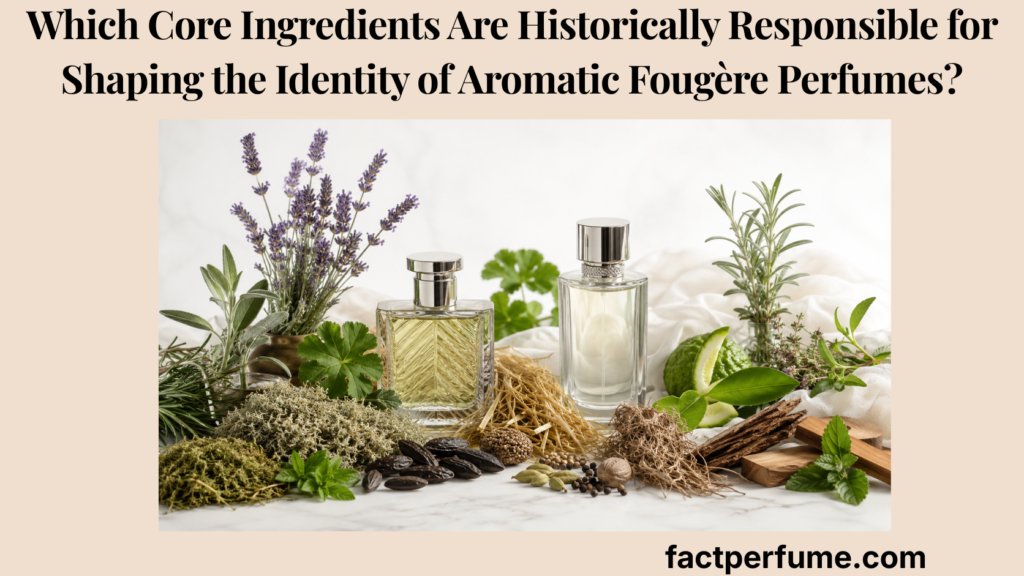
Which Core Ingredients Are Historically Responsible for Shaping the Identity of Aromatic Fougère Perfumes?
The historical identity of aromatic fougère perfumes is most closely associated with lavender-like aromatic freshness, coumarin-like sweet-hay warmth, and oakmoss or a related mossy effect. This relationship forms a widely recognised classical reference backbone rather than a compulsory recipe. Bergamot, geranium, vetiver, patchouli, herbs, spices, woods, and musks frequently extend the structure and give individual fougères their distinctive texture.
Fougère is a fantasy fern accord rather than a literal reproduction of one plant, and its development connects perfume artistry, synthetic chemistry, changing classification systems, and later grooming traditions. Understanding the family therefore requires more than searching a note pyramid for lavender, coumarin, and oakmoss: its complete architecture, historical context, dry-down, and modern reconstruction must also be considered.
Educational note: This article explains perfume history, classification, and finished-fragrance structure. Published note lists are not complete formulas, and IFRA Standards, supplier specifications, and applicable regulations may change. Do not use this guide as a raw-material formula, usage-limit calculation, or chemical-handling instruction.
How Should the Historical Fougère Accord Be Defined?
The historical fougère accord should be defined as an imagined fern-like perfume architecture combining aromatic freshness, coumarinic warmth, mossy depth, and supporting floral, citrus, herbal, or woody effects.
The French word fougère means “fern.” Most ferns do not produce the rich perfume traditionally associated with the fragrance family, so the style is better understood as an olfactory fantasy. Perfumers constructed an imagined forest atmosphere using herbal freshness, sweet hay, damp moss, flowers, roots, citrus, and woods.
This makes fougère an accord-based idea rather than a literal fern extract. Different perfumes can evoke that idea through different combinations of materials.
The Classical Reference Model
The most recognisable historical teaching model combines three broad facets:
- lavender or a related aromatic-herbal effect;
- coumarin or tonka-like sweet-hay warmth;
- oakmoss or a constructed mossy effect.
These facets create a useful way to understand the family, but they should not be treated as a legal formula or a test that every modern fougère must pass.
A fragrance may be officially classified as fougère without publicly listing all three. A brand may communicate “tonka,” “hay,” “moss,” “forest floor,” or “aromatic woods” instead of naming the exact historical materials. The formula may also use reconstructed accords that reproduce selected effects without relying on the same raw materials used in an earlier perfume.
Aromatic Fougère in Modern Classification
Michael Edwards’ Fragrances of the World currently describes Aromatic Fougère as a signature blend of lavender and geranium supported by citrus, herbs, and woods. This is one formal classification framework rather than a universal rule followed by every perfume house or fragrance writer.
The wider aromatic perfumes includes many herbaceous, spicy, green, citrus, and woody structures that are not necessarily fougères. Aromatic describes a broad scent character; fougère describes a more specific historical architecture.
Modern fougères may be:
- green;
- woody;
- spicy;
- floral;
- aquatic;
- ambered;
- sweet;
- musky;
- transparent;
- dense.
The family is therefore held together by a recognisable relationship among aromatic lift, warm coumarinic effects, and earthy or mossy depth—not by one unchanging ingredient list.
Fougère Is Not the Same as Green or Chypre
Fougère may smell green because lavender, herbs, moss, geranium, vetiver, and woods can evoke foliage or forest shade. However, green notes may also produce cut-grass, leafy, vegetal, resinous, watery, or stem-like effects without creating a fougère structure.
Chypre is another related but separate architecture. Traditional chypre structures frequently organise citrus, florals, patchouli, moss, woods, and labdanum-like warmth differently from the aromatic–coumarinic relationship associated with fougère.
Barbershop fragrance is also not a formal substitute for the whole family. It is a cultural descriptor for clean, powdery, soapy, lavender-rich, herbal, and mossy effects associated with shaving and grooming products.
Which Core Materials Formed the Classical Fougère Backbone?
Lavender-like aromatic lift, coumarin-like sweet-hay warmth, and oakmoss-like depth form the most recognisable historical fougère reference.
Their identity comes from interaction. Lavender supplies clarity and freshness, coumarin creates warmth and soft sweetness, and mossy materials add bitterness, shadow, and earthiness. Supporting materials connect these contrasts into a continuous perfume rather than three isolated notes.
Lavender and Related Aromatic Effects
Lavender is one of the clearest historical signals of fougère structure. Depending on its species, extraction, quality, and formula context, it may smell:
- herbal;
- floral;
- camphoraceous;
- dry;
- sweet;
- soapy;
- green;
- hay-like.
Lavandin may provide a brisker or more camphoraceous effect, while lavender absolute can introduce deeper herbal, floral, or warm nuances. Perfumers may also build a lavender impression through an accord rather than relying on one material.
Structurally, lavender can establish the aromatic identity, connect citrus to the heart, bridge fresh and warm facets, and provide clarity against a darker mossy base.
Lavender is not limited to the top of a perfume, and it is not inherently masculine. Its association with male-marketed fougères developed through repeated cultural and commercial use.
A modern fragrance may also communicate a lavender-like aromatic character without listing lavender in its published notes.
Coumarin and Tonka-Like Warmth
Coumarin is a molecule that occurs naturally in tonka bean and other plants and can also be produced synthetically.
Its olfactory effects may include:
- freshly cut or dried hay;
- soft powder;
- warmth;
- tonka-like sweetness;
- tobacco-adjacent nuances;
- almond-like impressions;
- vanilla-adjacent softness.
In a fougère, coumarinic warmth can soften the contrast between bright aromatics and bitter moss. It helps connect the fresh opening with the earthier dry-down and gives the imaginary fern landscape a warm, textured centre.
Coumarin is not identical to tonka bean. Tonka is a botanical material containing coumarin alongside numerous other constituents. A tonka material or accord may therefore smell richer, more balsamic, more almond-like, more tobacco-like, or more vanilla-like than isolated coumarin.
Coumarin is also not restricted to a single note stage. Its effect may influence the heart, base, or overall texture depending on the formula.
Most importantly, coumarin alone does not make a fragrance a fougère. Its role must be interpreted within the complete architecture.
Oakmoss and Constructed Mossy Effects
Oakmoss is a lichen-derived fragrance material associated with Evernia prunastri. Depending on its processing and surrounding formula, it may contribute:
- earthy depth;
- dampness;
- bitterness;
- woodiness;
- ink-like darkness;
- forest-floor character;
- leather-like texture;
- mossy shadow.
Historically, this facet counterbalanced coumarin’s sweetness and reinforced the fantasy of a cool, shaded woodland.
Oakmoss may also support the dry-down, connect florals to woods, and give the composition a sense of depth. However, it should not automatically be called a fixative simply because it appears in a base structure.
A base note is a concept describing later fragrance development. A fixative is a material or formulation strategy that may influence evaporation, diffusion, substantivity, or persistence within a particular formula. The two ideas overlap in some cases, but they are not interchangeable.
A modern note pyramid listing “moss” does not prove that natural oakmoss was used. The effect may come from compliant natural material, treated extracts, specialised molecules, patchouli, vetiver, woods, phenolic effects, or a multi-material accord.
Why the Three Facets Work Together
The classical fougère model can be understood as:
Aromatic lift + coumarinic warmth + mossy depth
Lavender-like freshness provides brightness and definition. Coumarinic warmth introduces softness, powder, and hay-like sweetness. Mossy materials create darkness, bitterness, and earthy contrast.
The complete identity emerges from their balance and from the citrus, florals, herbs, roots, woods, musks, and spices surrounding them.
Fougère Architecture and Boundary Matrix
| Term or Facet | Main Structural Focus | Common Signals | Status | Important Limitation |
|---|---|---|---|---|
| Classical fougère reference | Aromatic lift, coumarinic warmth, mossy depth | Lavender, hay-like sweetness, moss | Historical teaching model | Not a mandatory formula |
| Aromatic Fougère | Lavender and geranium with citrus, herbs, and woods | Aromatic freshness, floral-green continuity, woody support | Formal in some taxonomies | Frameworks may classify differently |
| Lavender-aromatic facet | Herbal and floral freshness | Lavender, lavandin, rosemary, sage | Structural facet | Lavender need not appear publicly |
| Coumarin-tonka facet | Warm, powdery, sweet-hay effect | Coumarin, tonka, hay, soft tobacco | Structural facet | Tonka and coumarin are not identical |
| Mossy facet | Bitter, earthy, shaded depth | Oakmoss, moss accords, vetiver, patchouli | Structural facet | A moss note does not prove oakmoss use |
| Green fougère | Fougère structure with stronger leafy or bitter effects | Herbs, galbanum, moss, green woods | Modern variation | Not every green perfume is fougère |
| Amber fougère | Aromatic structure with warmer ambered support | Tonka, resins, vanilla, amber woods | Modern variation | Sweetness alone is insufficient |
| Barbershop fragrance | Grooming-associated aromatic cleanliness | Lavender, soap, powder, herbs, moss | Cultural descriptor | Not the whole fougère family |
| Chypre | Citrus with mossy, woody, patchouli, floral, or resinous structure | Bergamot, patchouli, moss, labdanum | Separate family | Not a fougère synonym |
| General aromatic fragrance | Herbs, spices, green materials, citrus, or woods | Rosemary, sage, mint, basil, lavender | Broad category | Not automatically fougère |
Which Supporting Ingredients Expanded the Classical Fougère Structure?
Bergamot, geranium, vetiver, patchouli, herbs, spices, woods, and musks frequently expanded the classical fougère structure without becoming mandatory in every formula.
These materials create transitions among the fresh, warm, floral, earthy, and woody parts of the accord. They also allow perfumers to make fougères brighter, greener, darker, cleaner, sweeter, spicier, more transparent, or more substantial.
Bergamot and Other Citrus Materials
Bergamot is historically useful because it combines brightness with a slightly bitter, floral, and aromatic character.
It may:
- illuminate the opening;
- sharpen herbal freshness;
- bridge citrus and lavender;
- contrast with coumarin;
- prepare the transition into moss and woods.
Lemon, mandarin, lime, grapefruit, petitgrain, and bitter-orange effects can perform related roles.
Citrus is frequent in fougère construction but not compulsory. A modern formula may establish freshness through herbs, aquatic materials, spices, or diffusive woods instead.
Geranium as an Aromatic-Floral Bridge
Geranium may smell rosy, minty, green, herbal, metallic, or floral depending on the material and formula.
It is especially effective between lavender and moss because it can extend aromatic freshness while adding floral continuity. Its green or mint-like dimensions can connect herbs to earthy materials, while its rosy character gives the heart more volume.
Geranium does not make a fragrance feminine or masculine. Ingredient gender is a cultural interpretation, not an inherent material property.
Vetiver and Rooty Dryness
Vetiver may contribute:
- rootiness;
- dryness;
- grassiness;
- earthiness;
- smoke;
- wood;
- bitterness.
It can reinforce the forest-floor impression, provide a dry bridge into woods, and prevent coumarinic sweetness from becoming too soft.
Vetiver is not an exact replacement for oakmoss. It supplies related earthy and woody dimensions but does not duplicate the full character of a complex moss extract.
Patchouli and Earthy Body
Patchouli may smell earthy, woody, damp, camphoraceous, dark, clean, or transparent depending on its processing and fractionation.
It can add body, reinforce woody depth, support moss reconstruction, and connect the heart to the base.
Patchouli is valuable in modern fougère design, but it should not be described as a one-to-one substitute for oakmoss. Its role is usually part of a broader accord.
Aromatic Herbs
Rosemary, sage, basil, mint, thyme, tarragon, and artemisia can strengthen the aromatic identity.
They may introduce:
- bitterness;
- cooling freshness;
- savoury character;
- camphoraceous lift;
- medicinal texture;
- green complexity.
The exact balance determines whether the fragrance feels like a classical fougère, a green aromatic, a modern herbal perfume, or a hybrid. Readers seeking deeper coverage of this facet can compare the wider range of herbaceous aromatics.
Spices
Pepper, clove, cardamom, nutmeg, and coriander may warm or dry the heart.
Spices can connect aromatic herbs with woods, amber materials, or coumarinic warmth. They may also introduce a fresher, sharper, darker, or more contemporary character.
No spice automatically defines the family. Its role depends on how it supports the overall architecture.
Woods and Musks
Cedar, sandalwood, rosewood effects, dry woods, amber woods, and other woody materials shape the dry-down.
They may add:
- smoothness;
- dryness;
- warmth;
- diffusion;
- structure;
- modern abstraction.
Musks can soften sharp aromatics, smooth mossy or earthy effects, create clean diffusion, or produce a more transparent base.
Modern musks and woods have helped fougère evolve beyond one dense, powdery, or barbershop-associated style. A contemporary fougère can feel airy and musky, aquatic and woody, sweet and ambered, or dark and earthy while remaining connected to the historical model.
How Did Coumarin Isolation, Synthesis, and Perfume Use Differ Historically?
Coumarin’s natural isolation, artificial production, and landmark use in Fougère Royale were separate events involving different people and different historical achievements.
Collapsing these events into one story incorrectly credits perfume innovation with earlier chemical discoveries.
1820: Isolation From Tonka Bean
Historical chemical accounts generally place the initial isolation of coumarin from tonka bean in 1820.
Some accounts credit A. Vogel, while others also recognise independent work by Nicholas Jean-Baptiste-Gaston Guibourt. This attribution uncertainty should be preserved unless stronger archival documentation resolves it.
Isolation meant separating a naturally occurring substance from plant material. It was not the same as artificially producing the molecule, making it commercially available at scale, or using it to establish a fragrance family.
1868: William Henry Perkin’s Artificial Production
William Henry Perkin published his work on the artificial production of coumarin in 1868, fourteen years before the launch of Fougère Royale.
Perkin’s 1868 paper documents the chemical achievement and clearly establishes that artificial production preceded Paul Parquet’s perfume.
This was a synthetic-chemistry milestone. It expanded the possibilities available to later industries, including perfumery, but it did not itself create the fougère family.
1882: Fougère Royale
Houbigant dates Fougère Royale to 1882 and attributes its creation to perfumer Paul Parquet. The house also presents it as the fragrance that established the fougère family.
Parquet’s importance lies in the influential artistic use of coumarin within an abstract perfume structure. His work connected synthetic aroma chemistry with citrus, floral, aromatic, mossy, and woody effects in a form that became a repeatable family model.
He should not be credited with:
- discovering coumarin;
- first isolating coumarin;
- first synthesising coumarin;
- inventing synthetic chemistry.
The brand’s current marketing language supports its date and creator chronology, but earlier chemical documentation must control the synthesis history.
Later Decades: Male-Market and Grooming Adoption
The family’s dominant association with male-marketed fragrance developed after its creation.
Repeated use in fine fragrance, shaving products, soaps, aftershaves, and grooming preparations strengthened the connection between fougère effects and Western male grooming.
This later cultural adoption should not be confused with the original chemical history or the first market audience.
Coumarin Historical Milestone Timeline
| Date or Period | Event | Person or Source | Significance | Must Not Be Confused With |
|---|---|---|---|---|
| 1820 | Isolation of coumarin from tonka bean | Vogel and, in some accounts, Guibourt independently | Identification of a naturally occurring substance | Artificial production or perfume use |
| 1868 | Artificial production of coumarin | William Henry Perkin | Synthetic-chemistry milestone | Creation of Fougère Royale |
| 1882 | Launch of Fougère Royale | Paul Parquet for Houbigant | Landmark perfume use and family formation | Discovery or synthesis of coumarin |
| Later decades | Growth in male-market grooming | Multiple brands and product categories | Created the strong masculine-coded association | Biological ingredient gender |
| 3 August 2026 check | The 51st Amendment remains the latest complete published IFRA amendment | IFRA documentation | Controls current standards research until replaced | The closed 52nd consultation |
Why Was Fougère Royale Historically Important?
Fougère Royale was historically important because it transformed aromatic, coumarinic, mossy, citrus, and floral effects into an influential abstract fragrance-family model.
Houbigant attributes the perfume to Paul Parquet and dates it to 1882. The house’s historical account also identifies the creation as the beginning of a new fougère category.
An Imaginary Natural Landscape
Fougère Royale did not attempt to reproduce a strongly scented fern. It created an imagined environment: aromatic plants, warm hay, damp moss, florals, citrus, and woodland depth.
This was artistically significant because the perfume represented an idea rather than simply reproducing one identifiable flower.
The fantasy accord could then be reinterpreted by later perfumers. Some versions emphasised lavender and moss; others became floral, spicy, woody, leathery, aquatic, sweet, or ambered.
Natural and Synthetic Effects in One Structure
Fougère Royale is widely recognised for its prominent use of coumarin inside a composition that also drew on natural and naturalistic effects.
Its importance lies not in proving that it was the first perfume ever to contain any synthetic molecule, a claim that would require much narrower historical evidence. Its importance lies in demonstrating how a manufactured aroma material could contribute an expressive character of its own and help define a new perfume architecture.
The Original Formula Cannot Be Reconstructed From Modern Notes
Modern versions, brand descriptions, retailer pyramids, and later reconstructions should not be treated as complete copies of the 1882 commercial formula.
Historical evidence may establish important facets and artistic influence, but it does not provide public access to every original material, proportion, supplier quality, or production method.
The current product is itself described as reengineered from the historical compound, reinforcing the need to separate the original perfume from modern interpretations.
Original Audience and Later Positioning
The Perfume Society describes Fougère Royale and the family as originally introduced for women, despite fougère’s later dominance in male-marketed perfumery. This is a reputable historical interpretation and should be attributed rather than presented as an uncontested brand statement.
Fougère Royale was therefore a landmark in abstract perfume design that later became central to male-market fragrance. It should not be described simply as the first modern men’s perfume.
Why Did Fougère Later Become Associated With Men’s Grooming?
Fougère became strongly associated with men’s grooming through repeated commercial use in male-marketed fragrances, shaving products, soaps, and aftershaves—not because its materials possess biological gender.
Lavender, geranium, herbs, coumarin, oakmoss, vetiver, and woods can appear in perfumes marketed to any audience.
Repeated Commercial Exposure
As fougère-like structures appeared repeatedly in men’s fragrances and grooming products, consumers learned to associate their clean herbal freshness, powder, soap, moss, and woods with masculine presentation.
Retail placement, bottle design, product names, advertising, barbershop culture, and grooming routines reinforced the association.
The formula and the marketing context influenced one another, but they remained separate. A fougère architecture is a scent structure; a men’s fragrance label is commercial positioning.
What “Barbershop” Usually Describes
A barbershop-style fragrance may combine:
- lavender;
- geranium;
- soap-like cleanliness;
- powder;
- coumarinic warmth;
- moss;
- herbs;
- clean woods;
- spices.
The result may evoke shaving soap, talcum powder, aftershave, or a freshly groomed atmosphere.
Barbershop remains a useful sensory and cultural descriptor, but it does not define every fougère. A modern fougère may be green, floral, aquatic, ambered, sweet, smoky, leathery, or transparent without smelling like shaving products.
Modern Positioning
Contemporary fougères may be marketed to:
- men;
- women;
- all wearers;
- a gender-neutral audience.
The wearer’s gender is not a structural classification criterion. A perfume belongs to the family because of its olfactory architecture and classification, not because of who wears it.
How Have Oakmoss and Coumarin Restrictions Affected Modern Fougère Construction?
Modern fougère formulas may preserve classical mossy and coumarinic effects through compliant natural materials, controlled usage, synthetic support, and multi-material reconstruction accords.
Regulation and industry standards changed the options available to perfumers, but they did not eliminate fougère or require every modern formula to smell the same.
Current IFRA Publication Status
At the publication check on 3 August 2026, IFRA’s website continued to identify the 51st Amendment as its latest complete published amendment. Consultation on the proposed 52nd Amendment closed in June 2026, but the consultation material had not yet replaced the published 51st Amendment as the controlling complete amendment.
The current IFRA Standards should be checked again whenever the article is updated or republished.
Oakmoss Is Restricted, Not Universally Banned
Oakmoss extracts are subject to IFRA restrictions and material specifications.
Current controls address how the material may be used and include specification concerns related to atranol, chloroatranol, and other relevant constituents. Requirements depend on the current Standard, product category, material specification, and applicable documentation.
This means “oakmoss is completely banned” is inaccurate. Modern perfume may use specification-compliant or treated moss materials where permitted, alongside reconstructed effects.
No commercial perfume should be assumed to contain natural oakmoss solely because its note pyramid lists “moss.”
Coumarin Is Also Restricted
Coumarin has an IFRA restriction Standard. Acceptable concentrations depend on the intended finished-product category rather than one universal percentage.
The article should therefore avoid publishing a single raw-material limit as though it applied to every product. Fine fragrance, soap, body products, household products, and other applications are assessed through different exposure categories.
IFRA Standards Are Not Government Law
IFRA describes its Standards as a global industry risk-management and product-stewardship system. They may prohibit, restrict, or specify conditions for materials based on safety assessment.
Companies must still comply with national, regional, and local laws in the markets where their products are sold. IFRA conformity does not replace legal compliance or a complete product safety assessment.
Compliant and Treated Natural Materials
Modern moss strategies may include:
- specification-compliant oakmoss extracts;
- treated or purified extracts;
- reduced-atranol materials;
- controlled amounts of natural moss;
- natural material supported by reconstructed accords.
These are possible approaches, not facts that can be assigned to a particular commercial fragrance without formula evidence.
Veramoss and Evernyl-Type Materials
IFF identifies Veramoss as methyl 2,4-dihydroxy-3,6-dimethylbenzoate and describes its odour as oakmoss-like, soft woody, phenolic, and earthy.
This supports its usefulness in mossy fragrance construction. It does not make Veramoss chemically identical to natural oakmoss, nor does the appearance of a moss note prove that it was used.
“Evernyl” is another commercial name frequently associated with this type of mossy material. Supplier identity and context should be stated carefully because brand names, suppliers, and technical descriptions may vary.
Orcinyl-Type Support
Givaudan describes Orcinyl 3 as leathery, oakmoss-like, sweet, and phenolic. The supplier states that it may be combined with Evernyl to form the heart of an oakmoss substitute.
This statement demonstrates why modern reconstruction is normally multi-material. One molecule may capture an earthy or phenolic facet, while other materials contribute dampness, leather, wood, bitterness, diffusion, or natural complexity.
The supplier’s word “substitute” describes an olfactory and technical use. It does not mean chemical identity or perfect duplication.
Patchouli, Vetiver, Woods, and Musks
Patchouli and vetiver may add earthiness, dryness, woody body, roots, and shadow.
Woods can reinforce structure or create a cleaner, more abstract dry-down. Musks may improve diffusion, smoothness, transparency, or softness.
These materials can support a moss accord, but none is a universal one-to-one replacement for oakmoss.
The effect of these choices should be evaluated through the complete composition and longevity rather than by assuming that one base material guarantees strength, diffusion, or persistence.
How Reconstruction Can Change the Scent
A modern reconstruction may preserve the broad impression of:
- earthiness;
- dry woods;
- phenolic moss;
- bitterness;
- forest shade;
- aromatic contrast.
However, it may change:
- dampness;
- natural irregularity;
- inky darkness;
- sweetness;
- transparency;
- density;
- diffusion;
- leathery texture.
These differences do not automatically make a modern formula weaker or less authentic. They show that the same historical concept can be expressed through another material palette and formula architecture.
Regulation is also only one driver of change. Modern musks, amber woods, aquatic trends, brand identity, consumer taste, concentration, material availability, and artistic direction have all influenced contemporary fougère styles.
Historical-to-Modern Reconstruction Matrix
| Historical Facet | Modern Constraint or Change | Possible Reconstruction Strategies | What May Be Preserved | What May Change |
|---|---|---|---|---|
| Natural oakmoss complexity | Specification and restriction requirements | Compliant moss, treated extracts, Veramoss/Evernyl-type materials, Orcinyl-type support, patchouli, vetiver | Earthiness, bitterness, mossy shadow | Dampness, inky depth, natural complexity |
| Coumarinic warmth | Category-dependent coumarin limits | Controlled coumarin, tonka materials, hay, powdery and warm accords | Sweet-hay warmth, softness, powder | Intensity, sweetness, tobacco-like nuance |
| Dense earthy base | Changing materials and consumer preferences | Patchouli fractions, vetiver, woods, musks, resins | Depth, dryness, forest character | Weight, transparency, diffusion |
| Lavender-aromatic freshness | New aromatic materials and modern styling | Lavender, lavandin, herbs, geranium, aromatic accords | Herbal-floral identity | Camphor, soapiness, sharpness |
| Traditional barbershop texture | Broader modern positioning | Clean musks, woods, aquatics, spices, amber effects | Groomed freshness and aromatic clarity | Powder, mossiness, sweetness, cultural framing |
How Can You Recognise a Fougère Structure in a Modern Fragrance?
A modern fougère is best recognised through its official classification, aromatic core, coumarinic warmth, mossy or earthy depth, supporting materials, and complete dry-down—not one mandatory note list.
1. Check the Official Classification
Look for terms such as:
- Fougère;
- Aromatic Fougère;
- Modern Fougère;
- Woody Fougère;
- Green Fougère;
- Aquatic Fougère;
- Amber Fougère.
Classification systems may disagree, so the label should be treated as one evidence layer rather than final proof.
2. Identify the Aromatic Core
Possible signals include:
- lavender;
- lavandin;
- geranium;
- rosemary;
- sage;
- mint;
- basil;
- thyme;
- tarragon;
- other herbs.
Not every material needs to be present. The important question is whether an aromatic or herbal structure meaningfully organises the perfume.
3. Look for Coumarinic Warmth
Possible clues include:
- coumarin;
- tonka bean;
- hay;
- powder;
- sweet tobacco;
- almond-like warmth;
- vanilla-adjacent softness.
The absence of these terms from the note pyramid does not prove that the formula lacks a coumarinic effect.
4. Assess Mossy or Earthy Depth
Look for:
- oakmoss;
- moss;
- forest-floor effects;
- patchouli;
- vetiver;
- earthy woods;
- phenolic effects;
- dry roots.
A modern formula may express mossiness through a reconstruction rather than one named natural material.
5. Identify the Bridges
Citrus materials such as bergamot, lemon, mandarin, or bitter orange may connect the opening with the aromatic heart.
Geranium, neroli, and lavender may provide floral-aromatic continuity.
Cedar, sandalwood, patchouli, vetiver, musks, and amber woods may shape the transition into the base.
6. Follow the Dry-Down
A fougère may move from fresh herbs toward hay-like warmth and then into moss, earth, woods, musk, or amber.
This is a useful historical pattern, not a mandatory evaporation sequence. Modern formulas may reveal several facets simultaneously or arrange them differently.
7. Separate Notes From Formula Evidence
A note pyramid is an intended sensory map and marketing communication tool.
It cannot confirm:
- every material used;
- exact concentration;
- natural origin;
- chemical identity;
- evaporation timing;
- family classification by itself.
8. Allow for Modern Variation
Traditional fougères may feel:
- herbal;
- mossy;
- powdery;
- bitter;
- structured;
- soapy;
- barbershop-like.
Modern fougères may feel:
- aquatic;
- woody;
- musky;
- sweet;
- ambered;
- metallic;
- transparent;
- fresh-spicy.
A modern interpretation does not have to reproduce every classical effect to remain recognisably connected to the family.
Modern Fougère Recognition Checklist
Use this compact framework when evaluating a fragrance:
- Classification: Does the brand or a named taxonomy identify it as fougère?
- Aromatic core: Are lavender, geranium, herbs, or related effects structurally important?
- Coumarinic warmth: Is there a hay-like, tonka-like, powdery, or warm transition?
- Mossy depth: Does the fragrance develop earthy, bitter, forest-like, rooty, or mossy effects?
- Bridges: Do citrus, geranium, herbs, spices, roots, woods, or musks connect the structure?
- Dry-down: Does the complete development support the initial family impression?
- Evidence limit: Is the note pyramid being treated as a description rather than a complete formula?
- Aromatic boundary: Is the fragrance more than a general herb-forward aromatic?
- Green boundary: Does its greenness form part of a fougère architecture rather than standing alone?
- Chypre boundary: Is the coumarinic-aromatic relationship more central than a chypre-style framework?
- Modern variation: Could aquatic, ambered, woody, sweet, or musky materials be reinterpreting the classical model?
- Gender neutrality: Are ingredients being analysed structurally rather than labelled biologically male or female?
Frequently Asked Questions
The classical teaching model combines lavender-like aromatic freshness, coumarin- or tonka-like sweet-hay warmth, and oakmoss or a constructed mossy effect. These facets form a historical reference backbone rather than a compulsory formula for every modern fougère.
No. Fougère means fern in French, but the fragrance family is an imagined fern-like architecture. Perfumers construct the effect through aromatic herbs, sweet hay, moss, flowers, citrus, roots, woods, and related materials rather than reproducing one literal plant extract.
No. Historical accounts place coumarin isolation in 1820, and William Henry Perkin published artificial production in 1868. Paul Parquet’s importance lies in creating Fougère Royale in 1882 and using coumarin influentially within a new perfume-family model.
No. The article explains that oakmoss is restricted and subject to specifications rather than universally banned. Modern formulas may use compliant or treated natural materials, controlled amounts, and reconstructed moss accords, depending on current standards and product requirements.
No. A note pyramid is an intended sensory map, not a complete formula disclosure. A moss effect may come from compliant natural material, treated extracts, specialised moss molecules, patchouli, vetiver, woods, phenolic materials, or a multi-material accord.
Check the official classification, identify an aromatic core, look for coumarinic warmth, assess mossy or earthy depth, examine supporting citrus, geranium, herbs, roots, woods, and musks, and follow the complete dry-down. No single public note list is sufficient on its own.
Understanding the Historical Architecture of the Fougère Accord
The historical identity of aromatic fougère perfume is best understood as a relationship between aromatic freshness, coumarinic sweet-hay warmth, mossy depth, and supporting citrus, floral, herbal, woody, and earthy materials. Lavender, coumarin, and moss form a powerful historical reference, but they are not an absolute formula that every modern perfume must disclose or reproduce.
Coumarin’s isolation, artificial production, landmark perfume use, and later commercial adoption were separate historical events. Paul Parquet’s importance lies in the creation of Fougère Royale and its influential use of coumarin, not in discovering or first synthesising the molecule. The family’s strong male-grooming identity developed later through cultural and commercial repetition.
Modern fougères may use compliant natural moss materials, controlled coumarin, specialised moss molecules, patchouli, vetiver, woods, musks, and multi-material reconstruction accords. Oakmoss and coumarin are restricted rather than universally prohibited, and published note pyramids do not reveal the complete formula.
A fougère should ultimately be evaluated by identifying its aromatic core, looking for coumarinic warmth, assessing mossy or earthy depth, examining its citrus, geranium, herbs, roots, woods, and musks, following the complete dry-down, and comparing those observations with its official classification—without turning the classical teaching model into a rigid checklist.