
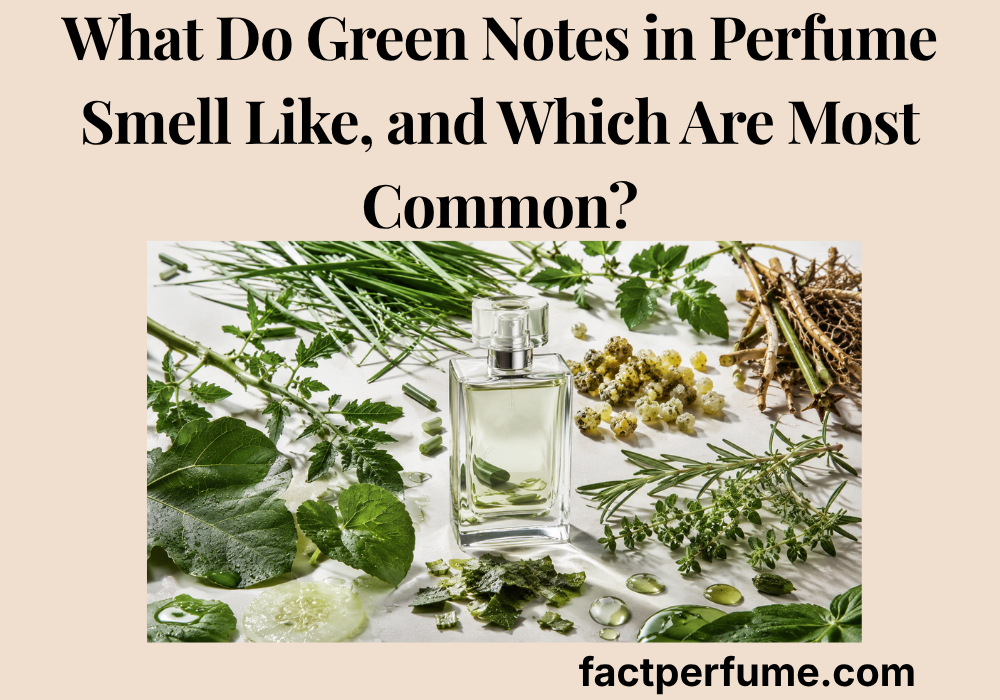
What Do Green Notes in Perfume Smell Like, and Which Are Most Common?
Green notes in perfume evoke different aspects of vegetation—including crushed leaves, cut grass, stems, sap, herbs, bitter greenery, and dewy foliage—and common green effects are created with materials such as galbanum, violet leaf, cis-3-hexen-1-ol, and reconstructed botanical accords.
Green notes are an olfactory concept rather than an environmental claim. They can smell leafy, grassy, sappy, bitter, vegetal, dewy, watery-green, metallic-green, or herbal-green. These effects may come from natural extracts, naturally occurring molecules made for perfumery, synthetic aroma materials, or reconstructed accords. Understanding those differences makes it easier to describe green notes, separate them from neighboring fresh styles, interpret fragrance pyramids, and recognize greenness on skin.
Fragrance Note: “Green” describes an olfactory effect. It does not automatically mean that a perfume or material is natural, sustainable, eco-friendly, non-toxic, or suitable for every wearer. A listed note may represent a natural material, a defined aroma molecule, or a reconstructed accord.
What Do Green Notes in Perfume Actually Smell Like?
Green notes usually smell leafy, grassy, sappy, bitter, vegetal, dewy, herbal, metallic-green, or crisp, with the exact impression depending on the material or accord creating the effect.
A green note is a perfume material or perceived scent effect associated with vegetation. A green accord is a blend of materials arranged to create one unified impression of leaves, stems, grass, sap, or related greenery.
Freshly cut grass provides one of the easiest references. Its smell is moist, vivid, slightly sharp, and immediately recognizable as living or recently cut vegetation. Green leaf volatiles released by plants contribute to the familiar smell associated with damaged leaves and freshly mown grass.
Sappy greenness feels different. Imagine snapping a fresh flower stem and smelling the moist interior. The effect may feel wet, bitter, raw, or faintly resinous rather than simply grassy.
Crushed tomato foliage provides another useful reference. It has a pungent, stemmy, herbal, vegetal character that is very different from the sweetness or acidity associated with ripe tomato fruit.
Dewy or watery greenness can resemble damp foliage, cucumber skin, or leaves covered with morning moisture. A florist shop can provide an accessible comparison because cut stems, leaves, water, and floral materials combine into a recognizable leafy atmosphere.
Green notes can therefore be sharp or soft, realistic or abstract. Some smell like an actual torn leaf. Others use botanical references more loosely to create a polished sensation of freshness and vegetation.
Greenness should not automatically be confused with sweet floral petals, ripe fruit flesh, citrus peel, or marine water effects. Those categories can overlap with green notes, but they do not create the same dominant sensory cue.
Readers who want to understand when these effects shape the identity of the whole fragrance can explore Green perfume.
Green notes can suggest crushed leaves, cut grass, stems, sap, herbs, bitter vegetation, and dewy foliage rather than one single fixed smell.
How Do Green Notes Differ From Citrus, Aquatic, Coniferous, and Aromatic Freshness?
Green notes emphasize vegetation, while citrus emphasizes peel and zest, aquatic emphasizes watery or atmospheric effects, coniferous emphasizes needles and resin, and aromatic freshness emphasizes herbs and camphoraceous facets.
All five styles can feel fresh. The difference lies mainly in the sensory source of that freshness.
Green freshness usually points toward leaves, grass, stems, sap, vines, or raw foliage. Citrus freshness points more strongly toward lemon peel, bergamot rind, grapefruit zest, or other bright fruit-skin impressions.
Aquatic freshness moves toward water, air, mist, marine effects, or ozonic impressions. A perfume can combine aquatic and green elements, but watery atmosphere remains different from the smell of crushed vegetation.
Coniferous freshness usually emphasizes pine or fir needles, resin, balsamic facets, and woody forest effects. Those materials are botanical and may contain green facets, but their dominant identity is often more needle-like and resinous than leafy or grassy.
Aromatic freshness commonly emphasizes herbs and camphoraceous materials. Lavender, rosemary, and sage may smell fresh because they are aromatic plants, while a distinctly green effect more directly suggests raw foliage, stems, grass, or plant sap.
The border is not rigid. Green and aromatic effects frequently overlap, especially when perfumes combine leafy materials with herbs. When this vegetation-like character is integrated into a fougère structure, the relationship becomes more specific; readers can explore Green fougère.
Fresh Scent Distinction Table
| Scent Style | Primary Sensory Cue | Representative Examples | Distinguishing Edge |
|---|---|---|---|
| Green | Leaves, stems, grass, sap | Galbanum, leafy accords | Vegetal and leafy |
| Citrus | Peel, zest, tart fruit | Bergamot, lemon, grapefruit | Sparkling and peel-like |
| Aquatic | Water, air, marine or ozonic effects | Watery and ozonic accords | Watery or atmospheric |
| Coniferous | Needles, resin, balsamic woods | Pine, fir | Resinous and needle-like |
| Aromatic | Herbs and camphoraceous freshness | Lavender, rosemary, sage | Herbal and aromatic |
Herbs and camphoraceous freshness | Lavender, rosemary, sage | Herbal and aromatic |
These are representative sensory cues rather than fixed universal categories. Modern perfumes can combine several of them at once. The most useful classification method is to identify the dominant sensory impression rather than assuming that one listed note determines the entire fragrance family.
Which Natural Materials and Botanical Inspirations Commonly Create Green Notes?
Green perfumery uses both natural materials, such as galbanum and violet leaf, and reconstructed botanical notes that recreate smells such as fig leaves, tomato vines, stems, and foliage.
A natural material is physically obtained from botanical matter through an extraction or processing method appropriate to that material. A botanical reconstruction is different: it is an accord designed to evoke a recognizable plant smell without necessarily containing a direct extract of the plant named in the note description.
That distinction matters when reading perfume descriptions. A fragrance pyramid that says “fig leaf” tells you that fig-leaf character is part of the intended scent experience. It does not automatically prove that literal fig-leaf extract appears in the formula.
How Does Galbanum Create a Sharp, Bitter Green Effect?
Galbanum contributes a strong bitter, resinous, sappy, and dry green effect that has played an important role in many classic green fragrances.
Galbanum is an aromatic gum-resin material associated with Ferula species. Technical references identify Ferula gummosa as a source of galbanum and describe the material as an oleo-gum-resin with a powerful odor used in fragrance applications.
Its character is more complex than simple fresh-cut grass. Galbanum can suggest broken stems, bitter plant sap, resin, dry greenery, and woody or balsamic facets at the same time.
That bitter-resinous dimension gives it a distinctive place within green perfumery. Fresh grass can feel light and humid; galbanum can feel denser, sharper, drier, and more structural.
Its importance in classic green fragrance styles should not be interpreted as a rule that every green perfume must contain galbanum. Green effects can be constructed through many different materials and accords.
How Does Violet Leaf Create a Dewy, Metallic Green Effect?
Violet leaf creates a cooler form of greenness that may smell watery, metallic, cucumber-like, earthy, or subtly leathery.
Violet-leaf absolute comes from the foliage of Viola odorata, not from the violet flower itself. Perfumery references describe the absolute through damp, leafy, earthy, stemmy, cucumber-like, and watery facets.
This distinction explains why “violet leaf” and “violet flower” can produce very different sensory expectations.
A violet-flower effect is often interpreted in a softer, sweeter, more floral or powdery direction. Violet leaf is much more closely associated with cool foliage.
Imagine a wet green leaf combined with cucumber skin and a faint metallic edge. That sensory picture captures the general direction more accurately than thinking of violet petals.
Its watery character also shows how fragrance categories can overlap. Violet leaf may contribute to an aquatic-feeling composition while still retaining a distinctly vegetal identity.
A published violet-leaf note should not, however, be treated as proof that every perfume uses the same form of violet-leaf absolute. The listed term may refer to natural material, reconstruction, or the intended olfactory effect.
How Do Fig-Leaf and Tomato-Leaf Notes Create Botanical Green Impressions?
Fig-leaf and tomato-leaf notes create recognizable botanical greenness, but their names often describe reconstructed accords rather than guaranteed direct extracts of the leaves themselves.
A fig-leaf effect may combine leafy greenness with milky sap, creamy facets, and sometimes a coconut-like softness. This creates a botanical impression that can feel rounder and more lactonic than freshly cut grass.
The reference is the vegetation surrounding the fig rather than simply the sweetness of ripe fig fruit. A perfumer can therefore evoke the feeling of breaking a fig leaf or smelling its milky sap without implying that the fragrance contains a literal leaf extract.
A tomato-leaf effect usually moves in a more pungent direction. It may smell herbal, vegetal, stemmy, vine-like, or sharply green.
Crushing the foliage of a tomato plant gives a useful real-world reference. The smell comes across as raw vegetation rather than ripe tomato flesh.
Both note names should therefore be interpreted as scent references. A fig-leaf accord does not need to be an exact chemical copy of a living fig leaf, and a tomato-leaf accord does not prove that tomato foliage was directly extracted for the formula.
Natural materials, isolated molecules, manufactured aroma materials, and reconstructed accords can all contribute distinct green effects.
Which Aroma Chemicals Commonly Create Realistic or Abstract Green Effects?
Isolated and synthetic aroma materials allow perfumers to reproduce vivid fresh-cut leaves, grass, stems, vines, and more abstract forms of greenness with high sensory precision.
A green leaf volatile, or GLV, is one of a group of volatile plant compounds associated with characteristic green odors, particularly after plant tissue is damaged. Scientific literature links these compounds with the familiar smell released by cut or wounded vegetation.
Modern perfumery uses both botanical extracts and manufactured fragrance molecules. A molecule may occur naturally in a plant and also be produced industrially for fragrance use; its chemical identity and its production route are separate questions.
This is why “natural” and “synthetic” should not be treated as simple synonyms for “good” and “artificial-smelling.” Either route can contribute to sophisticated green accords.
How Does Cis-3-Hexen-1-ol Create a Fresh-Cut Leaf Effect?
Cis-3-hexen-1-ol is one of several characteristic green leaf volatiles associated with cut or damaged vegetation and produces a strong fresh grass, leaf, and stem impression.
The material is also commonly called leaf alcohol and written chemically as (Z)-3-hexen-1-ol.
Its smell is an unusually direct reference to disturbed vegetation. Imagine mowing grass, tearing a fresh leaf, or snapping a green stem. The immediate smell belongs to the same broad sensory territory.
PubChem identifies (Z)-3-hexen-1-ol as leaf alcohol, notes its release by green plants after mechanical damage, and records a fragrance role; this supports its use as a reference for vivid leafy and grassy effects.
The molecule occurs naturally in plant systems, but material supplied to the fragrance industry can also be produced through industrial chemistry. Natural occurrence therefore does not tell you how a particular commercial batch was manufactured.
Cis-3-hexen-1-ol should also not be treated as the sole molecule responsible for the smell of cut grass. Plant green odor involves multiple volatile compounds, and perfumers can build grassy or leafy accords through several different material combinations.
How Do Triplal and Ligustral Create Sharp Green Effects?
Triplal and Ligustral are commercial names associated with high-impact green aldehydic perfumery materials that can create sharp leafy, grass-like, rind-like, and abstract green effects.
An important technical distinction is needed here. Triplal and Ligustral should not simply be presented as two unrelated fragrance molecules. IFRA documentation lists Triplal and Ligustral among commercial names covered by its standard for dimethylcyclohex-3-ene-1-carbaldehyde materials and related isomers.
This type of material is useful because its green impression does not have to imitate one exact botanical source. It can suggest crushed leaves, fresh stems, tart rind, grass, or an intensely abstract verdant effect.
Such materials function as tools inside an accord. They can strengthen a green direction, sharpen another fresh note, or help connect leafy character with citrus, floral, or aromatic materials.
They should not be understood as complete perfumes by themselves, and their presence does not mean every perfumer uses them in the same way.
How Does Stemone Create Leafy, Fig-Like, or Tomato-Vine Effects?
Stemone contributes distinctive leafy and green effects that may suggest fig leaves, tomato vines, minty nuances, or other modern botanical impressions.
Givaudan describes Stemone as green, natural, leafy, and fresh, and identifies fig-leaf and tomato effects among the directions it can support.
The important point is sensory rather than literal.
Stemone is not a fig-leaf extract simply because it helps create a fig-leaf impression. It is also not tomato-vine extract because an accord containing it reminds the nose of tomato foliage.
Instead, it acts as part of the perfumer’s botanical vocabulary. In the right context, its green character can help the brain interpret an accord as leafy, vine-like, or freshly vegetal.
That ability helps perfumers construct recognizable botanical effects even when the perfume is not based on direct extraction of the plant being evoked.
Common Green Materials Sensory Matrix
| Material / Note | Common Perfumery Form | Scent Profile | Real-World Analogy | Typical Role |
|---|---|---|---|---|
| Galbanum | Natural gum-resin derivative or extract | Bitter, resinous, sappy, sharp | Broken green stem with bitter resin | Sharp green structure |
| Violet leaf | Natural material or recreated effect | Dewy, watery, metallic, cucumber-like | Wet foliage | Dewy green effect |
| Fig-leaf note | Often reconstructed accord | Leafy, milky, creamy-green | Fig leaf and sap | Botanical greenness |
| Tomato-leaf note | Often reconstructed accord | Herbal, pungent, vegetal | Tomato vine | Vivid botanical greenness |
| cis-3-Hexen-1-ol | Aroma material; naturally occurring molecule | Fresh-cut, grassy, leafy | Mown grass | Fresh-leaf realism |
| Triplal / Ligustral-type material | Aroma material / commercial naming family | Sharp, high-impact, leafy | Crushed leaf or rind | Intense or abstract greenness |
| Stemone | Aroma material | Leafy, green, fresh, vine-like | Green vine or fig foliage | Botanical reconstruction |
Aroma material | Leafy, green, fresh, vine-like | Green vine or fig foliage | Botanical reconstruction |
The matrix describes representative perfumery forms and sensory effects, not a formulation recipe. Material grades and accord designs vary, so similar names do not guarantee identical odor profiles.
How Do Green Notes Behave Within a Perfume Structure?
Green notes do not share one structural behavior: some fresh leafy materials appear strongly in the opening, while other green, resinous, mossy, aromatic, or woody effects can remain perceptible later in the fragrance.
Volatility is the tendency of a material to evaporate and enter the surrounding air. Different fragrance materials have different volatility and persistence characteristics, so there is no single evaporation pattern shared by everything described as green.
Some fresh leafy or grassy effects may be especially noticeable near the opening. Other green materials can contribute through the heart or deeper parts of the composition.
This is why the statement “green notes are top notes” is too broad.
A fragrance might open with the sensation of crushed grass, develop toward herbs or flowers, and later reveal vetiver, woods, resinous materials, musks, or mossy accords.
Those later materials can create perceptual continuity. They do not physically prevent earlier volatile green molecules from evaporating. Instead, related earthy, vegetal, woody, mossy, or aromatic cues can make the evolving fragrance continue to feel green.
The fragrance pyramid helps describe this development through top, heart, and base impressions. IFF describes perfume structure in this top-heart-base format while also showing that different material families contribute at different stages of the olfactory journey.
A pyramid should nevertheless be treated as a descriptive model, not a complete molecular map or full formula disclosure. If a published note list says “green leaves,” “fig leaf,” or “moss,” that wording tells you about the intended scent experience; it does not automatically identify every material used to create it.
The practical question is therefore not “Which level must green notes belong to?” but “Where does the green character appear, and how does that character change during the dry-down?”
Readers interested in that development can examine Green longevity.
Green freshness is recognized by dominant vegetation-like cues rather than peel-driven citrus, watery aquatic, needle-and-resin coniferous, or primarily herbal-aromatic freshness.
How Can You Recognize Green Notes in a Perfume Pyramid or on Skin?
Recognize green notes by combining note-list clues with sensory evidence of leaves, grass, stems, sap, herbs, bitter foliage, and other vegetation-like effects.
A fragrance pyramid can point you in the right direction, but the note list alone is not enough. Use the following five diagnostic steps to decide whether the perfume contains a noticeable green effect and whether that effect actually dominates the composition.
Step 1 — Scan the Note Pyramid
Look first for names such as galbanum, violet leaf, green leaves, grass, tomato leaf, fig leaf, green tea, or leafy accord.
These terms are useful clues, but they are not proof of literal ingredient content.
A fig-leaf listing may represent an accord. “Green leaves” may describe a general olfactory effect. Even a note whose name corresponds to a real natural material does not prove that the exact botanical extract appears in the perfume formula.
Step 2 — Identify the Sensory Cue
Next, smell the fragrance itself and ask whether it evokes leaves, stems, grass, sap, vegetation, dewy foliage, or bitter greenery.
You do not need to identify the exact molecule.
The first task is to recognize whether the dominant sensory reference resembles vegetation.
A perfume that immediately reminds you of torn leaves, wet stems, a freshly mown lawn, or raw plant sap is giving much stronger green evidence than one that merely feels generically fresh.
Step 3 — Separate Neighboring Freshness
Use the dominant sensory reference as a practical shortcut.
If the freshness feels leafy or vegetal, it points toward green. If it feels peel-like or zesty, it points toward citrus. If it feels watery or ozonic, it points toward aquatic. If it feels needle-like and resinous, it points toward coniferous. If it feels primarily herbal or camphoraceous, it points toward aromatic freshness.
This is a recognition framework rather than an absolute taxonomy. One fragrance can contain several of these effects at the same time.
Step 4 — Observe Development
Notice what happens after the opening.
The green character may be strongest during the first impression, continue through the heart, move toward woods, become more mossy, become more herbal, or merge into floral materials.
This development helps show whether greenness is a short-lived accent or part of the perfume’s broader identity.
For example, an opening that smells vividly like cut leaves may gradually become woody and earthy while still retaining a connection to vegetation.
Step 5 — Judge Dominance
Finally, decide how important the green effect is to the complete fragrance.
One listed green note does not automatically make the perfume a green perfume.
A floral perfume can contain violet leaf. A citrus perfume can use a grassy accent. A woody fragrance can contain galbanum.
Green becomes dominant when verdant character substantially shapes what the perfume smells like and how its identity develops.
Green Note Recognition Checklist
The checklist is a diagnostic aid rather than a numerical scoring system. The goal is to identify the sensory evidence and then judge how strongly that evidence contributes to the perfume’s overall identity.
Frequently Asked Questions
Green notes can smell leafy, grassy, sappy, bitter, vegetal, dewy, herbal, metallic-green, watery-green, or crisp depending on the material or accord creating the effect.
No. A published note may describe a natural material, a defined aroma molecule, or a reconstructed accord. A note name such as fig leaf or tomato leaf does not automatically prove that literal leaf extract appears in the formula.
Green freshness points mainly toward leaves, grass, stems, sap, vines, or raw foliage. Citrus is more peel- and zest-led, while aquatic freshness is more watery, airy, marine, mineral, or ozonic.
No. Some fresh leafy or grassy effects are especially noticeable in the opening, while resinous, mossy, aromatic, woody, or other green-related effects may remain perceptible later in the fragrance.
No. Green becomes dominant only when verdant character substantially shapes what the perfume smells like and how its identity develops rather than appearing as a minor accent.
Conclusion
The simplest way to understand green notes is to treat them as perfume effects that reproduce different aspects of vegetation, from bitter resinous greenness to freshly cut leaves, grass, stems, sap, herbs, and dewy foliage.
Green effects can come from natural materials, isolated molecules, manufactured aroma materials, or reconstructed accords, and no single material defines the whole category. A note-list name also does not prove literal ingredient content. The clearest distinction is sensory: green emphasizes vegetation, citrus emphasizes peel and zest, aquatic freshness emphasizes water or atmosphere, coniferous freshness emphasizes needles and resin, and aromatic freshness emphasizes herbs and camphoraceous effects.
A green note is easiest to recognize when leaves, grass, stems, sap, or related vegetation-like character is more prominent than citrus peel, watery freshness, resinous needles, or mainly aromatic herbs.