
How Does Sillage Influence Your Perfume Selection?
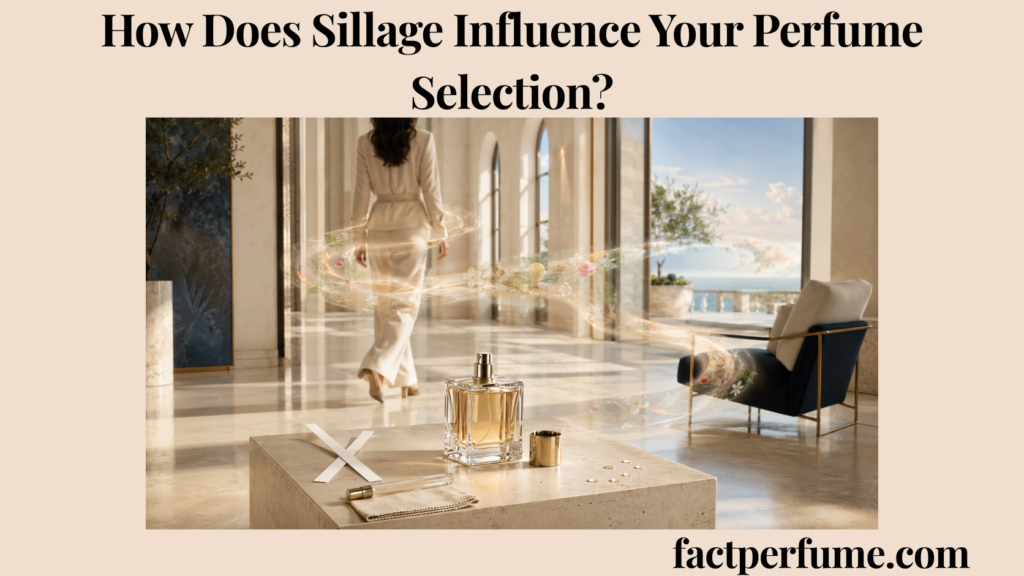
Sillage should influence your perfume selection because it determines how much scent presence other people may experience as you move through a space. Stronger sillage is not automatically better, more luxurious, more attractive, or more valuable. The best choice is a fragrance whose tested scent trail fits your real environments, remains pleasant through the dry-down, and can be controlled with conservative application.
Sillage matters most when a fragrance will be worn around other people. Offices, classrooms, public transport, restaurants, healthcare settings, places of worship, and close social events all place different demands on scent presence. A perfume may smell beautiful and last for hours yet still be a poor purchase when its trail is too broad for the wearer’s routine.
This guide explains how to distinguish sillage from projection and longevity, identify the level you actually need, test movement and stillness separately, evaluate the influence of formula and environment, collect useful external feedback, adjust application, troubleshoot inconsistent results, and choose between Buy, Sample Longer, Travel Size, or Skip.
Why Should Sillage Influence Your Perfume Selection?
Sillage should influence selection when the perfume needs to create a particular level of presence without becoming intrusive, difficult to control, or unsuitable for the wearer’s main routine. It is one factor among several, so scent quality, personal preference, longevity, occasion fit, comfort, and price may deserve equal or greater weight.
Sillage is the trail perceived during or shortly after movement. It is not a quality grade. An intimate perfume can be expressive, refined, and valuable, while a highly expansive perfume can be inconvenient. The useful question is not “How strong is it?” but “Does its movement trail support the way I will actually wear it?”
Evaluate sillage alongside the broader perfume buying factors. A fragrance earns a full-bottle purchase more easily when it works across several realistic settings and responds predictably to application changes. A perfume that suits only rare outdoor events may still be worthwhile, but a sample, decant, or travel size can provide better value.
Environment Fit Comes Before Maximum Output
Shared indoor environments increase the importance of control because other people may remain nearby for a long time and may not be able to move away. Public transport, fixed seating, care settings, meetings, and classrooms create stronger etiquette constraints than private or open-air use.
The most restrictive regular part of the wearer’s routine often determines the most useful sillage level. A fragrance that feels appropriate in open air may become excessive during transport, an indoor transition, or prolonged close seating. Test the complete routine rather than only the most spacious moment.
Personal Preference Should Be Defined in Advance
Some wearers want perfume to remain primarily personal. Others enjoy a controlled trail that becomes noticeable when they walk past. Both preferences are valid. Problems arise when a buyer mistakes a forceful opening or dramatic store impression for long-term suitability.
Before comparing fragrances, define whether you want intimate, moderate, or noticeable presence. This prevents strength from becoming a substitute for fit, identity, confidence, or value.
Control Range Is a Purchase Advantage
A versatile perfume should remain enjoyable at a conservative application and allow meaningful adjustment. If the smallest practical amount still dominates the intended environment, the fragrance has a narrow control range. If a slight increase moves it from barely detectable to excessive, repeated use may be difficult.
Maximum output is less valuable than predictable control. A perfume that moves comfortably between private wear and moderate social presence may offer more everyday value than one that performs loudly but cannot be lowered.
| Criterion | Good purchase signal | Warning signal | Likely decision |
|---|---|---|---|
| Main environment | The trail fits the closest and longest shared setting | Most real settings require the perfume to be avoided | Travel Size or Skip |
| Desired presence | The tested trail matches a clearly defined goal | Strength is being chosen mainly for status | Reassess the goal |
| Control range | Lower application meaningfully reduces the trail | The practical minimum remains excessive | Sample Longer or Skip |
| Dry-down quality | The later airborne scent remains pleasant | Diffusion amplifies an unpleasant phase | Skip |
| Price-to-use value | The perfume works across several regular settings | Full-bottle cost is justified only by trail strength | Choose a smaller format |
Select the presence level that fits your routine, remains comfortable around other people, and provides enough realistic use to justify the format and price.
How Does Sillage Differ From Projection, Longevity, Intensity, Scent Bubble, and Dry-Down?
Sillage describes the trail perceived during or shortly after movement. Projection describes how far a fragrance radiates from a relatively still wearer, longevity describes duration, intensity describes strength at a particular moment, scent bubble describes the immediate personal area, and dry-down describes the later scent profile.
These qualities overlap, but they are not interchangeable. A fragrance can project strongly during stillness yet leave little recognizable trail after movement. Another may sit close while the wearer is seated but become more noticeable when clothing and air move around the application areas.
Sillage
Sillage is best assessed through controlled movement. The evaluator observes whether a recognizable scent remains in the air while or shortly after the wearer passes. Its purchase relevance depends on whether that trail is appropriate, pleasant, and adjustable.
Projection and Scent Bubble
Projection measures surrounding reach from a relatively still wearer at a specific wear stage. The scent bubble is the immediate personal area where the fragrance can be noticed. A broad scent bubble may contribute to sillage, but it does not prove that a distinct movement trail will remain behind.
Longevity and Intensity
Perfume longevity measures how long the fragrance remains detectable. A scent can last close to skin for many hours while producing little trail. Intensity describes how strong it feels at one moment. A forceful opening may become quiet quickly, so opening intensity should not be treated as persistent performance.
Dry-Down
Dry-down is the later scent profile after the opening settles. It is not a distance measurement. Its importance comes from quality: if the later airborne scent becomes harsh, stale, overly sweet, or otherwise unpleasant, noticeable sillage spreads a phase the wearer may not want other people to experience.
| Metric | What it measures | Best assessment | Common mistake |
|---|---|---|---|
| Sillage | Trail during or shortly after movement | Normal walking test with structured feedback | Measuring only from a still wearer |
| Projection | Radiation from a relatively still wearer | Repeated stillness checks | Calling all surrounding presence sillage |
| Longevity | Duration of detectable scent | Checks across the full wear | Assuming long wear means a large trail |
| Intensity | Strength at one particular moment | Opening, middle, and later records | Judging the whole perfume from the opening |
| Scent bubble | Immediate personal area around the wearer | Still observation at conversational proximity | Treating personal aura as the complete trail |
| Dry-down | Later scent character | Skin and airborne evaluation later in wear | Treating scent development as a spatial metric |
Which Factors Influence a Perfume’s Scent Trail?
A perfume’s scent trail depends on the finished formula, application amount, application surface, temperature, airflow, movement, clothing, individual wear conditions, and perception. No note, material, concentration label, price, or brand reputation can predict the complete result by itself.
These variables interact. A fragrance may appear restrained while the wearer is seated but become more noticeable while walking. Fabric may retain scent into a later environment without proving that the perfume creates stronger movement-based sillage from skin. Testing should therefore control as many variables as practical and compare repeated results.
The Finished Formula Matters More Than the Public Note List
Public note descriptions highlight selected scent impressions, but they do not disclose every ingredient, proportion, accord, or interaction in the formula. The U.S. Food and Drug Administration explains that fragrance formulas may be complex mixtures and that individual ingredients can be listed collectively as “Fragrance.” Use FDA fragrance guidance to understand why a public note list cannot reveal the complete formula.
A note commonly associated with radiance or density does not guarantee noticeable sillage. The surrounding structure may amplify, soften, redirect, or shorten the effect. Use notes to create a testing hypothesis, not a performance conclusion.
Application Amount Changes Presence, but Not Always Proportionally
Additional fragrance can increase intensity, projection, and trail, but twice the application does not guarantee twice the sillage. A larger amount may make the result dense, uncomfortable, or harder to evaluate. It may also increase the duration of close-range scent without creating a cleaner movement trail.
Begin conservatively. A perfume that cannot produce a useful trail without becoming excessive has limited control value. Universal spray counts are unreliable because atomizers, formulas, body locations, wearers, and environments differ.
Skin, Fabric, and Hair Products Behave Differently
Skin allows the perfume to develop under the wearer’s temperature, movement, perspiration, clothing, and environmental conditions. Fabric can retain fragrance longer and carry it into later settings, but persistence on clothing is not the same as skin sillage. Perfume can also mark or damage some textiles, so avoid spraying delicate, historic, light-coloured, or cherished garments. Follow garment-care instructions and only test a hidden area when the manufacturer’s guidance permits it.
Products intended for hair may create additional movement-based presence, but they should be used only according to their directions. Count hair fragrance as part of the total scented application rather than treating it as an unrelated layer.
Temperature, Airflow, and Movement Change Perception
Warmth may make some fragrances feel more expansive, while cooler conditions may make the same perfume appear quieter or differently balanced. There is no universal multiplier for heat or fixed reduction for cold. Clothing, humidity, perspiration, and the finished formula remain relevant.
Airflow can disperse fragrance and change where the trail is perceived. Fans, open windows, corridors, ventilation systems, wind, and room layout may move scent away from one observer and toward another. Body and clothing movement can reveal a trail that was difficult to notice during stillness. This is why a stillness test cannot replace a normal walking test.
Individual Wear and Skin Comfort Must Be Observed, Not Assumed
Application amount, skin condition, temperature, clothing, perspiration, and environment can change how the same perfume is perceived. The result should not be reduced to skin pH, oiliness, dryness, or body temperature alone. None of these variables guarantees a particular trail.
Some fragrance ingredients can trigger allergic reactions or sensitivities in susceptible individuals, although many people use fragranced cosmetics without problems. Stop using a fragrance when a concerning reaction develops rather than trying to diagnose the cause from sillage or performance behaviour.
Olfactory Adaptation Can Reduce Self-Awareness
Continuous or repeated exposure may reduce the wearer’s awareness and encourage unnecessary reapplication. Research on long-term odour adaptation supports the general possibility of reduced perception after sustained exposure, but it does not establish exactly how quickly ordinary perfume wear produces that effect.
Treat adaptation as one possible explanation, not the default explanation for every weak self-impression. Time in unscented air and structured feedback from a willing evaluator can help distinguish reduced self-awareness from genuinely quieter performance.
| Variable | Possible influence | What it cannot guarantee | How to test |
|---|---|---|---|
| Finished formula | Shapes balance, development, and release | A fixed trail from notes alone | Wear the finished perfume |
| Application amount | May increase airborne presence | Proportional growth in sillage | Compare conservative amounts |
| Skin | Changes real-wear development | The same result for every wearer | Repeat on the buyer’s skin |
| Fabric | May retain scent and create carryover | Stronger skin sillage | Record separately and follow garment care |
| Temperature and airflow | Change diffusion, direction, and intensity | Stable results across settings | Compare realistic conditions |
| Movement | May reveal a trail hidden during stillness | A persistent trail at every wear stage | Conduct a normal walking test |
| Adaptation | May reduce self-awareness | That other people still smell it strongly | Use fresh air and repeated feedback |
How Should You Define the Sillage Level You Actually Need?
The sillage level you need depends on how close other people will be, how long they will share the space, whether they can move away, and whether a noticeable trail supports the intended use. Intimate, moderate, noticeable, and highly expansive presence are practical observation categories rather than scientific distance measurements.
Choose the lowest presence level that fully supports the intended experience. This gives the perfume a better chance of remaining usable across transport, indoor transitions, work, close conversation, and social events.
Intimate Sillage
Intimate sillage remains mainly close to the wearer and leaves little reliable trail for other people. It may suit public transport, close seating, offices, quiet gatherings, care environments, or wearers who prefer a private scent experience. Reduced noticeability in open air is a limitation, not proof of low quality.
Moderate Sillage
Moderate sillage creates nearby presence and a controlled movement trail without dominating the environment. It can provide social character while remaining more versatile than highly expansive performance. It still requires enclosed-space testing because warmth, ventilation, activity, and proximity may increase its effect.
Noticeable Sillage
Noticeable sillage creates a recognizable trail beyond the immediate personal area. It may suit selected events, larger rooms, outdoor settings, or deliberate statement wear. Its main limitation is reduced flexibility during transport, close seating, prolonged work, or care settings.
Highly Expansive Sillage
Highly expansive sillage dominates a broad area or remains strongly noticeable after the wearer passes. It is not a higher quality tier. Its realistic usefulness is usually limited, and it can affect people who did not choose to participate in the scent experience. A travel size may make more sense than a full bottle when use is rare.
| Level | Practical description | Often suitable for | Warning signal |
|---|---|---|---|
| Intimate | Mainly noticed close to the wearer | Enclosed or prolonged shared settings | Too quiet for the actual goal |
| Moderate | Nearby presence with a controlled trail | Mixed indoor and social use | Becomes intrusive with warmth or activity |
| Noticeable | Clearly perceived beyond the personal area | Selected events and open spaces | Cannot be reduced for normal routines |
| Highly expansive | Dominates a broad area or remains strongly noticeable | Rare, context-specific use | Affects people who cannot move away |
How Should You Match Sillage to Social and Professional Environments?
Sillage should generally be lower and more controllable when people share an enclosed space, remain nearby for a long period, or cannot easily move away. These are contextual principles, not universal rules. Follow the exact workplace, facility, school, or venue policy where one exists.
The appropriate trail depends partly on the occasion, but labels such as “work,” “date,” or “outdoor event” are not enough. Ventilation, duration, distance, crowd density, movement, policy, and indoor transitions also matter.
Shared Offices, Classrooms, and Places of Worship
Intimate or restrained moderate sillage is generally more versatile where people remain close for long periods. A fragrance that repeatedly becomes noticeable across rows, work areas, or meeting spaces may distract others even when the wearer enjoys it. Conservative application and a comparable private test should come before regular use.
Medical and Care Environments
Fragrance-free or highly intimate use may be appropriate when a facility’s policy or circumstances require it. Patients, residents, staff, and visitors may have limited ability to move away. Do not assume one universal policy; follow the institution’s specific guidance.
Public Transport
Intimate sillage is usually the most considerate choice in enclosed public transport. Passengers may remain close together, ventilation can vary, and moving away may not be possible. A fragrance that feels moderate outdoors can become excessive inside a vehicle or crowded station.
Restaurants and Close-Quarter Dates
Intimate to moderate sillage can provide personal presence without dominating food or conversation. Evaluate both seated and movement-based presence because walking between tables or a strong airborne dry-down can increase the effect beyond the first close-range impression.
Indoor Social Events
Moderate sillage may suit an indoor event when room size, airflow, crowd density, and activity support it. Heat, dancing, repeated movement, and close conversation may increase the perceived trail. A useful event fragrance can also be lowered for transport, arrival, and fixed seating.
Outdoor Events
Moderate to noticeable sillage may be practical outdoors, but queues, crowds, heat, and later indoor transitions still matter. Do not automatically compensate for open-air dispersion with excessive application. The same perfume may become intrusive when entering a vehicle, restaurant, or enclosed venue.
Gyms and Exercise Spaces
Fragrance-free or highly restrained use is often the most comfortable choice during exercise. Heat, perspiration, movement, close equipment spacing, and heavier breathing may change how scent is experienced. A perfume that becomes uncomfortable during exercise may still be suitable elsewhere.
| Environment | Practical range | Main concern | Purchase implication |
|---|---|---|---|
| Shared office or classroom | Intimate to restrained moderate | Prolonged proximity and distraction | Sample longer if the minimum is still broad |
| Medical or care setting | Fragrance-free to highly intimate | Policy and limited ability to move away | Use elsewhere or skip for this purpose |
| Public transport | Intimate | Enclosed compulsory proximity | Reduced daily value if the trail cannot be lowered |
| Restaurant or close date | Intimate to moderate | Food and close conversation | Choose a trail that supports the interaction |
| Indoor social event | Moderate | Crowd density, heat, and movement | Use selectively if activity makes it excessive |
| Outdoor event | Moderate to noticeable | Crowds and indoor transitions | Travel Size may be practical |
| Gym or exercise area | Fragrance-free to highly intimate | Heat, breathing, and proximity | Reserve the perfume for another setting |
Match the perfume to the closest and longest shared part of the routine, not only to the most open or exciting moment.
Which Formula Styles May Support Quieter or More Noticeable Sillage?
Formula styles can suggest what to test, but they cannot provide reliable sillage rankings. The same family, accord, note, or concentration category can appear in both restrained and highly diffusive fragrances. Direct testing of the finished perfume must override the label.
Airy Woody-Amber and Radiant Floral Styles
Airy woody-amber compositions may feel smooth and transparent while travelling farther than expected. Some radiant floral styles create an expressive airborne character, but others remain creamy, powdery, green, or close to skin. Smoothness and brightness should not be mistaken for intimacy.
Aldehydic and Sparkling Styles
Sparkling effects may create lift and a lively opening without guaranteeing a persistent movement trail. The opening can overstate later sillage. Test the middle and dry-down before buying for long-lasting spatial presence.
Dense Amber-Like, Resinous, and Gourmand Styles
Dense warm styles may create substantial surrounding presence, but density does not guarantee that scent will remain behind after movement. A fragrance can feel intense close to the body while leaving less trail than expected. Warm, sweet, or resinous effects may also become heavier in enclosed or hot conditions.
Fresh Citrus, Aquatic, and Green Styles
Fresh styles may create a bright early trail that becomes quieter later. Their first impression can be attractive, but the feature may fade before the intended event or work period ends. Some fresh perfumes remain highly diffusive, so the family label still cannot predict intimacy.
Musk-Focused and Skin-Scent Styles
Musk-focused perfumes may create an intimate aura, although some musky effects remain very diffusive. “Skin scent” suggests closeness but does not guarantee that every observer will experience the fragrance as quiet. Structured feedback is especially useful when the wearer becomes less aware of the scent.
Concentration Labels Do Not Guarantee Sillage
EDC, EDT, EDP, Parfum, and Extrait labels describe broad product categories. They do not independently determine trail strength, projection, control, or social suitability. A lower-concentration fragrance may be highly diffusive, while a richer category may remain close to skin. Buy according to the tested finished perfume rather than the label.
Use style and concentration labels to decide what to test, then let actual movement, dry-down, comfort, and environment determine the purchase.
How Do You Test Sillage Before Purchasing a Full Bottle?
Test sillage by standardising application, assessing projection while still, observing the trail during movement, evaluating the middle and dry-down, collecting structured feedback, and repeating the process in realistic conditions. One opening, room, climate, or observer cannot establish a reliable result.
- Test the fragrance alone. Reduce interference from another perfume and strongly scented body, hair, or laundry products where practical.
- Standardise application. Record the atomiser, qualitative amount, application locations, clothing, temperature, ventilation, and planned activity.
- Assess the opening while still. Record intensity, projection, and personal scent bubble without treating them as the final sillage result.
- Conduct a normal movement test. Walk naturally through a private or suitable space while a willing evaluator observes whether a trail appears before, during, or after you pass.
- Repeat during mid-wear. Determine whether the opening’s strength becomes a useful controlled trail, a quiet personal scent, or an excessive airborne presence.
- Evaluate the dry-down. Separate scent detectable only close to skin from a remaining movement trail, and judge whether the later airborne character stays pleasant.
- Simulate the intended environment. Consider temperature, ventilation, clothing, transport, proximity, movement, and the duration of shared exposure.
- Repeat the wear. Keep the method reasonably consistent while testing more than one realistic condition. A stable pattern supports buying; substantial variation supports longer sampling.
Ask Better External-Feedback Questions
Do not ask only whether the perfume is detectable. Ask a willing evaluator to comment separately on close presence, movement trail, timing, and comfort:
- Can you detect the perfume close to me?
- Can you detect it from the same conversational position used earlier?
- Is a trail noticeable after I pass?
- Does the airborne scent feel comfortable, distracting, or excessive?
- Does the dry-down smell different in the air than it does close to skin?
Feedback remains subjective. Record disagreement rather than forcing one final answer, and repeat the test with the same evaluator and comparable positioning when practical.
Use the Interactive Pre-Purchase Log
The log below stores entries locally in the browser used to complete it. It does not send information to FactPerfume. Use the same record across repeated wears so your decision reflects a pattern.
How Can You Adjust Application to Increase or Reduce Sillage?
You can adjust sillage by changing total application, placement, exposure, and surface, but no technique guarantees the same result for every formula. Change one variable at a time so you can identify what caused the difference.
A controlled perfume application method begins conservatively. Do not reapply until the existing scent has been evaluated through movement, later wear, and external feedback.
Reduce Total Application First
Lowering the total amount is the simplest way to test whether excessive sillage can be controlled. Repeat the same movement and evaluator protocol. The trail may become more appropriate, but the perfume may also become too subtle or lose an important part of its character. If the practical minimum remains excessive, the fragrance may not suit the intended environment.
Compare Covered and Exposed Placement
Covered placement may create a closer effect for some perfumes because the application area has less immediate exposure to moving air. It does not guarantee intimate sillage: warmth and clothing movement can still release noticeable scent. Exposed placement may increase movement-based noticeability, so test it only when the perfume is too quiet for a suitable open or social setting.
Use Spatial Separation Without Increasing the Total Amount
Dividing a restrained total amount across separate suitable areas may prevent one dense application point and create a more even surrounding effect. The limitation is that wider distribution can create more movement sources. Separation should not become a reason to add more fragrance.
Avoid Constant Nose-Level Exposure During Testing
Fragrance placed continuously near the face can make self-assessment harder. Avoiding constant nose-level exposure may help the wearer distinguish actual weakness from reduced awareness. It does not eliminate adaptation or create objective measurement, so use fresh-air reassessment and external feedback before reapplying.
Keep Fabric and Hair Fragrance in the Total Record
Fabric can retain scent into later environments, while hair-specific products may add movement-based presence. Record these separately from skin application, follow care and product directions, and count them as part of the total scented load.
| Desired outcome | Conservative method | Possible effect | Main limitation |
|---|---|---|---|
| Reduce an excessive trail | Lower total application | Less intensity and movement trail | May become too subtle |
| Create a closer effect | Compare covered skin placement | May reduce immediate diffusion | Warmth and movement can still release scent |
| Improve distribution | Use restrained spatial separation | May prevent one dense application point | Wider distribution may still travel |
| Increase a weak trail | Test one suitable exposed area | May increase movement noticeability | Can increase impact on others |
| Improve self-assessment | Avoid constant nose-level placement | May reduce continuous close exposure | Does not eliminate adaptation |
| Add another surface | Record fabric or hair product separately | May add carryover or movement | Can make the total trail harder to control |
How Do You Troubleshoot Excessive Sillage or a Trail That Seems to Disappear?
Troubleshoot sillage by checking application, movement, environment, observer feedback, fabric carryover, later scent development, and reduced self-awareness before changing the purchase decision. A weak self-impression does not automatically mean the perfume disappeared, and broad room presence does not identify one cause by itself.
The Wearer Cannot Smell the Perfume
Reduced awareness may reflect continuous exposure, a quieter dry-down, environmental dispersion, or genuinely reduced performance. Spend time in unscented air, change position, and ask a willing evaluator about both close presence and movement trail. Do not reapply before checking the existing scent.
The Perfume Fills the Room
Room-filling presence may result from excessive application, a diffusive formula, warm conditions, an exposed location, or fabric carryover. Lower the total amount and test skin only under similar conditions. If conservative application remains broadly intrusive, the perfume may have limited everyday suitability.
The Fragrance Is Strong Only at the Opening
A powerful opening may become a quiet dry-down with limited trail. Record the opening separately from the middle and later movement tests. The perfume may still be valuable when a bright opening is the intended effect, but it should not be purchased for persistent sillage until later wear confirms it.
The Trail Changes With Temperature or Airflow
Compare the same application under realistic warm, cool, still-air, and ventilated conditions. A fragrance that is controlled in cool air may become excessive in warmth, while another may lose the intended trail outdoors. Limited climate flexibility can reduce full-bottle value.
Fabric Creates Excessive Carryover
Identify whether continuing scent comes mainly from clothing after skin projection becomes quieter. Remove fabric application during the next test and do not cover retained scent with additional perfume. A fragrance may still work well on skin even when clothing carryover is impractical.
Other People Give Conflicting Feedback
Differences in sensitivity, position, airflow, timing, and expectation can produce conflicting reports. Record where each evaluator stood and which wear stage was observed. Repeat with the same willing evaluator and a comparable setup. Disagreement supports longer sampling rather than a forced conclusion.
The Perfume Is Pleasant but Too Noticeable
A beautiful scent can still be a poor daily purchase when its trail cannot be reduced sufficiently. Test lower application and less exposed placement. If the perfume remains excessive for the main routine, a travel size may suit occasional outdoor or event use. Skip it when no realistic environment justifies ownership or when strong sillage is its only meaningful advantage.
What Should You Check Before Buying a Perfume for Its Sillage?
Before buying, confirm that the tested trail matches the desired presence, remains controllable, fits the main environments, stays pleasant through the dry-down, and provides enough realistic use to justify the format and price.
Interactive checklist: Your selections are stored locally in this browser. Complete the items that apply before choosing Buy, Sample Longer, Travel Size, or Skip.
Buy
Choose Buy when the desired trail is repeatable, controllable, pleasant through the dry-down, suitable for most of the routine, and valuable enough to justify full-bottle use.
Sample Longer
Choose Sample Longer when results differ between wears, observer feedback conflicts, the intended environment has not been simulated, or the control range remains uncertain.
Travel Size
Choose Travel Size when the fragrance works mainly for occasional events, open-air use, or selected conditions and a small quantity better matches price-to-use value.
Skip
Choose Skip when conservative application remains unsuitable, the airborne dry-down is unpleasant, the scent repeatedly dominates shared environments, or realistic use does not justify ownership.
Frequently Asked Questions
Stronger sillage is not always better. The best trail fits the environment, remains controllable, stays pleasant through the dry-down, and does not impose unnecessarily on people sharing the space. Intimate or moderate sillage may provide greater daily versatility.
No. Projection describes how far perfume radiates from a relatively still wearer at a particular stage. Sillage describes the trail perceived during or shortly after movement. Test both separately.
No. The finished formula, application, skin, surface, temperature, movement, and airflow also influence spatial performance. Concentration labels are broad categories, not guaranteed trail rankings.
Sometimes, but check rather than assume. Spend time in unscented air, repeat a movement test, and ask a willing evaluator about both close presence and trail before reapplying.
It may be too strong when it remains clearly noticeable across shared areas, cannot be controlled at conservative application, distracts nearby people, or conflicts with workplace policy. Test in comparable private conditions before regular use.
A travel size may be more practical when the scent trail suits only occasional outdoor use. A full bottle offers less value when the fragrance cannot be worn comfortably during most of the buyer’s routine or indoor transitions.
Conclusion
Perfume sillage should influence selection only when the tested trail, controllability, environmental fit, dry-down quality, social comfort, and price align with the wearer’s actual routine. Sillage differs from projection and longevity, stronger performance is not automatically better, and realistic stillness, movement, environment, and later-wear tests should guide the decision.
External feedback is useful but subjective. Buy when the trail is repeatable and controllable, Sample Longer when results vary, choose a Travel Size for limited use, and Skip when conservative application remains impractical. The best sillage purchase is the fragrance whose scent trail fits the environment, not simply the one that fills the largest space.