
Why Are Citrus Notes So Often Used as Perfume Top Notes?
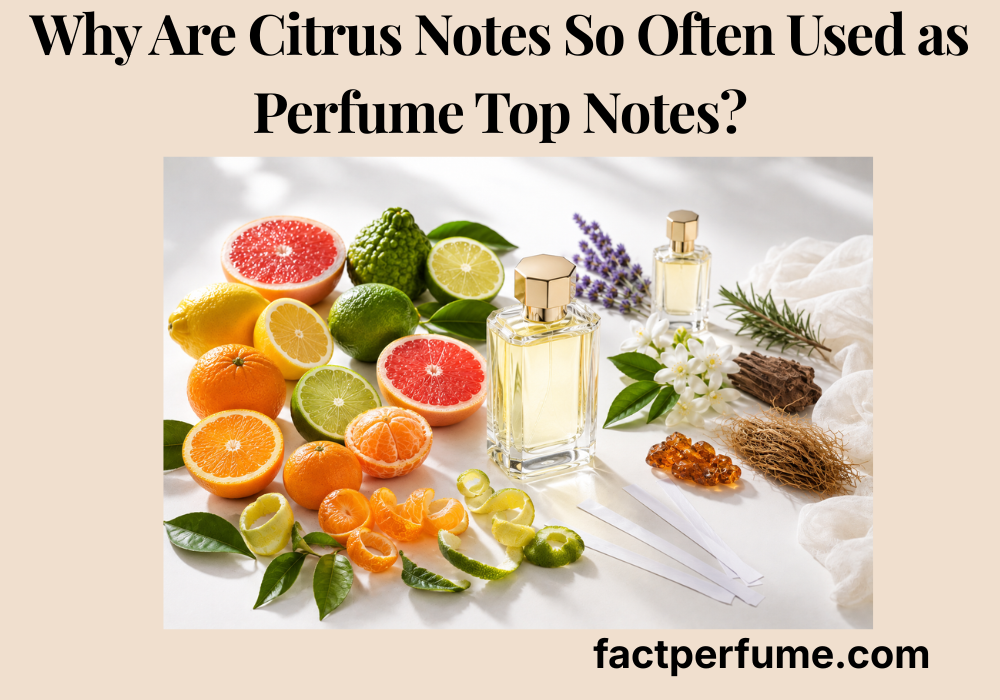
Citrus notes are often used in perfume openings because their bright, zesty, tart, juicy, bitter, green, and peel-like effects can create an immediate and recognisable first impression. Bergamot, lemon, lime, mandarin, orange, and grapefruit are common examples of Citrus directions that can make the first moments of a fragrance feel vivid and clearly defined.
Their early prominence is shaped by the specific material and the fragrance around it, so Citrus top-note behaviour should not be reduced to one evaporation rule, one molecular property, or one fixed time window. Material properties, formula composition, application surface, environmental conditions, and human perception can all influence how a Citrus opening develops.
Educational note: “Top note” describes an early perceived fragrance role rather than a fixed time window. A Citrus note shown in a perfume pyramid also does not by itself reveal the exact raw material, concentration, or evaporation sequence used in the formula.
What Does It Mean for Citrus to Function as a Perfume Top Note?
A Citrus top note is a Citrus-related scent effect that is especially noticeable during the early perceived stage of a perfume.
“Top note” and “head note” are commonly used to describe the opening-associated part of fragrance development. The top provides the early perceived emphasis, the heart describes the developing central direction, and the base describes the later dry-down direction.
These are useful structural and sensory descriptions, but they should not be treated as sealed compartments. The effects can overlap while their relative prominence changes.
A top note is therefore not a fragrance family, a fixed duration, or a universal volatility class. Citrus itself is a fragrance direction that may appear prominently in the opening of many different perfume structures. Readers who need broader classification context can first understand the Citrus family.
Why Are Citrus Effects Often Especially Noticeable in the Opening?
Citrus effects are often especially noticeable in the opening because their bright, zesty, tart, juicy, bitter, green, or peel-like character can create a clear sensory signal while many Citrus-related fragrance materials also contribute effectively to the early fragrance impression.
Three ideas explain much of this role.
First, the behaviour of many materials used to create Citrus effects can support early perceptual prominence. Their properties can make particular fragrant components readily noticeable in the vapour surrounding the applied perfume.
Second, Citrus character is highly recognisable. A sharp lemon-like effect, sparkling bergamot character, green lime impression, juicy mandarin direction, rounded orange effect, or bitter grapefruit facet can give the perfume a distinct identity from its first perception.
Third, perfumers can use this recognisable character to establish the fragrance’s opening direction before floral, aromatic, woody, musky, ambery, or other effects become relatively more prominent.
That does not mean Citrus is weak, cheap, low quality, or structurally unimportant. Opening prominence describes where an effect is especially noticeable, not its quality.
Natural Citrus oils also should not be treated as single chemicals. They are complex mixtures containing multiple constituents, and their composition varies according to the Citrus material and other factors. For broader examples, see the guide to Citrus notes.
Citrus can establish a vivid opening identity through bright fruit, peel, green, and aromatic impressions without implying one fixed evaporation clock.
Which Physical and Formulation Factors Influence How Citrus Develops After Application?
How a Citrus opening develops depends on several interacting variables rather than one property acting alone.
Material properties matter. Volatility—the tendency of a material to enter the vapour phase under defined conditions—is relevant because perfume must reach the surrounding air before its odour can be perceived. But volatility alone does not determine whether something functions as a top, heart, or base note.
Molecular weight alone is also insufficient. Fragrance release is influenced by a broader combination of physicochemical behaviour and the environment in which the material is used.
Formula composition matters. Concentration, solvent environment, surrounding fragrance materials, and the overall composition can influence how individual materials are released and perceived.
Application surface matters. Perfume applied to skin does not necessarily develop exactly as it does on a blotter, fabric, or inert testing surface. Research examining perfume evaporation on human skin has found that both fragrance-molecule characteristics and skin properties can contribute to differences in evaporation behaviour. See this 2025 study for the underlying research.
Environment can matter as well. Temperature and surrounding conditions can affect material release and perception, although they do not create one universal development schedule.
Finally, what the nose notices most is not necessarily the material present at the highest concentration. Sensory detectability and interactions among odour effects also contribute to perceived prominence.
Multi-Variable Citrus Development Flow
This development can be influenced by material properties, concentration, formula composition, solvent environment, supporting materials, application surface, temperature, and sensory detectability.
The central lesson is simple: Citrus opening behaviour is multi-variable.
Material properties, formula composition, application surface, temperature, and sensory detectability can all influence how a Citrus opening develops after application.
Why Does Citrus Create Such a Strong First Sensory Impression?
Citrus is especially effective at introducing a perfume because its bright, zesty, tart, juicy, bitter, and green effects can create a clear and familiar opening identity.
Different Citrus directions provide different sensory possibilities. Lemon may suggest sharpness, tartness, or peel-like brightness. Lime can feel green, juicy, or herbaceous. Mandarin may provide a softer and more rounded Citrus impression, while grapefruit can introduce bitter, pithy, or tart qualities.
These effects can perform several useful sensory roles. They can establish an immediate identity, create contrast with richer materials, or introduce a direction that later develops into floral, aromatic, green, woody, or other structures.
Sensory description, however, should not be confused with measurable performance.
Bright does not automatically mean strong projection. Fresh does not mean long-lasting. Immediate does not mean short-lived.
Words such as clean, energetic, or refreshing are also best understood as possible sensory or contextual associations rather than guaranteed psychological effects.
How Does a Citrus Opening Connect with Floral, Aromatic, Woody, or Other Later Structures?
A Citrus opening does not simply disappear before a separate heart begins; fragrance development can involve overlap, changing prominence, and sensory continuity.
A Citrus effect may flow toward floral materials such as neroli, orange blossom, or jasmine-like effects, creating floral-Citrus continuity.
It can also connect with lavender, herbs, petitgrain, or green materials to produce a more aromatic or botanical direction.
When woods such as vetiver, cedar, or dry woody effects become more prominent, the fragrance may develop toward a drier structure. Musky or ambery effects can create a softer or warmer later character, while tea-like effects may continue a dry, transparent impression of freshness.
These later materials can continue, contrast with, or reinterpret the Citrus theme.
That does not prove that woods “fix” Citrus, musk physically preserves it, or a floral note extends a Citrus material unchanged. Continuing freshness and preserving the original material are different concepts.
How Do Different Citrus Material Types Change the Opening Style?
A Citrus opening can be created with natural oils, isolates, manufactured aroma materials, reconstructed accords, or combinations of these, so the phrase “Citrus top note” does not describe one single material type.
Natural Citrus essential oils are complex mixtures of volatile compounds rather than single molecules, as documented in scientific reviews of Citrus-oil review. They may provide multi-faceted peel, juicy, bitter, green, or aromatic nuances depending on the particular material and its composition.
An isolate is an individual material separated or purified from a broader source or mixture. It can emphasize a more focused facet, but an isolate should not be treated as equivalent to an entire Citrus oil.
A manufactured aroma material may provide bright, diffusive, abstract, fresh, or highly specific Citrus effects depending on the material itself.
A reconstructed Citrus accord combines materials to create or reinterpret a Citrus impression. This gives the perfumer creative control without requiring the entire effect to come from one natural oil.
| Material Type | Possible Opening Character | Design Function | Important Qualification |
|---|---|---|---|
| Natural Citrus oil | Complex, peel-like, juicy, bitter, green | Multi-faceted Citrus character | Material and composition vary |
| Isolate | Focused Citrus facet | Precision | Not a complete natural oil |
| Manufactured aroma material | Bright, diffusive, abstract, fresh | Stylistic control | No universal synthetic profile |
| Reconstructed Citrus accord | Customised or stylised Citrus | Creative control | Not one raw material |
This is why natural and manufactured materials should not be placed into a simple better-versus-worse hierarchy. Their usefulness depends on the exact material and the intended fragrance effect.
For a more specific look at individual roles within this family, see how Bergamot, Lime & Petitgrain can contribute different olfactory functions.
Fragrance development can involve overlap and changing prominence: Citrus may become less dominant while floral, aromatic, musky, ambery, or woody effects become more noticeable.
What Can—and Can’t—the Traditional Fragrance Pyramid Tell You About Citrus Top Notes?
The fragrance pyramid is useful for communicating how a perfume is intended to develop perceptually, but it should not be read as an exact formula, evaporation chart, or stopwatch.
A pyramid can indicate that Citrus is important to the opening, that the perfume begins with a Citrus-led impression, and that another sensory direction is expected to become more prominent later.
It cannot independently reveal the exact duration, evaporation order, raw materials, ingredient concentrations, natural or manufactured origin, total perfume persistence, or complete formula architecture.
| Pyramid May Suggest | Pyramid Does Not Prove |
|---|---|
| Citrus is important in the opening | Exact duration |
| A later transition is intended | Exact evaporation order |
| Other effects become more prominent | Completely isolated stages |
| Citrus is presented as a top-note theme | Exact raw material |
| A listed note matters to the perfume story | Exact dosage |
| Opening, heart, and base directions | Complete formula |
The distinction between a note and a material is particularly important. If “bergamot” appears in a perfume’s top-note list, the label alone does not prove that natural bergamot essential oil was used. It also does not disclose its source, processing method, dose, or persistence.
The traditional top-heart-base structure is therefore most useful as a model of changing sensory emphasis.
The fragrance pyramid is a communication and structural model—not a literal timeline.
Practical Citrus Top-Note Interpretation Checklist
Use these checks when reading a Citrus top-note pyramid or testing the perfume itself.
Frequently Asked Questions
It means a Citrus-related scent effect is especially noticeable during the early perceived stage of the perfume. It does not define a fixed number of minutes or one universal volatility class.
Bright, zesty, tart, juicy, bitter, green, and peel-like Citrus effects can create a recognisable sensory signal, while the materials and formula can support early perceptual prominence.
No. Top, heart, and base are useful descriptions of changing sensory emphasis, not sealed time compartments. Their effects can overlap while relative prominence changes.
No. A note label communicates an intended scent effect. It does not by itself prove the exact raw material, source, processing method, concentration, dose, or persistence.
No. Later materials can continue, contrast with, or reinterpret the Citrus theme, but that does not prove they physically preserve the original Citrus material unchanged.
It can indicate that Citrus is important to the opening and that another sensory direction may become more prominent later. It cannot independently reveal exact duration, evaporation order, raw materials, dosage, or the complete formula.
Conclusion
Citrus is frequently used in perfume openings because its recognisable bright, zesty, tart, juicy, bitter, green, and fresh character can establish a clear first impression while fitting naturally into the early development of many fragrance structures.
A Citrus top note should be understood as an opening-associated perceptual role rather than a fixed period. Early prominence is not weakness, and different Citrus materials do not behave identically. Their development can depend on material properties, formula composition, concentration, surface, environment, and sensory perception.
Fragrance development can also overlap. Citrus may become less dominant while floral, aromatic, woody, musky, ambery, or other effects gain prominence, without requiring a rigid hand-off between separate stages.
Natural oils, isolates, manufactured aroma materials, and reconstructed accords can all create Citrus effects in different ways. Likewise, a perfume pyramid can help describe the intended sensory journey without revealing the exact chemistry behind it.
When interpreting a Citrus top-note pyramid, the most useful questions are:
- What Citrus effect is being communicated?
- Is the actual fragrance material identified?
- What other notes surround the Citrus opening?
- How does the perfume change after application?
- Is the pyramid describing perception rather than exact chemistry?
Understanding these distinctions explains why Citrus works so well at the top of a perfume: it can create a vivid and recognisable opening while remaining part of a much more complex, overlapping, and formula-dependent fragrance development.