
What Is a Citrus Perfume?
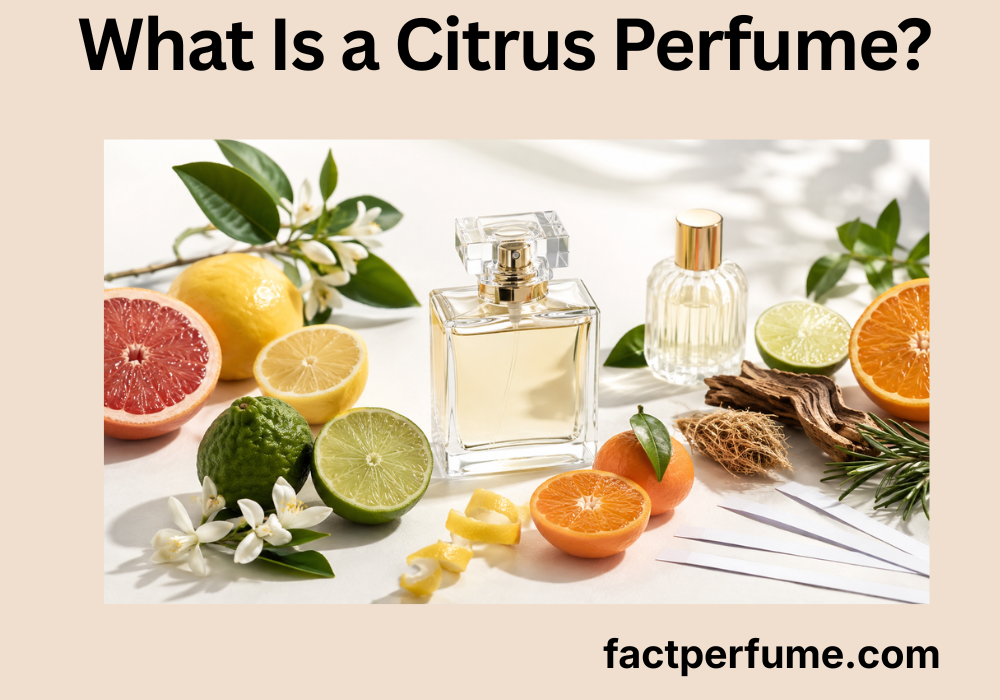
A citrus perfume is a fragrance in which citrus effects such as bergamot, lemon, mandarin, lime, orange, or grapefruit remain central to the overall scent identity rather than appearing only as a brief opening accent. Citrus is a recognised fragrance family, but the presence of one citrus note does not automatically make a perfume Citrus-family if another floral, aromatic, green, watery, or woody structure ultimately defines it.
Citrus perfumes can range from sharp and bitter to juicy, floral, herbal, woody, musky, tea-like, or softly warm depending on the materials and supporting structure around the citrus theme. Understanding the family means looking beyond the first spray to the citrus profile, botanical source, opening behaviour, later development, performance, structural direction, and the way the fragrance feels across its complete wear.
Educational note: A citrus note in a perfume description does not prove that a particular raw essential oil is present or that the raw material is suitable for direct skin use. This article discusses finished fragrances for consumer education. Use perfume products according to their directions.
What Defines a Perfume as Part of the Citrus Fragrance Family?
A perfume belongs in the Citrus family when citrus remains one of the defining themes of its overall scent identity rather than functioning only as an opening accent.
Michael Edwards’ Fragrance Wheel recognises Citrus as a distinct fragrance family associated with bergamot, lemon, mandarin, lime, orange, and grapefruit. The same framework also shows why a citrus note alone is not enough for classification: citrus effects can appear inside other fragrance families without controlling the perfume’s overall identity.
Citrus-Led
A citrus-led perfume keeps citrus character at the centre of its identity.
It may smell:
- zesty;
- tart;
- juicy;
- bitter;
- pithy;
- sparkling;
- peel-like;
- citrus-floral.
Other materials may support the composition, but the perfume continues to be understood primarily through its citrus character.
Citrus-Supported
A citrus-supported fragrance may use bergamot, lemon, mandarin, or another citrus effect prominently while another structure eventually becomes more important.
For example, an aromatic fragrance may open brightly with bergamot before lavender, herbs, geranium, and woods establish its dominant identity.
The citrus matters, but it does not necessarily determine the family.
Citrus Accent
A citrus accent mainly supplies lift or brightness to another fragrance structure.
Bergamot may brighten a floral perfume. Lemon may sharpen herbs. Mandarin may soften an ambered composition. Grapefruit may add bitterness to woods.
Those uses do not automatically turn the perfume into a Citrus fragrance.
The key question is:
Does citrus remain one of the fragrance’s defining olfactory themes?
Citrus Family Boundary Matrix
| Category | Dominant Identity | Can Citrus Appear? | Main Distinction |
|---|---|---|---|
| Citrus | Fruit peel, zest, pith, juicy or citrus-floral character | Yes, centrally | Citrus defines the scent identity |
| Green | Leaves, grass, stems, galbanum, vegetal effects | Yes | Green vegetation dominates |
| Water | Marine, watery, ozonic effects | Yes | Watery or marine character dominates |
| Aromatic | Lavender, herbs, geranium, rosemary, sage | Yes | Aromatic herbs define the structure |
| Woody | Cedar, vetiver, sandalwood, dry woods | Yes | Woods become the dominant identity |
Which Citrus Notes and Scent Profiles Commonly Define Citrus Perfumes?
Bergamot, lemon, lime, mandarin, sweet orange, bitter orange, grapefruit, and citrus-style accords can create distinctly different types of citrus character.
Citrus therefore means much more than “lemon.” Different materials can make a citrus fragrance feel sharp, green, bitter, juicy, sweet, floral, dry, or pithy.
Bergamot
Bergamot is widely used and historically important in perfumery.
It may contribute:
- brightness;
- floral nuance;
- bitterness;
- green freshness;
- zest;
- tea-like character.
Its floral-bitter profile often makes it easier to connect citrus with lavender, neroli, herbs, florals, or woods.
Lemon
Lemon commonly suggests:
- sharpness;
- tartness;
- bright peel;
- juiciness;
- crisp freshness.
A lemon note may feel realistic and juicy or more stylised and aldehydic depending on the accord around it.
Lime
Lime can appear:
- tart;
- green;
- bitter;
- sharp;
- terpenic.
It often works well when a fragrance needs a more penetrating or green citrus effect.
Mandarin
Mandarin commonly feels:
- soft;
- juicy;
- rounded;
- sweeter;
- less sharply bitter than some citrus profiles.
It can give a perfume a warmer, more approachable fruit character.
Sweet Orange
Sweet orange may evoke:
- juicy fruit;
- sweet peel;
- rounded citrus warmth;
- soft brightness.
It can feel fuller and sweeter than a sharp lemon or lime profile.
Bitter Orange
Bitter orange can introduce:
- dryness;
- bitterness;
- sharper peel;
- restrained sweetness;
- aromatic depth.
It can bridge especially well into herbs, flowers, spices, or woods.
Grapefruit
Grapefruit may smell:
- bitter;
- tart;
- pithy;
- juicy;
- slightly green.
Some perfume grapefruit effects are reconstructed accords rather than literal declarations of natural grapefruit oil.
Yuzu-Style Effects
Yuzu notes or accords may suggest:
- tart citrus;
- dry peel;
- green freshness;
- grapefruit-like bitterness;
- mandarin-like fruitiness.
Unless exact material identity is documented, “yuzu” is best treated as the communicated scent impression rather than proof that one particular natural material is present.
A broader guide to citrus notes helps show how widely citrus character can vary.
Citrus perfume can centre on several different fruit profiles, from sharp lemon and green lime to softer mandarin, floral-bitter bergamot, or pithy grapefruit.
How Are Citrus Peel Oils Different From Neroli, Orange Blossom, and Petitgrain?
Citrus peel oils, citrus flowers, and citrus leaves or twigs come from different parts of the plant and can create very different fragrance effects.
They may share a botanical connection, but they should not be treated as interchangeable citrus ingredients.
Citrus Peel Materials
Bergamot, lemon, lime, sweet orange, bitter orange, and grapefruit are commonly associated with peel-derived citrus effects.
Their scent profiles may include:
- zest;
- rind;
- juicy fruit;
- tartness;
- pith;
- bitterness;
- bright terpenic freshness.
These are the effects most consumers associate directly with a recognisable citrus-fruit opening.
Neroli
Neroli is associated with bitter-orange flowers rather than fruit peel.
It is commonly described as:
- floral;
- airy;
- green;
- fresh;
- citrus-bright.
Its floral character allows it to connect citrus openings naturally with floral hearts.
Orange Blossom Absolute
Orange blossom absolute also comes from bitter-orange flowers but is obtained differently from neroli.
Its profile is generally:
- richer;
- fuller;
- sweeter;
- more floral;
- warmer.
Neroli and orange blossom therefore share a botanical origin without being identical fragrance materials or scent effects.
Petitgrain
Petitgrain is produced mainly from citrus-tree leaves and twigs.
It may smell:
- green;
- woody;
- bitter;
- leafy;
- fresh.
It frequently acts as a bridge between citrus peel, aromatic herbs, green effects, and woods.
The different roles of bergamot, lime & petitgrain demonstrate why the source part of the plant matters.
Citrus Profile and Botanical-Source Matrix
| Entry | Source / Material Type | Typical Character | Common Role | Qualification |
|---|---|---|---|---|
| Bergamot | Citrus peel material or note | Floral, bitter, green, zesty | Brightness and transition | Published note does not confirm exact raw material |
| Lemon | Peel material or accord | Sharp, tart, juicy | Crisp citrus identity | May be reconstructed |
| Lime | Peel material or accord | Tart, green, bitter | Sharp freshness | Processing can change character |
| Mandarin | Peel material or note | Soft, juicy, sweet | Rounded citrus | Varieties differ |
| Sweet orange | Peel material or accord | Juicy, sweet peel | Soft citrus warmth | Note may be reconstructed |
| Bitter orange | Peel-related citrus material | Dry, bitter, sharp | Bitter citrus structure | Source part must be distinguished |
| Grapefruit | Peel material or accord | Pithy, tart, bitter | Modern bitter freshness | Accord construction is common |
| Yuzu-style accord | Constructed citrus impression | Tart, dry, green | Distinct citrus contrast | May not contain literal yuzu |
| Neroli | Bitter-orange flower material | Floral, green, bright | Citrus-floral bridge | Not peel oil |
| Orange blossom absolute | Flower-derived material | Richer, sweeter, floral | Floral body | Distinct from neroli |
| Petitgrain | Leaf/twig material | Green, woody, bitter | Botanical bridge | Not fruit-peel oil |
A fragrance note should always be understood as sensory communication. It may represent a natural material, manufactured molecule, reconstructed accord, mixture, or simply the intended impression. A note pyramid is not an ingredient declaration.
Citrus-fruit peel, citrus flowers, and citrus-tree leaves or twigs can produce very different scent effects even when they share a botanical relationship.
Why Are Citrus Effects Often Strongest Near the Opening?
Citrus effects are often especially noticeable near the opening because many characteristic constituents contribute readily to the fragrance headspace, but development depends on several physical, formula, and perceptual variables.
Citrus performance cannot be explained accurately by saying that citrus consists of the “smallest molecules.”
Citrus Oils Are Mixtures
A citrus essential oil contains many constituents.
It therefore does not possess:
- one molecular weight;
- one volatility;
- one evaporation rate;
- one smell molecule.
Limonene, for example, is common in many citrus oils, but limonene does not equal the complete scent of lemon, orange, grapefruit, or bergamot.
Minor constituents can meaningfully influence bitterness, juiciness, sweetness, floral nuance, peel texture, and the distinctive character of the fruit.
Volatility
Volatility describes a material’s tendency to enter the vapour phase under defined conditions.
Many citrus-related constituents contribute rapidly to the vapour above freshly applied perfume, which can make citrus especially prominent during the opening.
Vapour Pressure
Vapour pressure is another physical property related to a substance’s tendency to enter the gas phase.
It contributes to fragrance-release behaviour but does not operate independently of the formula.
Odour Threshold
Odour threshold refers to the concentration at which an odour becomes detectable under particular conditions.
A material can have a strong perceptual effect even when present in a relatively small amount.
This is another reason concentration alone cannot predict which note will dominate perception.
Formula and Environment Matter
Opening behaviour can also depend on:
- concentration;
- other citrus materials;
- herbs;
- florals;
- woods;
- musks;
- solvent;
- application surface;
- temperature.
The science behind top-note science is therefore more complex than a simple molecular-weight hierarchy.
As the brightest peel character softens, florals, aromatics, woods, tea-like effects, and musks may continue part of the perfume’s fresh identity.
What Is the Difference Between Citrus-Note Persistence and Whole-Perfume Longevity?
Citrus-note persistence measures how long citrus remains recognisable, while whole-perfume longevity measures how long the complete fragrance remains perceptible.
Between those two ideas is a third useful concept: freshness continuity.
Citrus-Note Persistence
Ask:
Can I still clearly recognise lemon, bergamot, lime, mandarin, grapefruit, orange, rind, or pith?
When that literal effect becomes difficult to identify, citrus-note persistence has changed.
Freshness Continuity
Ask:
Does the perfume still feel bright, green, airy, bitter-fresh, floral-citrus, or musky-fresh after the literal fruit impression becomes quieter?
Herbs, neroli, vetiver, tea, transparent woods, florals, and musks may continue a fresh sensation.
That does not mean the original citrus material remained unchanged.
Whole-Perfume Longevity
Ask:
Is the complete perfume still meaningfully detectable?
A citrus-woody fragrance might begin with lemon, move toward vetiver and cedar, then remain perceptible through its woody dry-down.
The correct interpretation is:
The perfume remained detectable longer than its literal lemon effect.
It would be inaccurate to conclude that the woods made the lemon itself last for the entire wear.
Citrus Performance Concept Matrix
| Concept | Core Question | Example | What It Does Not Prove |
|---|---|---|---|
| Citrus-note persistence | Can I still recognise citrus? | Bergamot remains identifiable | Total perfume longevity |
| Freshness continuity | Does the fragrance still feel fresh? | Vetiver, herbs, florals, or musk remain bright | Literal citrus remains unchanged |
| Whole-perfume longevity | Is the complete scent still perceptible? | Woody-musky dry-down remains | Citrus lasted equally long |
An Eau de Parfum label does not independently guarantee that recognisable citrus will persist longer than in an Eau de Toilette. Formula architecture matters.
Price is also not a reliable shortcut for citrus persistence, projection, realism, or total longevity.
Which Structural Directions Are Commonly Combined With Citrus?
Citrus may be supported by aromatic, floral, woody, musky, tea-like, spicy, or softly sweet structures while remaining important to the fragrance identity.
These are best understood as common citrus structural directions, not automatically as official fragrance subfamilies.
Citrus + Aromatic
Possible supporting facets include:
- rosemary;
- basil;
- mint;
- lavender;
- sage;
- geranium.
The result may feel crisp, green, dry, herbal, or botanical.
The trade-off is that the aromatic structure may eventually become more important than the citrus.
Citrus + Floral
Possible partners include:
- neroli;
- orange blossom;
- jasmine;
- rose;
- white florals.
These can create a luminous, airy, soft, or floral-citrus profile.
Later development may become distinctly more floral.
Citrus + Woody
Common supporting effects include:
- vetiver;
- cedar;
- sandalwood;
- dry woods.
These can make citrus feel:
- dry;
- grounded;
- structured;
- bitter-fresh.
Woods may remain long after literal citrus becomes quieter.
Citrus + Musk or Tea
Musk and tea-like structures can make citrus feel:
- transparent;
- clean;
- airy;
- restrained;
- contemporary.
The citrus identity may become more abstract as the perfume develops.
Citrus + Spice or Soft Sweetness
Ginger, pepper, cardamom, vanilla, tonka, or soft amber effects can add:
- sparkling spice;
- warmth;
- contrast;
- softly sweet citrus.
The trade-off is that sweetness or spice may eventually overtake the fruit character.
A wider range of citrus pairings can produce additional transitions without changing the core rule that citrus must remain central if the perfume is to be understood primarily as Citrus.
Citrus Structural Direction Matrix
| Direction | Citrus Role | Supporting Facets | Possible Development | Main Trade-Off |
|---|---|---|---|---|
| Citrus + aromatic | Bright botanical focus | Lavender, rosemary, basil, sage | Herbal, dry, green | Aromatics may become dominant |
| Citrus + floral | Luminous fruit-flower bridge | Neroli, orange blossom, jasmine, rose | Airy and floral | Citrus may recede behind flowers |
| Citrus + woody | Brightness over structure | Vetiver, cedar, sandalwood | Dry, grounded, bitter-fresh | Woods may dominate the dry-down |
| Citrus + musk/tea | Transparent freshness | Musk, tea-like effects | Airy, clean, abstract | Literal fruit identity may soften |
| Citrus + spice/sweet | Sparkling contrast | Ginger, pepper, vanilla, tonka, amber | Warm, spicy, softly sweet | Sweetness or spice may take over |
Blotter screening and skin testing help compare citrus character, supporting structure, development, and the balance between citrus persistence and the complete dry-down.
What Role Did Eau de Cologne Play in Citrus Perfumery?
Eau de Cologne is historically important to citrus perfumery because the classic style established an influential combination of bright citrus with floral and light supporting notes.
The historical Cologne tradition demonstrated that citrus did not need to stand alone. Bergamot, lemon, bitter orange, and lime could be supported by floral materials such as neroli and jasmine and by softer base effects.
That basic idea remains relevant to modern Citrus perfumes even though contemporary citrus perfumery is much broader.
Eau de Cologne Has More Than One Meaning
The term can refer to three different things.
Eau de Cologne style: the historical citrus-led fragrance tradition.
Eau de Cologne concentration: a concentration designation used by some fragrance brands.
Casual “cologne”: a generic English-language term often used for fragrances marketed toward men.
These meanings should not be treated as interchangeable.
A modern Citrus perfume may draw inspiration from traditional Cologne while using another concentration label, another structural style, or a completely different marketing position.
How Should You Evaluate and Choose a Citrus Perfume?
Choose a citrus perfume according to its dominant citrus character, supporting structure, complete development, and your own wear preferences rather than relying on the first spray, concentration label, price, or season.
Identify Your Preferred Citrus Character
Decide whether you enjoy:
- sharp lemon;
- floral-bitter bergamot;
- green lime;
- juicy mandarin;
- sweet orange;
- bitter grapefruit;
- dry bitter orange.
The word “citrus” is too broad to predict which of these profiles you will prefer.
Choose the Supporting Structure
Consider whether you prefer citrus combined with:
- aromatics;
- florals;
- woods;
- musk or tea;
- spice;
- soft sweetness.
The supporting structure can change the perfume substantially after the opening.
Decide How Central Citrus Should Remain
Ask:
- Do I want citrus to remain the defining theme through most of the wear?
- Am I happy with a strong citrus opening followed by a floral or woody transition?
- Do I enjoy the later dry-down as much as the opening?
This is more useful than judging the fragrance from the first few moments alone.
Evaluate Performance in Three Parts
Separate:
- Citrus-note persistence
- Freshness continuity
- Whole-perfume longevity
A perfume may perform well overall even if its most literal citrus effect changes relatively early.
Compare Blotter and Skin
Use a blotter for initial screening and side-by-side comparison.
Use skin for the final personal judgement because skin properties, formula, application conditions, and environment can influence development.
Do not assume that a blotter predicts exact personal wear.
Consider Climate Without Seasonal Rules
Citrus is not a summer-only fragrance family.
Instead ask:
- Is the scent comfortable in my normal climate?
- Does warmer weather make the opening too intense?
- Do I enjoy its dry-down in cooler conditions?
A dry woody citrus may be enjoyable in cool weather, while a bright aromatic citrus may suit warmer conditions for another wearer.
Ignore Price and Concentration Shortcuts
Higher price does not independently guarantee:
- greater citrus persistence;
- better realism;
- stronger projection;
- longer total wear.
Likewise, EDP does not automatically mean that the citrus itself remains recognisable proportionally longer.
Judge the actual fragrance.
Citrus Buying Evaluation Checklist
Frequently Asked Questions
A perfume belongs in the Citrus family when citrus remains one of the defining themes of the complete scent identity rather than serving only as a brief opening accent.
No. Bergamot, lemon, mandarin, grapefruit, or another citrus effect can support Green, Water, Aromatic, Woody, floral, and other structures without defining the whole fragrance.
Neroli and orange blossom are associated with bitter-orange flowers, while petitgrain is mainly associated with citrus-tree leaves and twigs. Peel materials come from the fruit rind and usually emphasize zest, pith, tartness, or juicy citrus character.
Many citrus-related constituents contribute readily to the fragrance headspace, but the opening also depends on volatility, vapour pressure, odour threshold, concentration, formula, surface, and environment.
No. Concentration labels do not independently determine how long recognizable citrus remains. Formula architecture and the complete fragrance structure matter.
Identify the citrus profile you enjoy, consider the supporting aromatic, floral, woody, musky, tea-like, spicy, or sweet structure, follow the complete development, test on skin, and judge citrus persistence separately from whole-perfume longevity.
Conclusion
A citrus perfume is defined by citrus remaining central to its scent identity—not simply by lemon, bergamot, or orange appearing in the opening. Citrus is a recognised fragrance family, but citrus effects can also support Green, Water, Aromatic, Woody, floral, and other fragrance structures without defining them.
Citrus itself is diverse. Bergamot can feel floral and bitter, lemon sharp and tart, lime green and penetrating, mandarin soft and juicy, orange rounded and sweet, and grapefruit pithy and bitter. Peel materials also differ from citrus-tree flowers and leaves: neroli and orange blossom are flower-derived but distinct from one another, while petitgrain is associated mainly with leaves and twigs.
Citrus oils are complex mixtures rather than single molecules, and early prominence depends on volatility, vapour pressure, odour threshold, concentration, formula, surface, and environment rather than molecular weight alone. Recognisable citrus persistence should also be separated from broader freshness continuity and whole-perfume longevity.
The most useful way to choose a Citrus perfume is therefore to identify the citrus profile you enjoy, understand its supporting structure, decide how dominant you want citrus to remain, follow the fragrance through its full development, evaluate it on your own skin, consider your usual climate and reapplication preferences, and avoid treating price or concentration labels as simple performance guarantees.