
What Are the Most Common Citrus Notes in Perfume?
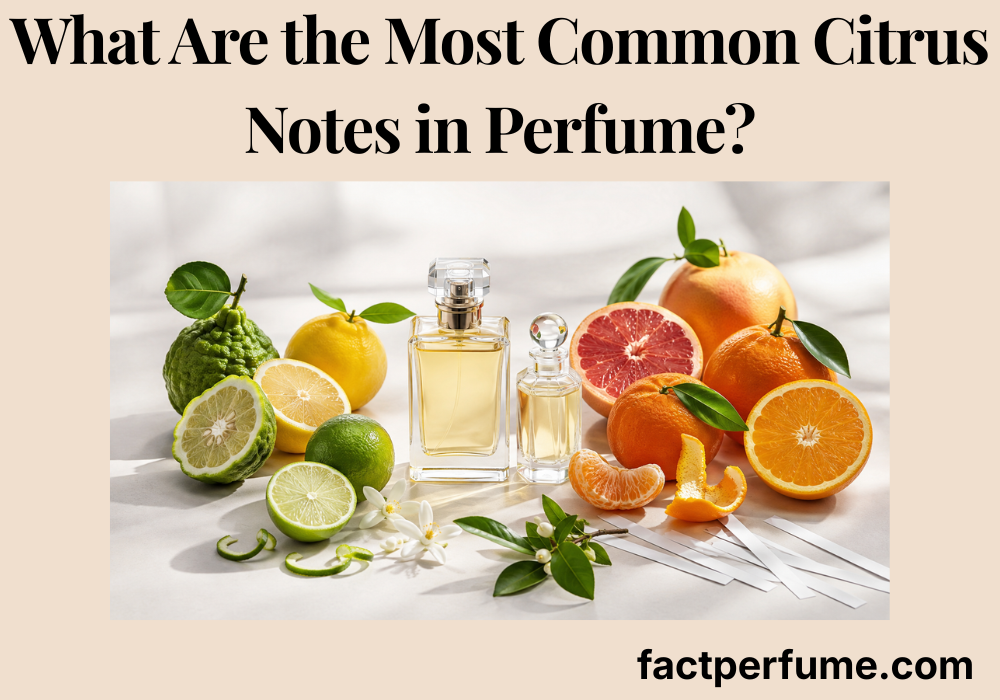
Bergamot, Lemon, Lime, Mandarin, Orange, and Grapefruit are the principal Citrus profiles a perfume consumer should recognise first. They form a useful core reference set for understanding Citrus fragrance, but they should not be treated as a statistically ranked list of ingredient frequency without separate database evidence.
These Citrus profiles differ in tartness, bitterness, juiciness, greenness, floral character, and dryness, and a note shown in a perfume pyramid does not necessarily reveal the exact material used to create it. Understanding those differences helps a reader compare Citrus scents, interpret natural and constructed effects, recognise related Citrus-tree materials, understand early fragrance development, and choose a profile that matches personal taste.
Educational note: A Citrus note in a perfume description does not establish which raw material is present, its concentration, or its processing method. This page discusses finished perfumes for consumer education; raw Citrus oils should not be treated as interchangeable with perfume note names.
How Do Bergamot, Lemon, Lime, Mandarin, Orange, and Grapefruit Smell Different?
Bergamot, Lemon, Lime, Mandarin, Orange, and Grapefruit share a Citrus identity but can differ substantially in tartness, bitterness, sweetness, juiciness, floral character, greenness, and peel texture.
The Citrus family covers more than a generic “lemon” smell. Michael Edwards’ Fragrance Wheel places bergamot, lemon, mandarin, lime, orange, and grapefruit within the Citrus family, supporting this practical reference set. For the broader family definition and the difference between citrus-led, citrus-supported, and citrus-accent structures, see the citrus family.
Bergamot often gives a bright, bitter, green, floral-citrus impression with aromatic or peel-like facets. It is widely used and historically important, without needing superlatives.
Lemon generally suggests a sharper, tart, bright, peel-like effect. Depending on the formula, it can also feel juicy or slightly bitter.
Lime may smell tart, green, dry, sharp, bitter, or aromatic. Processing and formula context can significantly change how its character is perceived.
Mandarin often feels softer, rounder, and juicier than sharply tart Lemon. It can suggest sweetness, but it should not be described as universally the sweetest Citrus profile.
Orange commonly gives a rounded, juicy, sweet-peel impression. Sweet Orange may lean softer, while Bitter Orange or Bigarade can feel drier, greener, and more peel-focused. Treat Bitter Orange as a variation rather than a seventh core profile.
Grapefruit often combines tartness with bitterness, dryness, juiciness, and a recognisable pith-like effect. A Grapefruit note in a perfume description does not by itself prove natural Grapefruit oil is present.
Core Citrus Sensory Matrix
| Citrus Profile | Typical Sensory Tendencies | Main Contrast | Qualification |
|---|---|---|---|
| Bergamot | Bright, bitter, green, floral-citrus | More floral/aromatic | Formula-dependent |
| Lemon | Sharp, tart, bright, peel-like | Direct tartness | May also feel juicy or bitter |
| Lime | Tart, green, dry, aromatic | Greener/drier character | Processing can alter the effect |
| Mandarin | Soft, juicy, rounded | Less aggressively tart | Sweetness varies |
| Orange | Rounded, juicy, sweet-peel | Softer, warmer fruitiness | Sweet and Bitter Orange differ |
| Grapefruit | Bitter, tart, pithy, dry | Strong pith-like bitterness | Effect may be reconstructed |
Bergamot, lemon, lime, mandarin, orange, and grapefruit provide a practical core reference set for comparing Citrus perfume profiles.
What Is the Difference Between a Citrus Note, Natural Citrus Oil, Isolate, Molecule, and Accord?
A Citrus note describes a perceived smell, while oil, isolate, molecule, and accord describe different types of material or construction that may create that impression.
A Citrus note is a communicated olfactory impression. If a perfume description lists “Grapefruit,” the safest interpretation is that Grapefruit is part of the intended scent experience. The note pyramid alone does not disclose how that effect was built.
A natural Citrus oil is a botanical aromatic mixture, not one molecule with one universal evaporation behaviour.
An isolate is an individual constituent separated or purified from another source. It may support one Citrus facet without reproducing a whole oil.
A synthetic aroma molecule is a manufactured fragrance material that may contribute peel, zest, brightness, juiciness, or diffusion. Its origin does not determine quality or safety.
A Citrus accord combines multiple materials to create or reinterpret a Citrus effect, potentially using naturals, isolates, manufactured molecules, and supporting materials.
For a deeper explanation of why perceived realism does not map directly to natural versus manufactured materials, see natural vs synthetic citrus.
Note-vs-Material Ontology Matrix
| Term | What It Is | What It Communicates | What It Does Not Prove |
|---|---|---|---|
| Citrus note | Perceived scent description | Intended Citrus character | Exact ingredient |
| Natural Citrus oil | Botanical aromatic mixture | Verified natural material | One molecule or one behaviour |
| Isolate | Separated or purified constituent | Specific olfactory contribution | Full natural Citrus profile |
| Synthetic aroma molecule | Manufactured fragrance material | Particular scent effect | Automatic quality or safety |
| Citrus accord | Multi-material construction | Recognisable Citrus impression | One ingredient or natural oil |
A note pyramid communicates intended sensory development. It is not necessarily a complete formula, ingredient list, percentage chart, or fixed evaporation clock.
A Citrus note describes a scent impression, while natural oils, isolates, manufactured aroma materials, and accords describe different material or construction routes.
Which Other Citrus Profiles May Appear in Perfume Descriptions?
Perfume descriptions may also use Citrus terms such as Yuzu, Pomelo, and Bitter Orange to communicate more specific variations beyond the six core profiles.
Yuzu can suggest a tart, dry, green, aromatic Citrus direction. Unless material identity is verified, treat it as a Yuzu note or Yuzu-style effect.
Pomelo can suggest a juicy, pithy, softly bitter profile. The note does not prove natural Pomelo material is present.
Bitter Orange or Bigarade can suggest a drier, greener, more bitter, peel-focused character than a softer Sweet Orange style.
These terms expand Citrus vocabulary, but trend claims require market evidence.
How Are Neroli, Orange Blossom, and Petitgrain Different From Fruit-Peel Citrus Notes?
Neroli, Orange Blossom Absolute, and Petitgrain are Citrus-tree-derived materials, but they come from different plant parts or processes and should not be treated as interchangeable fruit-peel Citrus notes.
Natural peel materials may come from Bergamot, Lemon, Lime, Orange, or Grapefruit when identity is verified; a note name alone is not proof.
Neroli is distilled from Bitter Orange flowers and may smell fresh, green, airy, and floral. It is not fruit-peel oil.
Orange Blossom Absolute also comes from Bitter Orange flowers but through a different extraction route. It can feel fuller and richer than Neroli.
Petitgrain is typically associated with Bitter Orange leaves and twigs and may smell green, leafy, woody, and bitter.
For a plant-part comparison of peel brightness, leafy bitterness, and transitional roles, see bergamot, lime & petitgrain.
Citrus-Tree Source Matrix
| Plant Part | Material | Process Category | Typical Direction | Boundary |
|---|---|---|---|---|
| Fruit peel | Verified Citrus peel oil | Material-specific extraction | Zesty, peel-like, Citrus | Presence must be verified |
| Flower | Neroli | Distillation | Fresh, green, floral-citrus | Not peel oil |
| Flower | Orange Blossom Absolute | Different flower extraction route | Fuller, richer floral | Not identical to Neroli |
| Leaf/twig | Petitgrain | Distillation | Green, leafy, woody, bitter | Not fruit peel |
Fruit peel, bitter-orange flowers, and citrus leaves or twigs can contribute different perfume effects, so botanical source matters when reading Citrus descriptions.
Why Are Citrus Effects Often Especially Noticeable Near the Opening of a Perfume?
Many Citrus effects are especially noticeable early, but their development depends on material, formula, surface, and wearer variables.
The opening simply means the early perceived stage of fragrance development. It should not be defined by a universal number of minutes.
Volatility and vapour pressure affect how readily materials enter the air, while odour threshold affects how easily they are perceived.
Primary evaporation research found that diffusion can vary with the odorant, surrounding mixture, and product matrix, supporting a multi-variable rather than fixed-clock model.
Molecular weight alone cannot explain top-note behaviour. Concentration, solvent environment, surrounding materials, surface, skin, and temperature also matter.
For the deeper mechanism behind opening prominence, see citrus top notes, including the roles of volatility, vapour pressure, odour threshold, and formula context.
How Can You Identify the Citrus Profile That Matches Your Preferences?
Choose a Citrus profile according to the tartness, sweetness, bitterness, floral character, or greenness you enjoy rather than relying on gender, profession, or psychological labels.
For a sharp or tart character, explore Lemon, Lime, or some Yuzu-style effects and check whether their sharpness feels refreshing or harsh.
For a soft or juicy effect, Mandarin and Sweet Orange may feel rounded and gentle; verify the sweetness of the complete perfume.
For a bitter or dry direction, explore Grapefruit, Bergamot, or Bitter Orange.
For floral-citrus styles, explore Bergamot, Neroli-led compositions, or Orange Blossom-supported structures.
For a greener Citrus direction, consider Lime, Petitgrain-supported styles, Bitter Orange, or some Yuzu-style effects.
Citrus Preference Matrix
| Preferred Character | Profiles to Explore | Possible Impression | What to Verify |
|---|---|---|---|
| Sharp / tart | Lemon, Lime, Yuzu-style | Crisp, tart, direct | Sharpness tolerance |
| Soft / juicy | Mandarin, Sweet Orange | Rounded, juicy, softer | Sweetness level |
| Bitter / dry | Grapefruit, Bergamot, Bitter Orange | Pithy, peel-like, dry | Bitter preference |
| Floral-citrus | Bergamot, Neroli, Orange Blossom-supported | Bright, floral, polished | Floral intensity |
| Green Citrus | Lime, Petitgrain, Bitter Orange, Yuzu-style | Green, leafy, aromatic | Herbal/leafy intensity |
These categories describe sensory preference. They should not be converted into supposedly objective categories such as masculine Citrus, feminine Citrus, professional Citrus, calming Citrus, or awakening Citrus.
Citrus Note Reading Checklist
Frequently Asked Questions
Bergamot, Lemon, Lime, Mandarin, Orange, and Grapefruit form a useful core reference set. They are not presented here as a statistical ranking of ingredient frequency.
No. A note communicates an intended scent impression. The effect may come from a natural oil, isolate, manufactured aroma material, reconstructed accord, or a combination of materials.
Neroli and Orange Blossom Absolute both come from bitter-orange flowers but use different processes and have different scent profiles. Petitgrain is associated mainly with citrus leaves and twigs rather than fruit peel.
No. Natural Citrus oils are complex aromatic mixtures. Individual molecules may contribute important facets, but one molecule does not represent the complete smell or behaviour of a whole Citrus oil.
Many Citrus-related materials contribute readily to the fragrance headspace, but opening behaviour also depends on volatility, vapour pressure, odour threshold, formula, surface, skin, temperature, and surrounding materials.
Choose by sensory preference. Lemon, Lime, and some Yuzu-style effects can feel sharper; Mandarin and Sweet Orange can feel softer or juicier; Grapefruit, Bergamot, and Bitter Orange can feel drier or more bitter; Neroli and Orange Blossom can support floral-citrus styles.
Conclusion
Bergamot, Lemon, Lime, Mandarin, Orange, and Grapefruit are the core Citrus profiles a fragrance consumer should recognise first, but their note names communicate scent character more reliably than they reveal exact formula composition.
Citrus is not one generic smell, and the six-profile reference set is not a statistical ranking. A Citrus note is not automatically an ingredient, a natural oil is not one molecule, an isolate does not reproduce every facet of a whole oil, and an accord is not one ingredient.
Yuzu and Pomelo should be treated first as scent-profile descriptions unless their material identity is verified. Neroli and Orange Blossom Absolute come from flowers through different processes, while Petitgrain is associated with leaves and twigs rather than fruit peel.
Citrus effects may be especially noticeable during the opening, but there is no universal 10-, 30-, or 60-minute clock governing their development, and molecular weight alone cannot explain fragrance evaporation. When reading a perfume description, identify the Citrus profile, treat the listed note first as a scent description, examine the surrounding structure, smell the finished fragrance, and decide whether its actual sensory character matches your preference.