
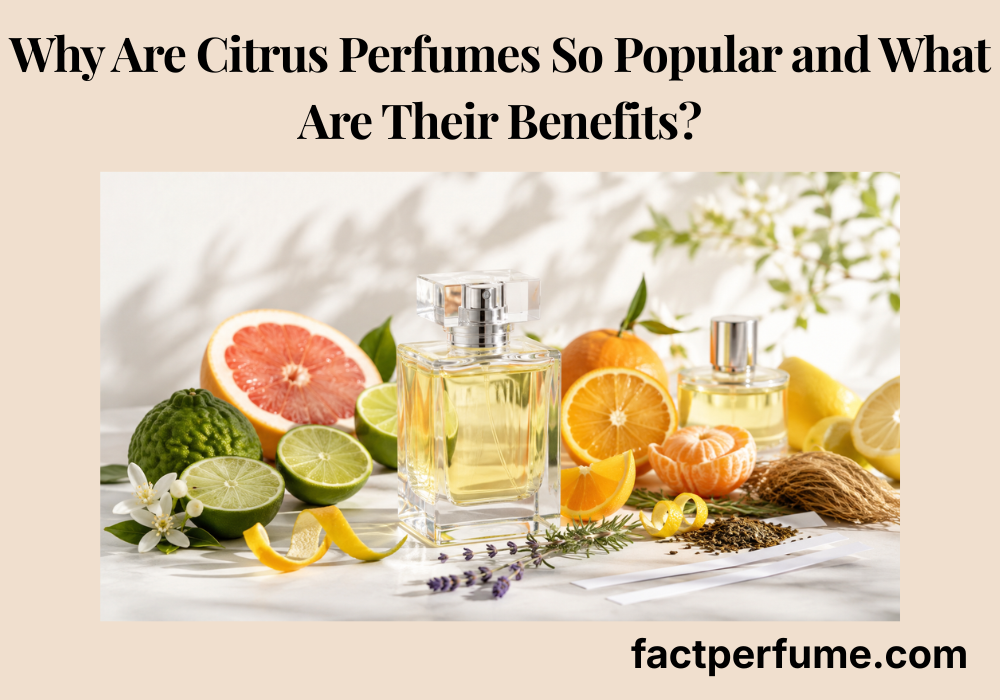
Why Are Citrus Perfumes So Popular and What Are Their Benefits?
Citrus perfumes have enduring appeal because bergamot, lemon, mandarin, lime, orange, grapefruit, and related citrus effects create a bright and recognisable fragrance identity that has remained prominent across generations of perfumery. Their familiar scent cues and ability to blend with many other fragrance styles help explain why citrus remains such a visible part of perfume.
Their advantages are best understood as sensory qualities, learned associations, personal reactions, and practical fragrance flexibility rather than universal psychological or health benefits. A citrus scent may feel refreshing, cheerful, energising, or calming to one wearer, but these responses can depend strongly on pleasantness, memory, expectation, familiarity, and context.
Evidence note: Citrus perfume can be discussed in terms of scent character, learned associations, personal responses, and practical use. These are not the same as clinical benefits. Studies involving limonene or citrus essential oils use specific materials and exposure conditions, so their findings should not automatically be applied to ordinary finished perfume.
What Makes Citrus Fragrances Widely Familiar and Enduring in Perfumery?
Citrus fragrances have remained familiar because they combine a long perfume tradition, recognisable fruit-related scent cues, and an ability to work within many different fragrance structures.
The modern Fragrance Wheel recognises Citrus as its own fragrance family and describes it through materials such as bergamot, lemon, mandarin, lime, orange, and grapefruit. Historical continuity and continued representation help explain enduring appeal, but they do not prove that Citrus currently leads perfume sales or that everyone prefers it.
These materials can produce several recognisable sensory effects. Lemon may contribute tart brightness, grapefruit can create a bitter or pithy impression, mandarin can feel softer and juicier, while bergamot often combines citrus freshness with more floral or bitter facets.
Anyone wanting the basic family definition can first explore the citrus family.
Citrus also benefits from familiarity outside fine fragrance. Similar odours regularly appear in food, beverages, soaps, grooming products, and household products. Because many people already understand ideas such as lemon-like, orange-like, or grapefruit-like, a citrus fragrance may also be comparatively easy to recognise and describe.
Familiarity, however, is not the same as preference. A person may instantly recognise a lemon-like smell and still dislike wearing it.
Citrus Appeal Driver Matrix
| Appeal Driver | Why It May Matter | Evidence Type | Limitation |
|---|---|---|---|
| Historical continuity | Keeps Citrus familiar within perfumery | Fragrance taxonomy | Does not prove current sales leadership |
| Familiar scent cues | Connects perfume with recognisable smells | Sensory experience | Recognition does not guarantee liking |
| Clear sensory identity | Bright, tart and juicy effects are easy to notice | Sensory description | Formulas differ |
| Structural flexibility | Works with many supporting notes | Fragrance analysis | Citrus may not dominate every formula |
| Accessible vocabulary | Familiar fruit terms aid description | Consumer familiarity | Interpretation remains personal |
Why Can Citrus Scents Feel Bright, Uplifting, or Energising to Some People?
Citrus scents may feel bright or uplifting to some people because their sensory character interacts with personal pleasantness, familiarity, memories, expectations, and context.
Sharp, tart, juicy, bitter, or sparkling effects can be interpreted as vivid, lively, fresh, or refreshing. Those words describe an experience of the smell; they do not establish a biological mechanism that automatically creates happiness or energy.
This distinction is supported by a controlled d-limonene study. The experiment did not find an odour-specific mood-lifting effect for d-limonene. Instead, participants’ judgments of how pleasant the odours were showed a relationship with how strongly induced negative mood reduced happiness.
A citrus perfume may feel uplifting when the person wearing it genuinely enjoys its smell.
Memory can also influence the experience. Lemon, orange, mandarin, or bergamot effects may remind someone of food, family routines, holidays, grooming, home, particular weather, or other personal experiences. Another wearer may have entirely different associations.
Citrus therefore does not produce one emotional response for everyone. Personal taste matters.
What Does Research on Citrus Odours and Bergamot Essential Oil Actually Support?
Research on citrus odours and essential oils provides useful context about specific experimental exposures, but it does not establish therapeutic benefits for ordinary citrus perfume.
The d-limonene research illustrates why this distinction matters. Its findings should not be simplified into the claim that “citrus boosts mood.” The study instead highlights the importance of how pleasant a person finds an odour.
Research involving bergamot essential oil requires another boundary. An essential-oil intervention is not interchangeable with an eau de toilette, eau de parfum, parfum, body mist, or another finished fragrance.
A commercial perfume may differ in its composition, amount of bergamot material, concentration, method of exposure, duration of exposure, and surrounding ingredients. Findings from a controlled essential-oil intervention therefore cannot automatically be transferred to an arbitrary perfume.
It is reasonable to say that some wearers find Citrus calming, personally refreshing, or enjoyable as part of a sensory ritual. It is not reasonable to turn those experiences into claims that Citrus perfume treats anxiety, depression, sleep problems, or clinical stress.
Citrus Response and Evidence Matrix
| Claimed Advantage | Appropriate Language | Evidence Context | Main Limitation | Avoid |
|---|---|---|---|---|
| Brightness | Citrus can smell bright | Sensory | Formula-dependent | “Creates alertness” |
| Refreshing character | May feel refreshing | Personal response | Individual variation | “Refreshes everyone” |
| Uplifting feeling | May feel uplifting | Pleasantness/context | Not universal | “Boosts happiness” |
| Calming feeling | Some wearers find it calming | Personal experience | Not treatment evidence | “Treats stress” |
| Alertness | Do not infer from brightness | Separate cognitive evidence required | Perfume evidence insufficient | “Lemon increases alertness” |
| Stress/anxiety | Keep intervention-specific | Clinical research required | EO ≠ finished perfume | “Citrus relieves anxiety” |
| Cleanliness | Associated with cleanliness | Learned association | Not hygiene | “Makes you cleaner” |
| Clinical benefit | Requires appropriate trials | Clinical intervention | Ordinary perfume is different | Therapeutic claims |
Why Are Citrus Scents Often Associated With Cleanliness and Freshness?
Citrus odours are often linked with cleanliness because they repeatedly appear in soaps, grooming products, household cleaners, and other freshness-related environments.
Shampoo, shower products, soaps, air fresheners, and cleaning products can repeatedly connect citrus-like smells with washing, grooming, and freshly cleaned spaces. Through repeated exposure, an odour can acquire an association with those ideas.
This helps explain why a Citrus perfume may evoke crispness, grooming, soapiness, or freshly washed imagery for some wearers.
But a clean-smelling perfume does not prove that its wearer is hygienically cleaner. Nor does it establish that other people will automatically find the wearer more approachable or attractive.
The same association can even work in the opposite direction. A particular lemon or orange effect may remind one person of fresh grooming while reminding another of detergent or household cleaner. That reaction is a contextual scent association rather than automatic evidence that the perfume is poor quality.
Why Can Citrus Work Across Many Fragrance Styles and Wearing Contexts?
Citrus is structurally versatile because its brightness, bitterness, tartness, and freshness can provide contrast or lift alongside floral, herbal, woody, musky, tea-like, and spicy materials.
With aromatic materials such as lavender, rosemary, sage, or mint, Citrus can contribute to a crisp, herbal, or dry profile. Combined with neroli, orange blossom, jasmine, or rose, it may become softer, more luminous, or floral-fresh.
Woody ingredients such as vetiver, cedar, or sandalwood can move Citrus toward a dry, structured, polished style. Musk or tea effects may create something airy and transparent, while ginger, pepper, or cardamom can give Citrus a sparkling or warm-bright direction.
Readers interested in composition can explore more citrus pairings.
Citrus Structural Versatility Matrix
| Direction | Supporting Facets | Possible Style | Practical Value | Limitation |
|---|---|---|---|---|
| Citrus + aromatic | Lavender, sage, rosemary, mint | Crisp, herbal, dry | Broadens fresh structures | Aromatics may dominate |
| Citrus + floral | Neroli, jasmine, rose | Luminous, soft, floral-fresh | Adds softness | Formula-dependent |
| Citrus + woody | Vetiver, cedar, sandalwood | Dry, polished, structured | Adds depth and contrast | May feel less overtly fresh |
| Citrus + musk/tea | Musk, tea facets | Airy, transparent, modern | Expands lighter styles | Not every formula is light |
| Citrus + spice | Ginger, pepper, cardamom | Sparkling, dry, warm-bright | Adds contrast | Spice changes the character |
That flexibility also helps Citrus appear in perfumes marketed toward many different audiences and gender positions. It should not be treated as possessing an inherent masculine, feminine, or biological gender identity. The relationship between citrus and gender depends more on composition, styling, marketing, and personal preference.
Likewise, Citrus should not automatically be called office-safe. Suitability depends on the perfume, projection, amount applied, scent policies, and people nearby.
Citrus is also commonly associated with warm-weather fragrance, but that is a wearing convention rather than a rule. Someone can enjoy Citrus in any season if the fragrance works for them.
Which Everyday Advantages of Citrus Perfume Are Practical Rather Than Psychological?
Citrus perfume offers several practical advantages that do not require psychological or medical claims, including recognisable scent vocabulary, broad stylistic range, and flexible fragrance character.
Because consumers often already recognise lemon, orange, mandarin, lime, and grapefruit, citrus-led fragrances can make it easier to identify and communicate personal scent preferences.
Citrus can also appear across fresh, aromatic, floral, woody, musky, tea-like, and spicy styles. A Citrus perfume can therefore be transparent or sharp, juicy or bitter, soft or dry, floral or woody.
That breadth means Citrus does not imply one fixed strength, personality, or gender position.
Some wearers also enjoy lighter Citrus fragrances precisely because they like returning to the brighter opening through reapplication. That is a preference, not an objective advantage every wearer will value.
Because Citrus appears across fragrances created for many different consumer groups, readers who want to explore that distinction further can examine the citrus audience.
How Can You Use Citrus Fragrance as Part of a Personal Routine Without Treating It as Therapy?
Citrus fragrance can support a personal sensory routine when the wearer enjoys it, but the routine should be framed around scent preference and context rather than promised mental or physical outcomes.
If bright Citrus feels refreshing to you, it can become part of a preferred morning fragrance ritual. That does not mean Citrus “wakes up the brain” or medically increases alertness.
At work or during meetings, wearing a familiar perfume may feel personally comfortable or confidence-supporting. Again, the useful point is the wearer’s experience—not a claim that fragrance reduces anxiety, regulates the nervous system, or improves professional performance.
Citrus can also provide stylistic contrast after several days of wearing dense amber, gourmand, smoky, or woody fragrances. It may simply feel different and lighter to you; there is no need to describe this as “resetting the nose.”
In shared spaces, consider the specific fragrance rather than relying on the family name. Projection, number of sprays, public transport, close seating, classrooms, healthcare environments, and local scent policies can all affect suitability.
Everyday Citrus Use Checklist
Frequently Asked Questions
Citrus perfumes combine a long perfume tradition, familiar fruit-related scent cues, and the ability to work across aromatic, floral, woody, musky, tea-like, and spicy structures. Familiarity can support recognition, but it does not mean everyone prefers Citrus.
No universal mood-boosting effect should be claimed for ordinary citrus perfume. A citrus scent may feel uplifting when a wearer finds the smell pleasant, familiar, or personally meaningful.
No. Essential-oil studies use specific materials, doses, exposure methods, and experimental conditions. A finished eau de toilette or eau de parfum may have a very different composition and exposure pattern.
Citrus-like odours are repeatedly encountered in soaps, grooming products, air fresheners, and cleaning products, so some wearers learn to associate them with freshness or cleanliness. That association is not proof of hygiene.
No. Citrus is commonly associated with warm weather, but that is a wearing convention rather than a rule. A wearer can enjoy Citrus in any season when the fragrance and setting suit them.
Practical advantages include recognisable scent vocabulary, broad structural versatility, and a wide range of bright, tart, juicy, bitter, floral, woody, musky, tea-like, and spicy interpretations without requiring psychological or medical claims.
Conclusion
Citrus fragrances continue to appeal because they combine recognisable scent cues, a long perfume tradition, structural flexibility, and a wide range of personal associations without requiring one universal reason for everyone to enjoy them.
Their brightness, tartness, juiciness, bitterness, and sparkling character are sensory qualities. Whether those qualities feel cheerful, uplifting, calming, refreshing, or energising depends partly on the individual experiencing them. Cleanliness is better understood as a learned association than proof of hygiene, while research involving d-limonene or essential oils should remain tied to the specific materials and interventions actually studied.
Citrus also works across aromatic, floral, woody, musky, tea-like, and spicy structures. It can be marketed for different audiences, worn in different seasons, and used in different settings, but none of those possibilities creates a universal rule.
The most useful approach is simple: identify the Citrus qualities you genuinely enjoy, separate the smell itself from the emotional meaning you give it, consider the perfume’s structure and projection, and wear it because the scent experience suits you.