
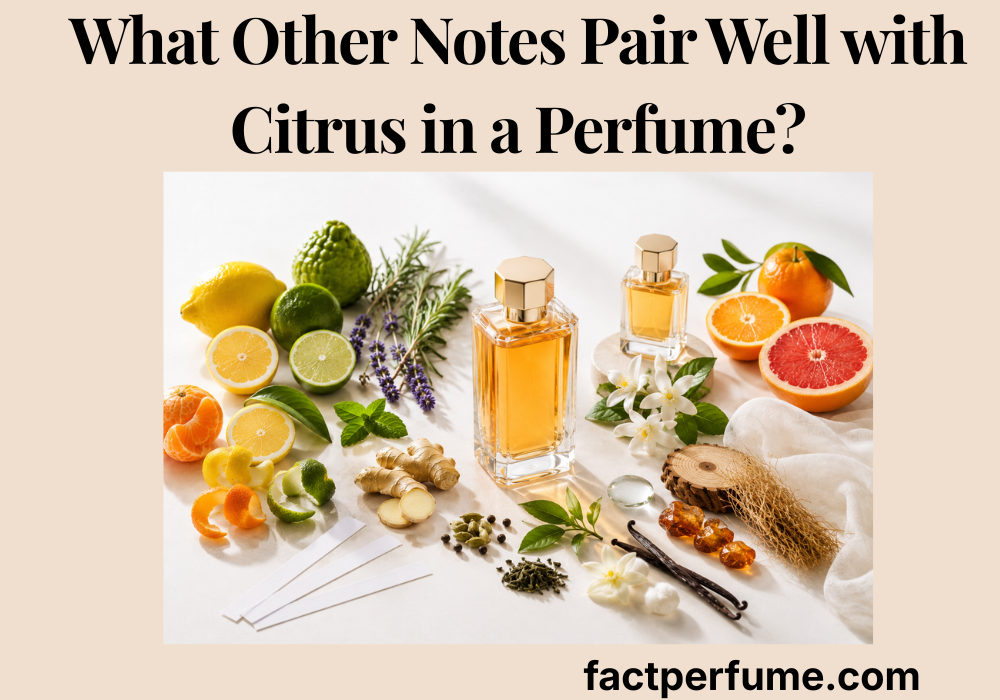
What Other Notes Pair Well with Citrus in a Perfume?
Citrus pairs well with aromatic herbs, florals, spices, green and tea-like effects, marine or mineral accords, woods, musks, ambery or resinous structures, and sweet or gourmand materials. Each pairing changes the Citrus in a different way, making the overall perfume more herbal, floral, sparkling, green, airy, dry, soft, warm, rich, or sweet.
The most useful way to choose among these pairings is to decide what you want the Citrus to become—more herbal, floral, sparkling, green, transparent, airy, woody, soft, warm, or sweet. The goal is not to find one universally best companion note, but to understand how each pairing family can reshape the complete fragrance.
Pairing note: These combinations describe common olfactory directions rather than fixed perfume formulas. The same pairing family can produce very different results depending on the specific materials, their balance, and the rest of the composition.
Why Can Citrus Work with So Many Different Fragrance Families?
Citrus is versatile because its bright, tart, juicy, bitter, peel-like, or aromatic facets can either harmonise with fresh materials or create contrast with floral, woody, warm, resinous, and sweet structures.
The Citrus family includes different sensory profiles rather than one generic Citrus smell. The Fragrance Wheel identifies Citrus through materials and effects such as bergamot, lemon, mandarin, lime, orange, and grapefruit.
That variety matters because a sharp Lemon-style profile does not interact with other notes exactly like soft Mandarin, bitter Grapefruit, or floral-green Bergamot. The underlying Citrus character influences whether a pairing feels sharper, softer, greener, warmer, drier, or sweeter.
Supporting fragrance directions may preserve a fresh impression, introduce floral character, add spice, increase perceived dryness, create airiness, add woody structure, soften the texture, or move the perfume toward warmth and sweetness.
Citrus is therefore not limited to light or summer-oriented fragrance styles.
Master Citrus Pairing Matrix
| Pairing Family | Main Sensory Contribution | Possible Result | Main Qualification |
|---|---|---|---|
| Aromatic | Herbal freshness | Crisp, botanical | Can dominate delicate Citrus |
| Floral | Floral brightness or softness | Luminous, floral | May shift attention toward flowers |
| Spice | Sparkle, texture, warmth | Vibrant, spicy | Different spices create different effects |
| Green / Tea | Leafy or dry transparent freshness | Green, restrained | Green and Tea remain distinct |
| Marine / Mineral | Airy, watery, cool or abstract freshness | Expansive, fresh | Often accord-level effects |
| Woods | Dry structure | Woody, grounded | Does not guarantee Citrus persistence |
| Musk | Softness, texture, diffusion | Smooth, sheer | Musk systems vary widely |
| Amber / Resin | Warm or balsamic depth | Rich, warm | Amber and Resin are not synonyms |
| Gourmand | Sweet or creamy contrast | Warm, edible-style | Citrus may become less dominant |
Citrus can move toward herbal, floral, spicy, green, woody, soft, warm, or sweet territory depending on the surrounding accord.
How Do Aromatic Notes Complement Citrus Freshness?
Aromatic notes can reinforce the botanical side of Citrus by adding herbal freshness, aromatic complexity, and crisp green-adjacent character.
Lavender, Rosemary, Basil, Thyme, Sage, and mint-like effects can move a Citrus perfume toward a more herbal or botanical profile. They may make freshness feel less purely fruity and more aromatic or cologne-adjacent.
The underlying Citrus also matters. Lemon, Lime, Bergamot, Mandarin, Orange, and Grapefruit can respond differently to aromatic structures, which is why understanding the Citrus notes helps when comparing possible directions.
Aromatic is not the same as Green. Aromatic freshness focuses primarily on herbs and aromatic botanical effects. Green freshness more directly suggests leaves, stems, foliage, cut vegetation, or related vegetal impressions.
The two can overlap, but they should not be treated as synonyms.
Aromatic materials can reshape the character of a Citrus perfume without automatically making the original Citrus impression last longer.
How Do Floral Notes Reshape Citrus Brightness?
Floral notes can move Citrus from a primarily peel-focused impression toward a more luminous, petal-like, soft, or expansive floral-Citrus structure.
White-floral directions such as Neroli, Orange Blossom, and Jasmine-type effects may introduce floral brightness while remaining compatible with Citrus freshness.
Neroli is a useful example. Givaudan’s Givaudan profile identifies the material as distilled Bitter Orange flower and describes a fresh floral profile. This helps explain why Neroli can occupy both floral and Citrus-associated sensory territory.
The dedicated guide to Neroli guide explains that relationship in more detail.
Rose can create fresh petal contrast, while transparent floral structures may introduce airiness and softer diffusion. Jasmine-type effects can move Citrus toward a fuller white-floral character.
Citrus plus Floral does not create one universal fragrance style, and floral direction should not be used to assign wearer gender.
What Do Spices Add to Citrus Compositions?
Spices can make Citrus feel more sparkling, textured, aromatic, dry, or warm depending on the spice direction.
Fresh or sparkling spices such as Ginger, Cardamom, and pink-pepper-like effects may add vibrancy, fresh-spicy lift, and texture.
Warmer spice effects such as Cinnamon-type, Clove-like, or Nutmeg-style notes can move Citrus toward a richer and warmer structure that feels less purely fresh.
Dry spice directions can make the composition feel more structured, aromatic, or woody-adjacent without necessarily adding pronounced sweetness.
These distinctions matter because not every spice should be classified as warm spice. A bright Ginger effect and a warm Cinnamon-type effect can lead Citrus in very different directions.
Spice may change the perfume’s perceived energy or texture, but it does not automatically increase projection or wear time.
How Do Green, Tea-Like, Marine, and Mineral Directions Reshape Citrus Freshness?
Green, tea-like, marine, and mineral directions can all reshape Citrus freshness, but each creates a different sensory effect.
Green directions may introduce leafiness, stems, foliage, crushed vegetation, or botanical dryness. They can make Citrus feel greener and less fruit-focused.
Tea-like effects may introduce dryness, transparency, restrained freshness, or soft bitterness. Tea-like character is not automatically the same as a Green note, and a tea description does not prove actual tea extract is present.
Marine accords typically suggest watery, airy, oceanic, expansive, or sometimes saline freshness. Marine should be treated mainly as an accord or effect rather than one universal natural ingredient.
Mineral effects are more abstract. Depending on the composition, they may suggest coolness, dryness, stone-like character, saltiness, metallic facets, or another mineral-style impression.
The useful distinctions are:
- Aromatic → herbal
- Green → leafy
- Tea-like → dry and transparent
- Marine → watery and airy
- Mineral → cool, dry, or abstract
These directions can overlap, but they do not mean the same thing.
Aromatic, green, tea-like, marine, and mineral directions can all feel fresh, but they create different herbal, leafy, dry, watery, or abstract effects.
How Do Woods, Musks, and Ambery Directions Change a Citrus Perfume’s Dry-Down?
Woods, musks, and ambery directions can move a Citrus perfume toward three different later-stage scent profiles: dry and structured, soft and sheer, or warm and rich.
A woody direction may use Cedar, Vetiver, or other dry-wood effects to create dryness, earthiness, structure, or a more grounded character. Vetiver can also contribute green or earthy facets depending on the material.
A musky direction may provide softness, smooth texture, transparency, skin-like character, or clean-feeling diffusion. Musk is a broad category, so not every musk smells or behaves the same way.
An ambery direction can add warmth, richness, and depth. Amber should be understood as a broad olfactory direction or accord concept rather than one specific raw material.
These categories should remain distinct:
Woods ≠ Musk ≠ Amber.
Amber should also not be treated as synonymous with Resin. Resinous materials may contribute to warm or ambery structures, but they have their own material and sensory identities.
None of these categories should automatically be described as a Citrus fixative.
A substantial woody, musky, or ambery dry-down does not prove that the original Citrus effect remains unchanged for longer.
How Do Sweet, Resinous, and Gourmand Notes Contrast with Citrus?
Citrus can work effectively in warm and sweet perfumes because its brightness can create perceptual contrast against creamy, balsamic, resinous, or dessert-like effects.
Vanilla can add creaminess and sweetness, producing a softer bright-versus-sweet contrast.
Tonka-style directions may add rounded sweetness, warmth, and sometimes creamy or powdery effects depending on the composition.
Benzoin and other resinous directions can provide balsamic warmth, sweet richness, or resinous depth.
Gourmand structures may introduce creamy, confectionery, edible, or dessert-like associations. Citrus can remain perceptible as a contrasting bright idea even when the overall perfume becomes much sweeter.
Amber, Resin, and Gourmand should not be treated as synonyms:
- Amber is a broad warm olfactory direction.
- Resinous refers to materials or effects with balsamic, warm, resin-like qualities.
- Gourmand describes edible or dessert-like scent associations.
Sweet materials do not inherently destroy Citrus freshness. Instead, they can change how strongly the Citrus contrasts with the rest of the perfume.
How Should You Choose a Citrus Pairing Based on the Scent Profile You Want?
Choose a Citrus pairing according to the final sensory direction you want rather than searching for one universally best companion note.
If you want a more herbal Citrus, explore Aromatic directions. For floral brightness, consider floral structures. Fresh spices can introduce sparkle, Green notes can add leafiness, and Tea-like effects can create dry transparency.
Marine accords can move Citrus toward watery or airy freshness, while Mineral effects may create a cooler and more abstract impression.
Woods can provide dry structure, Musks can introduce softness or sheerness, and Amber or Resin can move Citrus toward warmer and richer territory.
For a sweeter direction, Vanilla, Tonka, or Gourmand structures can create creamier or more dessert-like contrast.
Desired Citrus Profile Decision Matrix
| Desired Profile | Pairing Direction | Expected Shift | What to Verify |
|---|---|---|---|
| Herbal | Aromatic | More botanical | Herbal intensity |
| Floral | Floral | More luminous/petal-like | Floral dominance |
| Sparkling | Fresh spice | More vibrant/textured | Spice intensity |
| Green | Green | More leafy | Vegetal intensity |
| Dry / transparent | Tea-like | More restrained | Bitterness/dryness |
| Airy | Marine | More expansive/watery | Aquatic character |
| Cool / abstract | Mineral | Drier, more mineral-like | Abstractness |
| Woody | Woods | More structured | Wood dominance |
| Soft | Musk | Smoother/sheerer | Musk style |
| Warm | Amber / Resin | Richer | Warmth density |
| Sweet | Vanilla / Gourmand | Creamier/sweeter | Sweetness level |
The useful choice is not one universally best companion note; it is the pairing direction that moves Citrus toward the scent profile you want.
What Can Pairing Materials Change—and What Can’t They Guarantee About Citrus Performance?
Pairing materials can change the overall character and later development of a Citrus perfume, but they cannot automatically guarantee how long the original Citrus impression will remain recognisable.
They may alter perceived freshness, floral character, dryness, warmth, sweetness, airiness, texture, softness, or dry-down structure.
What they cannot automatically determine is exact Citrus-note longevity, projection, total wear time, evaporation order, or fixed top-heart-base timing.
The key distinction is:
Citrus-note persistence ≠ whole-perfume persistence.
A perfume can continue to smell strongly of woods, musks, amber, resins, or Gourmand effects after its earlier Citrus character has changed substantially.
That means the complete perfume remains perceptible. It does not prove that the original Lemon, Bergamot, Lime, Orange, or other Citrus effect has persisted unchanged.
Citrus Pairing Selection Checklist
Frequently Asked Questions
Aromatic herbs, florals, spices, green and tea-like effects, marine or mineral accords, woods, musks, ambery or resinous structures, and sweet or gourmand materials can all pair with Citrus. Each moves the fragrance in a different sensory direction.
No. The useful choice depends on what you want the Citrus to become, such as more herbal, floral, sparkling, green, airy, woody, soft, warm, or sweet.
No. Aromatic freshness focuses mainly on herbs and aromatic botanical effects, while Green freshness more directly suggests leaves, stems, foliage, cut vegetation, or related vegetal impressions.
Florals can move Citrus from a peel-focused impression toward a more luminous, petal-like, soft, or expansive floral-Citrus structure. Neroli is one example of a material that can connect floral and Citrus-associated territory.
Not automatically. They can change the dry-down and keep the whole perfume perceptible, but that does not prove the original Citrus effect remains unchanged for longer.
Yes. Citrus brightness can create perceptual contrast against vanilla, tonka-style, resinous, creamy, or dessert-like effects, although the Citrus may become less dominant in a sweeter composition.
Conclusion
The strongest Citrus pairing is not one universal note but the fragrance direction that moves the Citrus toward the sensory profile you actually want.
Aromatic pairings can make Citrus more herbal and botanical. Florals can make it more luminous or petal-like. Spices can create sparkle, texture, dryness, or warmth. Green effects add leafiness, while Tea-like directions can create dry transparency.
Marine accords can move freshness toward an airy or watery character, while Mineral effects can produce a cooler, drier, or more abstract impression. Woods can add structure, Musks can add softness, and ambery or resinous directions can introduce warmth and richness. Vanilla and Gourmand structures can create sweeter or creamier contrast.
The final decision therefore begins with a simple question: What do I want this Citrus perfume to become? Once the desired sensory direction is clear—herbal, floral, sparkling, green, transparent, airy, woody, soft, warm, or sweet—the most relevant pairing family becomes easier to identify.