
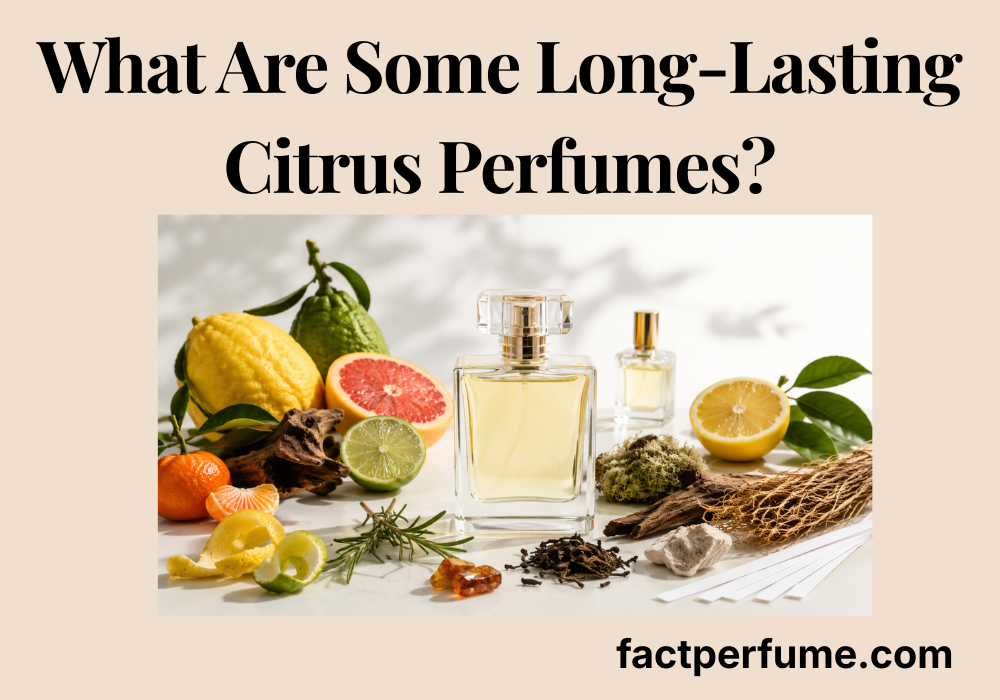
What Are Some Long-Lasting Citrus Perfumes?
Long-lasting Citrus perfumes do exist, but “long-lasting” can describe different scent experiences: recognizable Citrus may persist, a broader fresh or aromatic impression may continue, or the bright opening may evolve into a longer-wearing woody, musky, creamy, or warm dry-down.
The right choice therefore depends on whether you care most about recognizable Citrus, total fragrance longevity, projection, dry-down style, climate, occasion, or price. A fragrance that remains detectable for a long time is not automatically one that smells strongly of Citrus throughout its entire development.
Performance note: Fragrance longevity and projection vary by skin, application, climate, and formula. This guide separates how long the complete perfume remains detectable from how long recognizable Citrus—or a related fresh aromatic impression—remains important.
Quick Answer: Which Long-Lasting Citrus Perfumes Are Worth Comparing?
Based on current product verification and qualified performance evidence, these are useful bottles to compare:
- Nishane Hacivat — Bergamot, grapefruit, pineapple, woods, patchouli, and oakmoss. A strong choice if overall wear and a structured Citrus-woody/chypre evolution matter most. Nishane currently lists it as an Extrait de Parfum.
- Louis Vuitton Imagination — Citrus moving through black tea, amber, and fresh aromatic effects. A strong candidate for someone who wants freshness to continue even when literal Citrus becomes less dominant. Louis Vuitton currently lists bergamot, black tea, and amber among its key notes.
- Terre d’Hermès Eau Givrée Eau de Parfum — Citron with juniper, Timut pepper, and the woody-mineral identity of Terre d’Hermès. Best suited to someone who wants a dry, crisp, structured Citrus profile rather than a sweet one.
- Acqua di Parma Colonia Essenza Eau de Cologne — A broad Citrus opening built around lemon, orange, bergamot, mandarin, grapefruit, neroli, and petitgrain before developing through aromatic, woody, musky, and amber directions. It is worth comparing if classic Citrus character matters more than maximum projection.
- Goldfield & Banks Bohemian Lime Eau de Parfum — Australian finger lime with coriander, aromatic greens, vetiver, cedarwood, and sandalwood. Its Citrus identity is particularly clear, but reported longevity varies enough that it is better treated as a personal-test candidate than a maximum-performance choice.
If you want the strongest starting shortlist, Hacivat, Imagination, and Terre d’Hermès Eau Givrée cover three useful interpretations of long-wearing Citrus: powerful Citrus-to-woody development, sustained fresh-aromatic continuity, and a drier mineral-woody Citrus structure.
What Does “Long-Lasting Citrus Perfume” Actually Mean?
A long-lasting Citrus perfume is not necessarily one in which the original Citrus note remains unchanged for the entire wear.
It is more useful to separate four types of performance.
| Persistence Type | What Remains Noticeable | Best For | Main Trade-Off |
|---|---|---|---|
| Citrus-Forward Persistence | Recognizable Citrus remains important | Citrus-first shopper | Later structure may feel lighter |
| Fresh / Aromatic Continuity | Fresh, green, sparkling, tea-like, or aromatic character continues | Someone who wants sustained freshness | Literal Citrus may change |
| Citrus-to-Woody Evolution | Citrus leads into woods, vetiver, moss, or dry materials | Longer structured wear | Citrus may become secondary |
| Citrus-to-Soft / Warm Evolution | Citrus moves toward musk, creaminess, amber, or warmth | Smoothness and depth | Opening brightness may recede |
Long wear can mean different things: recognizable Citrus may remain, freshness may continue through aromatic materials, or the perfume may develop into woods, musk, or warmer structures.
This distinction matters because Citrus persistence is not the same as overall longevity.
A fragrance might begin with lemon or bergamot and remain detectable much later because woods, musk, amber, tea, patchouli, or other materials have become dominant. That is a long-lasting perfume, but it does not automatically mean the original Citrus impression remained equally strong.
Likewise, fresh continuity is not identical to unchanged Citrus. Green, aromatic, tea-like, or transparent woody effects can keep a perfume feeling fresh after its literal Citrus identity has softened.
For a deeper explanation of this distinction, see how Citrus longevity interact during fragrance development.
Research on fragrance evaporation from human skin also supports the need for caution around universal performance claims: fragrance release can be affected by both molecular properties and characteristics of the application surface. See this skin evaporation study.
What Should You Look for in a Long-Lasting Citrus Perfume?
Look beyond the first Citrus burst and evaluate what the complete fragrance does after the opening.
A vivid first spray can be attractive, but Citrus top notes do not by themselves prove that recognizable Citrus will remain equally prominent later.
Citrus with Aromatic or Green Materials
Herbs, tea-like effects, green materials, petitgrain, coriander, or similar aromatic directions can preserve an overall sense of freshness.
This can work especially well when you want a fragrance that continues to feel clean, bright, or transparent even after a literal lemon, lime, bergamot, or orange effect becomes quieter.
The important boundary is:
continued freshness ≠ unchanged Citrus.
Citrus with Woods
Vetiver, cedar, sandalwood, dry woods, patchouli, or mossy materials can give a Citrus perfume a more substantial later structure.
This is one reason fragrances such as Hacivat, Terre d’Hermès Eau Givrée, and Bohemian Lime can remain interesting after their initial Citrus impression changes. Their later identities have additional structure to carry the perfume forward.
Persistent woods, however, do not prove that Citrus itself has been physically “fixed.”
Citrus with Musk, Amber, or Softer Materials
Musky, creamy, vanilla-like, ambery, or soft woody effects can create a smoother transition from a bright opening into a more rounded dry-down.
This type of perfume may appeal if you enjoy Citrus but do not want the complete fragrance to remain sharp or sparkling throughout its development.
Different Citrus pairings can therefore influence what kind of scent remains after the opening.
Do Not Choose by Concentration Label Alone
Eau de Cologne, Eau de Toilette, Eau de Parfum, Parfum, and Extrait are useful product attributes, but the label alone does not determine how long recognizable Citrus remains.
Hacivat is currently sold as Extrait de Parfum, Terre d’Hermès Eau Givrée as Eau de Parfum, Colonia Essenza as Eau de Cologne, and Bohemian Lime as Eau de Parfum with the brand stating 20% essences and botanicals. These very different concentration descriptions show why the label should be treated as only one part of the buying decision.
Judge the complete scent evolution—not the concentration label or strength of the first spray alone.
How Should You Evaluate a Long-Lasting Citrus Perfume Before Buying?
Use the same criteria for every fragrance so that brand reputation or opening strength does not replace meaningful comparison.
Start with Citrus identity. Ask whether Citrus is the central theme or mainly an opening accent.
Next, identify the persistence type. Does recognizable Citrus continue, does general freshness continue, or does the fragrance clearly transition toward woods, musk, amber, creaminess, or another structure?
Evaluate overall longevity separately. This means how long the complete fragrance remains detectable—not how long the opening remains unchanged.
Then assess projection. Projection describes how noticeably the perfume radiates from the wearer. A scent can remain detectable close to skin even after its projection becomes restrained.
Sillage is related but different. It describes the perceived scent trail rather than simply the distance a fragrance projects around a stationary wearer.
Also evaluate the dry-down. A Citrus fragrance that becomes woody, mossy, musky, creamy, aromatic, or ambery can provide a very different ownership experience even if two perfumes begin with similarly bright Citrus effects.
Finally, consider climate, intended use, and price. These should function as filters rather than absolute quality judgments.
Which Long-Lasting Citrus Perfumes Stand Out by Scent Profile?
Comparing long-lasting Citrus fragrances by the olfactory direction they take as they develop is more useful than ranking them by brand prestige, concentration, or price alone.
| Fragrance | Citrus Direction | Broader Profile | Persistence Type | Projection | Climate / Use Fit | Relative Price Context | Main Trade-Off | Best-Fit Reader |
|---|---|---|---|---|---|---|---|---|
| Nishane Hacivat | Bergamot, grapefruit with pineapple | Woody, mossy, chypre | Citrus-to-Woody | Stronger | Versatile; test for close spaces | Higher | Mossy/woody structure can dominate later | Wants substantial wear |
| Louis Vuitton Imagination | Bergamot and broader noble Citrus | Tea, amber, aromatic freshness | Fresh / Aromatic Continuity | Moderate to noticeable | Daily, warm weather, polished indoor use | Highest within this shortlist in current US context | Literal Citrus does not remain unchanged | Wants sustained freshness |
| Terre d’Hermès Eau Givrée EDP | Citron | Juniper, pepper, mineral woods | Citrus-to-Woody | Controlled to moderate | Warm weather, daily, office-friendly contexts | Mid relative to luxury candidates | Drier than juicy Citrus styles | Wants crisp structure |
| Colonia Essenza EDC | Lemon, orange, bergamot, grapefruit, mandarin | Aromatic, floral, woody, musky | Citrus-to-Woody / Fresh Continuity | Moderate and wearer-dependent | Daily, office, classic dress | Mid | Performance reports vary | Wants traditional Citrus character |
| Bohemian Lime EDP | Finger lime | Aromatic greens, vetiver, cedar, sandalwood | Citrus-to-Woody | Moderate and variable | Warm weather, casual or outdoor-oriented use | Mid | Not the safest maximum-longevity choice | Wants vivid lime identity |
Different Citrus fragrances can pursue different persistence profiles: substantial woody wear, fresh aromatic continuity, dry mineral structure, classic broad Citrus character, or a vivid lime identity.
Current official pages confirm all five products remain available at the time of verification. Price comparisons are deliberately relative because regional pricing, bottle size, taxes, and currency differ. Hermès currently lists the 100 ml Eau Givrée EDP at $168 in the US, Louis Vuitton lists 100 ml Imagination at $360, Nishane lists Hacivat across multiple sizes from $120 to $395, Acqua di Parma lists a 100 ml Colonia Essenza at £156 in the UK, and Goldfield & Banks lists Bohemian Lime 100 ml at €180 in its European store.
Which Citrus-Woody Perfumes Offer a Drier, More Structured Profile?
Nishane Hacivat is the most performance-oriented candidate in this group. Its current official profile combines bergamot and grapefruit with pineapple before moving through patchouli, cedarwood, oakmoss, Clearwood, and dry timber effects. Community performance reports consistently position longevity and projection above many fresh fragrances, although individual wear still varies.
Its main trade-off is that the later experience is not simply “Citrus for longer.” The woody, mossy, and chypre structure becomes increasingly important. It is best for a shopper who values strong overall wear and structure as much as literal Citrus.
Terre d’Hermès Eau Givrée Eau de Parfum takes a leaner direction. Hermès centers the fragrance on citron, juniper berry, Timut pepper, and the woody-mineral identity associated with Terre d’Hermès. Current wearer evidence suggests respectable performance for such a Citrus-heavy profile, but it is generally less forceful than Hacivat.
Choose Eau Givrée when you want crisp, dry Citrus with controlled structure rather than maximum projection.
Bohemian Lime is the most literal lime-focused option here. Its finger-lime opening moves into aromatic greens, vetiver, cedarwood, and sandalwood. Goldfield & Banks classifies it as Citrus Aromatic and currently sells it as an Eau de Parfum.
Its trade-off is performance variability. Some wearers report good persistence of the lime-and-wood identity, while others find the total wear more moderate. It should therefore be sampled rather than selected purely from a longevity claim.
Which Citrus-Aromatic or Fresh Perfumes Keep the Overall Profile Fresh?
Louis Vuitton Imagination is the strongest fit for a shopper who cares about the continuation of freshness rather than literal Citrus staying unchanged.
Louis Vuitton currently emphasizes bergamot, black tea, and amber, while its broader description connects Citrus with tea and Ambrox. The result is better understood as fresh/aromatic continuity than as an unchanging bergamot fragrance. Current community evidence also supports above-average longevity for a fresh scent, although performance still varies by wearer.
The main trade-off is price. It sits at the high end of this verified shortlist in current US retail context.
Acqua di Parma Colonia Essenza approaches freshness more traditionally. Its current official formula story begins with a wide Citrus spectrum—lemon, orange, bergamot, mandarin, grapefruit, neroli, and petitgrain—then moves through rosemary, floral effects, clove, vetiver, patchouli, white musk, and amber.
Performance reports are less uniform than Hacivat or Imagination. Some wearers find it notably persistent for an Eau de Cologne structure, while others experience more moderate wear. That variability makes it a good candidate for someone prioritizing classic Citrus character, but not a blind recommendation for maximum strength.
How Should You Test Whether a Citrus Perfume Lasts Well Enough on You?
Because fragrance performance varies by wearer and conditions, test shortlisted perfumes on your own skin before treating a longevity claim as settled.
First, compare fragrances under reasonably similar conditions. Changing climate, test area, or other variables can make comparison less useful.
During the opening, ask two questions:
- What Citrus profile do I smell?
- How important is it to the complete scent?
Revisit the perfume during development. Ask whether recognizable Citrus is still present or whether the scent has become primarily aromatic, woody, mossy, musky, creamy, ambery, or something else.
Later, separate these questions:
“Can I still smell the perfume?”
from:
“Can I still identify the Citrus?”
They measure different things.
Also assess projection separately. A fragrance that has become close to the skin may still be present even if it no longer creates a large scent cloud.
Where practical, test the perfume in conditions similar to how you expect to wear it—such as an office, outdoors, warmer weather, a moderate climate, or an evening setting.
The goal is not to force better performance. It is to determine whether the fragrance’s natural development meets your expectations.
A useful wear test separates three questions: whether the perfume is still detectable, whether recognizable Citrus is still present, and how the later dry-down changes the ownership experience.
Which Long-Lasting Citrus Profile Best Matches Your Priorities?
Choose the performance profile first, then select the verified fragrance that best fits that profile, your intended use, and your price range.
| Priority | Start With | What You Gain | Main Trade-Off |
|---|---|---|---|
| Strong overall wear | Hacivat / substantial Citrus-Woody | Greater total presence and structure | Citrus can become secondary |
| Freshest continuing impression | Imagination / Citrus-Aromatic | Sustained fresh, tea-like, aromatic character | Freshness ≠ unchanged Citrus |
| Dry, structured Citrus | Terre d’Hermès Eau Givrée | Crisp Citrus with woody-mineral development | Less juicy later |
| Classic broad Citrus profile | Colonia Essenza | Multiple Citrus facets with aromatic development | Performance varies |
| Recognizable lime identity | Bohemian Lime | Distinctive finger-lime character | Total longevity is less predictable |
| Hot-weather priority | Fresh or aromatic profiles | Comfort and freshness | Projection still requires testing |
| Office priority | Controlled fresh profiles | Easier close-range wear | May sacrifice raw strength |
| Price priority | Compare current regional prices | More efficient shortlist | Price does not prove performance |
If recognizable Citrus matters most, focus on fragrances where the Citrus character remains central in your personal wear test rather than choosing according to total longevity alone.
If maximum overall wear matters most, Hacivat deserves early consideration because its substantial woody and mossy structure gives the complete fragrance a stronger performance profile.
If continued freshness matters most, Imagination is a particularly useful comparison because its Citrus opening connects naturally with tea, amber, and fresh aromatic character.
If you want a dry structured profile, Terre d’Hermès Eau Givrée is the more restrained choice.
If classic Citrus character matters more than maximum intensity, Colonia Essenza deserves a skin test.
If you specifically want lime, Bohemian Lime provides the clearest lime-centered proposition in this shortlist, but its performance should be confirmed personally.
Long-Lasting Citrus Test Checklist
Frequently Asked Questions
No. A long-lasting Citrus perfume may keep recognizable Citrus important, continue a broader fresh or aromatic impression, or remain detectable because woody, musky, creamy, ambery, or other later materials become more prominent.
Hacivat, Imagination, and Terre d’Hermès Eau Givrée provide three useful comparison points: substantial Citrus-to-woody wear, sustained fresh-aromatic continuity, and a drier mineral-woody Citrus structure.
No. Concentration labels are useful product attributes, but they do not by themselves determine how long recognizable Citrus remains important. The complete formula and its development matter more.
Not automatically. Those materials can give the later fragrance more structure, softness, warmth, or persistence, but that does not prove the original Citrus effect remains unchanged for longer.
Compare fragrances under similar conditions, identify the opening Citrus profile, revisit the fragrance as it develops, and separately ask whether the perfume is still detectable and whether you can still identify the Citrus.
Longevity describes how long the fragrance remains detectable. Projection describes how noticeably it radiates from the wearer, while sillage describes the perceived scent trail. They should be evaluated separately.
Conclusion
The right long-lasting Citrus perfume depends not only on how long the complete fragrance remains detectable, but on what part of its Citrus-related character still matters later in the wear.
Do not ask only:
“How long does it last?”
Also ask:
“What am I still smelling later?”
A long-wearing Citrus perfume may preserve recognizable Citrus, continue a fresh aromatic theme, transition into dry woods, soften into musk, or develop toward a richer later structure. Those outcomes are not interchangeable.
The final choice should balance the Citrus character you enjoy, persistence type, overall longevity, projection, dry-down, climate, occasion, and current price context.
The most useful long-lasting Citrus perfume is therefore not automatically the strongest or most expensive one. It is the fragrance whose later development still gives you the scent experience you wanted when you chose Citrus in the first place.