
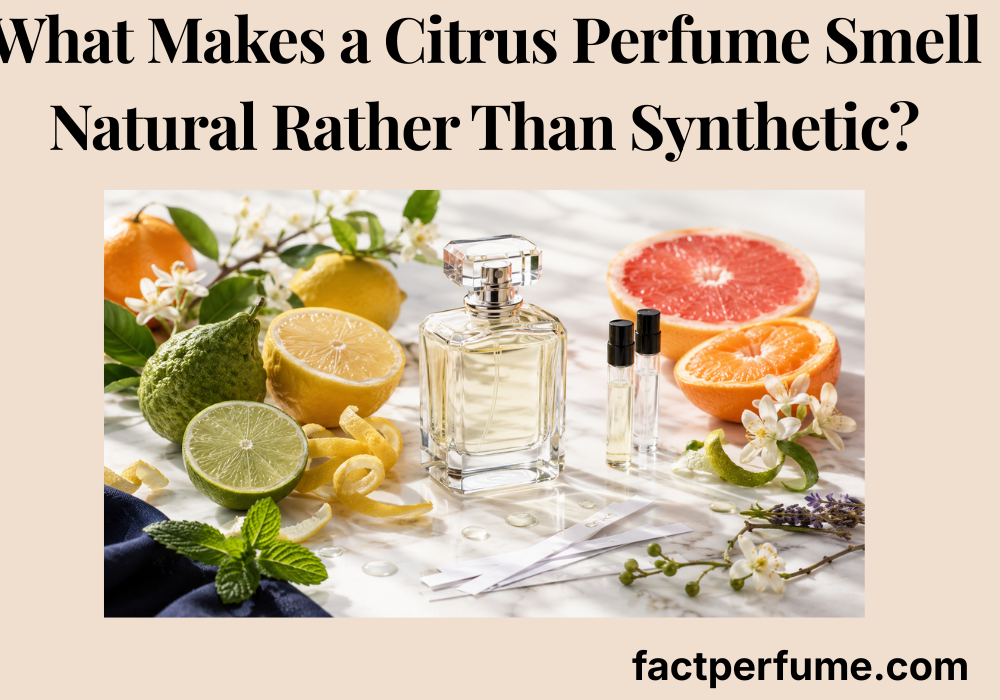
What Makes a Citrus Perfume Smell Natural Rather Than Synthetic?
A Citrus perfume tends to smell more naturalistic when its Citrus impression contains several coherent details—such as fresh peel, zest, juice, pith, bitterness, sweetness, green rind, or floral nuance—rather than relying on one simplified Citrus signal. Realism usually comes from several related sensory cues working together as a believable fruit or botanical impression.
Those realistic effects do not prove the formula is mostly natural, because whole Citrus oils, fractions, isolates, manufactured aroma materials, and reconstructed accords can all contribute to a convincing Citrus impression. What matters perceptually is how the materials create detail, balance, integration, and development—not simply where the ingredients came from.
What Does “Natural-Smelling Citrus” Actually Mean in Perfume?
Natural-smelling Citrus describes an olfactory impression that feels plausibly connected to real fruit, peel, rind, juice, blossom, leaves, or related botanical details.
A Citrus scent can sit anywhere on a creative spectrum. It may be photorealistic, closely resembling freshly cut fruit; naturalistic, suggesting believable fruit and botanical details without copying them exactly; stylized, emphasizing selected Citrus characteristics; or abstract, using Citrus as an idea rather than recreating literal fruit.
Some Citrus scents can also feel strongly associated with household or personal-care fragrance styles.
A naturalistic profile may include peel, zest, juice, pith, bitterness, sweetness, green rind, floral character, leafy nuance, and changes in emphasis as the perfume develops.
These are descriptions of sensory style. They do not independently reveal ingredient origin, ingredient cost, natural percentage, or overall quality.
For broader context on how Citrus is defined as a fragrance category, see the Citrus family.
Which Sensory Cues Make a Citrus Accord Feel Realistic?
Citrus realism usually comes from several coherent sensory details working together rather than from brightness alone.
Peel and zest can create the impression of fresh rind and aromatic sharpness. This often makes the Citrus feel more specific, but sharpness by itself does not create a complete fruit impression.
Juiciness can suggest pulp, moisture, and freshly squeezed fruit. It gives the accord body beyond a simple bright opening.
Bitterness and pith can introduce a dry, slightly rough dimension similar to the white pith or bitter surface of certain Citrus fruits.
Green facets may suggest rind, leaf, stem, or other botanical material. They can make the scent feel less like sweet juice alone.
Sweetness can suggest ripeness and roundness, but too much sweetness may change the intended Citrus identity.
Floral and aromatic nuances can evoke blossom, herbs, leaves, or other botanical details around the fruit.
Finally, evolution can contribute to realism. A Citrus impression may move from sharp zest toward juice, green rind, floral character, or a softer aromatic direction as different effects change in prominence.
More facets are not automatically better. The details need to feel related and proportionate to the Citrus style being created.
| Sensory Cue | What It May Suggest | Contribution to Realism | Qualification |
|---|---|---|---|
| Peel / Zest | Fresh rind | Specific peel detail | Sharpness alone is incomplete |
| Juiciness | Pulp or juice | Fresh-fruit body | Can also be deliberately stylized |
| Bitterness / Pith | Rind depth | Dry fruit complexity | Degree depends on Citrus style |
| Green Facets | Leaf, rind, stem | Botanical realism | Not every Citrus needs strong greenness |
| Sweetness | Ripeness | Fruit body and roundness | Must fit the intended profile |
| Floral / Aromatic Nuance | Blossom, herbs | Added dimensionality | Formula-dependent |
| Evolution | Changing Citrus character | Reduces a one-note impression | Static design may also be intentional |
Realistic Citrus impressions usually come from several coherent fruit and botanical cues working together, not from brightness alone.
How Do Whole Natural Citrus Oils Contribute to a Realistic Scent Profile?
Whole natural Citrus oils can support realism because they are complex botanical mixtures capable of contributing several Citrus-related facets at once.
A whole oil may combine peel, zest, sweetness, bitterness, green nuances, and aromatic or floral details. Different Citrus materials can also lean in different directions: bergamot may feel zesty with floral-herbal nuances, lemon may emphasize sharp peel and tartness, mandarin may feel softer and juicier, and grapefruit may bring bitterness and pith.
This is why a whole Citrus oil should not be treated as one molecule or one sensory effect. Research using GC-MS analysis has shown that Citrus essential oils contain multiple chemical constituents and that their composition differs between Citrus types. See this Citrus-oil study.
The exact sensory result can also vary with botanical identity, origin, processing, fractionation, and the specific supplied material.
For a broader look at the different profiles found across Citrus perfumery, see these Citrus notes.
However, whole natural oil is only one possible route to realism. It does not guarantee that the finished perfume will smell like convincing fresh fruit. Balance, proportion, supporting materials, and the creative direction of the complete accord remain important.
How Can Fractions, Isolates, Manufactured Aroma Materials, and Reconstructed Accords Create Citrus Realism?
A convincing Citrus impression can be built from several material strategies, with each material contributing one or more parts of the final sensory picture.
A fraction is a selected portion of a broader material. It can emphasize certain botanical or fresh qualities while leaving other parts of the original oil less prominent.
An isolate is a more focused constituent. It may provide one precise Citrus, peel-like, green, or floral facet. An isolate should not be confused with a complete whole oil or complete Citrus accord.
A manufactured aroma material can contribute Citrus, floral, green, fresh, peel-like, diffusive, or structural effects depending on the particular material. Manufactured origin does not automatically make the resulting smell less realistic.
A reconstructed Citrus accord combines several materials to create a designed Citrus impression. That impression might aim to resemble lemon, lime, bergamot, mandarin, orange, or grapefruit, or it may deliberately produce a more stylized or abstract version.
The important distinction is that material origin and sensory realism are different questions.
| Material Type | Structural Role | Possible Contribution to Realism | Limitation |
|---|---|---|---|
| Whole Natural Oil | Multi-faceted botanical material | Several related Citrus cues | Does not guarantee realism |
| Fraction | Selected part of a broader material | Focused botanical detail | Narrower than whole oil |
| Isolate | Focused constituent | Precise sensory detail | Not a complete Citrus impression alone |
| Manufactured Aroma Material | Specific fragrance material | Citrus, green, floral, fresh, or structural detail | Behaviour is material-specific |
| Reconstructed Accord | Multi-material construction | Naturalistic, stylized, or abstract Citrus illusion | Not one raw material |
Natural oils, fractions, isolates, manufactured aroma materials, and reconstructed accords can all contribute to a convincing Citrus result.
Why Do Some Citrus Accords Remind People of Household Cleaning Products?
A Citrus accord can evoke household-cleaner associations when its finished scent pattern resembles Citrus profiles the wearer already knows from cleaning, laundry, or other functional-fragrance products.
Possible contributors include a very dominant sharp lemon-like effect, a simplified Citrus structure, strong soapy character, certain aldehydic effects in context, or limited contrast from peel, pith, juicy, green, and floral details.
Familiarity also matters. If someone has repeatedly encountered a similar Citrus pattern in cleaning or personal-care products, that pattern may trigger the same association when it appears in perfume.
That association is not an ingredient test.
A cleaner-like Citrus smell does not prove that the perfume uses synthetic ingredients, inexpensive ingredients, or poor-quality materials. It describes how the finished scent is being perceived in relation to previous experience.
How Do Perfumers Combine Different Materials Into a Coherent Realistic Citrus Accord?
A coherent Citrus accord depends on how its sensory facets relate to one another rather than on whether one particular material is natural.
Core fruit details may include peel, zest, juice, pith, and bitterness. Supporting botanical details can add green rind, leaves, blossom, herbal character, floral nuance, or sweetness.
Other materials can then influence how the Citrus develops. They may continue botanical freshness, soften the fruit, connect it with floral effects, introduce dryness, or guide the perfume toward a later aromatic or woody direction.
The key is integration.
A juicy effect that feels disconnected from the peel may appear less convincing. A bitter pith effect that overwhelms every other detail may distort the fruit identity. In contrast, a balanced relationship between rind, juice, green character, bitterness, and softer botanical details can create a more coherent impression.
Materials from the same Citrus tree can also play very different sensory roles. For example, Bergamot, Lime & Petitgrain can contribute different fruit, peel, green, leafy, and aromatic directions.
Realism therefore depends on balance, coherence, integration, development, and creative intent—not one ingredient category.
How Should You Evaluate Citrus Realism on Blotter and Skin?
Evaluate Citrus realism by looking for sensory detail, coherence, and development rather than asking only whether the fragrance smells “natural” or “synthetic.”
Start with the opening. Notice whether the Citrus feels one-dimensional or whether you can detect peel, juice, bitterness, sweetness, green character, or floral nuance.
Then observe development. Does the Citrus change? Does one effect dominate continuously? Do secondary facets become easier to notice? A changing scent is not automatically better, and a static one is not automatically worse.
Next, evaluate coherence. Ask whether the different Citrus facets seem to belong together or whether one element feels detached from the rest.
Compare the perfume on both blotter and skin when practical. A blotter is useful for more standardized side-by-side comparison, while skin shows how the fragrance develops on you personally. Research examining fragrance evaporation on human skin found that both molecular characteristics and differences between wearers can influence evaporation behaviour. See this skin study.
Neither surface should be treated as the universally “true” version of the perfume.
Finally, identify creative intent. A deliberately abstract Citrus perfume should not be judged as unsuccessful simply because it does not smell exactly like freshly cut fruit.
| Evaluation Area | Question | What to Notice |
|---|---|---|
| Complexity | Are several relevant Citrus facets perceptible? | Peel, juice, pith, green, floral details |
| Coherence | Do the facets feel related? | Balance and integration |
| Evolution | Does the Citrus change intentionally? | Changing prominence |
| Fruit Identity | Is a recognizable Citrus style suggested? | Peel, rind, juice, bitterness |
| Cleaner Association | Does a familiar sharp or soapy pattern dominate? | Association, not ingredient diagnosis |
| Style | Is realism actually the goal? | Photorealistic, naturalistic, stylized, or abstract |
Blotter and skin testing reveal different parts of Citrus development; neither surface should be treated as the universally true version.
What Can Scent Alone Tell You—and Not Tell You—About a Citrus Perfume’s Ingredients?
Smell can reveal useful information about the style and sensory construction of a Citrus accord, but it cannot reliably disclose the complete formula or the origin of every material.
From smell, you may reasonably describe whether the perfume seems naturalistic or abstract, juicy or dry, peel-heavy or floral-green, complex or simplified, or coherent versus disconnected.
You can also discuss whether the perfume seems to aim for photorealistic fruit, a broader naturalistic interpretation, or an intentionally stylized Citrus effect.
What you cannot reliably determine from smell alone is the percentage of natural ingredients, exact formula, precise ingredient list, sourcing route, material cost, safety, or the manufacturer’s complete formulation philosophy.
A naturalistic Citrus scent may contain natural materials, manufactured materials, isolates, reconstructed effects, or all of them together.
Likewise, a simplified or abstract Citrus scent does not prove that the formula is primarily synthetic.
Natural-smelling is a sensory outcome, not an ingredient certificate.
Citrus Realism Evaluation Checklist
Use this checklist to evaluate whether a Citrus perfume feels coherent, detailed, and intentionally realistic or stylized.
Frequently Asked Questions
No. Natural-smelling describes a sensory outcome. Natural oils, fractions, isolates, manufactured aroma materials, and reconstructed accords can all contribute to a realistic Citrus impression.
Peel, zest, juice, pith, bitterness, sweetness, green rind, floral or aromatic nuance, and believable development can all contribute when they feel coherent and proportionate.
No. Whole oils can contribute complex botanical detail, but realism still depends on balance, supporting materials, integration, and creative direction.
A sharp, simplified, soapy, or familiar Citrus pattern can trigger associations with cleaning or personal-care products. That association does not identify ingredient origin, quality, or cost.
Both can be useful. Blotters support more standardized side-by-side comparison, while skin shows how the perfume develops on you. Neither surface is the universally true version.
Not reliably. Smell can help describe sensory style and construction, but it cannot reveal the complete formula, natural percentage, sourcing route, exact ingredient list, or material cost.
Conclusion
A Citrus perfume tends to feel most naturalistic when its Citrus character contains coherent sensory detail—such as peel, juice, pith, bitterness, sweetness, green facets, floral nuance, and believable development—rather than depending on one simplified signal.
Whole natural oils can contribute useful complexity, but they do not guarantee realism. Fractions and isolates can provide focused details, manufactured aroma materials can contribute convincing Citrus effects, and reconstructed accords can combine multiple facets into a realistic sensory picture.
Cleaner-like associations also do not reveal ingredient origin or quality. They may reflect the shape of the finished scent and the wearer’s familiarity with similar Citrus patterns elsewhere.
The strongest way to evaluate Citrus realism is therefore to ask:
- What Citrus facets can I perceive?
- Do those facets feel coherent?
- Is the fruit identity convincing or intentionally stylized?
- Does the Citrus develop in a believable or intentional way?
- Do the supporting notes integrate with it?
- Is realism actually the creative goal?
- Am I evaluating the smell rather than guessing ingredient origin?
Citrus realism is ultimately a sensory achievement created through detail, balance, integration, and development—not proof of how the formula was sourced or manufactured.