
How Do Perfumers Use Neroli to Build Floral Brightness in Citrus Perfumes?
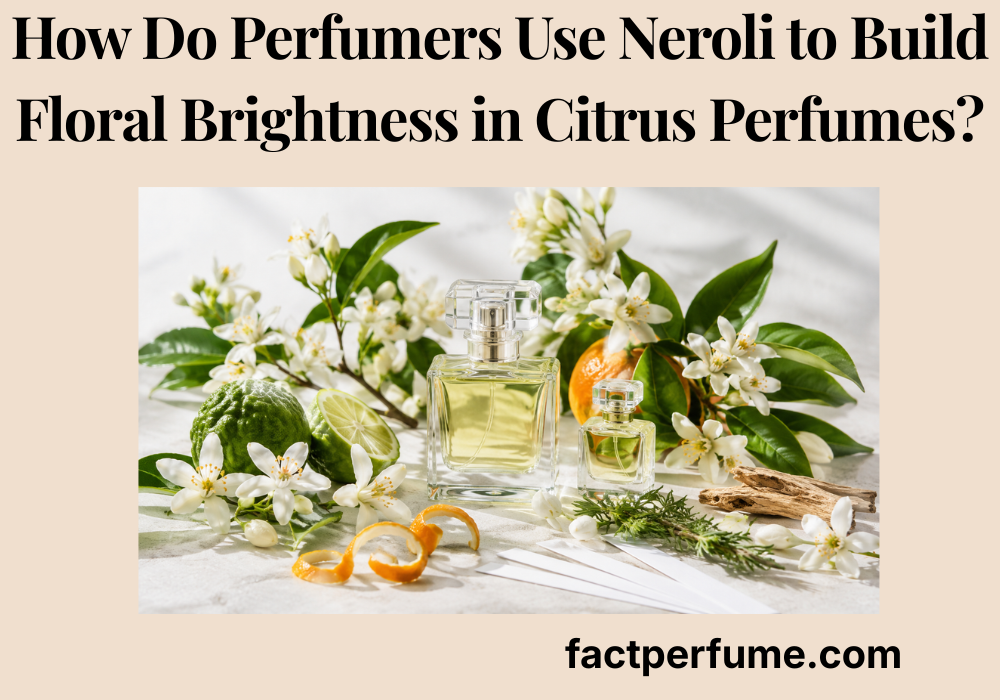
Neroli can build floral brightness in Citrus perfumes because its distilled Bitter Orange blossom character combines fresh floral, green, sweet, and Citrus-associated facets. Perfumers can use those overlapping qualities to reinforce brightness, introduce floral identity, and connect peel-like Citrus effects with floral, green, or aromatic structures.
Perfumers can also use Neroli to create continuity between bright Citrus effects and floral or aromatic structures as the perfume develops. These are sensory and compositional functions rather than fixed top-, heart-, or base-note assignments, and Neroli should not be treated as a universal fixative or as a material that automatically extends Citrus longevity.
Educational note: A Neroli note in a perfume description communicates a scent impression but does not by itself confirm the exact raw material, origin, extraction quality, dosage, or concentration used. This page discusses Neroli in finished fragrance rather than raw essential-oil application or perfume formulation.
What Makes Neroli Different From Fruit-Peel Citrus Materials?
Neroli is a flower-derived Bitter Orange material rather than a fruit-peel Citrus oil.
When natural Neroli material is verified, it comes from Citrus aurantium flowers and is produced by distillation. That flower source separates it from peel-derived materials associated with zest, tartness, juiciness, or rind-like bitterness.
Within the Citrus family, Neroli can introduce floral freshness, green character, Orange Blossom identity, and Citrus-tree brightness while moving the composition beyond a purely fruit-peel impression.
Floral brightness means a fresh, luminous floral impression that remains perceptually connected to the brighter Citrus structure. It is a sensory description, not a measurement of projection, diffusion, strength, or persistence.
Which Floral, Green, and Citrus Facets Does Neroli Contribute?
Neroli can combine fresh white-floral character with green, sweet, and Citrus-associated facets, giving it a useful position between floral and fresh scent territory.
An official Givaudan profile material profile identifies the processed plant part as the flower of Citrus aurantium var. amara and the transformation process as distillation. Its sensory description emphasizes fresh floral character, supporting Neroli’s identity as a distilled Bitter Orange blossom material rather than a peel oil.
In a finished perfume, Neroli may suggest fresh white flowers, Orange Blossom character, green botanical freshness, gentle sweetness, and Citrus-associated brightness. Woody, smoky, or animalic nuances may occur in particular materials but are not universal.
Words such as bright, luminous, and airy describe olfactory impressions. They do not establish how strongly a perfume projects or how long Neroli will remain noticeable.
How Do Perfumers Use Neroli to Build Floral Brightness?
Perfumers can use Neroli to bring floral character into a Citrus structure without completely breaking the fresh Citrus theme.
First, Neroli can reinforce brightness. Its fresh floral character can support the light, lifted impression created by Bergamot, Lemon, Bitter Orange, or other bright Citrus effects.
Second, Neroli can introduce floral identity. A composition that reads mainly as zest or peel can move toward floral-Citrus territory while retaining freshness.
Third, its green facets can add botanical lift and connect Citrus to leafy, herbal, or aromatic directions.
Fourth, Neroli can connect structures. Because its profile overlaps floral and Citrus-associated territory, it can make a transition from bright Citrus to floral or aromatic materials feel more continuous.
Fifth, Neroli can maintain the theme. As sharper Citrus effects change in prominence, Neroli may help the fragrance remain floral-fresh and related to its earlier Citrus character.
These are compositional strategies, not formulas. They do not imply required ratios, percentages, dosage ranges, or fixed fragrance stages.
Neroli can keep a citrus composition bright while adding a fresh floral and green identity derived from bitter-orange blossom.
Why Can Neroli Act as a Sensory Bridge Between Citrus and Floral Accords?
Neroli can work as a sensory bridge because its own olfactory profile already overlaps both floral and fresh Citrus-associated territory.
On the floral side, it can suggest white flowers, Orange Blossom, and gentle sweetness. On the fresher side, it can show green, airy, fresh, and Citrus-associated qualities. Because these facets coexist within the same sensory profile, a composition can move from zestier Citrus toward floral territory without feeling abruptly disconnected.
This bridge effect is primarily perceptual. It does not prove fixation, lower volatility, or greater molecular persistence. Neroli may help the theme feel continuous while the relative prominence of individual materials changes.
Neroli Role & Floral-Citrus Bridge Matrix
| Dimension | Neroli Contribution | Possible Connection | Boundary |
|---|---|---|---|
| Flower source | Floral identity | Floral accords | Not peel |
| Citrus-associated facet | Freshness | Citrus peel effects | Not Citrus peel oil |
| Green facet | Botanical lift | Petitgrain, herbs, greens | Formula-dependent |
| Floral facet | White-floral brightness | Floral structures | Not a universal heart note |
| Bridge role | Sensory continuity | Citrus ↔ floral | Not a fixative |
How Does Neroli Differ From Orange Blossom Absolute and Petitgrain?
Neroli, Orange Blossom Absolute, and Petitgrain can originate from the same Bitter Orange tree, but they are distinct materials because plant part and processing matter.
Neroli comes from flowers and is produced by distillation.
Orange Blossom Absolute is also flower-derived, but its extraction route is different. An IFF profile material profile identifies Bitter Orange flowers as the processed plant part and solvent extraction followed by purification as the process, supporting the distinction between the Absolute and distilled Neroli.
Petitgrain is different again because it is foliage-derived, commonly associated with leaves and twigs, and tends toward greener, more bitter, leafy, and aromatic effects. Bitter Orange peel material comes from the fruit peel.
The core rule is simple: same tree does not mean same material.
This is also why Bergamot, Lime & Petitgrain should be compared according to botanical source and sensory role rather than assuming that all Citrus-tree materials perform the same function.
Bitter Orange Tree Material Matrix
| Plant Part | Material | Process | Broad Direction |
|---|---|---|---|
| Flower | Neroli | Distillation | Fresh floral, green, Citrus-associated |
| Flower | Orange Blossom Absolute | Solvent extraction | Richer floral direction |
| Leaves/twigs | Petitgrain | Distillation | Green, bitter, aromatic |
| Fruit peel | Bitter Orange material | Peel processing | Zesty, bitter Citrus |
Flowers, leaves and twigs, and fruit peel can come from the same Bitter Orange tree while producing distinct perfumery materials and scent directions.
Which Fragrance Directions Can Complement Neroli Without Obscuring Its Brightness?
Surrounding fragrance materials can reinforce Neroli’s fresh floral character or move it toward greener, richer, softer, or drier territory.
Additional Citrus effects may reinforce brightness, although a dominant Citrus structure can make Neroli less distinct.
Green or aromatic materials can emphasize botanical character and make the composition more leafy or herbal.
Other florals can strengthen Neroli’s floral identity, although a richer floral structure may reduce transparency.
Musks may change the perception of softness and diffusion, while woods can introduce a drier and more structured direction.
These changes belong to the complete composition rather than guaranteeing persistence. For a broader view of Citrus pairings, treat those families as supporting directions rather than required companions.
Supporting Direction Matrix
| Direction | What It May Emphasise | Main Trade-Off |
|---|---|---|
| Citrus | Brightness | Neroli may recede |
| Green/aromatic | Botanical character | Can become more herbal |
| Floral | Floral richness | May reduce transparency |
| Musk | Softness/diffusion | Clean effect may dominate |
| Woody | Dry structure | Woods may dominate |
How Can Neroli Maintain Floral-Citrus Continuity as a Perfume Develops?
Neroli can help a perfume remain recognizably floral-Citrus even as the relative prominence of peel, floral, green, musky, or woody effects changes.
During early perception, Neroli may overlap with peel brightness, green freshness, and aromatic effects. As the perfume develops, its floral and Orange Blossom character may become more noticeable relative to changing Citrus effects.
Later, the complete composition may move toward floral, aromatic, musky, woody, or tea-like territory while preserving a relationship with the earlier floral-Citrus theme.
This is olfactory continuity, not proof that Neroli itself persists unchanged. A continuing scent theme does not establish a universal heart-note stage, fixed timeline, or molecular extension of Lemon, Bergamot, or another Citrus material.
Neroli can preserve a floral-Citrus relationship while the wider composition shifts toward green, floral, musky, woody, or other supporting directions.
What Can a Neroli Note in a Perfume Description Actually Tell You?
A Neroli note can suggest a fresh floral-Citrus, Orange Blossom, green, or aromatic direction, but it cannot reveal the complete formula.
Reasonable inferences include floral brightness, Orange Blossom character, green nuance, and Citrus-to-floral continuity. You cannot infer natural Neroli oil, exact origin, extraction quality, dosage, concentration, fragrance stage, or longevity.
A Neroli note also does not prove that Petitgrain or Orange Blossom Absolute is present simply because those materials come from related parts of the Bitter Orange tree.
Neroli Note-List Inference Matrix
| Neroli May Suggest | It Does Not Prove |
|---|---|
| Fresh Orange Blossom character | Natural Neroli oil |
| Floral-Citrus brightness | Exact dose |
| Green floral nuance | Fixed fragrance stage |
| Citrus-to-floral continuity | Citrus longevity |
| Bitter Orange-tree character | Petitgrain or Orange Blossom Absolute present |
Neroli Evaluation Checklist
Use these checks when reading or testing a Citrus perfume that lists Neroli.
Frequently Asked Questions
No. When natural Neroli material is verified, it is distilled from Bitter Orange flowers. That makes it distinct from fruit-peel Citrus materials associated with zest, tartness, juiciness, or rind-like bitterness.
Floral brightness describes a fresh, luminous floral impression that remains perceptually connected to the brighter Citrus structure. It does not measure projection, diffusion, strength, or persistence.
Neroli can overlap fresh Citrus-associated, green, and floral territory at the same time. That overlap can make a transition from zestier Citrus effects toward floral or aromatic material feel more continuous.
No. Both can come from Bitter Orange flowers, but Neroli is produced by distillation while Orange Blossom Absolute uses a different extraction route. Their sensory profiles can therefore differ.
No. Sensory continuity is not the same as molecular persistence. Neroli should not be treated as a universal fixative, base note, or automatic Citrus longevity enhancer.
It can suggest fresh floral-Citrus, Orange Blossom, green, or aromatic character. It cannot by itself reveal the exact raw material, origin, extraction quality, dosage, concentration, fragrance stage, or longevity.
Conclusion
Neroli builds floral brightness in Citrus perfume by contributing fresh floral, green, and Citrus-associated facets that can keep the composition perceptually connected as it moves beyond a purely peel-focused impression.
Perfumers can use that overlap to reinforce brightness, introduce floral identity, add green botanical lift, connect Citrus and floral directions, and maintain thematic continuity as the perfume develops. These functions remain sensory and compositional: a bridge is not a fixative, and continuity is not molecular persistence.
Neroli is also distinct from Orange Blossom Absolute and Petitgrain even though all can be associated with the Bitter Orange tree. Supporting Citrus, floral, aromatic, musky, or woody materials can reshape its expression, but none is required to make Neroli function correctly.
When evaluating a perfume that lists Neroli, consider how floral and green the effect feels, which Citrus character surrounds it, what other materials shape it, and how the complete fragrance actually develops. The note is best read as a guide to expected scent character, not as a disclosed formula.