
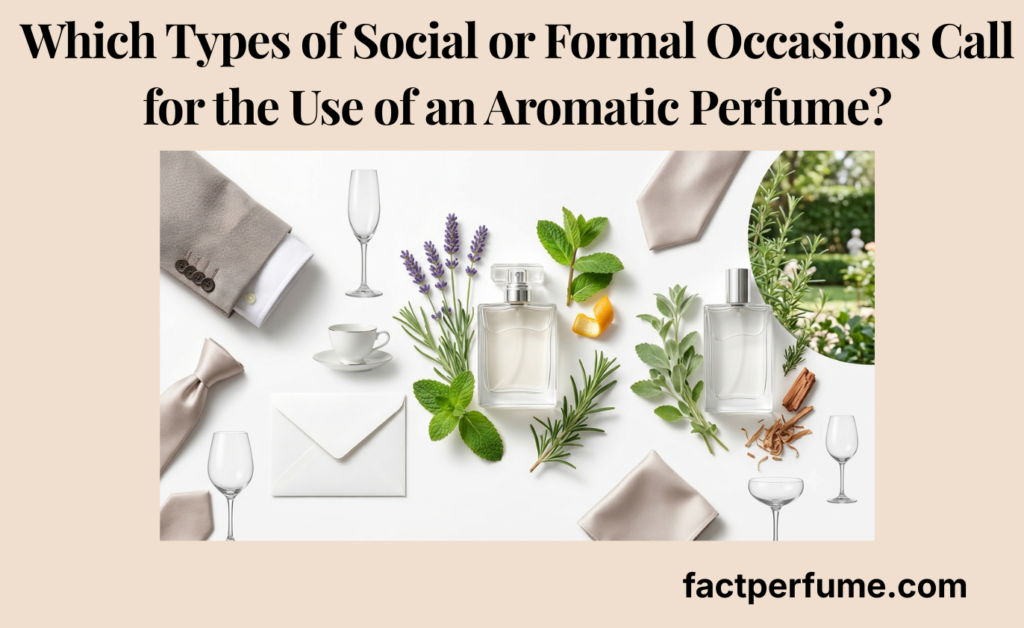
Which Types of Social or Formal Occasions Call for the Use of an Aromatic Perfume?
Aromatic perfumes can suit fragrance-permissive offices, daytime weddings, business events, brunches, garden parties, and other social occasions when their formula and application fit the venue. Their herbal, green, groomed, brisk, or fresh character may complement these settings, although these are common associations rather than guaranteed effects. No social or formal event automatically requires perfume.
The final decision should be based on venue policy, host expectations, cultural context, physical proximity, ventilation, food, sensitivity, and the exact aromatic subfamily. This applies to workplaces, interviews, weddings, business meals, relaxed social events, scent-free settings, evening occasions, romantic dates, and events with formal dress codes.
Aromatic perfume can complement offices, weddings, meals, and outdoor gatherings when the venue, formula, and application are appropriate; no occasion requires fragrance.
Why Can Aromatic Perfumes Suit Daytime and Professional Settings?
Aromatic perfumes can suit daytime and professional settings because herbal, lavender, mint, green, and fougère-like effects are often culturally associated with grooming and freshness.
These associations partly reflect the use of lavender, herbs, citrus, geranium, woods, and related scent effects in soaps, shaving products, grooming preparations, barbershop traditions, and botanical personal-care products. As a result, some people may perceive an aromatic profile as groomed, brisk, structured, fresh, or approachable.
These impressions are not universal. Fragrance perception can vary according to culture, personal memory, age, fragrance tradition, event setting, and individual preference. An aromatic perfume does not prove that someone is hygienic, competent, reliable, productive, or professionally prepared.
A review of responses to odours in occupational environments found that introducing pleasant odours to improve workplace productivity or mood was not well supported by the research reviewed. Aromatic perfume should therefore be treated as a personal styling choice rather than a method of influencing professional performance or behaviour.
The broad aromatic perfumes is more varied than the word “fresh” suggests. An aromatic fragrance may be:
- soft and lavender-led;
- sharp and herbal;
- sweet and coumarin-like;
- bitter and green;
- mossy and traditional;
- watery or marine;
- citrus-bright;
- dry and woody;
- spicy and warm;
- close-wearing;
- or strongly projecting.
Herbal materials also differ considerably. Perfumes with herbaceous aromatics may smell leafy, minty, culinary, earthy, medicinal, bitter, floral, or woody depending on the surrounding composition.
For this reason, the fragrance-family label should never replace an evaluation of the actual formula. A fragrance-permissive venue and controlled application matter more than the “fresh” or “aromatic” label.
Which Formal and Professional Occasions Can Suit an Aromatic Perfume?
Aromatic perfume can suit a formal or professional occasion when fragrance is permitted, the formula matches the event’s tone, and the application remains considerate.
In structured settings, policy and unavoidable exposure matter more than personal taste. A fragrance that feels restrained outdoors may become prominent in a small meeting room, a crowded conference hall, or a vehicle with limited airflow.
Projection is how noticeably a fragrance radiates from the wearer at a particular point during wear.
Sillage is the scent trail or diffusion impression associated with the wearer’s movement.
Neither projection nor sillage has one universally correct level for an office, wedding, interview, date, or formal dinner. The practical goal is the minimum effective application: the least application needed for the fragrance to remain a personal scent rather than becoming a shared environmental presence.
This cannot be translated into one universal number of sprays. Atomiser output, concentration, formula density, application surface, room conditions, temperature, clothing, and individual wear can all affect the result. Detailed application guide should be tested before the intended event.
Office and Boardroom Settings
A controlled aromatic perfume may suit a fragrance-permissive office when the formula remains close to the wearer and does not dominate shared rooms.
Before wearing it, check:
- whether the workplace has a scent-free policy;
- whether the space is open-plan or private;
- how closely people sit together;
- whether the room has effective ventilation;
- how long meetings are likely to last;
- whether a colleague has requested fragrance restraint;
- and whether visitors must follow the same policy.
The Canadian Centre for Occupational Health and Safety explains that workplaces may establish scent-free policies covering workers, visitors, personal-care products, cleaning products, and other scented materials. This is guidance rather than a universal law, but it demonstrates why local policy must override general perfume advice.
Where fragrance is permitted:
- test the perfume before wearing it through a full workday;
- use the minimum effective application;
- avoid reapplying in meeting rooms;
- avoid spraying in shared washrooms or corridors;
- and aim to keep the fragrance within personal space.
Consider wearing no fragrance when:
- scented products are prohibited;
- a fragrance-reduction request has been made;
- close exposure is unavoidable;
- ventilation is poor;
- or the formula projects more strongly than expected.
California workplace surveillance documented work-related asthma cases associated with fragrance exposure. This does not establish that every perfume exposure causes illness, but it supports taking workplace policies and expressed health concerns seriously.
Job Interviews
Fragrance is not necessary for an interview.
The interviewer’s preferences, the organisation’s policy, the room size, and the sensitivities of other participants are usually unknown. In that situation, wearing no fragrance is the prudent default.
An extremely restrained aromatic perfume may be considered only when fragrance is clearly permitted and the wearer already understands how the formula behaves at close range.
Ordinary hygiene, clean clothing, punctuality, preparation, and professional communication matter more than perfume. An aromatic fragrance cannot create trust, competence, confidence, reliability, or interview success.
Daytime Weddings and Ceremonies
Light or polished aromatic perfumes may suit many daytime weddings, but the invitation, host, venue, and cultural setting should guide the decision.
Consider:
- whether the ceremony is religious or secular;
- whether the event is indoors or outdoors;
- how closely guests will sit;
- whether the host has requested a scent-free environment;
- the formality of the dress code;
- the climate and airflow;
- and whether fragrance has a particular cultural significance in that community.
Possible aromatic directions include:
- a soft fougère;
- a restrained green aromatic;
- a polished citrus aromatic;
- or a lightly structured woody aromatic.
A bright herbal perfume may complement a garden wedding, while a soft lavender-and-wood structure may coordinate with daytime formal clothing. These are styling tendencies rather than universal rules.
A daytime wedding does not automatically require a fresh fragrance. Some ceremonies may be better attended without perfume.
Evening Weddings and Formal Receptions
Evening formality does not automatically exclude aromatic perfumes.
Aromatic fragrances with greater structure may complement an evening reception, including:
- woody aromatics;
- mossy fougères;
- spicy aromatics;
- deeper green aromatics;
- and lavender-led formulas supported by woods or restrained warmth.
A transparent aquatic or highly casual citrus-herbal composition may feel less aligned with some formal evening settings. However, the exact construction matters more than the family name. A polished citrus aromatic supported by woods may feel more formal than a sweet, sporty fougère.
The venue remains decisive. Close seating, crowded dance floors, warm rooms, and long receptions can increase other people’s exposure even when the perfume initially seems restrained.
Business Lunches and Networking Meals
A restrained aromatic perfume may suit a business lunch or networking meal when it remains secondary to the food and conversation.
Use less or wear none when:
- seating is tight;
- the dining room is small;
- the meal is designed around subtle aromas;
- wine, tea, coffee, or spirits are being evaluated;
- attendees have expressed fragrance sensitivity;
- or the event involves extended close conversation.
A fragrance does not need to be heavy or sweet to interfere with a meal. Mint, lavender, citrus, marine effects, herbs, musks, and woods can all become noticeable at a shared table.
Perfume should not compete with the food, drink, or people present.
Conferences and Training Sessions
Aromatic perfume may suit a conference or training session when organiser rules permit fragrance and the application remains personal.
These events require particular restraint because attendees may experience:
- several hours of exposure;
- closely arranged seating;
- recirculated indoor air;
- repeated contact with the same people;
- crowded registration areas;
- shared transport;
- and limited opportunities to move away.
Do not reapply fragrance inside a conference hall, classroom, meeting room, or exhibition space. The wearer may have become less aware of the perfume through olfactory adaptation while other attendees can still perceive it.
When the organiser’s policy or nearby participants’ comfort is uncertain, wearing no fragrance is a reasonable choice.
Venue-First Aromatic Occasion Matrix
The recommendations below are conditional. Venue policy, host instructions, cultural expectations, and human comfort always come first.
| Occasion or Setting | Baseline Recommendation | Aromatic Direction That May Fit | Main Etiquette Check | When to Wear None |
|---|---|---|---|---|
| Open-plan office | Use only where fragrance is permitted and remains personal | Soft fougère, restrained green aromatic, subtle citrus aromatic | Policy, colleague proximity, ventilation, all-day exposure | Scent-free rule, colleague request, unpredictable projection, poor airflow |
| Private meeting | A restrained aromatic may be considered | Soft lavender aromatic or polished woody aromatic | Room size, seating distance, meeting length | Unknown sensitivity, very small room, unavoidable close exposure |
| Job interview | Fragrance is optional; no fragrance is the prudent default | Only an already-tested near-skin aromatic when clearly permitted | Unknown policy, close interaction, interviewer preference | Policy is unknown, room is small, several interviewers are present |
| Conference | Use considerable restraint | Light green, citrus, or soft fougère profile | Organiser rules, long exposure, recirculated air, close seating | Rules are unclear, seating is dense, formula projects strongly |
| Daytime wedding | Often compatible when the host and venue permit it | Soft fougère, green aromatic, citrus aromatic, restrained woody aromatic | Host request, culture, ceremony type, seating, climate | Scent-free request, close ceremony seating, culturally sensitive setting |
| Evening wedding | Structured aromatics may complement the event | Woody, mossy, spicy, or deeper green aromatic | Formality, crowd density, indoor heat, application level | Host request, confined venue, known sensitivity |
| Business lunch | Keep fragrance secondary to food and conversation | Subtle green, citrus, or soft herbal aromatic | Table proximity, menu, room size, tasting component | Aroma-focused meal, tight seating, fragrance-sensitive company |
| Formal dinner | A polished aromatic may work at low intensity | Woody aromatic, refined fougère, restrained spicy aromatic | Food, table distance, ventilation, event duration | Chef’s-table format, tasting menu, small enclosed room |
| Religious or cultural ceremony | Follow host, community, and venue expectations | Only a culturally appropriate restrained profile when permitted | Religious practice, cultural etiquette, close seating, host guidance | Expectations are unknown, discretion is expected, fragrance is discouraged |
| Medical or scent-free venue | Follow the restriction rather than the fragrance style | None | Posted rules, staff instructions, visitor policy | Whenever scented products are restricted or uncertainty remains |
Check venue policy, physical proximity, airflow, food, and fragrance sensitivity before choosing an aromatic perfume or deciding to wear none.
Which Casual and Social Events Can Suit Aromatic Fragrances?
Aromatic fragrances often suit relaxed daytime and outdoor social events, provided the wearer considers food, crowd density, exercise, wind, and other people’s comfort.
Their herbal, citrus, green, lavender, woody, or watery effects can coordinate naturally with informal clothing and daylight settings. However, a casual dress code does not remove the need for restraint.
Weekend Brunches
Green, citrus-aromatic, soft herbal, or light fougère profiles may suit a weekend brunch.
A brunch setting often combines food, close seating, conversation, warm drinks, and a busy indoor environment. Before applying fragrance, consider:
- whether the table will be indoors or outdoors;
- how close guests will sit;
- whether the restaurant is crowded;
- whether the meal centres on delicate aromas;
- and whether anyone attending is fragrance-sensitive.
A perfume described as fresh can still be highly detectable. Citrus, mint, lavender, marine effects, musks, and aromatic woods may diffuse noticeably even when the fragrance does not smell heavy.
Keep the perfume personal and allow the meal to remain the main sensory experience.
Garden Parties and Outdoor Gatherings
Botanical aromatics may feel coherent with daylight, vegetation, warm weather, smart-casual clothing, and outdoor surroundings.
Green leaves, herbs, lavender, citrus, vetiver, woods, or soft floral-aromatic elements may complement the atmosphere of a garden party without being limited to it.
Outdoor air does not justify unrestricted application. Guests may still:
- stand closely while talking;
- sit together at shared tables;
- move into enclosed marquees or rooms;
- travel together;
- or gather in areas protected from the wind.
Wind may also reduce the wearer’s awareness of the perfume, encouraging unnecessary reapplication. Once guests move into a sheltered space, the result may feel much stronger than expected.
Casual Daytime Social Visits
A restrained aromatic fragrance may suit:
- coffee meetings;
- shopping trips;
- museum visits;
- daytime celebrations;
- informal lunches;
- community gatherings;
- and casual visits with friends.
Choose the formula according to the actual setting rather than the broad social label. A quiet museum gallery requires more restraint than an open-air market. A small coffee shop creates more unavoidable exposure than a spacious outdoor café.
Companion preference also matters. Where someone has expressed discomfort around fragrance, respecting that request is more important than matching perfume to an outfit or occasion.
Golf, Tennis, and Social Clubs
Aromatic and green fragrances have cultural associations with sporty grooming, outdoor leisure, and casual club styling. These associations do not mean sport automatically calls for perfume.
Before wearing fragrance:
- check the facility’s policy;
- avoid strong perfume during exercise;
- do not spray fragrance in enclosed changing rooms;
- keep scented products away from people who cannot move aside;
- and do not use perfume to mask sweat.
Exercise increases heat, perspiration, movement, and close contact. These variables can change how a fragrance is released and perceived, but they do not make its behaviour completely predictable.
For a meal or gathering after exercise, shower and change into clean clothing before considering perfume.
Post-Gym Social Plans
Perfume should never replace washing or clean clothing after exercise.
Use this order:
- Clean the skin.
- Change into clean clothing.
- Leave the enclosed gym or changing area.
- Check the rules and conditions of the next venue.
- Apply minimally only when fragrance is appropriate.
Spraying an aromatic perfume over sweat may combine odours rather than conceal them. It can also create a more noticeable environmental scent for other people using the shared facility.
Outdoor Day Events
Aromatic perfumes may suit outdoor events such as:
- markets;
- picnics;
- daytime festivals;
- outdoor exhibitions;
- community fairs;
- and casual celebrations.
Green, citrus, herbal, aquatic, and lightly woody profiles may feel especially coherent in daylight. Nevertheless, crowd density, heat, wind, shade, clothing, and later movement indoors can all change the experience.
Temperature and airflow can influence the release and perception of volatile fragrance materials, but they do not guarantee stronger projection, longer wear, or better performance. Research indicates that molecular properties, skin characteristics, time, and application surface can influence fragrance evaporation.
Test the fragrance in comparable conditions rather than assuming that an outdoor event permits a larger application.
When Should You Reduce, Reconsider, or Skip an Aromatic Perfume?
Aromatic perfume should be reduced, reconsidered, or skipped when policy, sensitivity, proximity, ventilation, food, or formula intensity creates a greater concern than the perfume’s style.
The decision is not a judgement on the quality of the perfume. It is an evaluation of whether other people can reasonably avoid exposure and whether fragrance could interfere with the purpose of the setting.
Scent-Free Workplaces and Venues
No aromatic perfume is appropriate where a valid rule prohibits scented products.
This remains true even when the fragrance is:
- light;
- natural-smelling;
- expensive;
- marketed as fresh;
- applied in a small amount;
- or barely detectable to the wearer.
Scent-free guidance may apply to perfumes, personal-care products, air fresheners, cleaning products, and other fragranced materials. A person’s adaptation to their own perfume does not establish that nobody else can smell it.
Follow the policy rather than attempting to identify a personal exemption based on fragrance family or concentration.
Medical and Clinical Settings
Follow all venue instructions in hospitals, clinics, treatment facilities, pharmacies, care environments, and similar settings.
Do not argue that:
- the perfume smells fresh;
- the application is small;
- the ingredients are natural;
- the product is expensive;
- or the wearer can no longer detect it.
The fragrance family does not override the purpose or policy of the setting. Where instructions are unclear, wearing no fragrance is the more considerate choice.
Enclosed Transport and Close Seating
Consider no fragrance or an already-tested near-skin application in:
- aircraft;
- coaches;
- small vehicles;
- lifts;
- crowded trains;
- shared taxis;
- and long indoor queues.
People in these environments cannot easily increase their distance from the wearer. Air may be recirculated, seating may remain fixed for hours, and individual preferences or sensitivities are usually unknown.
A perfume that feels moderate while walking outdoors may become much more noticeable when several people occupy a confined space.
Food, Wine, Coffee, Tea, and Aroma Events
Reduce or skip fragrance when sensory evaluation is central to the event.
Examples include:
- wine tastings;
- tea tastings;
- coffee cuppings;
- chef’s-table meals;
- food judging;
- aroma training;
- culinary workshops;
- and perfume evaluation sessions.
The concern is sensory interference rather than the aromatic family itself. A subtle mint, citrus, lavender, marine, woody, or musky fragrance can still affect the sensory environment around the wearer.
For perfume workshops, follow the organiser’s instructions. Participants may need to arrive without personal fragrance so that test materials can be evaluated more clearly.
Black-Tie Events
Aromatic perfume is not automatically wrong for black tie.
Some watery, highly sporty, or very casual aromatic styles may feel less aligned with a formal evening ceremony. That is an editorial styling judgement rather than a dress-code law.
Aromatic options that may complement formal evening wear include:
- polished woody aromatics;
- mossy fougères;
- restrained spicy aromatics;
- structured lavender-and-wood compositions;
- and deeper green aromatics.
No other perfume family is mandatory. The appropriate choice depends on the formula, venue, event tone, clothing, and application level.
Romantic Dates
Aromatic perfume may suit a romantic date when:
- the companion enjoys fragrance;
- the selected profile works at close range;
- the application remains restrained;
- the venue permits it;
- and neither person has expressed fragrance sensitivity.
A soft fougère, green aromatic, woody aromatic, citrus-herbal composition, or spicy aromatic may all be suitable depending on personal preference.
No fragrance family guarantees attraction, intimacy, confidence, or sensuality. Because dates often involve close physical proximity, the companion’s comfort matters more than broad claims about which perfume families are romantic.
Funerals and Solemn Ceremonies
Use considerable restraint or wear no fragrance at funerals and solemn ceremonies, especially when:
- attendees will sit closely;
- the ceremony has religious or cultural expectations;
- host guidance is unknown;
- the venue is small;
- or a noticeable perfume could draw attention.
The governing principle is discretion.
A personal connection to a particular scent does not automatically make it appropriate for every attendee or ceremony. Follow family requests, venue rules, and local customs.
Cold Weather
Cold weather does not automatically make aromatic perfume disappear.
Perception may change because:
- clothing can cover application areas;
- outdoor air can disperse fragrance differently;
- people may move repeatedly between heated rooms and cold air;
- some bright effects may appear quieter beside dense clothing;
- and the formula may release differently from skin and fabric.
Deeper woods, moss, herbs, spices, resins, or warmer fougère effects may provide greater structural weight in some cold-weather settings. However, this is a formula and styling consideration rather than a guarantee of longer wear or stronger projection.
Studies of fragrance evaporation indicate that molecular characteristics, individual skin properties, time, and test surfaces can influence release. They cannot predict one fixed wear time for every person, perfume, or winter event.
A fuller explanation of these variables belongs to the guide on aromatic longevity.
Dense Aromatic Formulas
Not every aromatic perfume is light or transparent.
Some formulas contain substantial amounts or impressions of:
- moss;
- patchouli;
- musks;
- coumarin-like warmth;
- amber woods;
- resins;
- dense lavender;
- powerful spices;
- or strong marine effects.
These materials can create weight, sweetness, persistence, or broad diffusion. A dense aromatic perfume may require the same level of restraint as fragrances from other families.
The aromatic label should never be treated as proof that a perfume will remain discreet.
How Should Aromatic Subfamilies Be Matched to Dress Code and Venue?
Aromatic subfamilies should be matched by density, freshness, warmth, sweetness, structure, and projection—not by assuming that every fougère is formal or every aquatic aromatic is casual.
Dress-code pairings are editorial tendencies rather than fixed rules. The same subfamily can contain transparent, dense, sweet, bitter, traditional, modern, soft, or strongly projecting formulas.
Aromatic Fougère
An aromatic fougère may include:
- lavender;
- geranium;
- herbs;
- coumarin-like warmth;
- woods;
- mossy effects;
- spices;
- or fresh citrus materials.
Depending on its construction, it may complement:
- smart-casual clothing;
- business-casual settings;
- business-professional dress;
- daytime formal events;
- or some evening formal occasions.
Fougères can smell soapy, fresh, sweet, mossy, dense, vintage-inspired, dry, sporty, or contemporary. A soft lavender fougère may work for daytime professional use, while a deeper mossy or woody fougère may feel coherent at an evening reception.
Fougère should not be treated as the universally most formal aromatic subfamily.
Green Aromatic
A green aromatic may use impressions of:
- galbanum;
- leaves;
- herbs;
- grass;
- vetiver;
- moss;
- stems;
- or dry woods.
Possible settings include:
- smart-casual events;
- business-casual workplaces;
- creative professional settings;
- daytime formal occasions;
- garden parties;
- and outdoor gatherings.
Some green aromatics feel crisp and polished. Others are bitter, earthy, sharp, vegetal, or strongly projecting. A green label does not establish that the fragrance is automatically suitable for an office or close seating.
Citrus Aromatic
A citrus aromatic may combine:
- bergamot;
- lemon;
- mandarin;
- petitgrain;
- basil;
- mint;
- rosemary;
- lavender;
- or aromatic woods.
It may complement:
- casual dress;
- smart-casual occasions;
- business-casual environments;
- daytime formal events;
- brunches;
- and warm-weather social gatherings.
A citrus aromatic may be transparent and relaxed, but it may also be polished, woody, bitter, musky, or persistent. Citrus materials do not make every composition casual or discreet.
Aquatic Aromatic
An aquatic aromatic may use:
- marine effects;
- watery effects;
- ozonic materials;
- salty impressions;
- mint;
- herbs;
- citrus;
- or woods.
It may suit:
- casual events;
- smart-casual styling;
- modern business-casual settings;
- daytime gatherings;
- and outdoor social occasions.
Watery or clean-air impressions can still project strongly in enclosed rooms. A fragrance can smell transparent while occupying a noticeable amount of shared space.
Aquatic aromatics should therefore be assessed through actual wear rather than assumptions about lightness.
Woody Aromatic
A woody aromatic may combine:
- herbs;
- lavender;
- vetiver;
- cedar;
- sandalwood;
- patchouli;
- moss;
- dry spices;
- resins;
- or amber woods.
Depending on its density, it may complement:
- business-professional dress;
- formal dinners;
- evening social events;
- cooler-weather gatherings;
- and some black-tie settings.
Woody support can give an aromatic perfume greater structure and depth. However, dense woods, patchouli, musks, resins, and amber materials may increase the need for application restraint.
Spicy Aromatic
A spicy aromatic may include:
- lavender;
- herbs;
- pepper;
- cardamom;
- ginger;
- dry woods;
- or warm spices.
Possible settings include:
- smart-casual evening events;
- dinner dates;
- formal dinners;
- evening receptions;
- and cooler-weather professional functions.
Spicy aromatics may become warm, sweet, dense, or strongly projecting as they develop. Evaluate the dry-down before choosing one for close seating or a food-focused event.
Aromatic Subfamily and Occasion Matrix
These pairings describe possible directions rather than universal dress-code rules.
| Aromatic Subfamily | Typical Character | Possible Dress-Code Range | Social Occasions That May Fit | Formal Occasions That May Fit | Main Caution |
|---|---|---|---|---|---|
| Aromatic fougère | Lavender, herbs, coumarin-like warmth, woods, moss | Smart casual to some evening formal settings | Brunches, social clubs, dates, daytime gatherings | Offices, daytime weddings, receptions, selected black-tie events | Can be sweet, dense, mossy, sporty, or strongly traditional |
| Green aromatic | Leaves, galbanum, grass, herbs, vetiver, woods | Casual to daytime formal | Garden parties, museums, outdoor gatherings, community events | Creative workplaces, daytime ceremonies, business-casual functions | May be bitter, sharp, earthy, or projecting |
| Citrus aromatic | Citrus peel, petitgrain, herbs, mint, aromatic woods | Casual to daytime formal | Brunches, picnics, markets, daytime celebrations | Business-casual events, daytime weddings, professional daytime functions | May be fleeting, musky, woody, bitter, or more noticeable than expected |
| Aquatic aromatic | Watery, marine, ozonic, salty, herbal, woody | Casual to modern business casual | Outdoor events, casual visits, warm-weather gatherings | Selected modern daytime events where fragrance is permitted | Transparent character does not guarantee discreet projection |
| Woody aromatic | Herbs, lavender, vetiver, cedar, patchouli, moss, amber woods | Business professional to selected black-tie settings | Evening gatherings, dinners, dates, cooler-weather events | Boardrooms, formal dinners, evening weddings, selected black-tie occasions | Dense woods, musks, resins, and amber materials may dominate close spaces |
| Spicy aromatic | Herbs, pepper, cardamom, ginger, warm spices, woods | Smart-casual evening to formal dinner | Dinner dates, evening social events, cooler-weather gatherings | Formal dinners, professional evening functions, receptions | Warmth, sweetness, and projection may increase during wear |
Match fougère, green, citrus, aquatic, woody, or spicy aromatic styles to the dress code, venue conditions, and required level of restraint.
Final Occasion-Etiquette Checklist
0 of 12 completed
Research and Policy Sources
These sources support the workplace-policy, fragrance-exposure, and evaporation principles used in this guide.
- Scent-free policy — Canadian Centre for Occupational Health and Safety.
- Workplace odour review — Current Opinion in Allergy & Clinical Immunology.
- Work-related asthma — California Department of Public Health.
- Evaporation study — International Journal of Cosmetic Science.
Frequently Asked Questions
No. Aromatic perfume can complement some formal events, but venue rules, host expectations, close seating, ventilation, cultural context, and sensitivity matter more than the fragrance family. Wearing no fragrance is valid and may be the most considerate choice.
Fragrance is not necessary for an interview. Because the policy, room size, and interviewer preferences are usually unknown, no fragrance is the prudent default. An already-tested near-skin aromatic should be considered only when fragrance is clearly permitted.
A soft fougère, restrained green aromatic, polished citrus aromatic, or lightly structured woody aromatic may fit when the host and venue permit fragrance. The ceremony type, culture, seating, climate, and application level still govern the decision.
Yes. Black tie does not automatically exclude aromatic perfume. Polished woody aromatics, mossy fougères, structured lavender-and-wood compositions, restrained spicy aromatics, and deeper green aromatics may work when their density and application suit the venue.
Skip it in scent-free workplaces, medical or clinical settings that restrict fragrance, enclosed transport, aroma-focused meals or tastings, and any setting where sensitivity, policy, or unavoidable close exposure creates uncertainty.
Use the minimum effective application rather than a universal spray count. Atomiser output, formula density, concentration, clothing, temperature, room size, and ventilation vary, so test the exact perfume before the event and keep it within personal space.
Finalising Your Aromatic Perfume Occasion Decision
Aromatic perfumes often suit daytime, professional, and relaxed social settings, but policy, sensitivity, proximity, formula density, and application amount matter more than the fragrance-family label. Workplace rules come first, interviews may call for no fragrance, weddings require host and venue awareness, and food-focused events require particular restraint.
Black tie does not automatically exclude aromatic perfume, and aromatic fragrances are not inherently unsuitable for romantic dates or cold weather. Match the exact subfamily and formula to the setting, keep the fragrance within personal space, and remember that no event requires perfume. When the context remains uncertain, wearing none is often the most considerate decision.