
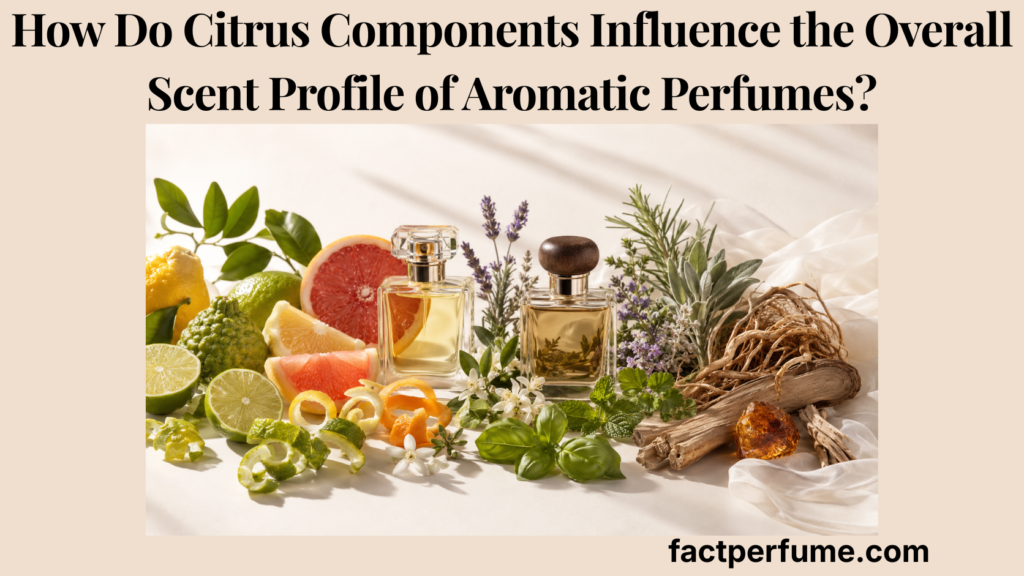
How Do Citrus Components Influence the Overall Scent Profile of Aromatic Perfumes?
Citrus components can make aromatic perfumes feel brighter, more bitter, juicy, pithy, floral, green, sharp, spacious, or clean-smelling, depending on the exact material and the formula around it. Their effect is shaped by material type, extraction, processing, concentration, odour threshold, aromatic partners, base structure, wearer, environment, and the condition of the material at the time of evaluation.
Although citrus is often most recognisable in the opening, its influence can continue through aromatic contrast, floral and green bridges, bitterness, rind effects, diffusion, and the way the formula transitions into its dry-down. Understanding that influence requires distinguishing oils from molecules and accords, comparing citrus–herb interactions, reviewing safety documentation, and evaluating the entire fragrance rather than judging only its first spray.
What Types of Citrus Materials Are Used in Aromatic Perfumery?
Aromatic perfumery may use expressed and distilled citrus oils, processed natural qualities, isolates, manufactured molecules, reconstructed accords, and citrus-leaf or flower materials.
These categories are not interchangeable. “Bergamot,” “lemon,” or “grapefruit” in a note pyramid may describe a natural oil, a processed quality, an individual molecule, a reconstructed accord, or an intended sensory impression.
The wider aromatic perfumes commonly combines herbs, lavender, spices, green effects, citrus, woods, and related botanical materials. Citrus can brighten that structure, sharpen it, soften it through floral effects, or create a bridge between the opening and aromatic heart.
Expressed Citrus Oils
Expressed oils are mechanically obtained primarily from citrus peel. They are complex natural substances containing many constituents rather than one isolated citrus molecule.
Common examples include:
- bergamot oil expressed;
- lemon oil cold pressed;
- lime oil expressed;
- grapefruit oil expressed;
- mandarin oil;
- sweet-orange oil;
- bitter-orange oil.
Depending on the exact fruit, quality, supplier, and batch, expressed oils may contribute:
- zest;
- fresh peel;
- juicy brightness;
- bitter pith;
- sweetness;
- floral nuances;
- sulphurous grapefruit effects;
- green or terpenic freshness.
Bergamot often combines citrus brightness with floral, bitter, and green facets. Lemon may feel sharper, more acidic, or more immediately peel-like. Expressed lime may appear tart, bright, and penetrating. Grapefruit can introduce bitterness, pith, juiciness, or sulphurous nuances.
Mandarin and sweet orange frequently produce softer, rounder, or sweeter citrus impressions, although their exact character depends on botanical variety, origin, processing, and material condition.
Some expressed citrus qualities require specific phototoxicity controls. Their regulatory status cannot be inferred from the fruit name alone.
Distilled Citrus Oils
Distilled citrus oils are obtained through distillation rather than mechanical expression.
Distillation can change:
- chemical composition;
- peel richness;
- terpenic balance;
- sharpness;
- sweetness;
- sensory complexity;
- safety characteristics.
Distilled lime, for example, may differ substantially from expressed lime in both scent profile and relevant documentation. One should not be substituted conceptually for the other simply because both are labelled “lime.”
Distillation may reduce or alter certain constituents, but it does not establish that every distilled citrus oil is non-phototoxic, unrestricted, or suitable for every application. The exact technical specification still controls the assessment.
Processed Citrus Qualities
Natural citrus oils may be further processed into qualities described as:
- folded;
- terpeneless;
- rectified;
- fractionated;
- FCF.
These processes may alter intensity, texture, composition, stability, diffusion, or the balance between terpenic and character-giving constituents.
A folded oil may concentrate selected aspects by reducing highly volatile fractions. A terpeneless quality may provide a more concentrated citrus character with less of the original terpenic body. Rectification and fractionation can refine or rebalance specific parts of the material.
FCF terminology requires particular caution. It commonly relates to a furocoumarin-reduced or furocoumarin-free quality, but the exact meaning, processing standard, analytical specification, and remaining constituents are supplier-specific.
FCF should never be interpreted as a universal guarantee that a material is risk-free.
Citrus-Associated Molecules
Individual molecules can contribute selected parts of citrus character without reproducing the full complexity of an oil.
Important examples include:
Limonene: A molecule found in many natural citrus oils. It can contribute terpenic, peel-like, bright citrus character. Its presence does not prove that an accord is synthetic because natural citrus oils may contain substantial limonene.
Citral: A molecular material associated with a sharp lemon-like impression. Citral is not lemon oil. It represents one type of lemony effect without the full peel, pith, wax, floral, and juicy complexity of a complete oil.
Decanal: An aldehyde that may contribute waxy citrus-peel, orange-like, and diffusive effects. It is one potential component of a citrus accord rather than a complete orange or lemon reconstruction.
Other aldehydes, terpenes, sulphurous materials, florals, and green molecules may also be combined to create citrus effects.
Natural Isolates
A natural isolate is an individual molecule separated from a natural source.
Its natural origin does not turn it back into the complete oil from which it was obtained. An isolated natural limonene remains one molecule, while sweet-orange oil contains a broader mixture whose minor constituents may significantly influence aroma.
Natural origin also does not automatically establish superior quality, greater realism, longer performance, or improved safety.
Manufactured Aroma Molecules
Manufactured molecules may provide:
- consistency;
- specificity;
- controlled intensity;
- stability;
- diffusion;
- novel citrus effects;
- support for reconstructed accords.
They should be evaluated according to their actual scent contribution and documentation rather than dismissed as cheap or inferior because of their production method.
Natural and manufactured materials often work together within the same citrus accord.
Reconstructed Citrus Accords
A citrus accord is a combination of materials designed to produce a unified citrus impression.
Examples include:
- grapefruit accords;
- yuzu-style accords;
- lemon-peel accords;
- mandarin accords;
- bitter-orange accords.
A grapefruit accord might combine juicy citrus, bitter pith, peel, green effects, and carefully controlled sulphurous nuances. A yuzu-style accord might emphasise tartness, green peel, mandarin-like fruit, grapefruit bitterness, or floral brightness without containing literal yuzu oil.
An accord can be constructed to highlight one specific dimension of fruit rather than imitate the whole natural material.
Citrus Leaves and Flowers
Citrus trees provide olfactory materials beyond their fruit peel.
Petitgrain is commonly associated with leaves and twigs. It can smell green, woody, bitter, leafy, and citrus-bright, making it especially useful as a bridge between citrus openings, aromatic herbs, and woody dry-downs.
Neroli is associated with the essential oil of bitter-orange blossom. It may feel floral, green, fresh, citrus-bright, and lightly bitter.
Orange blossom generally communicates a richer floral effect. Depending on the material or accord, it may feel sweet, indolic, honeyed, green, luminous, or warm.
Peel oils, leaf materials, and flower materials come from different plant parts and perform different structural roles. They should not be treated as interchangeable forms of “orange.”
Readers seeking a wider overview can compare the citrus notes used across perfumery.
Citrus Material Classification Matrix
| Citrus Entry | Technical Type | Typical Sensory Role | Main Verification Question | Important Limitation |
|---|---|---|---|---|
| Bergamot expressed | Natural complex peel oil | Floral, bitter, zesty, green | What exact expressed or processed quality is supplied? | May be subject to quality-specific phototoxicity controls |
| Lemon cold pressed | Natural complex peel oil | Sharp peel, juice, acidity, freshness | Is it cold pressed, distilled, folded, or processed? | Not equivalent to citral or distilled lemon |
| Distilled lime | Distilled natural oil | Tart, terpenic, sharp citrus | What does the supplier specification confirm? | Distilled does not automatically mean unrestricted |
| Mandarin oil | Natural complex peel oil | Soft, juicy, sweet, rounded | Which botanical variety and processing method? | Character varies among qualities |
| Sweet-orange oil | Natural complex mixture | Sweet peel, juiciness, terpenic brightness | What is the batch composition and condition? | Not pure limonene |
| Limonene | Individual molecule | Terpenic citrus peel | Is it natural isolate or manufactured material? | Does not reproduce a complete citrus oil |
| Citral | Molecular material | Sharp lemon-like effect | What exact material or mixture is being used? | Not lemon oil |
| Grapefruit accord | Constructed accord | Bitter, pithy, juicy, sulphurous | Which materials create the communicated effect? | Note language does not disclose the formula |
| Petitgrain | Leaf-and-twig oil or accord | Green, woody, bitter citrus leaf | What plant source and processing apply? | Not a peel oil |
| Neroli | Citrus-flower oil or accord | Floral, green, citrus-bright | Is the note a natural oil or reconstruction? | Not orange-peel oil |
How Do Citrus Materials Influence the Opening and Transition of an Aromatic Perfume?
Citrus materials often influence the opening strongly because many constituents enter the headspace readily, but perceived impact also depends on odour threshold, concentration, formula, skin, temperature, and airflow.
Volatility is important, but it is not the only reason citrus may dominate the first impression.
A more complete opening-perception model is:
Volatility + odour threshold + concentration + formula interaction + application surface + environment + perception
Volatility and Headspace
Volatility describes a material’s tendency to enter the vapour phase under defined conditions. Many citrus constituents contribute rapidly to the headspace above a freshly applied perfume.
This can create an immediate impression of:
- zest;
- peel;
- juiciness;
- brightness;
- bitterness;
- green freshness;
- aromatic sharpness.
However, rapid headspace contribution does not establish a universal wear time. A material may be highly volatile but detectable at a low concentration because of its odour threshold, while another may remain physically present but no longer dominate perception.
Odour Threshold and Concentration
Odour threshold describes the level at which a material becomes detectable under particular conditions.
Two citrus materials at the same concentration may not smell equally strong. One may dominate because it has a lower perceptual threshold, while another may integrate more quietly with the aromatic structure.
The surrounding perfume can also enhance, suppress, or transform an effect. A sharp lemon material may feel more prominent against soft musk than against a dense herbal, resinous, or woody background.
Skin and Environment
Fragrance evaporation is influenced by both molecular properties and the characteristics of the wearer’s skin. Research examining fragrance molecules on volunteers found that intrinsic molecular properties and individual skin properties both affected evaporation profiles, supporting the need to avoid universal note timelines.
Temperature, airflow, application surface, humidity, and the amount applied may further change how quickly citrus enters the surrounding air and how it is perceived.
This is why citrus openings should be understood as a variable formula-and-wear phenomenon rather than a fixed clock.
Aromatic Lift
Citrus may make lavender, rosemary, sage, mint, basil, or geranium feel:
- brighter;
- sharper;
- more spacious;
- more floral;
- greener;
- more bitter;
- more polished;
- cleaner-smelling.
Bergamot can give lavender a floral-bitter lift. Lemon may sharpen rosemary or basil. Grapefruit can increase bitterness and pith. Mandarin may round a dry herbal structure with softer fruit.
The effect depends on the exact quality and balance. Citrus can clarify herbs, but it can also overwhelm them or make them feel excessively sharp.
Contrast With the Base
Citrus can create contrast with:
- coumarin;
- moss;
- patchouli;
- vetiver;
- resin;
- amber;
- woods;
- musk.
A bright citrus opening over a darker mossy or woody base can increase the perceived depth of both parts. The opening feels more luminous by comparison, while the base feels richer when it emerges.
Contrast must still be connected. Without suitable bridge materials, the perfume may appear divided into a bright citrus opening and an unrelated woody or musky dry-down.
Building the Transition
Materials that may connect the citrus opening to the aromatic heart include:
- petitgrain;
- neroli;
- orange blossom;
- geranium;
- green leaves;
- lavender;
- aromatic herbs;
- floral materials;
- woods;
- musks;
- recurring bitter effects.
Petitgrain is particularly useful because it can share citrus brightness with the opening, leafy bitterness with herbs, and woody dryness with the later structure.
The literal peel or juice impression may soften while floral lift, green brightness, pithy bitterness, or citrus-associated luminosity continues.
This is transformation, not unchanged persistence.
Which Citrus Profiles Can Complement Different Aromatic Herbs?
Bergamot, lemon, lime, grapefruit, mandarin, bitter orange, and reconstructed citrus effects can support aromatic herbs differently, but no pairing is universally correct.
The following combinations are creative starting hypotheses. Results depend on exact material identity, concentration, formula context, processing, condition, and evaluation.
Lavender
Possible citrus directions include:
- bergamot;
- mandarin;
- lemon;
- bitter orange;
- grapefruit.
Bergamot may reinforce lavender’s floral and aromatic dimensions, producing a polished or classical effect. Mandarin may make the structure softer, rounder, or sweeter. Lemon can increase sharpness and clarity, while grapefruit may emphasise bitterness or modern pithiness.
Potential risks include:
- generic cologne character;
- an opening that feels too sharp;
- citrus obscuring lavender;
- a disconnected dry-down.
Rosemary
Possible citrus directions include:
- lemon;
- bergamot;
- grapefruit;
- yuzu-style accords.
Lemon may produce a bracing, herbal, peel-rich effect. Bergamot may add floral smoothness and bitterness. Grapefruit can reinforce resinous or pithy qualities, while a yuzu-style accord may add tartness and green peel.
The combination can become medicinal, excessively terpenic, or abrasive if both the rosemary and citrus are strongly penetrating.
Sage and Clary Sage
Possible citrus directions include:
- bergamot;
- mandarin;
- grapefruit;
- bitter orange.
Bergamot may produce a dry tea-like or botanical effect. Mandarin may add warmth and softness. Grapefruit can emphasise bitterness, while bitter orange may connect sage with ambered, woody, or floral materials.
The principal risks are excess bitterness, aromatic heaviness, or a transition that feels too dry.
Mint
Possible citrus directions include:
- lime;
- grapefruit;
- lemon;
- mandarin.
Lime and mint may feel crisp, tart, and strongly green. Grapefruit can add bitterness, while lemon produces a bright and sharp effect. Mandarin may offer a softer, juicier contrast.
Mint and citrus can easily evoke oral care, confectionery, personal care, or functional products. The effect is an odour association rather than evidence of physical cooling.
Basil
Possible citrus directions include:
- lime;
- bergamot;
- grapefruit;
- lemon.
Lime may emphasise basil’s green, peppery, or culinary aspects. Bergamot can add floral bitterness. Grapefruit may reinforce savoury or pithy dimensions, while lemon can produce a vivid garden-like sharpness.
The combination may become culinary, food-like, or cleaner-associated if it lacks floral, woody, musky, or bitter structural support.
Geranium
Possible citrus directions include:
- bergamot;
- lemon;
- mandarin;
- grapefruit.
Bergamot can support geranium’s rosy, green, and aromatic dimensions. Lemon may sharpen its mint-like side. Mandarin may soften the floral profile, while grapefruit can add modern bitterness.
Possible risks include flat soapiness, generic cologne character, or citrus masking the complexity of the geranium.
More detailed comparisons of bergamot, lime, and petitgrain can help separate peel brightness from leafy and transitional effects.
Citrus–Aromatic Pairing Matrix
| Aromatic Profile | Citrus Directions | Possible Result | Contrasting Alternative | Main Risk |
|---|---|---|---|---|
| Lavender | Bergamot, mandarin, lemon, bitter orange | Floral-aromatic, polished, bitter, soft | Grapefruit for drier pith | Generic cologne or excessive sharpness |
| Rosemary | Lemon, bergamot, grapefruit, yuzu-style accord | Bracing, herbal, resinous, tart | Mandarin for softer contrast | Medicinal or terpenic harshness |
| Sage or clary sage | Bergamot, mandarin, grapefruit, bitter orange | Tea-like, dry, botanical, warm | Lemon for a sharper profile | Excess bitterness or heaviness |
| Mint | Lime, grapefruit, lemon, mandarin | Crisp, green, juicy, bitter | Bitter orange for warmer contrast | Mouthwash, confectionery, or personal-care association |
| Basil | Lime, bergamot, grapefruit, lemon | Leafy, peppery, savoury, garden-like | Mandarin for softer fruit | Food or cleaner association |
| Geranium | Bergamot, lemon, mandarin, grapefruit | Rosy-citrus, green-floral, minty | Bitter orange for greater depth | Soapiness or generic cologne character |
These are creative starting hypotheses, not universal formulation rules. Results depend on exact material identity, concentration, formula context, and evaluation.
What Safety and Regulatory Checks Apply Before Using Citrus Materials?
Citrus safety must be assessed from the exact material, processing, supplier specification, finished-product category, total formula contribution, and current regulatory documentation.
“Citrus oil” is too broad a label for a safety decision. Bergamot expressed, lemon cold pressed, distilled lime, expressed lime, grapefruit expressed, mandarin, and processed FCF qualities may have different compositions and documentation requirements.
Confirm the Exact Identity
Professional records should identify, where relevant:
- botanical name;
- plant part;
- extraction method;
- processing;
- supplier;
- batch;
- dilution status;
- CAS number;
- analytical specification;
- storage history.
A generic note name is not sufficient.
“Lime” does not establish whether the material is expressed, distilled, folded, fractionated, or reconstructed. “Bergamot” does not establish whether it is expressed, FCF, rectified, or an accord.
Check the Current IFRA Standard
IFRA Standards apply to named materials and defined conditions rather than treating every citrus material as one category.
At the verification date of August 3, 2026, the 51st Amendment remained the latest complete published Amendment. The consultation on the proposed 52nd Amendment closed on June 12, 2026, with formal notification expected toward the end of November 2026. Proposed consultation documents should not be treated as adopted Standards. The current Standards Library must therefore be rechecked whenever the article or a product assessment is updated.
The existence of one Standard for bergamot expressed does not mean that the same requirements can be transferred to lemon, lime, grapefruit, or a distilled quality.
Identify the Finished-Product Category
Safety requirements may depend on the intended product and its exposure pattern.
Fine fragrance, soap, rinse-off products, body products, household products, and other applications may belong to different assessment categories.
A limit or conclusion from one category should not be transferred to another without current technical documentation.
Review Combined Contributions
Several natural complex substances can contribute the same restricted constituent.
A complete formula review may therefore need to consider:
- every relevant citrus oil;
- other natural complex substances;
- the contribution of restricted constituents from multiple sources;
- the appropriate finished-product category;
- current supplier analytical data.
Assessing one citrus material in isolation may not establish the total formula contribution.
Distinguish Expressed, Distilled, and FCF Qualities
Expressed, distilled, rectified, folded, fractionated, and FCF materials must be assessed according to their exact documentation.
Do not assume:
- every distilled oil has the same phototoxicity status;
- every FCF material follows an identical specification;
- a generic citrus name proves compliance;
- one supplier’s processing description applies to another supplier.
Review Oxidation and Material Condition
Oxidation is both an odour and safety concern.
Limonene and other citrus-associated materials can change through exposure to air. Oxidation may alter scent quality and produce compounds with different sensitisation relevance.
Review:
- material age;
- oxygen exposure;
- heat;
- light;
- container headspace;
- closure condition;
- odour drift;
- colour or clarity changes;
- batch history;
- supplier shelf-life guidance.
A material that smells flat, harsh, stale, solvent-like, or substantially different from a verified fresh reference should be investigated before the fragrance is adjusted.
Deteriorated material should not simply be hidden under additional perfume materials.
Understand the Limits of an IFRA Certificate
An IFRA Certificate of Conformity relates to an intended use and is prepared by the fragrance-mixture manufacturer.
It does not replace:
- complete professional safety assessment;
- supplier specifications;
- stability review;
- regional or national regulations;
- finished-product responsibility.
Conformity with one documentation layer does not establish that the complete product is universally safe or legally compliant in every market.
Require Professional Assessment
This article does not provide safe-use percentages, dilution instructions, phototoxicity calculations, or raw-material handling procedures.
Any formulation decision requires current documents, the correct product category, a review of combined contributions, applicable legal requirements, and qualified professional safety assessment.
Safety and Documentation Matrix
| Check | Evidence Required | Risk Prevented | Required Decision |
|---|---|---|---|
| Exact identity | Technical name, botanical source, plant part, supplier, batch | Confusing unlike citrus materials | Confirm the precise material |
| Extraction and processing | Expressed, distilled, folded, fractionated, rectified, or FCF specification | Transferring the wrong scent or safety assumptions | Assess the supplied quality |
| Current IFRA Standard | Current adopted Standard and documentation | Using outdated or proposed requirements | Apply current published information |
| Product category | Intended finished-product use | Transferring limits across exposure types | Select the correct assessment category |
| Other contributing sources | Complete formula and constituent review | Missing combined restricted contributions | Assess the total formula |
| Material age and oxidation | Batch age, odour comparison, storage history | Using deteriorated material | Investigate or replace as appropriate |
| Storage documentation | Shelf life, closure, heat, light, oxygen exposure | Preventable degradation | Confirm acceptable material condition |
| Professional assessment | Qualified finished-product review | Treating one certificate as complete safety proof | Approve only after complete assessment |
How Should Citrus Balance Be Evaluated Without Universal Percentages?
Citrus balance should be evaluated through controlled comparisons because oils, isolates, molecules, and accords differ in intensity, composition, odour threshold, and safety context.
A universal citrus percentage cannot account for the differences between bergamot expressed, citral, distilled lime, mandarin oil, grapefruit accord, or a natural limonene isolate.
Use Controlled Comparisons
Within documented professional boundaries:
- Keep the main aromatic structure constant.
- Change only one citrus variable.
- Use coded samples.
- Evaluate blind where practical.
- Record sensory observations.
- Repeat the comparison under consistent conditions.
This is an evaluation framework, not an instruction to use a particular quantity.
Evaluate Herbal Clarity
Ask whether the citrus:
- clarifies lavender or herbs;
- sharpens them excessively;
- obscures their identity;
- makes the aromatic heart feel greener;
- introduces unwanted sweetness;
- creates excessive bitterness.
The correct balance is the one that supports the intended perfume character, not the highest or lowest citrus impact.
Evaluate Structural Connection
A successful citrus opening should feel related to the aromatic heart and dry-down.
Possible bridge materials include:
- petitgrain;
- neroli;
- orange blossom;
- geranium;
- herbs;
- green materials;
- florals;
- woods;
- musks.
These materials connect facets through shared odour characteristics. They should not all be described as fixatives.
Separate Different Concentration Concepts
Do not confuse:
- fragrance concentrate;
- finished consumer product;
- diluted evaluation stock;
- neat material;
- contributions from other natural sources.
A percentage in one context does not automatically translate into another.
Completion Standard
A direction is coherent only when:
- the citrus identity is intentional;
- herbs remain clear;
- the transition is connected;
- bitterness and sweetness are balanced;
- the dry-down supports the concept;
- documentation and safety assessment are complete.
How Can Citrus Character Continue After the Opening Changes?
Citrus character can continue through repeated peel, leaf, blossom, bitter, floral, green, and diffusive effects after the brightest opening materials have transformed.
Continuity does not mean that the original lemon, lime, or bergamot molecules remain unchanged throughout wear. It means that the formula continues to evoke related citrus characteristics.
Repeat Related Facets
A perfume may repeat citrus-associated impressions through:
- zest;
- rind;
- pith;
- blossom;
- leaf;
- bitter peel;
- citrus-floral effects;
- aromatic brightness.
The opening may begin with juicy peel and later become drier, more floral, greener, or more bitter while still feeling connected to citrus.
Use Petitgrain as a Botanical Bridge
Petitgrain can connect:
- citrus peel;
- leafy greenness;
- herbs;
- floral materials;
- dry woods;
- bitterness.
It is valuable because it shares characteristics with both the citrus opening and the aromatic or woody heart.
Petitgrain does not guarantee persistence. Its role depends on the complete formula.
Use Hedione for Luminosity and Diffusion
Hedione is a dsm-firmenich trade material described as an elegant, transparent jasmine-floral note with a refreshing citrus hint.
It may contribute:
- luminosity;
- floral spaciousness;
- presence;
- noticeability;
- diffusion;
- a smoother citrus-to-floral transition.
Hedione should not be called a citrus fixative. It does not preserve bergamot, lemon, or another citrus oil unchanged.
Its role is better understood as supporting radiance, diffusion, and floral-citrus continuity.
Use Ambrox-Type Materials as Base Support
Ambrox DL is described by dsm-firmenich as an ambery material with a rich woody character that can add warmth, richness, performance, and substantivity.
It may help create a stable woody-amber framework beneath a citrus–aromatic composition.
It does not:
- preserve lemon molecules unchanged;
- anchor every bergamot accord;
- guarantee citrus longevity;
- prevent the opening from transforming.
Ambrox-type materials support the complete base. They do not freeze the top of the fragrance.
Echo Bitterness and Terpenic Texture
Later stages of the perfume may retain a citrus connection through:
- dry pith;
- bitter peel;
- herbs;
- green materials;
- dry woods;
- aromatic spices;
- restrained terpenic effects.
A bitter bergamot opening can transition naturally into petitgrain, herbs, vetiver, or dry woods even after its juicy fruit impression has softened.
Construct Multi-Stage Citrus Accords
A reconstructed citrus accord can use materials with different evaporation and perceptual profiles.
Some parts may create an immediate juicy or peel effect. Others may provide later bitterness, floral lift, waxy rind, leafy greenness, or citrus-associated diffusion.
The accord evolves over time rather than remaining chemically unchanged.
Choose a Compatible Base
Compatible dry-down structures may include:
- woods;
- vetiver;
- moss;
- musk;
- amber;
- herbs;
- florals.
The base should extend or transform the citrus–aromatic identity rather than erase it completely.
Why Can Some Citrus Accords Evoke Household or Functional Products?
Citrus may evoke household or functional products because of cultural familiarity, accord simplicity, excessive sharpness, poor transition, material condition, or formula context—not solely because a material is synthetic.
Citrus is widely used in fine fragrance, soap, detergent, cleaning products, oral care, and personal care. Shared familiarity can produce functional associations even when the materials are high quality.
Cultural Familiarity
Consumers repeatedly encounter lemon, lime, orange, mint, and terpenic effects in functional products.
A perfume can therefore evoke:
- detergent;
- surface cleaner;
- soap;
- mouthwash;
- toothpaste;
- air freshener.
This association does not prove poor quality or manufactured origin. It reflects prior exposure and formula context.
An Overly Simple Accord
A narrow citrus effect may lack:
- peel complexity;
- pith;
- floral nuance;
- green contrast;
- herbs;
- woods;
- musks;
- a developed transition.
A one-dimensional lemon impression placed over alcohol and a simple clean base may feel more functional than a layered accord containing rind, bitterness, floral lift, leaves, herbs, and wood.
Excessive Sharpness
Strong citral-like or aldehydic lemon effects may feel:
- linear;
- abrasive;
- detergent-like;
- disinfectant-like.
The issue may be intensity, lack of modulation, or poor integration rather than the production origin of the material.
Strong Terpenic Emphasis
A highly terpenic profile can feel:
- solvent-like;
- thin;
- repetitive;
- functional.
Natural oils can produce the same impression when terpenic brightness dominates and the surrounding formula offers little contrast.
Sweet Orange and Limonene
Sweet-orange oil is commonly dominated by limonene, but it is still a complex natural material with additional constituents affecting its scent.
Limonene therefore does not prove that an accord is synthetic, inexpensive, or poorly constructed.
Poor Transition
A sudden gap between citrus and the aromatic heart can make a perfume feel unfinished.
The opening may smell vivid for a moment and then collapse into unrelated musk, wood, or herbs. A suitable floral, leafy, bitter, herbal, or woody bridge can make the change feel intentional.
Oxidation
Material deterioration should be investigated when:
- the odour has changed;
- the batch is old;
- storage is uncertain;
- oxygen exposure was high;
- colour or clarity shifted;
- the material differs from a verified fresh reference.
Oxidation can affect both scent quality and safety characteristics. It should not be treated as a colour problem alone.
Structural Directions to Evaluate
Depending on the diagnosis, useful directions may include:
- bitter peel;
- pith;
- petitgrain;
- florals;
- green effects;
- herbs;
- woods;
- controlled sweetness;
- a more complex accord;
- verified fresh material.
These are diagnostic directions, not guaranteed corrections.
Citrus Continuity and Diagnostic Matrix
| Observed Effect | Possible Cause | Structural Direction to Evaluate | Expected Transformation | Limitation |
|---|---|---|---|---|
| Sharp lemon opening ends abruptly | Weak connection to heart | Petitgrain, florals, herbs, green effects | Smoother citrus-to-aromatic transition | Does not preserve lemon unchanged |
| Bergamot loses floral bitterness | Formula emphasises only bright peel | Neroli, geranium, bitter orange, dry woods | More floral and bitter continuity | Depends on exact bergamot quality |
| Grapefruit becomes thin or harsh | Excess sharpness or weak pith structure | Bitter peel, greens, florals, soft woods | Greater body and controlled bitterness | Sulphurous balance remains formula-specific |
| Mandarin becomes too sweet | Insufficient bitterness or aromatic contrast | Petitgrain, herbs, grapefruit, dry woods | Drier and more structured fruit | May reduce the intended softness |
| Lime and mint evoke mouthwash | Familiar functional combination | Bitter pith, woods, florals, restrained herbs | Less oral-care association | Cultural perception varies |
| Basil and citrus evoke food or cleaner | Strong culinary or terpenic overlap | Floral bridge, musk, woods, controlled bitterness | More perfume-like abstraction | May alter botanical realism |
| Citrus feels flat or solvent-like | Accord simplicity, terpene dominance, or degradation | More layered peel, pith, floral and green effects; verify material | Greater complexity and texture | Diagnose condition before reformulating |
| Material differs from fresh reference | Age, heat, light, oxygen, or storage issue | Review documentation and compare with verified batch | Establish whether material is deteriorated | Do not mask suspected degradation |
How Should the Final Citrus–Aromatic Perfume Be Evaluated?
The final citrus–aromatic perfume should be evaluated through documentation, opening, transition, aromatic clarity, continuity, dry-down, stability, and repeat testing.
A vivid opening is not enough. The complete fragrance must remain coherent after the literal citrus-fruit impression changes.
Stage 1: Documentation
Confirm:
- exact material identity;
- technical class;
- supplier;
- batch;
- extraction;
- processing;
- dilution status;
- current IFRA status;
- intended product category;
- storage history;
- total contribution from relevant sources.
Incomplete documentation should be resolved before the sensory direction is approved.
Stage 2: Opening
Assess:
- recognisable citrus identity;
- zest;
- peel;
- pith;
- bitterness;
- juiciness;
- sharpness;
- alcohol bite;
- functional association;
- herbal clarity.
Ask whether the opening feels intentional or merely loud.
Stage 3: Transition
Observe:
- citrus-to-herb continuity;
- floral or green bridges;
- sudden gaps;
- excessive overlap;
- growing sweetness;
- loss of aromatic definition;
- changes in bitterness.
The transition should feel designed even if the citrus character transforms substantially.
Stage 4: Aromatic Heart
Evaluate lavender, rosemary, sage, mint, basil, geranium, or other aromatic materials.
Ask:
- Does citrus clarify them?
- Does it obscure them?
- Does the heart feel greener, sharper, softer, or more floral?
- Does one material dominate unexpectedly?
- Does the perfume retain a clear aromatic identity?
Stage 5: Dry-Down
Assess:
- woods;
- musk;
- amber;
- moss;
- vetiver;
- residual freshness;
- transformed citrus character;
- overall coherence.
The base should support the original concept rather than becoming an unrelated second perfume.
Stage 6: Repeat Testing
Repeat the assessment:
- on another day;
- on a controlled blotter;
- under defined conditions;
- with coded samples;
- using consistent application.
One evaluation may be influenced by adaptation, environment, expectation, or temporary perception.
Stage 7: Stability Review
Observe:
- odour drift;
- colour;
- clarity;
- precipitation;
- ageing;
- container condition.
Formal stability testing requires an appropriate professional protocol. A casual visual check cannot replace it.
Stage 8: Final Decision
A citrus–aromatic direction should be approved only when:
- documentation is complete;
- professional safety assessment is complete;
- citrus identity is intentional;
- aromatic materials remain recognisable;
- the transition is coherent;
- functional associations are controlled;
- the dry-down supports the concept;
- results are repeatable.
Final Citrus–Aromatic QA Checklist
- Exact identity: Is every citrus material technically identified?
- Processing: Are expressed, distilled, folded, fractionated, rectified, and FCF qualities distinguished?
- Supplier and batch: Are supplier, batch, specification, and dilution recorded?
- Current documentation: Have current Standards and supplier documents been reviewed?
- Product category: Is the correct finished-product category being assessed?
- Combined contributions: Have relevant restricted constituents from all sources been considered?
- Material condition: Have age, storage, oxygen exposure, and fresh-reference comparison been reviewed?
- Opening: Is citrus identity clear, balanced, and intentional?
- Transition: Does citrus connect naturally with the aromatic heart?
- Aromatic clarity: Do herbs remain recognisable?
- Continuity: Do related peel, leaf, blossom, bitter, green, or floral effects continue?
- Functional association: Are cleaner, mouthwash, detergent, or food associations controlled?
- Dry-down: Does the base support the citrus–aromatic concept?
- Repeat testing: Are observations consistent across controlled evaluations?
- Specialist review: Is professional safety and regulatory assessment complete?
Frequently Asked Questions
No. A note pyramid may communicate a natural oil, processed quality, molecule, isolate, reconstructed accord, or intended sensory impression. Exact material identity requires technical documentation.
Many citrus constituents enter the headspace readily, but opening impact also depends on odour threshold, concentration, formula interaction, application surface, temperature, airflow, and perception.
No. Expression and distillation can produce materially different chemical compositions, sensory profiles, and safety documentation. The exact supplied quality must be assessed.
No. FCF terminology is supplier-specific and commonly relates to reduced or removed furocoumarins. It does not replace the supplier specification, current standards, legal requirements, or professional safety assessment.
No. Hedione may support floral luminosity and diffusion, while Ambrox-type materials may support a woody-amber base and substantivity. Neither should be described as preserving lemon or bergamot unchanged.
Possible causes include cultural familiarity, an overly simple accord, excessive sharpness, strong terpenic emphasis, poor transition, or oxidised material. The association does not prove that a material is synthetic or low quality.
Understanding Citrus as Structure, Not Just a Top Note
Citrus components influence aromatic perfume as structural materials, sensory textures, transitions, and continuing freshness effects—not only as short-lived top notes. Expressed oils, distilled oils, processed qualities, isolates, manufactured molecules, accords, leaves, and flowers can all create citrus character, but they do so through different technical identities and sensory roles.
Volatility helps explain opening impact, but odour threshold, concentration, formula interaction, application, skin, environment, and perception also matter. Pairings with lavender, rosemary, sage, mint, basil, or geranium are creative hypotheses rather than universal rules, and no one citrus percentage can apply across materials and formulas.
Citrus-character continuity comes from repeated peel, leaf, blossom, bitter, green, floral, and diffusive effects rather than keeping the opening chemically unchanged. Hedione may support luminosity and diffusion, while Ambrox-type materials can strengthen the woody-amber base; neither should be described as locking citrus in place.
The final judgement should always consider exact material identity, processing, current documentation, oxidation, opening, transition, aromatic clarity, continuity, and complete dry-down. A successful citrus–aromatic perfume is not simply bright at first spray—it remains structurally coherent as its citrus character changes.