
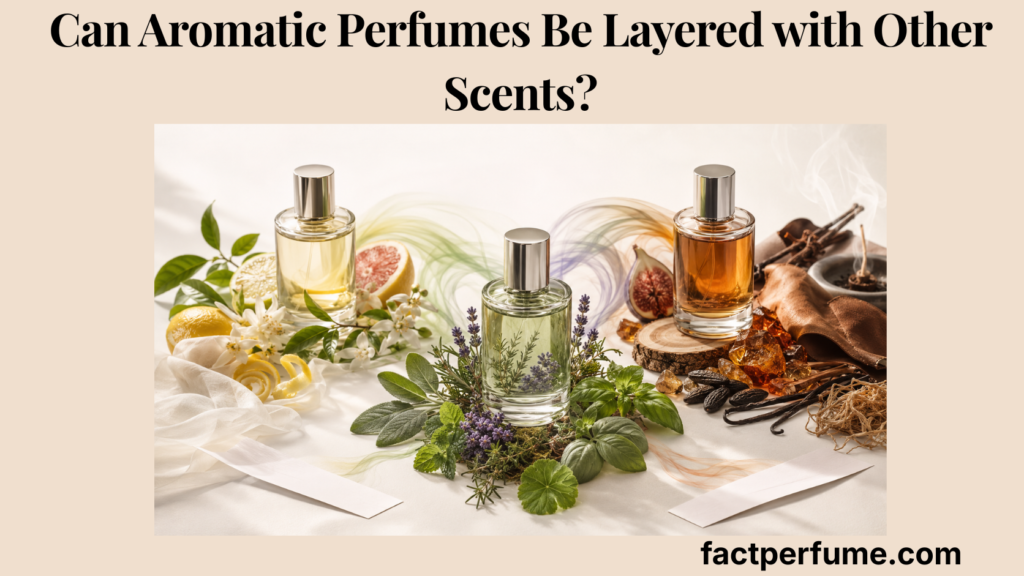
Can Aromatic Perfumes Be Layered with Other Scents?
Yes, aromatic perfumes can often be layered with other finished scents, but the best result depends on the complete structures, projection, sweetness, density, application method, wearer, and environment. Aromatic fragrances may connect with citrus, florals, woods, musk, amber, tea, green scents, selected aquatic profiles, fruit, leather, or smoke, but they are not automatically neutral foundations.
The most reliable method is to identify the aromatic perfume’s profile, choose one supporting direction, screen the pairing, select a defined layering method, and judge the complete dry-down before approving it. Amount, order, application area, product format, skin, weather, airflow, clothing, and olfactory adaptation should be treated as test variables rather than universal rules.
What Does Fragrance Layering Mean?
Fragrance layering is the deliberate use of two or more finished scented products to create a personalised combined scent.
It may involve:
- applying two perfumes to the same area;
- applying them to the same area at different times;
- placing them on separate areas of the body;
- smelling two labelled blotters together;
- pairing scented body care with perfume;
- combining finished formats such as mist, lotion, oil, EDT, or EDP.
Layering does not mean pouring two commercial fragrances into one bottle. It also does not involve modifying perfume concentrates, mixing raw aroma materials, or creating an untested homemade formula.
The goal is to compare how two finished products interact during their opening, transition, middle development, and dry-down.
What Role Can an Aromatic Perfume Play?
An aromatic perfume may contribute:
- herbal lift;
- green contrast;
- dryness;
- floral-herbal continuity;
- woody structure;
- mossy depth;
- fougère-like character;
- camphoraceous sharpness;
- botanical complexity.
Common aromatic materials and impressions include lavender, geranium, rosemary, sage, mint, basil, thyme, tarragon, spices, citrus, woods, moss, musk, and coumarin-like warmth.
The broader aromatic perfumes includes several distinct directions. One aromatic fragrance may be light and herbaceous, while another may be sweet, woody, mossy, spicy, medicinal-smelling, or strongly projecting.
This diversity is why the word “aromatic” alone cannot predict whether a pairing will work.
A dry lavender fragrance may respond differently to amber than a sweet aromatic fougère. A light mint fragrance may layer differently from a dense mossy aromatic. The complete formula matters more than the family label.
Begin With a Profile, Not a Category
Before selecting a second scent, describe the aromatic perfume in practical terms:
- Is it light or dense?
- Is it dry or sweet?
- Is it lavender-led, minty, woody, spicy, mossy, or aquatic?
- Does it project strongly?
- Does it contain citrus, amber, musk, fruit, leather, or smoke already?
- Which materials control its dry-down?
- Which quality should the second fragrance support, soften, or contrast?
This profile establishes the purpose of the experiment.
Which Scents Can Be Explored With Aromatic Perfume?
Citrus, amber, woods, musk, florals, tea, green scents, selected aquatics, fruit, leather, and smoke can all be explored with aromatic perfume, but each direction has its own benefits and risks.
These are pairing hypotheses rather than guaranteed combinations. Two fragrances belonging to apparently compatible families can still clash because of their sweetness, projection, density, bitterness, or dry-down.
Warm Contrast: Amber, Vanilla, Resin, and Tonka
Amber, vanilla, resins, tonka, and warm spices may soften dry herbs or add warmth beneath lavender, sage, rosemary, or woody aromatics.
A successful warm contrast may create:
- herbal warmth;
- resinous depth;
- rounded sweetness;
- a softer dry-down;
- a richer evening character.
The main risk is excessive density. If both fragrances already contain amber, tonka, vanilla, sweet musk, or resin, the result may become powdery, overly sweet, or indistinct.
A dry wood or tea fragrance may be a clearer alternative when amber makes the pairing too heavy.
Bright Freshness: Citrus, Green Scents, Tea, and Selected Aquatics
Citrus, green fragrance, tea, and selected aquatic profiles may increase brightness and openness.
They can create:
- crispness;
- airy freshness;
- green lift;
- botanical clarity;
- brighter herbal definition.
The combination may become too sharp when both products contain strong citrus, mint, rosemary, marine effects, or clean musks. It may also evoke soap, shampoo, mouthwash, or household products.
A soft floral-citrus fragrance may provide a smoother alternative to an intensely sharp fresh scent.
Dry Structure: Cedar, Vetiver, Sandalwood, and Mossy Woods
Dry woods can give an aromatic fragrance a more rooted and organised base.
Possible results include:
- polished dryness;
- forest-like depth;
- smoky or rooty character;
- stronger connection between herbs and the dry-down;
- reduced perceived sweetness.
The risk is austerity. Cedar, vetiver, moss, herbs, leather, and bitter citrus can reinforce one another until the fragrance feels severe or overly dry.
A clean musk may provide structure with less bitterness.
Soft Contrast: Musk, Florals, Iris, Orange Blossom, and Tea
Soft musk, light florals, iris, orange blossom, and tea may smooth sharper herbs or make a dense aromatic fragrance feel more spacious.
Possible results include:
- softer edges;
- floral transparency;
- cleaner diffusion;
- a smoother transition;
- reduced medicinal sharpness.
The combination may become soapy, powdery, or indistinct. A strong musk may also dominate rather than merely soften the aromatic perfume.
Zoning is useful when direct layering removes too much aromatic clarity.
Dark Contrast: Leather, Incense, Smoke, and Tobacco Effects
Leather, incense, smoke, and tobacco effects may add shadow and tension.
They can produce:
- resinous depth;
- darker woods;
- smoky contrast;
- an atmospheric dry-down;
- greater structural drama.
These combinations require restraint because both perfumes may be dense, bitter, dry, or strongly projecting. Direct layering can quickly become harsh or difficult to diagnose.
Zoning is generally a clearer first skin test for this direction.
Fruity Contrast: Pear, Fig, Blackcurrant, and Green Fruit
Fruit can introduce juiciness, tartness, or a contemporary contrast to herbs.
Possible directions include:
- pear with soft herbs;
- fig with dry woods or lavender;
- blackcurrant with green or mossy aromatics;
- tart citrus with rosemary or sage;
- green fruit with aquatic aromatics.
The main risks are excess sweetness, shampoo-like associations, and loss of the original aromatic identity.
A tart or green fruit is often easier to evaluate than a dense, syrupy fruit accord, but the actual fragrances still require testing.
Aromatic Profile and Pairing Matrix
| Aromatic Direction | Common Signals | Directions to Explore | Possible Result | Main Risk |
|---|---|---|---|---|
| Light herbal | Rosemary, mint, basil, thyme, citrus | Citrus, tea, green fragrance, light musk | Bright, crisp, botanical | Sharpness or functional-product association |
| Lavender aromatic | Lavender, geranium, citrus, herbs | Bergamot-style citrus, amber, iris, musk, woods | Polished, floral-herbal, warm | Powder, soapiness, generic cologne effect |
| Aromatic fougère | Lavender, coumarinic warmth, moss, woods | Dry woods, amber, citrus, florals, leather | Structured, warm, mossy | Density, sweetness, barbershop overload |
| Woody aromatic | Herbs, cedar, vetiver, patchouli | Musk, tea, citrus, light floral, fruit | Dry, polished, spacious | Wood dominance or excessive dryness |
| Spicy aromatic | Pepper, cardamom, herbs, warm woods | Citrus, tea, amber, soft florals | Lively, warm, textured | Harshness or excessive warmth |
| Aquatic aromatic | Herbs, marine effects, citrus, clean musk | Green scents, tea, woods, light fruit | Airy, fresh, modern | Shampoo, shower-gel, or hollow dry-down |
| Mossy aromatic | Herbs, moss, vetiver, patchouli, woods | Citrus, musk, tea, soft floral, incense | Forest-like, bitter, atmospheric | Muddiness, bitterness, heavy projection |
The matrix provides directions to test rather than guaranteed compatibility.
Which Fragrance-Layering Method Should Be Used?
Blotter overlap is useful for screening, zoning is usually the clearest first skin method, and direct layering creates the strongest integration but is harder to troubleshoot.
Each method answers a different question. They should not be treated as interchangeable.
Blotter Overlap
Blotter overlap means applying one fragrance to each labelled fragrance strip, smelling them separately, and then smelling their scent clouds together.
This method helps identify:
- immediate dominance;
- obvious clashes;
- excessive sweetness;
- excessive bitterness;
- likely density;
- whether the combination deserves a skin test.
Keep the perfumes on separate strips rather than spraying both on the same blotter. Separate strips allow each scent to be evaluated alone and in combination.
Blotters are preliminary screening tools. They do not reproduce skin temperature, surface lipids, product residue, movement, or personal evaporation patterns.
Zoning
Zoning means applying the two perfumes to different body areas so their scent clouds overlap without placing both products directly on the same spot.
Possible benefits include:
- greater clarity;
- easier dominance assessment;
- simpler adjustment;
- less direct interaction;
- easier identification of each perfume.
Zoning is often the most informative first skin method after blotter screening.
Its limitation is that it creates spatial overlap rather than one completely integrated skin accord. The result may smell harmonious around the wearer while remaining recognisably two separate fragrances.
Direct Layering
Direct layering means applying both finished fragrances to the same area.
Its main benefit is strong integration. The perfumes can merge into a more unified opening, heart, and dry-down.
The risks include:
- muddiness;
- one perfume dominating;
- difficulty identifying the cause of a clash;
- increased local product load;
- an overly dense dry-down.
Direct layering is best tested only after the two perfumes have been evaluated individually and screened together.
Sequential Layering
Sequential layering means applying the fragrances to the same area at different application times.
This supports a comparison of application order and avoids one immediate combined spray cloud.
It does not force the published notes of the first fragrance to develop completely before the second begins. Both products continue evaporating and interacting after application.
A fixed waiting period cannot guarantee a controlled note sequence. Consistency within the comparison matters more than a universal number of seconds.
Format Layering
Format layering combines finished formats such as:
- scented lotion with perfume;
- body oil or balm with fragrance;
- body mist with EDT or EDP;
- shower gel with perfume;
- EDT with EDP.
A format label does not establish its role automatically.
An oil may remain close to the skin or project strongly, depending on its formula. A mist may be soft or highly diffusive. An EDP does not always dominate an EDT.
The actual products must be tested.
Broader questions about placement, clothing, and projection are addressed through application techniques.
Layering Method and Format Matrix
| Method or Format | Application Pattern | Possible Benefit | Main Risk | Best Starting Use |
|---|---|---|---|---|
| Blotter overlap | One scent on each labelled strip | Low-commitment clash and dominance screening | Does not predict exact skin development | First comparison |
| Zoning | Fragrances on separate areas | Clarity and easy adjustment | Does not create one fully blended accord | First skin test |
| Direct layering | Both fragrances on the same area | Strong integration and unified dry-down | Muddiness and difficult diagnosis | After successful screening |
| Sequential layering | Same area at separate times | Tests application order | Does not control note sequence | Order comparison |
| Lotion plus fragrance | Finished scented lotion beneath or near perfume | Softer thematic background | Added scent may obscure the perfume | Simple format test |
| Body oil or balm plus fragrance | Finished oil or balm used with perfume | Closer scented layer or altered diffusion | Not automatically a longevity anchor | Controlled format comparison |
| Mist plus fragrance | Diffuse mist combined with perfume | Broad background effect | Aggregate projection may increase quickly | Zoning or light screening |
| EDT and EDP combination | Two finished perfume concentrations | Potential contrast in texture and development | Label does not predict dominance | Test the actual products minimally |
How Should Application Order and Intensity Be Compared?
Application order and intensity should be compared through minimal, repeatable trials rather than a spray ratio or a rule that the heavier perfume must go first.
No universal order applies to every perfume because concentration labels, atomisers, formula density, projection, and odour thresholds vary.
Establish Each Perfume’s Baseline
Wear each perfume alone before combining them.
Record:
- the opening;
- dominant materials;
- sweetness;
- bitterness;
- density;
- projection;
- middle development;
- dry-down;
- facets that remain recognisable later.
Without an individual baseline, it becomes difficult to determine what changed during layering.
Screen the Pair on Separate Blotters
Smell each strip alone and then together.
Ask:
- Is one immediately dominant?
- Does the combined scent become harsh?
- Do the dry-downs appear compatible?
- Does the combination become too sweet or dense?
- Is there a clear purpose for continuing?
Reject obvious clashes before full skin wear.
Begin Minimally
Use the smallest practical, label-compliant application that still permits evaluation.
This cannot be translated into one universal spray count because atomiser output, product concentration, and perfume projection vary.
Minimal application makes dominance and structural problems easier to diagnose.
Compare A Then B
Apply fragrance A first.
Allow the immediate spray cloud and prominent alcohol impression to settle consistently within the trial, then apply fragrance B.
Record the result through the complete development.
Do not assume the first fragrance will control the base or act as a foundation.
Compare B Then A
Reverse the order on another occasion.
Keep the method, environment, application areas, and general amount reasonably consistent.
Order may influence the immediate perception and local product distribution, but neither order is universally correct.
Compare Zoning With Same-Area Layering
When direct layering becomes muddy, test the same perfumes through zoning.
A combination that fails on one area may remain clear when the scent clouds overlap spatially.
This is not a failed experiment. Zoning can be the best final method for two complex perfumes.
Change One Variable at a Time
During each retest, change only one main variable:
- amount;
- order;
- application location;
- layering method;
- product format;
- pairing partner.
Changing several variables simultaneously prevents a clear diagnosis.
Avoid Rubbing During Controlled Tests
Rubbing does not need to be described as crushing perfume molecules.
It should be avoided during controlled comparisons because it changes product distribution, transfers material, alters the application area, and makes repeated trials less consistent.
Controlled Order and Intensity Framework
| Trial | Method | Variable Held Consistent | Main Question | Possible Decision |
|---|---|---|---|---|
| Each scent alone | Independent skin wear | Normal testing conditions | What does each fragrance do by itself? | Establish baseline |
| A then B | Sequential same-area test | Method and general application | Does this order preserve clarity? | Retain or compare reverse order |
| B then A | Reverse sequential test | Same products and conditions | Does the second order improve balance? | Choose clearer order |
| Zoning | Separate application areas | Same fragrance pair | Is spatial overlap clearer? | Approve zoning only |
| Direct minimal | Same-area integration | Minimal consistent application | Does a unified accord form? | Approve or reject direct layering |
| Reduced dominant fragrance | Retest with one controlled reduction | Other variables unchanged | Can the quieter perfume remain visible? | Adjust intensity or replace partner |
| Repeat trial | Same selected method on another day | Method and conditions | Is the result reproducible? | Approve or continue testing |
How Can a Failed Layering Combination Be Diagnosed?
A clashing, muddy, bitter, sweet, medicinal, or overpowering result should be diagnosed before amount, order, application area, or pairing partner is changed.
The symptom should guide the correction.
One Fragrance Appears to Disappear
Possible causes include:
- unequal projection;
- unequal application;
- one fragrance having a lower odour threshold;
- similar dry-downs merging;
- one perfume masking the other;
- olfactory adaptation.
Useful tests include:
- Smell both perfumes separately again.
- Test them through zoning.
- Reduce the apparently dominant perfume.
- Ask whether another person can still detect both.
- Repeat the test on another day.
Reduced self-perception does not prove that the quieter perfume has disappeared or that nearby people cannot smell the combination.
The Combination Becomes Muddy
A muddy effect is a dense, indistinct combination in which individual facets lose clarity.
Possible causes include:
- two highly complex fragrances;
- excessive total application;
- overlapping amber, musk, woods, or sweetness;
- similar dense bases;
- insufficient contrast;
- direct same-area application.
Possible corrections include:
- reducing total application;
- changing to zoning;
- replacing one perfume with a simpler partner;
- combining one scented body-care product with one perfume;
- choosing a partner with a more distinct texture.
Adding a third perfume usually makes diagnosis more difficult.
The Result Is Too Bitter
Bitterness may be reinforced by:
- citrus rind;
- aromatic herbs;
- moss;
- galbanum;
- vetiver;
- leather;
- smoke;
- dry woods.
Controlled corrections include:
- reducing one bitter fragrance;
- testing zoning;
- replacing one partner with soft musk, tea, floral, or smooth wood;
- comparing the fragrances alone to identify the main source.
Do not immediately add sweetness before identifying which perfume creates the problem.
The Result Is Too Sweet
Excess sweetness may come from:
- vanilla;
- tonka;
- amber;
- gourmand effects;
- sweet fruit;
- balsamic materials;
- sweet musk.
Possible corrections include:
- reducing the sweeter perfume;
- using zoning;
- selecting a drier aromatic or woody partner;
- replacing sweet fruit with tart fruit, tea, or green fragrance.
The goal is structural clarity, not simply the removal of every sweet facet.
The Combination Feels Medicinal or Harsh
Mint, rosemary, sage, lavender, eucalyptus-like effects, sharp citrus, smoke, and excessive application may reinforce medicinal sharpness.
Useful tests include:
- reducing the aromatic perfume;
- zoning the fragrances;
- testing a tea, musk, or light floral partner;
- evaluating whether the effect improves after the opening;
- rejecting the combination if it remains uncomfortable.
A medicinal impression is sensory and contextual. It should not be treated as a medical diagnosis.
The Pairing Smells Like Soap, Shampoo, or Personal Care
Possible contributors include:
- citrus;
- aquatics;
- clean musk;
- lavender;
- geranium;
- aldehydic florals;
- clean woods;
- familiar product associations.
Possible corrections include:
- blind-testing the pairing;
- reducing the cleanest fragrance;
- testing a drier, greener, or more bitter contrast;
- using zoning;
- choosing a partner with less clean musk or aquatic character.
Reject the pairing when the functional association remains unwanted.
One Fragrance Overpowers the Entire Wear
A dominating perfume may control the opening, heart, or dry-down because of projection, amount, density, or a particularly strong accord.
Do not assume EDP will always dominate EDT or that oil will always dominate spray perfume.
Test the products individually, reduce only the dominant fragrance, and repeat under the same method.
If dominance remains after reasonable adjustment, replace the pairing partner or approve zoning only.
How Do Product Format, Skin, Weather, and Clothing Affect Layering?
Product format, skin, temperature, airflow, humidity, clothing, and olfactory adaptation can change a layered fragrance, but none creates one universal performance rule.
These variables help explain why a combination may behave differently across separate trials.
Shower Gel
A scented shower gel may leave a light thematic background.
Its fragrance may fade substantially before perfume application, or it may remain noticeable enough to influence the result.
Do not assume that every shower gel is too weak to matter.
Scented Lotion
A lotion may change the application surface and contribute its own scent.
It may make a perfume seem smoother, softer, or different in diffusion, but it does not guarantee longer wear.
The lotion’s fragrance may also clash with the selected perfume pair.
Body Oil or Balm
A finished scented oil or balm may create a close scent layer or alter diffusion.
It should not automatically be treated as an anchor or fixative. The effect depends on the formula, the amount used, the perfume applied with it, and the wearer.
Body Mist
A mist may create a diffuse background across a larger area.
Broad application can increase the total scented-product load even when the mist seems individually light.
Aggregate projection should be evaluated rather than assuming mist is always weak.
EDT, EDP, and Extract
Concentration labels provide useful product information, but they do not predict every layering result.
An EDT may project more sharply than a dense EDP. An extract may remain close to the skin while another product dominates the scent cloud.
Test the actual products rather than assigning fixed performance roles.
Skin Variation
Skin may affect fragrance development through several interacting properties, including surface lipids, temperature, previous product residue, application area, and individual physical characteristics.
A primary evaporation study found that both fragrance-molecule properties and individual skin characteristics contributed to observed differences in evaporation. This supports treating blotters as preliminary screens and skin as the final personal test rather than reducing fragrance behaviour to “skin pH” alone. skin-evaporation research.
Questions about how formula architecture affects later development are explored further through composition and longevity.
Heat
Heat may increase initial diffusion and make the combined scent feel stronger.
A pairing that is comfortable in a cooler setting may become more intense in warm conditions. This does not establish one universal change in longevity.
Use restraint rather than applying extra fragrance in advance.
Cold
Cool conditions may change perceived diffusion or keep the scent closer to the wearer.
Do not assume that cold conditions automatically require additional application. The complete combination should be reassessed in that environment.
Humidity and Airflow
Humidity and airflow may alter how the scent cloud moves and how quickly the wearer or nearby people perceive it.
Strong ventilation can make a fragrance seem less noticeable to the wearer without proving that the combination has disappeared.
Clothing
Apply fragrance to clothing only when manufacturer directions permit and fabric compatibility has been considered.
Potential issues include:
- staining;
- discolouration;
- altered evaporation;
- scent remaining in fabric;
- interaction with laundry products.
Clothing does not universally extend every fragrance more successfully than skin.
Olfactory Adaptation
Olfactory adaptation can reduce the wearer’s perception after continued exposure.
Before reapplying:
- pause;
- get fresh air;
- move to another environment;
- assess the full scent cloud;
- consider whether nearby people can still detect it.
Automatic reapplication can turn a balanced layering experiment into an excessive one.
Clash and Wear-Variable Diagnostic Matrix
| Symptom or Variable | Possible Cause or Effect | Controlled Test | Correction Direction | Stop or Rejection Condition |
|---|---|---|---|---|
| One scent disappears | Projection difference, masking, merging, adaptation | Zone, smell separately, reduce dominant scent | Adjust only the dominant fragrance | Replace partner if identity remains absent |
| Muddy result | Excess amount, complexity, overlapping dense bases | Reduce total use or zone | Choose a simpler or more contrasting partner | Reject direct layering if clarity never returns |
| Excess bitterness | Herbs, rind, moss, vetiver, leather, smoke | Identify bitter source separately | Reduce source or use softer contrast | Reject if harshness remains |
| Excess sweetness | Amber, vanilla, tonka, fruit, sweet musk | Reduce sweeter perfume | Test drier wood, tea, or aromatic partner | Reject if the dry-down remains cloying |
| Medicinal harshness | Mint, sage, rosemary, lavender, citrus, excess use | Reduce aromatic scent or zone | Test soft floral, tea, or musk | Stop if discomfort develops |
| Soap or shampoo association | Aquatics, clean musk, citrus, geranium, familiarity | Blind-test and reduce cleanest fragrance | Introduce drier or greener contrast in a new trial | Reject if association remains unwanted |
| Heat | Increased initial diffusion and total intensity | Repeat with lower total application | Use minimal application or zoning | Reject for that environment if excessive |
| Clothing | Different diffusion, fabric retention, laundry-product interaction | Compare permitted skin and fabric application | Use one surface only | Stop if staining or damage appears |
| Olfactory adaptation | Reduced self-detection | Fresh air and outside confirmation | Avoid automatic reapplication | Stop adding product when projection is uncertain |
| Skin discomfort | Individual reaction or excessive local product load | Stop use rather than retesting immediately | Follow product instructions | Discontinue combination |
What Safety and Etiquette Checks Apply?
Layering should remain within product instructions, skin comfort, total projection, and the fragrance expectations of the surrounding space.
A pleasant-smelling combination is not automatically suitable for every person or environment.
Use Finished Products as Directed
Use each perfume, lotion, mist, balm, or oil according to its own label.
Do not:
- pour two perfumes into one bottle;
- modify the commercial formula;
- transfer one product’s instructions to another;
- use visibly deteriorated products;
- assume two separately sold products were safety-assessed as one combined formula.
Layering on the wearer is a consumer sensory practice, not a new commercially validated formula.
Consider Skin Condition and Comfort
Do not apply fragrance to irritated, broken, or recently damaged skin.
Stop using the combination if irritation or significant discomfort develops. Do not add another scented product in an attempt to hide the problem.
People with known fragrance allergy or sensitivity should follow their individual professional guidance rather than general layering advice.
Consider Aggregate Projection
Projection describes the outward strength of the scent near the wearer. Sillage describes the scent trail left through movement.
Layering may increase both even when each fragrance feels moderate alone.
Consider:
- perfume;
- scented lotion;
- mist;
- hair products;
- deodorant;
- laundry fragrance;
- other scented body care.
The total scented environment matters more than the strength of one product.
Follow Current Product-Safety Frameworks
IFRA maintains an industry product-stewardship framework for fragrance ingredients, but it does not personally approve every finished perfume. Its documentation currently presents the 51st Amendment as the latest complete published amendment, while consultation on the proposed 52nd Amendment closed on June 12, 2026. Consultation material should not be treated as adopted Standards. IFRA Standards.
IFRA also states that its conformity documentation does not replace a complete safety assessment or applicable national, regional, and local requirements. Responsibility remains with the companies placing products on the market.
Respect Shared Spaces
Use restraint in:
- offices;
- classrooms;
- public transport;
- restaurants;
- ceremonies;
- healthcare settings;
- close seating;
- long indoor gatherings.
Do not describe any fragrance amount as universally office-safe or crowd-safe. Actual policies and the sensitivity of nearby people vary.
Guidance on matching perfume character and projection to social occasions can help determine whether a successful private combination is appropriate publicly.
Respect Scent-Free Policies
A scented lotion, body mist, minimal application, or zoning method is not a loophole where fragrance is prohibited.
Follow the actual policy of the workplace, school, venue, healthcare facility, or event.
Test New Combinations Before Important Events
Avoid first testing a new combination immediately before:
- work;
- travel;
- formal events;
- close dinners;
- ceremonies;
- long indoor meetings.
A pairing that seems pleasant during its opening may become muddy, sweet, bitter, smoky, or strongly projecting later.
Complete-wear testing should happen in an appropriate low-stakes setting.
How Should the Final Layering Combination Be Evaluated?
Approve an aromatic layering combination only after evaluating both perfumes separately, the chosen method, the complete development, aggregate projection, comfort, and repeatability.
The final outcome should be a clear decision rather than indefinite experimentation.
Stage 1: Establish the Individual Baselines
Wear both perfumes separately.
Confirm:
- dominant facets;
- projection;
- sweetness and bitterness;
- middle development;
- dry-down;
- personal comfort.
Stage 2: Complete Blotter Screening
Use one labelled blotter for each perfume.
Smell:
- perfume A alone;
- perfume B alone;
- their scent clouds together;
- the later development of both strips.
Reject the pairing when an obvious clash or overwhelming dominance is already clear.
Stage 3: Select and Record the Method
Choose one:
- zoning;
- direct layering;
- sequential layering;
- one body-care format with one perfume.
Record the method so that the result can be repeated.
Stage 4: Evaluate the Opening
Ask:
- Can both perfumes still be identified?
- Is one already dominant?
- Is the combined opening harsh?
- Is the total projection excessive?
- Does the pairing have a clear purpose?
Stage 5: Evaluate the Transition
Ask:
- Does citrus connect with herbs?
- Do florals or woods provide a bridge?
- Has the scent become muddy?
- Has sweetness or bitterness increased?
- Does one perfume vanish too quickly from perception?
- Does the combination evoke an unwanted functional product?
Stage 6: Evaluate the Middle Development
Ask:
- Does the combination have a recognisable identity?
- Are the aromatic facets still clear?
- Has one fragrance taken complete control?
- Is projection appropriate?
- Could olfactory adaptation be affecting the judgement?
Stage 7: Evaluate the Dry-Down
Ask:
- Which perfume controls the base?
- Are the woods, musk, amber, moss, leather, or smoke compatible?
- Does the aromatic identity transform acceptably?
- Is the combined dry-down more satisfying than either perfume alone?
- Does the pairing remain comfortable?
Stage 8: Repeat the Strongest Result
Repeat the selected method on another day using reasonably consistent minimal application and an appropriate environment.
A result should be reproducible before it is approved.
Stage 9: Record the Final Decision
Choose one outcome:
- approve direct layering;
- approve sequential layering;
- approve zoning only;
- approve one scented body-care format with one perfume;
- reduce one fragrance;
- replace the pairing partner;
- reject the combination.
Rejecting a pairing is a successful outcome when repeated testing shows that it remains muddy, excessive, uncomfortable, or unclear.
Safety, Etiquette, and Final QA Checklist
- I used finished products according to their labels.
- I did not mix the products inside a bottle.
- The application area was not irritated or damaged.
- I began with minimal application.
- I understood both perfumes separately.
- I completed a separate-blotter screen.
- I selected and recorded one layering method.
- I confirmed the result on skin.
- I compared order only as a test variable.
- I did not use a universal spray ratio.
- I evaluated the opening, transition, middle, and dry-down.
- I considered total projection and sillage.
- I considered olfactory adaptation before reapplying.
- I checked the actual policy of the setting.
- I understood that discomfort requires stopping.
- I repeated the clearest result.
- I recorded an approval, adjustment, zoning, replacement, or rejection decision.
Frequently Asked Questions
Yes. Aromatic perfumes can often be layered with citrus, florals, woods, musk, amber, tea, green scents, selected aquatics, fruit, leather, or smoke, but success depends on the complete fragrances and the testing method.
Zoning is usually the clearest first skin method after separate-blotter screening because each perfume remains easier to identify and adjust while their scent clouds overlap.
No. Application order is a test variable. Compare A then B and B then A on separate occasions while keeping the method and general conditions reasonably consistent.
No. Layering means using finished products on separate blotters, body areas, application times, or formats. Do not pour two commercial fragrances into one bottle or modify their formulas.
Muddiness may result from excessive total application, two complex fragrances, overlapping dense bases, similar amber, musk, wood, or sweet effects, or direct same-area application.
Approve it only after understanding both perfumes alone, screening them on separate blotters, selecting a defined method, evaluating the complete development, considering projection and comfort, and repeating the clearest result.
Building an Aromatic Layer That Still Feels Clear
Aromatic perfumes can be layered successfully when the combination preserves clarity, creates intentional contrast or continuity, develops comfortably, and remains appropriate for the surrounding space. Aromatic fragrances are diverse, so family names provide directions to explore rather than proof of compatibility.
Begin by identifying the aromatic profile and selecting one supporting finished scent. Screen the perfumes on separate blotters, use zoning as the clearest first skin method, and test direct layering only when greater integration is useful. Apply minimally, compare application order rather than following a universal rule, and change one variable during each retest.
Blotters provide preliminary information, while skin confirms personal development. Lotion, oil, balm, mist, EDT, and EDP have no fixed dominance or longevity roles. Rubbing is avoided for consistency rather than because it crushes molecules, and reduced self-perception should not trigger automatic reapplication.
The final decision should reflect complete development, comfort, repeatability, aggregate projection, and the requirements of the setting. Approve the clearest method, adjust one variable when the cause is identifiable, use zoning when direct integration becomes muddy, and reject any combination that remains excessive, unclear, or uncomfortable.