
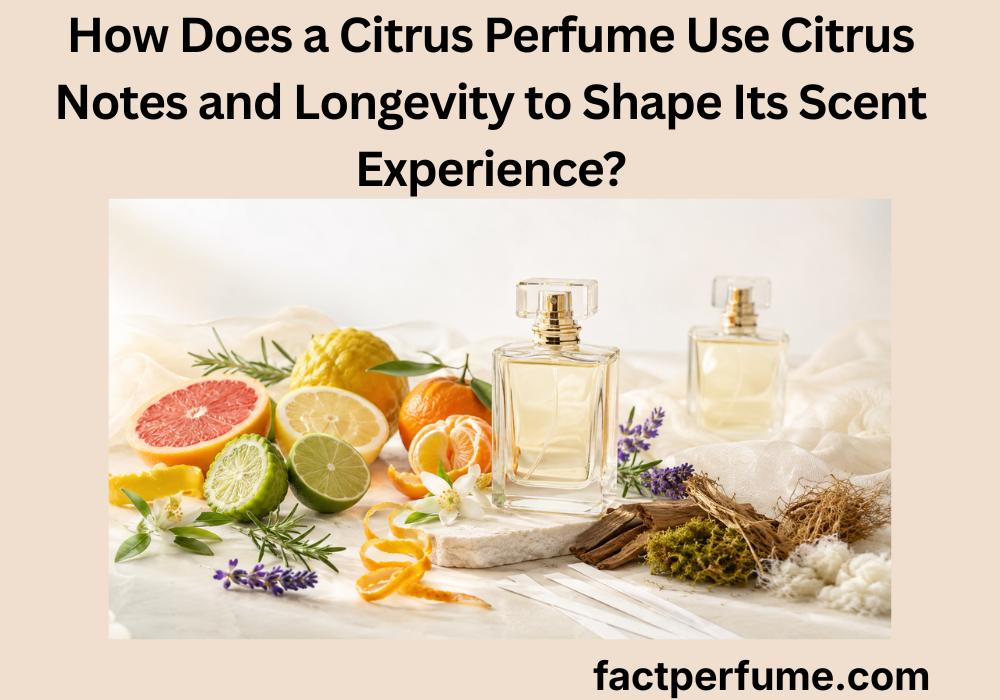
How Does a Citrus Perfume Use Citrus Notes and Longevity to Shape Its Scent Experience?
Citrus perfumes often feel brightest near the opening, but the fading of an obvious lemon, bergamot, lime, grapefruit, or mandarin impression does not necessarily mean the complete fragrance has disappeared. Citrus oils are complex mixtures, opening perception depends on several physical and sensory variables, and deeper aromatic, floral, woody, musky, mossy, or ambered structures may remain after the clearest fruit-peel character changes.
The clearest way to judge citrus perfume performance is to separate citrus-note persistence, freshness continuity, and whole-perfume longevity. That distinction helps explain why citrus is often prominent early, how evaporation differs from oxidation, how later structures can reinterpret freshness, why skin and other surfaces matter, how climate and olfactory adaptation change perception, and when reapplication is actually justified.
Educational note: This article explains the wear and evaluation of finished commercial fragrances. Do not apply raw citrus oils or infer raw-material safety from a citrus note name. Use fragrance products according to their directions, avoid irritated or damaged skin, and treat fabric application cautiously because fragrance formulas and garments vary.
What Is the Difference Between Citrus-Note Persistence, Freshness Continuity, and Whole-Perfume Longevity?
Citrus-note persistence tracks recognisable citrus, freshness continuity tracks the broader fresh impression after citrus transforms, and whole-perfume longevity tracks how long the complete fragrance remains perceptible.
These are three related but different parts of the scent experience. Treating them as one measurement is a major reason citrus perfumes are sometimes described as having “disappeared” when their character has actually shifted into another stage.
Citrus-Note Persistence
Citrus-note persistence asks whether the wearer can still clearly identify a literal citrus-like effect.
That might include:
- lemon peel;
- bergamot;
- lime;
- grapefruit pith;
- mandarin;
- orange rind;
- bitter peel;
- a floral-citrus impression.
A citrus family may begin with an unmistakable fruit impression and gradually lose that literal identity as other facets become more noticeable.
If the lemon-like quality becomes quieter while woods and musk remain, the citrus note has changed before the perfume as a whole.
Freshness Continuity
Freshness continuity asks a different question: does the perfume still feel bright, green, airy, aromatic, clean, sparkling, floral-citrus, or dry-fresh after the obvious fruit impression softens?
This sense of freshness can continue through materials or accords that are not themselves literal citrus notes.
Examples may include:
- lavender;
- rosemary;
- geranium;
- neroli;
- transparent florals;
- bitter woods;
- vetiver;
- green effects;
- clean or airy musks.
A wearer may no longer identify lemon clearly but still experience the perfume as fresh because the later structure echoes some of its brightness or dryness.
Whole-Perfume Longevity
Whole-perfume longevity concerns the entire fragrance.
After the citrus opening changes, the perfume may remain perceptible through:
- aromatic herbs;
- florals;
- cedar or other woods;
- vetiver;
- mossy effects;
- musks;
- amber;
- warm or dry base structures.
A more accurate description is therefore:
The citrus opening changed earlier while the complete perfume remained detectable later.
That statement separates literal citrus persistence from the complete wear experience.
Three-Layer Citrus Longevity Matrix
| Measurement | Core Question | Example | Does Not Prove |
|---|---|---|---|
| Citrus-note persistence | Can I still identify citrus? | Bergamot or lemon peel remains recognisable | Total perfume longevity |
| Freshness continuity | Does the perfume still feel fresh? | Herbs, florals, vetiver, or musk continue brightness | Original citrus remains unchanged |
| Whole-perfume longevity | Is the complete fragrance still perceptible? | Woody, musky, mossy, or ambered dry-down remains | Citrus lasted equally long |
Citrus perfume often begins with a vivid peel-and-fruit impression, while the complete formula already contains aromatic, floral, woody, and musky structures that shape what follows.
Why Are Citrus Effects Often Most Noticeable Near the Opening?
Citrus is often prominent early because many citrus-related constituents contribute readily to the headspace, but perception depends on volatility, vapour pressure, odour threshold, concentration, formula, skin, and environment.
It is therefore too simple to say that citrus is noticed first only because its molecules are “small” or because all citrus materials evaporate at the same rate.
Citrus Oils Are Complex Mixtures
Bergamot, lemon, lime, grapefruit, mandarin, and sweet orange oils contain multiple constituents.
A citrus oil does not have one universal molecular weight, one evaporation rate, or one scent molecule.
Even when limonene is abundant, the complete odour also reflects other components that may contribute:
- floral nuances;
- bitterness;
- peel texture;
- sweetness;
- juiciness;
- green character;
- waxy rind;
- pith;
- characteristic trace effects.
This is why a list of citrus notes describes sensory ideas rather than revealing the exact technical composition of a perfume.
Limonene Is One Molecule, Not an Entire Citrus Oil
Limonene occurs widely in citrus materials and can contribute a recognisable terpenic citrus-peel effect.
It is still only one molecule.
A complete orange, lemon, grapefruit, or mandarin oil may smell richer and more nuanced because many constituents interact. A communicated orange note might also be a reconstructed accord rather than natural orange oil.
The appearance of “orange” or “lemon” on a note pyramid therefore does not reveal the exact material used.
Volatility Matters, but It Is Not the Whole Explanation
Volatility refers to a material’s tendency to enter the vapour phase under defined conditions.
Many citrus-related substances contribute strongly to the vapour surrounding freshly applied perfume, which can make the opening feel:
- bright;
- sparkling;
- juicy;
- sharp;
- airy;
- pithy;
- zesty.
But volatility alone cannot predict exactly how long a citrus impression remains recognisable.
Vapour Pressure Also Matters
Vapour pressure is another physical property related to how readily a substance contributes to the gas phase under particular conditions.
Higher vapour-phase availability can influence the initial scent cloud, but perfume contains interacting materials rather than isolated molecules under laboratory conditions.
Solvent, formula composition, application surface, temperature, and other materials all affect the final sensory result.
Odour Threshold Changes What We Notice
Odour threshold concerns the amount of a substance needed before its smell becomes detectable under defined conditions.
A small quantity of one material may produce a strong sensory impression, while a larger amount of another may be less obvious.
This helps explain why physical presence and perceived strength are not always the same thing.
The strongest-smelling material at one stage is not necessarily the material present in the largest amount.
Formula Context Shapes Citrus Perception
Citrus may be surrounded by:
- additional citrus materials;
- lavender;
- herbs;
- flowers;
- green effects;
- woods;
- musk;
- vetiver;
- moss;
- amber.
These materials can sharpen, soften, mask, transform, or echo the citrus character.
For example, bergamot beside lavender and geranium can feel floral-aromatic, while lemon beside rosemary may feel sharper and more herbal. Mandarin over soft musk can become smoother, while grapefruit beside vetiver may emphasise bitterness and dryness.
This is one reason citrus top notes should be understood as part of a complete formula rather than as substances following one universal evaporation clock.
How Is Citrus Evaporation Different From Citrus Oxidation?
Evaporation is normal physical fragrance release into the air, whereas oxidation is a chemical transformation caused by exposure to oxygen.
The two processes should not be used interchangeably when explaining citrus perfume development.
Evaporation Is Part of Normal Wear
During wear, fragrance materials move from the applied perfume into the surrounding air.
This process can be influenced by:
- volatility;
- vapour pressure;
- formula structure;
- surface;
- temperature;
- airflow;
- other materials in the perfume.
As the relative contribution of different components changes, the wearer experiences fragrance development.
An opening can therefore become less citrus-dominant without anything having gone wrong with the perfume.
Oxidation Is Chemical Change
Oxidation involves chemical reactions with oxygen.
In citrus-related materials, compounds such as limonene can form oxidation products over time. Some oxidised products, including certain hydroperoxides, are relevant to sensitisation research.
That is a deterioration and safety issue, not the ordinary explanation for why a citrus opening changes during normal wear.
What Oxidation May Mean for a Finished Fragrance
Consumers do not need to diagnose raw-material chemistry at home.
Instead, unusual changes in a finished product can justify checking:
- product age;
- storage conditions;
- exposure to heat;
- prolonged light exposure;
- whether the bottle was left poorly closed;
- unusual changes in odour;
- visible deterioration.
Normal development from citrus into woods, florals, herbs, or musk should not automatically be described as oxidation.
Which Fragrance Structures Can Keep a Citrus Perfume Feeling Fresh?
Aromatic herbs, florals, sheer woods, musks, vetiver, mossy effects, and other structures can continue or reinterpret freshness after obvious citrus changes.
These later materials do not “lock” lemon, bergamot, or lime onto the skin. Instead, they can preserve related sensory qualities such as dryness, brightness, greenness, bitterness, cleanliness, or spaciousness.
Transparent Woods
Cedar and sheer woody effects can carry the fragrance into a dry, spacious stage.
Iso E Super-type woody effects may contribute smoothness, fullness, woody transparency, and an amber-wood character.
That can make the fragrance continue to feel open and dry after the literal fruit impression softens.
This should not be described as Iso E Super fixing citrus. A substantive woody material remaining later does not prove that it preserved an early citrus molecule unchanged.
Musks
Musks can produce very different effects because “white musk” is not one universal material.
Depending on the formula, musk may contribute:
- softness;
- diffusion;
- clean texture;
- skin-like warmth;
- airy continuity.
A clean musky dry-down may make a citrus perfume continue to feel fresh even after the wearer can no longer identify the original lemon or mandarin.
This is freshness continuity, not literal citrus persistence.
Vetiver
Vetiver may contribute:
- dry greenness;
- rooty texture;
- bitterness;
- woody freshness;
- earthy structure.
It can connect citrus bitterness with the later woody dry-down particularly well.
Vetiver does not trap lemon or prevent a citrus oil from changing. It introduces related dry and green sensory cues that can keep the whole composition feeling crisp.
Mossy Effects
Mossy effects may add:
- bitter-green depth;
- shaded dryness;
- forest character;
- earthy contrast.
A bright citrus opening over a mossy base can create a strong transition from luminous to darker green freshness.
The later moss does not prove that citrus itself persisted for the full wear.
Aromatic Herbs
Lavender, rosemary, sage, and geranium can continue botanical brightness after the fruit-peel stage becomes quieter.
Aromatic herbs may retain:
- freshness;
- bitterness;
- green character;
- herbal sharpness;
- dry cleanliness.
This can make a citrus-forward perfume feel continuously fresh even when its citrus identity has transformed.
Floral-Citrus Bridges
Neroli, orange blossom, and luminous jasmine-like floral effects can create another form of continuity.
The opening might feel distinctly citrusy, then move toward:
- floral brightness;
- orange-flower freshness;
- airy floral diffusion;
- green-floral character.
The citrus has not necessarily remained unchanged; the floral heart carries part of its brightness forward.
Ambered Structures Transform Rather Than Extend Citrus
Vanilla, resins, warm woods, and amber effects may create a citrus-to-warm transformation.
A bright mandarin or bergamot opening might gradually become warmer, sweeter, or more resinous.
That is a legitimate perfume development, but it should not be described automatically as extending the literal citrus note.
For more detailed structural differences among bergamot and petitgrain roles, it is useful to compare peel brightness with leafy, bitter, and transitional effects.
Citrus Opening and Structural Continuity Matrix
| Citrus Profile | Early Impression | Supporting Direction | Possible Later Effect | Limitation |
|---|---|---|---|---|
| Bergamot | Floral, bitter, zesty | Lavender, geranium, neroli, woods | Floral-aromatic brightness and dry freshness | Later brightness does not prove bergamot remains unchanged |
| Lemon | Sharp, peel-like, bright | Herbs, florals, musk, dry woods | Crisp or clean continuity | Supporting notes do not trap lemon |
| Grapefruit | Bitter, pithy, juicy | Vetiver, greens, aromatic herbs | Dry, bitter-green freshness | Later bitterness may come from other materials |
| Mandarin | Soft, juicy, rounded | Florals, musk, woods | Smooth fruity-floral transition | Sweetness may replace obvious citrus identity |
| Lime | Tart, penetrating, green | Petitgrain, mint, woods, herbs | Green, leafy, aromatic transition | Leafy freshness is not literal lime persistence |
| General citrus brightness | Sparkling, airy | Musk, florals, woods, aromatics | Continued luminosity or clean freshness | Overall freshness and citrus persistence are different measurements |
Freshness can continue after literal citrus softens because herbs, florals, vetiver, woods, and musk can echo brightness, dryness, greenness, or cleanliness without preserving the original citrus unchanged.
How Do Skin and Application Conditions Affect Citrus Perfume?
The same citrus fragrance can develop differently between wearers because skin is a variable application surface rather than a fixed environment.
Fragrance behaviour should therefore not be explained through one vague idea such as “skin chemistry” or through skin pH alone.
Skin Is a Complex Surface
Relevant variables may include:
- surface condition;
- barrier characteristics;
- hydration;
- lipids;
- temperature;
- previous cosmetic residue;
- application area.
A primary study examining fragrance-molecule evaporation on human volunteers found that both intrinsic molecular characteristics and measured skin properties contributed to differences in evaporation. skin evaporation research
The research supports a multi-variable interpretation rather than a universal oily-skin-versus-dry-skin rule.
Moisturiser Is an Application Variable, Not a Guarantee
An unscented moisturiser may be compared as an application variable.
It changes the surface on which the finished fragrance is applied and may affect how the perfume behaves for a particular wearer.
That does not justify a universal claim that moisturiser always adds a specific amount of longevity.
The effect should be evaluated through repeatable wear comparison.
Occlusive Products Do Not “Lock” Perfume
If a finished balm or another occlusive product is used according to its directions, it may change the application surface.
That is different from proving that it traps fragrance molecules or guarantees longer wear.
Petroleum jelly, balm, lotion, and body oil should therefore not be presented as universal longevity hacks.
Application Area Changes Wear Conditions
Different areas may experience different amounts of:
- washing;
- rubbing;
- clothing contact;
- movement;
- sweat;
- heat;
- airflow.
There is no need to create a universal pulse-point hierarchy.
An application area that works well for one wearer or product may not produce the same result with another.
Avoid Rubbing During Controlled Comparison
The claim that rubbing “crushes fragrance molecules” should be avoided.
During controlled evaluation, rubbing is better avoided because it changes how the product is distributed, transfers fragrance across the surface, and makes comparisons less repeatable.
The reason is test consistency, not molecule destruction.
How Do Blotters, Skin, and Clothing Change Citrus Development?
Blotters, skin, and fabric are different fragrance-release environments, so performance on one surface cannot be automatically transferred to another.
Each surface answers a different evaluation question.
Blotters Provide a Controlled Reference
A fragrance blotter is especially useful for:
- establishing a baseline;
- comparing two fragrances;
- studying the opening;
- following formula development without personal skin variables.
Blotter testing is useful precisely because the surface is different from human skin.
It should not be treated as a prediction of exactly how the fragrance will perform on the wearer.
Skin Provides Personal-Wear Confirmation
Skin introduces individual physiological variables and real-world body temperature.
It is the more relevant surface when the reader wants to know:
- how the fragrance develops personally;
- whether the dry-down is enjoyable;
- how noticeable it feels during wear;
- whether the citrus-to-base transition works on them.
One person’s result should still not be universalised to every wearer.
Fabric Is a Separate Surface
Fabric may absorb and release fragrance differently from both blotter and skin.
Possible differences include:
- absorption into fibres;
- altered release;
- lower interaction with skin lipids;
- different surface temperature.
However, fabric introduces its own risks:
- staining;
- colour changes;
- fabric damage;
- incompatibility with particular fragrance formulas.
Only consider fabric application when the finished product’s directions allow it and the garment is suitable.
Clothing should not be promoted as a guaranteed method for adding a fixed amount of wear.
How Does Hot Weather Affect Citrus Perfume Performance?
Warm conditions can influence fragrance release and diffusion, but hot weather does not create one predictable citrus-longevity result.
Climate affects both physical release and human perception, so it should be treated as one part of the larger wear environment.
Heat Can Intensify the Opening
Warmer conditions may increase initial diffusion and create:
- a brighter early scent cloud;
- stronger perceived projection;
- faster-feeling transition into later facets.
This can make a citrus perfume seem especially vivid at first.
It does not prove that every citrus fragrance will disappear faster or last for one predictable duration in summer.
Sweat and Movement Add More Variables
Body movement and perspiration can change how fragrance is released and perceived.
The wearer may experience changes in:
- diffusion;
- scent-cloud movement;
- comfort;
- how frequently the application area is disturbed.
Again, no one outcome applies to every perfume.
Humidity Should Not Be Treated as a Longevity Formula
Humidity is part of the environment, but it does not guarantee longer or shorter fragrance performance.
Formula, skin, temperature, airflow, application, and personal perception still matter.
Airflow Can Change What Reaches the Nose
Wind, fans, air conditioning, outdoor movement, and enclosed indoor spaces change how fragrance moves through the air.
A wearer may perceive less perfume in strong airflow because the scent cloud is being dispersed differently.
That does not automatically mean the perfume has vanished from the surface.
Do Not Automatically Apply More Fragrance in Heat
Before applying additional fragrance, consider:
- how strongly it is currently projecting;
- whether citrus changed but the dry-down remains;
- whether the wearer has adapted;
- how close other people are;
- the setting.
A perfume that seems less noticeable to the wearer may still be projecting clearly around them.
Skin, Surface, and Climate Matrix
| Variable | Possible Influence | Useful Comparison | Limitation |
|---|---|---|---|
| Skin properties | May alter release and retention of different materials | Repeat wear under similar conditions | Individual result is not universal |
| Moisturiser | Changes application surface | Compare with and without the same unscented product | No guaranteed longevity increase |
| Application area | Changes washing, friction, heat, and movement | Use consistent areas between tests | No universally superior point |
| Blotter | Provides controlled reference development | Compare perfumes side by side | Not equivalent to skin |
| Fabric | Different absorption and release | Compare only if product and fabric allow | Staining or damage risk; no guarantee |
| Temperature | May change initial diffusion and transition | Compare cooler and warmer wear | No universal citrus-fade rule |
| Humidity | May alter perceived scent environment | Record conditions during repeat tests | Does not predict longevity alone |
| Airflow | Changes scent-cloud movement | Compare sheltered and ventilated settings | Lower self-detection may not equal disappearance |
When Should You Reapply a Citrus Perfume?
Reapply only after deciding that the whole fragrance is genuinely weak rather than assuming it disappeared because the citrus opening changed or your nose adapted.
Reapplication should follow evaluation rather than a fixed clock.
Olfactory Adaptation Can Mimic Poor Longevity
Olfactory adaptation is reduced awareness after continuing exposure to an odour.
A wearer may gradually notice their own perfume less even while other people can still detect it.
This is especially relevant when the fragrance is applied near the nose or worn continuously for long periods.
Reduced self-detection therefore does not prove complete fragrance disappearance.
Check the Dry-Down Before Adding More
Before reapplying:
- Stop repeatedly smelling the application area.
- Move into fresh air or a different environment.
- Reassess later.
- Check whether woods, musk, herbs, vetiver, florals, moss, or amber remain.
- Consider the perfume’s current projection.
- Consider the surrounding space.
This separates the loss of citrus identity from actual low whole-perfume longevity.
Setting Matters
Additional fragrance increases the total scented-product load.
Reapplication should only be considered when:
- the complete perfume is meaningfully faint;
- the product directions allow it;
- the setting permits additional fragrance;
- stronger projection remains appropriate.
Avoid automatic reapplication in close indoor spaces simply because the wearer has stopped noticing the opening.
Discomfort Is a Stop Signal
If a finished fragrance causes irritation or significant discomfort, stop use rather than applying more.
The purpose of a longevity assessment is to understand the scent experience, not to override product comfort or safety considerations.
Current technical safety requirements for fragrance ingredients are maintained through IFRA’s published documentation; the site currently continues to list the 51st Amendment as the latest complete documentation while the 52nd Amendment process is still pending formal notification. IFRA Standards
Reapplication Decision Matrix
| Observation | Possible Explanation | Recommended Response |
|---|---|---|
| Citrus disappeared but woods or musk remain | Citrus-note persistence ended before whole-perfume longevity | Do not treat the fragrance as fully gone |
| Wearer smells little but others still detect perfume | Olfactory adaptation or lower self-perception | Avoid automatic reapplication |
| No scent is meaningfully detectable after fresh-air reassessment | Whole perfume may genuinely be faint | Consider reapplication only if directions and setting permit |
| Opening feels unusually intense in heat | Greater early diffusion or environmental effect | Assess projection before adding more fragrance |
| Irritation or discomfort occurs | Product is not comfortable for current use | Stop use rather than reapply |
How Should Citrus Perfume Longevity Be Evaluated Accurately?
Evaluate citrus perfume through repeatable sensory stages rather than fixed top-, heart-, and base-note clock times.
A structured wear test makes it easier to identify exactly what changed.
Stage 1: Record the Baseline
Before evaluating, record:
- the perfume;
- concentration label;
- test surface;
- environment;
- application approach.
The purpose is not laboratory precision. It is to make repeated wear reasonably comparable.
Stage 2: Evaluate the Opening
Describe what is actually noticeable:
- lemon;
- bergamot;
- grapefruit;
- lime;
- mandarin;
- orange;
- peel;
- juice;
- pith;
- bitterness;
- sharpness;
- initial projection.
Do not begin by predicting how long those facets “should” last.
Stage 3: Follow the Early Development
Ask:
- Is citrus still dominant?
- Which supporting notes are becoming clearer?
- Is brightness still present?
- Has the perfume become greener, more floral, or more aromatic?
- Is the transition coherent?
This stage often reveals that literal fruit identity and general freshness do not disappear together.
Stage 4: Evaluate the Middle of the Wear
Assess:
- herbs;
- florals;
- woods;
- musk;
- vetiver;
- moss;
- amber;
- freshness continuity;
- projection.
A citrus perfume may no longer smell distinctly lemony while still maintaining a clear bright or dry-fresh character.
Stage 5: Evaluate the Later Dry-Down
Ask:
- What remains?
- Is the dry-down connected to the opening?
- Is the complete perfume still meaningfully noticeable?
- Can literal citrus still be identified?
- Has freshness transformed into wood, musk, aromatic herbs, or amber?
These questions describe scent development more accurately than an arbitrary top-heart-base timetable.
Stage 6: Identify the Personal End Point
The personal end point is the stage at which the complete fragrance is no longer meaningfully perceptible to the wearer after reasonable consideration of temporary olfactory adaptation.
No one universal number should be attached to this point.
It depends on the perfume, wearer, surface, environment, application, and method of evaluation.
Stage 7: Repeat the Wear
Repeat on another day using:
- a similar application approach;
- the same general test surface;
- a reasonably known environment.
One wear can be influenced by weather, activity, expectation, adaptation, or unusual circumstances.
Repeat testing makes the judgement more useful.
Stage 8: Record Three Different Results
Do not record just “longevity.”
Record:
Citrus-note persistence: brief, moderate, or comparatively sustained under the tested conditions.
Freshness continuity: whether the fresh character drops with the citrus, continues through herbs and florals, or survives through dry woods, vetiver, and musk.
Whole-perfume longevity: relatively short, moderate, or comparatively extended under the conditions tested.
The three results may be very different.
A useful citrus wear test follows the fragrance from opening to dry-down, compares surfaces consistently, and records citrus persistence, freshness continuity, and whole-perfume longevity as separate outcomes.
Final Citrus Longevity QA Checklist
Frequently Asked Questions
Separate citrus-note persistence, freshness continuity, and whole-perfume longevity. Citrus can stop smelling clearly like lemon or bergamot while the fragrance still feels fresh or remains detectable through woods, musk, herbs, florals, moss, vetiver, or amber.
No. A citrus opening may change before the complete fragrance ends. Later aromatic, floral, woody, musky, mossy, or ambered structures can remain clearly perceptible after the literal fruit-peel impression softens.
No. Evaporation is normal fragrance release into the air during wear. Oxidation is chemical change caused by oxygen exposure and is a deterioration and safety issue rather than the ordinary explanation for top-note development.
Not automatically. These structures can continue dryness, brightness, greenness, cleanliness, or spaciousness after citrus transforms, but their later presence does not prove that the original citrus material remained unchanged.
No. Warm conditions can intensify early diffusion and change the perceived transition, but formula, skin, airflow, humidity, application, movement, and perception all affect the result. There is no universal hot-weather citrus rule.
Reapply only after checking that the whole fragrance is genuinely faint, not simply because the citrus opening changed or olfactory adaptation reduced self-detection. Product directions and the surrounding setting should also permit additional fragrance.
Citrus Longevity Is More Than How Long the Opening Lasts
Citrus perfume performance is best understood by separating how long citrus stays recognisable, how long freshness continues, and how long the complete fragrance remains detectable. A lemon, bergamot, lime, grapefruit, mandarin, or orange effect may become quieter while aromatic herbs, florals, woods, vetiver, musk, moss, or amber remain clearly perceptible.
Citrus oils are complex mixtures rather than single molecules, and their behaviour cannot be predicted from molecular weight alone. Opening perception depends on volatility, vapour pressure, odour threshold, formula structure, surface, wearer, environment, and perception. Normal evaporation should also be distinguished from oxidation, which is a chemical deterioration process rather than the ordinary explanation for top-note development.
Supporting woods, musks, herbs, vetiver, mossy effects, and florals can transform or echo freshness, but they do not freeze the original citrus opening. Skin, blotter, and fabric are different surfaces; temperature and airflow can change diffusion; and olfactory adaptation can make a detectable fragrance seem quieter to its wearer.
The most useful evaluation therefore follows the fragrance from opening through transition and dry-down, separates citrus loss from perfume loss, accounts for the wearer and environment, checks adaptation before reapplication, repeats the wear test, and records citrus-note persistence, freshness continuity, and whole-perfume longevity as three distinct outcomes.