
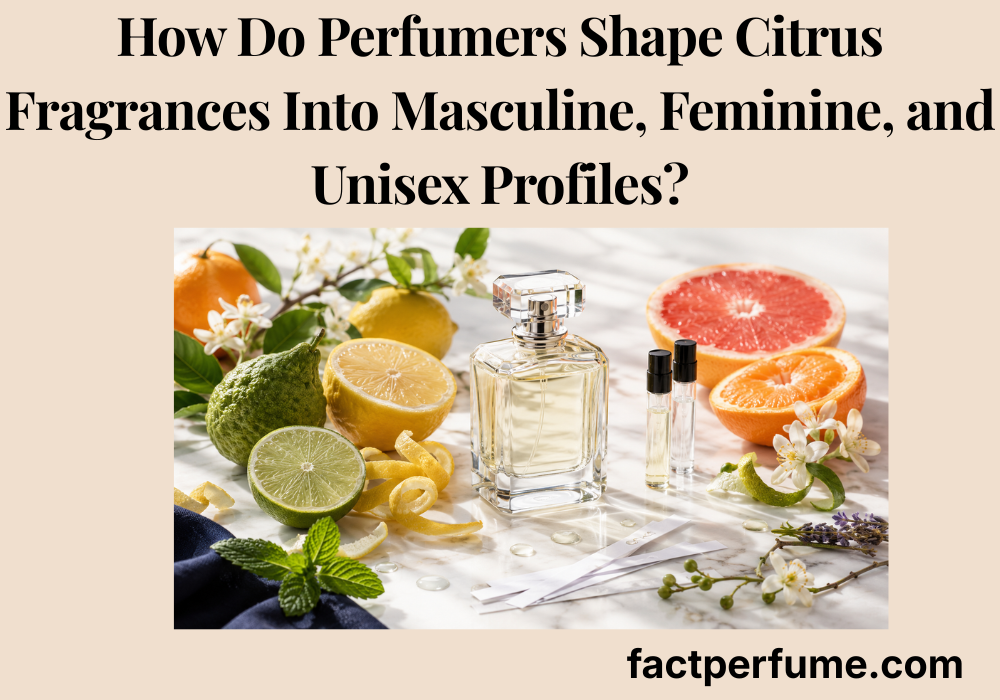
How Do Perfumers Shape Citrus Fragrances Into Masculine, Feminine, and Unisex Profiles?
Citrus materials such as Bergamot, Lemon, Lime, Mandarin, Orange, and Grapefruit are not inherently masculine or feminine; their gendered impression comes from the larger fragrance structure built around them. Aromatics, florals, woods, musks, sweetness, green character, and the balance between these elements can all redirect the character of a Citrus fragrance.
Perfumers can move the same bright Citrus opening toward traditionally masculine, traditionally feminine, or unisex territory by changing the relative balance of supporting accords, the way the fragrance develops, the dry-down, and the cultural fragrance conventions the finished composition resembles. Understanding those layers makes it easier to compare Citrus profiles and choose by scent style rather than by a gender label alone.
Why Do Citrus Notes Not Have an Inherent Gender Profile?
Bergamot, Lemon, Lime, Mandarin, Orange, and Grapefruit can contribute fresh, zesty, tart, juicy, bitter, green, or aromatic effects, but none of those scent materials possesses an inherent gender.
A Lemon accord may emphasize piercing freshness and tartness, while Mandarin can feel softer or juicier. Grapefruit may introduce bitterness, and Bergamot can combine bright Citrus freshness with green, aromatic, or floral-adjacent nuances. These are descriptions of smell, not gender properties.
The same materials therefore appear throughout the Citrus family in fragrances traditionally marketed as masculine, traditionally marketed as feminine, and positioned as unisex.
The important distinction is ingredient ≠ profile. A Citrus note provides part of the olfactory material, while the complete Citrus fragrance profile emerges from how that material interacts with everything surrounding it.
The material itself has no inherent gender, although particular Citrus fragrance styles can acquire cultural and marketing associations.
How Do Supporting Accords Change the Gendered Impression of a Citrus Fragrance?
Perfumers change the perceived style of a Citrus fragrance mainly by altering the architecture around the Citrus rather than by assigning gender to the Citrus material itself.
The first question is what kind of Citrus opening leads the fragrance. It may be juicy, bitter, green, sharp, soft, sparkling, or aromatic. That opening establishes the initial character, but it does not determine the complete profile.
As the fragrance develops, its supporting accords become more important. Aromatic herbs may introduce herbal dryness. Florals can increase luminosity or floral volume. Woods can create dryness, depth, or structure. Musks may add softness and texture. Green notes can make the composition more botanical or bitter, while sweetness can round sharp Citrus edges.
The wider range of Citrus pairings therefore matters because supporting materials can complement, contrast with, or redirect the original Citrus impression.
Relative balance matters as much as the ingredients themselves. Lavender, Rose, Cedar, Musk, or Vanilla can function very differently depending on how dominant they are, what surrounds them, and what remains noticeable in the dry-down.
This also explains why context matters. Research on scent labeling has found that describing the same neutral scent with feminine or masculine information can influence how its gender character is perceived, although the study did not find a corresponding difference in fragrance preference. This supports treating gender coding as partly contextual rather than as a biological property of the fragrance itself. Frontiers study.
The Citrus material remains the starting point, while aromatic, floral, woody, green, musky, or sweet surroundings can redirect the complete fragrance profile.
What Does Classic Eau de Cologne Show About Citrus Fragrance Structure?
Classic Eau de Cologne provides useful historical context because it developed as an important light Citrus-aromatic fragrance structure whose history does not map neatly onto the modern shorthand “men’s cologne.”
Traditional Cologne structures have commonly centered bright Citrus materials such as Bergamot and Lemon alongside aromatic or herbal facets and, in important historical formulations, materials such as Neroli or Rosemary. The result is a light, fresh structure in which Citrus and aromatic effects work together rather than functioning as isolated notes.
Johann Maria Farina’s early eighteenth-century Eau de Cologne is an important reference for this style. The Perfume Society describes Farina’s historical composition as a bright fragrance associated with Bergamot, Lemon, and Neroli. Farina history.
This history is useful because Eau de Cologne and the modern casual use of cologne are not identical concepts. Eau de Cologne refers to a historical fragrance style and concentration context. In some contemporary English usage, “cologne” is also used loosely as shorthand for fragrance marketed to men.
Treating those meanings as interchangeable can hide the broader history of Citrus perfumery.
How Do Perfumers Build a Traditionally Masculine Citrus Profile?
A traditionally masculine Citrus profile often uses aromatic, dry, green, woody, bitter, or spicy structures that make the Citrus feel crisper, drier, or more structured.
Aromatic materials such as Lavender, Rosemary, Basil, or Sage can introduce herbal dryness, aromatic lift, and green character. Against a bright Citrus opening, these effects can create a crisp and sharply defined transition into the heart.
Woody materials provide another common direction. Cedar, Vetiver, Sandalwood, and dry woody accords can add depth, structure, dryness, or contrast. Vetiver is especially useful when a perfumer wants a Citrus opening to evolve toward an earthy, green, or dry woody character.
Pepper, dry spices, bitter green facets, and similar effects can sharpen the structure further.
These combinations may produce descriptors such as crisp, dry, aromatic, green, structured, or sharp.
However, woods do not make Citrus masculine by nature. Dry woody and aromatic structures have frequently appeared in fragrances traditionally marketed as masculine, but the same materials are widely used across feminine and unisex perfumery.
How Do Perfumers Build a Traditionally Feminine Citrus Profile?
A traditionally feminine Citrus profile often combines the Citrus with floral, soft musky, creamy, or lightly sweet structures that make the complete scent feel more luminous, rounded, or soft.
Jasmine, Orange Blossom, Neroli, Rose, or Tuberose can expand a bright Citrus opening into a more noticeable floral heart. Depending on proportion and composition, these materials may add floral volume, luminosity, softness, or diffusion.
Musks can change the texture in another direction. A soft musk structure may smooth the transition from the sparkling opening into the later stages of the perfume, producing a softer, skin-like, or clean-feeling impression.
Vanilla, creamy accords, or restrained sweetness may add roundness and create contrast with tart Citrus. Rather than removing freshness, a small sweet or creamy effect can soften its sharper edges.
The resulting profile may feel luminous, floral, rounded, smooth, soft, or sweet-tart.
Again, the association is conventional rather than inherent. Floral, musky, and lightly sweet structures have frequently appeared in fragrances traditionally marketed as feminine, but these structures are common across contemporary fragrance categories.
How Can Perfumers Create Unisex Citrus Profiles Without One Fixed Formula?
Unisex Citrus fragrance is not one specific structural formula; perfumers can create cross-category profiles using transparent, woody, floral, aromatic, green, musky, sweet, spicy, or other combinations depending on the intended style.
One possible approach is a transparent or restrained structure. Light woods, restrained musks, mineral effects, subtle aromatics, or soft green facets can allow the Citrus to remain airy and prominent. This can create a bright, balanced, or skin-like profile.
But transparency is only one strategy.
A unisex Citrus composition can also be strongly woody, noticeably floral, warm, sweet, spicy, musky, dense, or green. What matters is the complete composition and how it is designed, marketed, or perceived across traditional fragrance categories.
Even “balance” should not be treated as a compulsory formula. Some cross-category compositions reduce strongly familiar traditional coding through careful balance, while others intentionally emphasize a dominant floral, woody, aromatic, or sweet direction.
Unisex therefore does not mean chemically neutral, minimalist, transparent, culturally unassociated, or automatically suitable for every wearer. It is a broad positioning and perception category capable of containing many different olfactory structures.
Traditionally masculine, traditionally feminine, and unisex Citrus profiles are different complete structures—not different genders of Citrus fruit.
How Do Traditionally Masculine, Traditionally Feminine, and Unisex Citrus Structures Compare?
The main difference between these profile categories lies in the overall structural pattern and its cultural interpretation—not in the Citrus fruit itself.
| Profile | Common Structural Tendencies | Possible Olfactory Effect | What to Inspect | Critical Qualification |
|---|---|---|---|---|
| Traditionally masculine | Aromatic herbs, dry woods, Vetiver, green, bitter, or spicy facets | Crisp, dry, structured, aromatic | Lavender, Rosemary, Vetiver, Cedar, dry spice, green character | Traditional convention only; these materials cross categories |
| Traditionally feminine | Florals, softer musks, creamy or lightly sweet structures | Luminous, rounded, soft, floral | Jasmine, Orange Blossom, Neroli, Rose, soft Musk, Vanilla | Traditional convention only; these materials cross categories |
| Unisex | Aromatic, woody, floral, musky, green, sweet, spicy, transparent, or dense structures | Can range from airy and restrained to rich, woody, floral, or sweet | Overall balance and complete structure rather than one required note family | Unisex has no single structural formula |
These patterns describe common fragrance conventions rather than fixed rules. The same materials may appear in traditionally masculine, traditionally feminine, and unisex compositions depending on proportion, context, balance, design intention, and market positioning.
The categories are therefore descriptive conventions, not fixed ingredient recipes.
How Can You Choose a Citrus Fragrance by Its Complete Olfactory Style?
To choose a Citrus fragrance, decide which complete scent style you prefer rather than treating the masculine, feminine, or unisex label as the primary decision.
Start with the opening. Identify whether Bergamot, Lemon, Lime, Grapefruit, Mandarin, Orange, Yuzu, Pomelo, or another Citrus effect leads the fragrance—but do not classify the complete profile yet. Citrus materials are especially noticeable early in many compositions, which is why understanding Citrus top notes helps separate the opening from the fragrance that develops afterward.
Next, inspect the supporting structure. Does the fragrance become aromatic, floral, woody, musky, green, sweet, creamy, spicy, transparent, or dense?
Then follow its development. A sparkling Citrus opening may later become dry and woody, floral and rounded, soft and musky, sweet and creamy, transparent and airy, or green and bitter.
Match that final direction to the olfactory style you enjoy.
If you prefer a crisp, dry, structured scent, aromatic, woody, and green Citrus structures may be useful directions to explore.
If you prefer something softer, luminous, or rounded, look for floral, soft-musky, or lightly sweet structures.
If you enjoy transparent and airy fragrances, light woods, restrained musks, and subtle aromatics may suit that preference.
If you prefer richer or denser fragrances, do not assume they cannot be unisex. Evaluate the whole composition instead.
Reading the opening, supporting accords, development, and dry-down gives a more useful profile than relying on a masculine, feminine, or unisex label alone.
Citrus Fragrance Structure Checklist
Frequently Asked Questions
No. Bergamot, Lemon, Lime, Mandarin, Orange, and Grapefruit describe scent materials or effects, not biological gender. Gendered impressions come from the complete fragrance structure and its cultural context.
Aromatic herbs, dry woods, Vetiver, green or bitter facets, and dry spices can create a crisp, dry, structured profile that has often been marketed as masculine.
Floral materials, softer musks, creamy effects, and light sweetness can make a Citrus fragrance feel more luminous, rounded, soft, or floral, although those materials are not inherently feminine.
No. Unisex Citrus can be transparent, woody, floral, musky, green, sweet, spicy, dense, or restrained. It is a broad positioning and perception category rather than one recipe.
Not exactly. Eau de Cologne is a historical fragrance style and concentration context. In some modern English usage, cologne is also used loosely for fragrance marketed to men.
Choose by complete olfactory style. Evaluate the Citrus opening, supporting accords, development, and dry-down, then match the final scent profile to what you enjoy rather than relying on the label alone.
Conclusion
Citrus provides the bright starting point, but the fragrance’s broader profile comes from what surrounds that Citrus, how those materials are balanced, and what becomes prominent as the perfume develops.
Traditionally masculine structures may emphasize aromatics, dry woods, Vetiver, green or bitter effects, and dry spice. Traditionally feminine structures may emphasize florals, softer musks, creamy effects, and light sweetness. These are recurring cultural, olfactory, and marketing conventions rather than properties that belong naturally to one gender.
Unisex structures do not have one required recipe. They can be transparent, woody, floral, musky, green, sweet, spicy, dense, minimal, or combinations of several directions depending on composition and positioning.
None of these labels determines who may wear the fragrance. The more useful question is not simply, “Which Citrus note is this?”
It is: “What does this Citrus become as the fragrance develops?”