
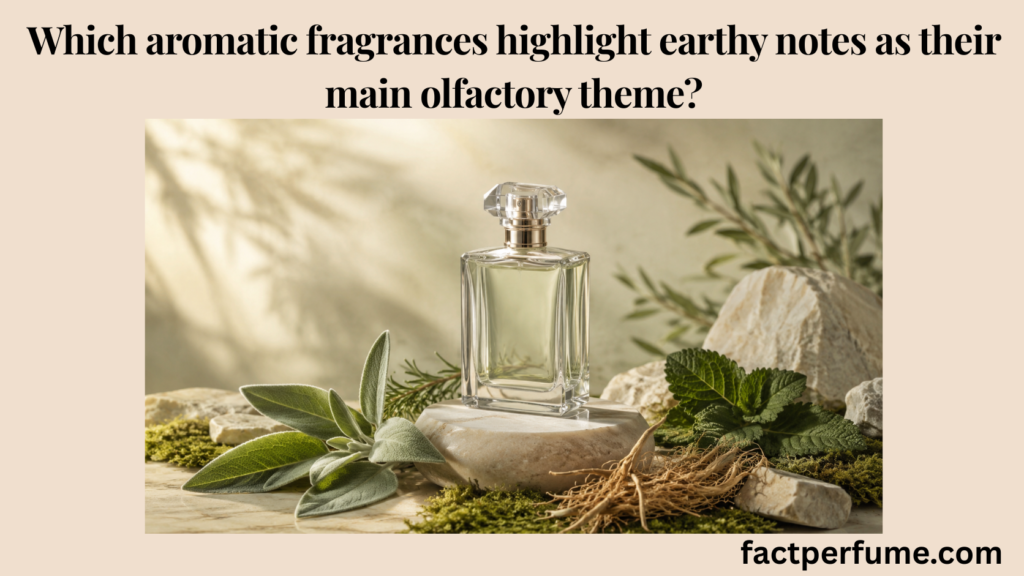
Which aromatic fragrances highlight earthy notes as their main olfactory theme?
Aromatic fragrances highlight earthy notes most clearly when a recognizable herbal or aromatic layer remains balanced with a grounded foundation built around vetiver, patchouli, mossy accords, roots, dry grasses, woods, mineral effects, or restrained smoke.
This article explains how that balance defines earthy aromatic fragrances, which materials create their main scent expressions, how they differ from adjacent fragrance directions, why some dry-downs may feel muddy or sour, and how to retest and select the right earthy aromatic profile.
What Defines Earthy Aromatic Fragrances as a Distinct Scent Profile?
Earthy aromatic fragrances form a distinct scent profile by combining herbal, fresh, green, or camphoraceous aromatic lift with grounded facets that may smell dry, rooty, mossy, damp, mineral, woody, smoky, or soil-adjacent.
The profile depends on a relationship rather than one mandatory ingredient. Lavender, sage, rosemary, thyme, basil, mint, clary sage, and citrus-herbal effects may provide the upper contrast, while vetiver, patchouli, mossy accords, roots, grasses, woods, mineral impressions, or restrained smoke provide depth. Earthy variations become easier to identify after establishing aromatic perfume and how herbal materials shape its identity.
Perfume houses, retailers, and databases may classify the same composition differently. “Earthy aromatic” is therefore most useful as a controlled description of scent behavior, not as a universally standardized formal family.
How Do Earthy Aromatic Fragrances Differ From Woody Fragrances?
Earthy aromatic fragrances differ from woody fragrances because their identity depends on a noticeable herbal or aromatic contrast, while woody fragrances may center more heavily on cedar, sandalwood, dry timber, resins, smoke, or other wood-associated effects.
Woods can appear in both directions. The useful distinction is the center of gravity: an aromatic-earthy structure keeps herbal, green, cooling, or camphoraceous lift perceptible beside its grounding, whereas a woody structure may allow timber, resin, or wood-smoke effects to lead. Woody fragrances can still smell earthy, but earthiness alone does not make them earthy aromatic.
How Do Earthy Aromatic Fragrances Differ From Green Aromatic Fragrances?
Earthy aromatic fragrances usually carry more rooty, mossy, loamy, mineral, woody, or shaded base depth than green aromatic fragrances, which often emphasize leaves, stems, grass, sap, crisp herbs, or bright vegetal freshness.
Green and earthy facets can coexist in one formula. A composition moves closer to green aromatics when leafy brightness and crisp vegetal freshness dominate; it reads as earthy aromatic when the grounded dry-down remains the main theme.
How Do Earthy Aromatic Fragrances Differ From Herbaceous Aromatic Fragrances?
Earthy aromatic fragrances use herbs mainly as lift or contrast above a grounded foundation, while herbaceous aromatic fragrances place lavender, sage, rosemary, thyme, basil, mint, or related herbal effects closer to the center of the scent identity.
The difference is dominance rather than exclusion. Herbaceous scents may contain soil-adjacent or woody facets, and earthy aromatic scents may contain a strong herbal opening. Lavender, sage, rosemary, thyme, basil, or mint become the primary theme in herbaceous aromatics rather than serving mainly as contrast above an earthy base.
How Do Earthy Aromatic Fragrances Differ From Fougère Fragrances?
Earthy aromatic fragrances may overlap with fougère structures, but the earthy aromatic label emphasizes the grounded scent theme, whereas fougère classification usually depends on a broader aromatic architecture involving lavender-like freshness, coumarin-like warmth, mossy effects, woods, musks, and related supports.
Lavender or a mossy impression alone does not confirm a fougère. These elements can connect an earthy profile with fougère ingredients, although the two labels are not interchangeable and a mossy effect does not prove the presence of natural oakmoss.
Olfactory Boundary Table
The table compares dominant relationships rather than declaring one universal taxonomy.
| Fragrance direction | Dominant aromatic feature | Dominant grounding feature | Common materials or accords | Typical sensory impression | Main classification boundary |
|---|---|---|---|---|---|
| Earthy aromatic | Herbal, fresh, green, cooling, or camphoraceous contrast | Dry, rooty, mossy, loamy, mineral, woody, or restrained smoky depth | Vetiver, patchouli, mossy accords, roots, grasses, herbs, woods | Grounded but still recognizably aromatic | Defined by the balance between aromatic lift and earthy foundation |
| Woody | May be secondary or absent | Timber, resin, wood smoke, creamy or dry wood effects | Cedar, sandalwood-style effects, resins, dry woods | Timber-led, dry, creamy, smoky, or resinous | Wood structure leads more clearly than herbal contrast |
| Green aromatic | Leafy, grassy, sappy, crisp, vegetal freshness | Usually lighter or less soil-adjacent | Leaves, stems, grasses, basil, mint, green accords | Bright, crisp, leafy, or freshly cut | Vegetal brightness dominates over earthy depth |
| Herbaceous aromatic | Herbs are central rather than supportive | Variable and sometimes minimal | Lavender, sage, rosemary, thyme, basil, mint | Herbal, brisk, culinary, medicinal, or camphoraceous | Herbal identity leads the composition |
| Aromatic fougère | Lavender-like freshness within a structured accord | Coumarin-like warmth, mossy effects, woods, musks | Lavender, coumarin-related effects, mossy accords, woods | Fresh, warm, mossy, groomed, or classically structured | Depends on the wider fougère architecture, not earthiness alone |
| Smoked aromatic | Herbal or aromatic contrast may remain visible | Smoke, incense-like dryness, charred woods, dark resins | Smoke accords, incense-like effects, woods, resins | Dry, atmospheric, charred, or shadowed | Smoke becomes the main modifier rather than one earthy facet |
Which Materials Give Earthy Aromatic Fragrances Their Grounded Character?
Earthy aromatic fragrances gain their grounded character from materials and accords that suggest roots, grasses, moss, dark soil, woods, minerals, damp air, or smoke while aromatic herbs preserve contrast and lift.
A raw material is an ingredient or extract used in a formula, whereas an accord is a constructed scent effect created by combining materials. Marketing note lists may describe an intended impression but do not disclose complete composition, dosage, or every supporting material. The relationship between herbal lift and grounded base materials belongs to the wider subject of aromatic composition.
How Does Vetiver Shape Earthy Aromatic Fragrances?
Vetiver can give earthy aromatic fragrances a dry, rooty, grassy, woody, smoky, or mineral backbone that contrasts with lavender, sage, citrus, or other aromatic materials.
Its role changes with material character, processing, dose, and surrounding notes. A vetiver-led aromatic structure may feel clean and architectural when dryness and herbal separation remain clear, or austere when bitter, smoky, or mineral facets dominate. Peer-reviewed work on vetiver complexity supports treating vetiver as a complex odor system rather than one uniform earthy smell.
Vetiver does not guarantee strong projection or long wear. Those outcomes depend on the complete formula, concentration, application, surface, and environment.
How Does Patchouli Deepen Earthy Aromatic Fragrances?
Patchouli can deepen earthy aromatic fragrances with dark, woody, loamy, damp, camphoraceous, or slightly sweet facets that add weight to the base.
The result varies by material, treatment, dose, and pairing. Dry herbs or woods may sharpen its outline, while ambered materials or musks may make it feel softer and fuller. A dense patchouli-rich base can feel blurred, sweet, damp, or heavy to some wearers, but patchouli does not always smell dirty, muddy, or sweet.
How Do Oakmoss-Style Accords Make Earthy Aromatic Fragrances Feel Mossy?
Oakmoss-style accords can make earthy aromatic fragrances feel mossy, bitter-green, shaded, woody, damp, or forest-floor-like without proving that the formula contains natural oakmoss extract.
Perfumers can reconstruct mossy effects through several natural extracts and aroma materials, so sensory resemblance is not ingredient confirmation. A narrow regulatory distinction is also important: EU Regulation 2017/1410 prohibited atranol and chloroatranol as cosmetic ingredients in the European Union; it did not establish that every mossy accord contains them or that every material described as oakmoss is universally banned.
Which Herbs Keep Earthy Aromatic Fragrances Fresh and Distinct?
Lavender, sage, rosemary, thyme, basil, mint, and clary sage can keep earthy aromatic fragrances distinct by adding herbal brightness, dryness, cooling contrast, green lift, or camphoraceous sharpness.
Each herb behaves differently. Lavender may bridge herbal and softly floral facets; sage can feel dry or bitter; rosemary may feel brisk and camphoraceous; basil can feel leafy or spicy; mint can add cooling contrast; and clary sage can feel dry, tea-like, or softly ambered. Dose and pairing determine whether these materials support an earthy base or become the primary herbaceous theme.
Earthy Material and Accord Map
These materials are possible contributors, not a required formula.
| Material or accord | Main earthy facet | Aromatic contribution | Common pairing | Possible imbalance | Accuracy or verification note |
|---|---|---|---|---|---|
| Vetiver | Dry, rooty, grassy, woody, smoky, mineral | Can reinforce dry aromatic structure | Lavender, sage, citrus, woods | May feel bitter, austere, sharp, or smoky | Odor varies by material and composition |
| Patchouli | Dark, woody, loamy, damp, camphoraceous | May bridge aromatic freshness and base depth | Herbs, woods, musks, ambered materials | May feel dense, sweet, damp, or blurred | Character depends on treatment, dose, and pairing |
| Oakmoss-style accord | Mossy, shaded, bitter-green, forest-floor-like | Adds green-dark contrast | Lavender, woods, musks, herbs | May feel musty or dated to some readers | Does not confirm natural oakmoss |
| Roots and grasses | Fibrous, bitter, dry, soil-adjacent | Supports dry herbal transitions | Vetiver, citrus, sage, dry woods | May feel thin, dusty, or severe | Sensory effect is not literal soil |
| Mineral or petrichor-style effects | Stone, rain, wet ground, cool metal, damp air | Can sharpen or cool the aromatic layer | Citrus, herbs, woods, musks | May feel metallic, cold, or abstract | Constructed impressions; no universal formula |
| Lavender | Usually supports rather than creates earthiness | Herbal-floral, clean, soft, camphoraceous lift | Vetiver, mossy effects, woods | May shift the profile toward fougère territory | Presence alone does not confirm classification |
| Sage or clary sage | Dry, bitter, tea-like, softly ambered support | Structured herbal lift | Vetiver, patchouli, woods, citrus | May feel medicinal or overly dry | Species, material, dose, and pairing matter |
| Rosemary, thyme, basil, or mint | Secondary grounding through dry or green contrast | Brisk, savory, leafy, cooling, or camphoraceous | Roots, grasses, citrus, mineral effects | May feel culinary, sharp, or medicinal | Do not treat all herbs as interchangeable |
| Smoke or incense-like effects | Dry, dark, atmospheric, charred | Can intensify contrast with fresh herbs | Patchouli, woods, resins, lavender | May overpower aromatic clarity | Smoky perception does not imply literal burning |
Which Earthy Aromatic Fragrances Match Different Scent Expressions?
Earthy aromatic fragrances can express their grounded character through clean dryness, quiet mossiness, bright herbal contrast, dark atmospheric depth, mineral abstraction, or rooty austerity.
These are sensory directions rather than fixed product categories. The most useful choice depends on which earthy facet remains pleasant through the dry-down and whether the aromatic contrast stays recognizable.
Which Earthy Aromatic Fragrances Feel Clean and Structured?
Clean and structured earthy aromatic fragrances usually emphasize dry vetiver, restrained herbs, bitter citrus, light woods, mineral dryness, or controlled mossy depth rather than dense sweetness, smoke, or damp-earth effects.
Clear separation between the herbal opening and dry foundation may feel polished or orderly. That impression depends on composition and perception; vetiver is not automatically clean, and a structured profile is not universally suitable for every shared setting.
Which Earthy Aromatic Fragrances Feel Quiet and Mossy?
Quiet and mossy earthy aromatic fragrances often combine soft herbs, cypress, restrained woods, mossy accords, dry grasses, or incense-like dryness to create a shaded and understated impression.
Quietness describes the style of the scent rather than its ingredient count or measured projection. Some mossy formulas may remain diffusive, while others stay close to the application area.
Which Earthy Aromatic Fragrances Feel Bright and Herbal?
Bright and herbal earthy aromatic fragrances keep citrus, mint, basil, rosemary, sage, lavender, or other aromatic materials prominent enough to lighten the rooty, woody, mossy, or mineral foundation.
The earthy base remains present, but the opening and heart provide more contrast. When herbs become the dominant theme and grounding becomes secondary, the profile may be more accurately described as herbaceous aromatic.
Which Earthy Aromatic Fragrances Feel Dark and Atmospheric?
Dark and atmospheric earthy aromatic fragrances may combine patchouli, mossy accords, smoke, resins, dark woods, mineral effects, or dense herbs to create greater perceived depth.
Darker does not automatically mean stronger or longer-lasting. Heavy application can make patchouli, smoke, woods, and musks merge, reducing the separation that makes the aromatic-earthy relationship readable.
Which Earthy Aromatic Fragrances Feel Mineral and Abstract?
Mineral and abstract earthy aromatic fragrances use stone-like, rain-like, metallic-cool, dry-air, wet-ground, or atmospheric effects to suggest earthiness without relying only on moss, woods, or patchouli.
These are olfactory impressions, not proof of one material. Petrichor-style effects can be constructed in different ways, and an abstract mineral quality should not be dismissed as inferior merely because it does not resemble literal soil.
Earthy Aromatic Expression Matrix
| Preferred expression | Dominant earthy direction | Supporting aromatic layer | Likely sensory character | Possible contextual fit | What may feel excessive |
|---|---|---|---|---|---|
| Clean and structured | Dry vetiver, light woods, mineral dryness | Sage, lavender, bitter citrus | Ordered, dry, clear, restrained | May suit readers who prefer low sweetness and clear separation | Bitterness, austerity, or sharp dryness |
| Quiet and mossy | Mossy accords, cypress, dry grasses | Soft herbs or lavender | Shaded, understated, forest-like | May suit readers who prefer muted green-dark depth | Mustiness or a dated association |
| Bright and herbal | Rooty or woody support | Mint, basil, rosemary, sage, citrus | Brisk, crisp, high-contrast | May suit readers who want earthiness without heavy darkness | Medicinal, culinary, or camphoraceous sharpness |
| Dark and atmospheric | Patchouli, smoke, resins, dark woods | Dense herbs or lavender | Deep, shadowed, smoky, loamy | May suit readers who prefer dramatic base depth | Density, sweetness, smoke, or blurred structure |
| Mineral and abstract | Stone, rain, wet-ground, cool-metal effects | Citrus-herbal or cool aromatic contrast | Atmospheric, cold, modern, nonliteral | May suit readers who prefer conceptual earthiness | Metallic coldness or synthetic association |
| Rooty and dry | Vetiver, roots, grasses, dust-dry woods | Thyme, sage, lavender, citrus | Fibrous, austere, grassy, soil-adjacent | May suit readers who prefer dryness over dampness | Harshness, dustiness, or severe bitterness |
Why Do Earthy Aromatic Fragrances Feel Muddy, Sour, or Musty During the Dry-Down?
Earthy aromatic fragrances may feel muddy, sour, or musty when the aromatic contrast fades, dense base facets become dominant, scented products interfere, or heat, sweat, dose, ventilation, and personal perception alter the balance.
“Muddy” describes blurred or insufficiently separated facets. “Sour” describes an acidic, fermented, sweaty, sharp, or unpleasantly tangy impression. “Musty” describes a stale, damp, cellar-like, wet-fabric, or mildew-associated impression. These sensory descriptions do not by themselves prove poor quality, contamination, allergy, or a skin disorder.
Why Do Earthy Aromatic Fragrances Become Muddy After the Opening Fades?
Earthy aromatic fragrances can feel muddy after the opening fades when patchouli, mossy effects, smoke, woods, musks, or other dense base facets become difficult to distinguish from one another.
Lighter herbs and citrus-herbal effects may become less prominent before the denser foundation. Formula balance, application amount, testing surface, ventilation, and personal perception can all contribute. Retest with a lower amount and without layering before deciding that the fragrance is poorly constructed.
Why Do Earthy Aromatic Fragrances Smell Sour on Some Skin?
A sour perception may develop when an earthy aromatic fragrance is evaluated alongside sweat, scented lotion, deodorant, grooming products, heat, heavy application, or an individual sensory association.
Skin pH should not be used as a catch-all explanation. Compare a blotter with a separate test on clean, unfragranced skin while keeping the amount low. A sour smell alone is not evidence of allergy; fragrance allergy in sensitized individuals. Stop testing if burning, rash, swelling, breathing discomfort, or worsening irritation develops.
Why Do Earthy Aromatic Fragrances Feel Musty in Humid Conditions?
Earthy aromatic fragrances may feel mustier in humid conditions when damp mossy, patchouli-rich, smoky, or forest-floor effects combine with heavy application, sweat, low airflow, or personal scent associations.
Humidity does not affect every formula identically, and mustiness is not proof of mold. A lower amount, cleaner testing conditions, and better ventilation can help determine whether the impression belongs to the formula or the evaluation context.
Why Do Earthy Aromatic Fragrances Feel Flat After the Aromatic Opening Fades?
Earthy aromatic fragrances may feel flat when the transition between their aromatic opening and earthy foundation lacks enough contrast for the wearer to perceive separate stages.
The formula may be intentionally linear, the dose may be too high for clear separation, or olfactory adaptation may reduce awareness of familiar facets. This does not diagnose anosmia and does not prove a defect. Reassess on another day and compare surfaces before rejecting the scent direction.
Perceived Dry-Down Diagnostic Matrix
| Perceived problem | Possible contributing variables | Immediate adjustment | Controlled retest | Stop-testing condition | Alternative scent direction |
|---|---|---|---|---|---|
| Muddy | Dense dose, patchouli, mossy effects, smoke, musks, surface | Lower the amount and remove other scents | Compare blotter and clean skin separately | Stop for physical irritation or breathing discomfort | Drier vetiver or brighter herbal contrast |
| Sour | Sweat, heat, lotion, deodorant, grooming products, dose, association | Wash the test area and wait before retesting | Use clean skin and a separate blotter | Stop for burning, rash, swelling, or breathing discomfort | Dry mineral or low-patchouli direction |
| Musty | Humidity, mossy depth, patchouli, smoke, low airflow, association | Reduce the amount and improve ventilation | Repeat in a neutral, ventilated setting | Stop for worsening irritation or respiratory symptoms | Rooty, grassy, or cleaner dry-earth direction |
| Too smoky | Smoke accord, resins, charred woods, high dose | Use less and avoid scented body products | Test a single light application on paper first | Stop if discomfort develops | Mossy, mineral, or herbal-earthy direction |
| Too flat | Linear formula, adaptation, low contrast, expectation | Pause and reassess later | Record opening and dry-down separately | Stop only for physical symptoms | Brighter herbal or high-contrast dry vetiver direction |
| Too dense | Patchouli, resins, woods, musks, smoke, heavy application | Reduce the amount | Change only dose while keeping surface and environment stable | Stop for irritation or breathing discomfort | Clean, structured, or mineral-earthy direction |
| Aromatic opening disappears too quickly | Volatile opening, adaptation, heat, dose, dense base prominence | Do not immediately add more fragrance | Track the opening and later stage on blotter and skin | Stop for physical symptoms | Herbal-forward earthy direction |
How Should Earthy Aromatic Fragrances Be Retested Without Distorting Their Scent Balance?
Earthy aromatic fragrances should be retested by changing one variable at a time so the wearer can determine whether the formula, application amount, testing surface, body products, or environment is affecting the perceived balance.
A complete wear routine belongs in the dedicated guidance on aromatic application, because no single spray pattern works for every formula. For evaluation, use the controlled sequence below rather than adding more product or changing several conditions together.
- Test one light application on a fragrance blotter.
- Record the initial aromatic impression.
- Reassess after the opening becomes less prominent.
- Test separately on clean, unfragranced skin.
- Avoid scented lotion, deodorant overlap, or another perfume.
- Keep the application amount low during comparison.
- Change only one variable between tests.
- Test fabric only after checking an inconspicuous area for staining.
- Stop testing if burning, rash, swelling, breathing discomfort, or worsening irritation develops.
- Decide whether the perceived problem appears consistently across surfaces and conditions.
How Do You Select the Right Earthy Aromatic Fragrance Direction?
The right earthy aromatic fragrance direction is the one whose aromatic opening, dominant earthy facet, dry-down balance, and perceived intensity remain compatible with the reader’s scent preferences.
Selection should focus on scent development rather than product hype. Evaluate which earthy direction leads, whether the aromatic layer remains identifiable, whether the dry-down stays clear, and whether the perceived intensity fits the intended context.
Which Dominant Earthy Direction Do You Prefer?
The first selection decision is whether you prefer dry vetiver, damp moss, dark patchouli, rooty grass, restrained smoke, mineral abstraction, or a mixed earthy foundation.
Dry vetiver tends toward structured, rooty, grassy, or mineral earthiness. Mossy accords tend toward shaded, bitter-green, forest-floor depth. Patchouli-rich structures tend toward darker, loamier, woody weight. Roots and grasses tend toward fibrous austerity, smoke and resins toward atmospheric darkness, and mineral effects toward stone-like, rain-like, or abstract earthiness.
Does the Aromatic Layer Remain Distinct?
A balanced earthy aromatic fragrance keeps enough herbal, green, citrus-herbal, cooling, or camphoraceous contrast for the aromatic layer to remain identifiable beside the earthy foundation.
Balance does not require equal strength. Ask whether some aromatic contrast remains perceptible as the fragrance develops and whether it supports, rather than fights, the grounded base.
Does the Dry-Down Remain Clear or Become Blurred?
The dry-down is more likely to suit the reader when its earthy facets remain distinguishable rather than collapsing into an unwanted muddy, musty, sour, smoky, or overly dense impression.
Use the diagnostic method to separate dislike from testing interference. A personally unpleasant result is not automatically low quality, while physical irritation is a reason to stop use rather than continue sensory evaluation.
Does the Perceived Intensity Fit the Intended Context?
Perceived intensity should fit the reader’s expected context, but formula strength, application amount, ventilation, temperature, and local expectations matter more than the earthy aromatic label alone.
Judge the actual formula under realistic conditions. Do not assume a fragrance is universally suitable for an office, event, climate, season, or time of day based only on its family label or concentration name.
Final Earthy Aromatic Selection Checklist
- Identify the aromatic layer.
- Identify the dominant earthy direction.
- Classify the profile as dry, damp, mossy, rooty, smoky, mineral, or patchouli-rich.
- Compare the opening with the dry-down.
- Test on a blotter when possible.
- Test separately on clean skin.
- Avoid competing scented products during evaluation.
- Change one testing variable at a time.
- Check whether the aromatic contrast remains identifiable.
- Check whether the earthy base remains distinct rather than blurred.
- Do not judge the fragrance from the opening alone.
- Do not judge it from a note list alone.
- Do not judge it from a concentration label alone.
- Select the expression that remains balanced to your perception.
Frequently Asked Questions
Earthy aromatic fragrances are better understood as an aromatic scent expression or descriptive theme than as one universally standardized fragrance family used identically by every perfume house, retailer, or database.
No. Vetiver is a common source of dry, rooty, grassy, smoky, or mineral earthiness, but patchouli, mossy accords, roots, grasses, woods, mineral effects, and other materials can also create an earthy aromatic identity.
No. A mossy smell does not confirm natural oakmoss because perfumers can construct mossy or forest-floor effects through combinations of natural extracts, aroma materials, woods, musks, green notes, and other accords.
An earthy aromatic fragrance may smell different on paper and skin because heat, moisture, sweat, body products, application amount, and evaporation context can change the relative prominence of its aromatic and earthy facets.
Earthy aromatic fragrances can work in warm or humid conditions, but lighter herbal contrast, drier earthy facets, restrained application, airflow, and personal perception often matter more than the fragrance label alone.
No. A note list does not reveal material quality, dosage, transitions, balance, projection, or how the dry-down will be perceived, so controlled testing provides more useful information than the listed notes alone.
Conclusion
Earthy aromatic fragrances highlight earthy notes most effectively when an identifiable herbal or aromatic layer remains balanced with a grounded foundation of vetiver, patchouli, mossy accords, roots, grasses, woods, mineral effects, or restrained smoke.
The main material roles create dry, mossy, damp, dark, rooty, or mineral directions, but the most useful judgment comes from evaluating the transition into the dry-down. Select the expression whose aromatic contrast and earthy depth remain clear and personally balanced rather than relying on product hype, note lists, or concentration labels alone.