
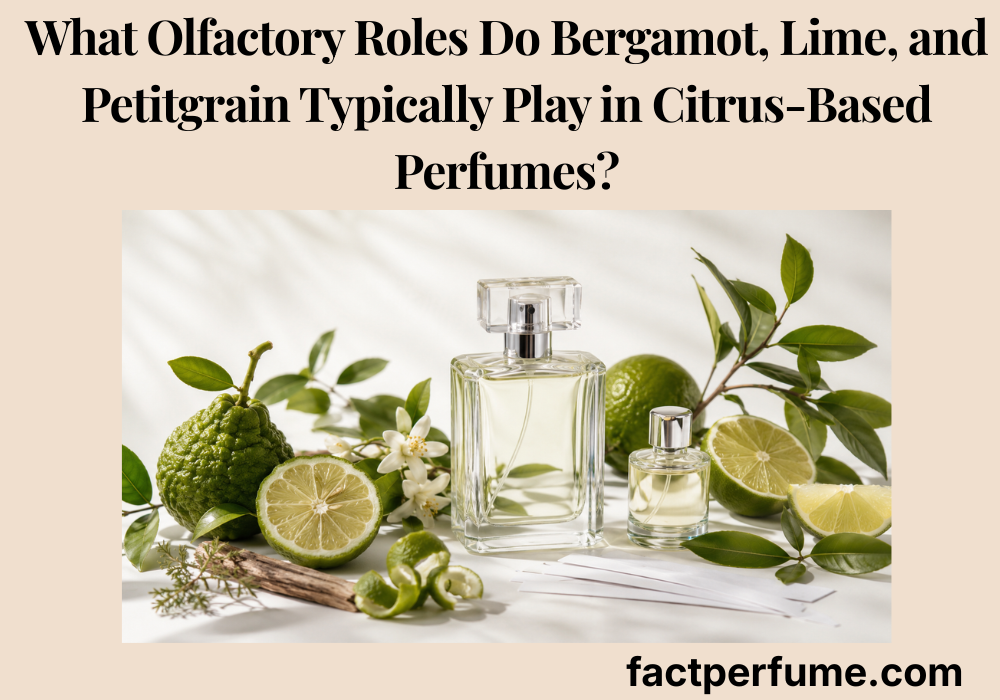
What Olfactory Roles Do Bergamot, Lime, and Petitgrain Typically Play in Citrus-Based Perfumes?
Bergamot, Lime, and Petitgrain can all contribute Citrus character, but they perform different sensory functions. Bergamot can bring zesty brightness with floral, herbal, and softly bitter complexity; Lime can provide vivid tart, juicy, green, or herbaceous Citrus effects; and Petitgrain can introduce bitter-green, leafy, aromatic character associated with Citrus-tree foliage.
These are typical olfactory tendencies rather than fixed top-, heart-, or base-note assignments. The way each effect develops depends on the exact material, processing, concentration, surrounding formula, surface, skin, temperature, and wearing environment, so their names alone cannot establish a universal evaporation sequence.
Educational note: Bergamot, Lime, and Petitgrain shown in a perfume note list should first be treated as communicated scent effects unless the actual materials are independently verified. Their exact processing, dosage, concentration, safety status, longevity, and evaporation order cannot be inferred from the note names alone.
What Distinguishes the Olfactory Roles of Bergamot, Lime, and Petitgrain?
Bergamot usually brings the most floral-herbal complexity of the trio, Lime can provide vivid tart or juicy Citrus contrast, and Petitgrain contributes a greener, leafier Bitter Orange-tree character.
Within the broader Citrus family, these three names should not be treated as interchangeable. They can overlap in freshness and greenness, but their typical sensory directions remain distinct.
Bergamot may combine zest, freshness, soft bitterness, floral nuance, and aromatic or herbal qualities. Lime may emphasize tartness, juiciness, green zest, or herbaceous freshness. Petitgrain moves away from a juicy fruit impression toward foliage, bitterness, leaves, twigs, and aromatic greenery.
An official Givaudan source provides a useful material-specific example: it identifies Citrus aurantium var. amara, steam distillation, and a branch-derived material with fresh, green, floral, woody, and herbaceous characteristics.
None of these sensory differences means Lime must occupy the top, Bergamot the heart, or Petitgrain the base.
Three-Material Quick Comparison Matrix
| Material | Botanical Source | Typical Sensory Facets | Possible Olfactory Roles | Qualification |
|---|---|---|---|---|
| Bergamot | Bergamot Citrus when material is verified | Zesty, floral, herbal, fresh, softly bitter | Citrus brightness, floral connection, aromatic nuance | Formula-dependent |
| Lime | Lime fruit material when verified | Tart, juicy, zesty, green, herbaceous | Vivid contrast, freshness, aromatic lift | Material and processing matter |
| Petitgrain | Citrus-tree foliage, especially Bitter Orange | Bitter-green, leafy, aromatic, twiggy | Green continuity, botanical contrast, Citrus-aromatic connection | Not automatically a base or fixative |
Bergamot, Lime, and Petitgrain can share a Citrus identity while contributing different floral-herbal, tart-juicy, and bitter-green foliage effects.
What Sensory and Structural Roles Can Bergamot Play in Citrus Perfume?
Bergamot can add fresh zesty Citrus character together with floral and herbal facets, allowing it to participate in several different sensory directions.
When the actual botanical material is verified, Bergamot is associated with Citrus bergamia. Its olfactory character can combine freshness, zest, gentle bitterness, floral nuance, herbal facets, and aromatic complexity.
That range gives Bergamot several possible compositional functions. It can brighten a Citrus structure while linking naturally with floral or aromatic effects. It may complement herbs, tea-like structures, or woods, and it can soften the sensory impression of a sharper Citrus composition.
This does not make Bergamot an indispensable connector. “Bridge” or “connection” should be understood as sensory language: the material may make two parts of a composition feel related without occupying a mandatory physical position between them.
Bergamot’s familiar association with Earl Grey tea can help consumers recognise one facet of its character, but that association is a sensory reference rather than a technical definition.
Readers wanting the broader comparison among Bergamot, Lemon, Lime, Mandarin, Orange, and Grapefruit can refer to the guide to Citrus notes.
How Does Lime Contribute Tartness, Freshness, and Contrast to Citrus Perfumes?
Lime can create a vivid Citrus effect that ranges from tart and zesty to juicy, green, herbaceous, or softly sweet depending on the material.
Its most recognisable function is often sensory contrast. A tart or acidulous Lime effect can make a Citrus composition feel vivid and energetic, while greener or more herbal Lime materials may connect naturally with aromatic ingredients.
Lime can also provide juiciness, zest, fresh lift, or brightness against denser surrounding materials. Depending on the formula, it may be paired with other Citrus effects, herbs, ginger, florals, spices, woods, or cocktail-inspired accords.
These are possibilities rather than required pairings.
It is also better to say Lime creates perceptual contrast than to say it “cuts through” a perfume. The first describes what the wearer may perceive; the second can incorrectly suggest a fixed physical mechanism.
How Can Processing Change the Olfactory Character of Lime Materials?
The smell of Lime material can change with species, origin, and processing, so cold-pressed and distilled Lime should not be reduced to one simple sweet-versus-dry comparison.
A cold-pressed or expressed material may show zest, peel, juiciness, herbal facets, or fresh Citrus character. A distilled Lime material can also retain juiciness, sweetness, fresh Citrus, herbal qualities, or acidulous facets depending on the exact material.
Processing is only one variable. Species, geographic origin, harvest conditions, distillation conditions, rectification, fractionation, furocoumarin reduction, and supplier specification may also influence the resulting material.
The useful rule is simple: process matters, but process alone does not determine the complete sensory profile.
Lime Processing Comparison
| Variable | What May Change | What Cannot Be Assumed |
|---|---|---|
| Cold pressing / expression | Peel, zest, juiciness, herbal nuances | That every expressed Lime is sweet |
| Distillation | Freshness, juiciness, herbal or acidulous character | That every distilled Lime is dry |
| Rectification / fractionation | Relative balance of particular facets | One universal sensory result |
| Species / origin | Character of the starting material | That all materials sold as Lime smell identical |
Lime character can shift with material identity and processing, so expressed, distilled, rectified, or fractionated materials should not be reduced to one universal sensory rule.
What Green, Bitter, and Aromatic Role Can Petitgrain Play in Citrus Perfume?
Petitgrain can introduce bitter-green, leafy, aromatic character that recalls the foliage of a Citrus tree rather than the juicy peel effect associated with Bergamot or Lime.
Petitgrain Bigarade is associated with Citrus aurantium, particularly its leaves and small twigs. Its typical tendencies can include bitterness, greenery, leafy freshness, aromatic character, and sometimes woody, floral, or twig-like nuances.
In a Citrus composition, Petitgrain may provide botanical contrast, reinforce a Bitter Orange-tree impression, or create sensory continuity toward aromatic, herbal, floral, or woody effects.
However, those functions must not be confused with persistence. Petitgrain is not automatically a base note, low-volatility material, fixative, anchor, or longevity enhancer.
Saying Petitgrain creates green continuity means the fragrance may retain a related leafy or aromatic idea as other sensations change. It does not prove that Petitgrain physically keeps Bergamot or Lime present for longer.
How Is Petitgrain Different From Neroli and Orange Blossom Materials?
Petitgrain, Neroli, and Orange Blossom materials may come from the same Bitter Orange tree, but different plant parts and extraction routes create distinct perfumery materials.
Petitgrain is foliage-associated, particularly with leaves and twigs, and tends toward green, bitter, leafy, and aromatic effects.
Neroli is flower-derived and can combine floral, Citrus, green, and sweet facets. Orange Blossom Absolute also comes from flowers, but its extraction route differs from distilled Neroli and its sensory character can move toward a richer, fuller, sweeter floral impression.
The central rule is: same tree does not mean same material.
Understanding how perfumers use Neroli guide further clarifies why a flower-derived Citrus-tree material performs a different sensory task from foliage-derived Petitgrain.
Bitter Orange Tree Material Map
| Plant Part | Material | Broad Sensory Direction | Main Distinction |
|---|---|---|---|
| Fruit peel | Bitter Orange material | Bitter, dry, peel-like Citrus | Fruit-derived |
| Flower | Neroli | Floral, Citrus, green | Distilled flower material |
| Flower | Orange Blossom Absolute | Richer, fuller, sweet-floral | Different flower extraction |
| Leaves / twigs | Petitgrain | Bitter-green, leafy, aromatic | Foliage-derived |
Bitter Orange peel, Neroli or Orange Blossom flowers, and Petitgrain foliage can come from related botanical sources while creating clearly different perfumery effects.
How Can Bergamot, Lime, and Petitgrain Complement One Another in a Citrus Accord?
Bergamot, Lime, and Petitgrain can create a layered Citrus effect by combining zesty complexity, tart or juicy contrast, and bitter-green foliage character without following one mandatory evaporation sequence.
Lime may provide vivid tartness, juiciness, or fresh contrast. Bergamot may add floral-herbal complexity and connect Citrus with aromatic or other surrounding directions. Petitgrain may contribute bitter greenery, foliage character, and aromatic continuity.
Their relationship is better understood through overlap, contrast, continuity, and changing perceptual prominence than through a three-step chronological handoff.
Primary Headspace study found different diffusion rates among odorants and showed that behaviour changed when components were tested individually versus in mixtures and when fragrance was delivered from different matrices. This supports treating perfume development as formula-dependent rather than assigning a universal Lime → Bergamot → Petitgrain schedule.
The complete composition may later emphasize herbs, flowers, tea, woods, musk, spices, or other Citrus effects depending on what surrounds the trio. Readers interested in the deeper mechanism can explore why perfumes commonly feature Top-note science.
Bergamot-Lime-Petitgrain Interaction Framework
| Material | Possible Early Contribution | Possible Developing Contribution | Sensory Connection | Qualification |
|---|---|---|---|---|
| Lime | Tartness, zest, vivid freshness | Green or juicy Citrus may remain apparent | Citrus ↔ herbs / fresh effects | No fixed first stage |
| Bergamot | Zesty, fresh complexity | Floral, herbal, aromatic facets may remain noticeable | Citrus ↔ floral / aromatic / tea-like | Not a mandatory bridge |
| Petitgrain | Green or bitter contrast may be perceptible | Leafy and aromatic effects may contribute continuity | Citrus ↔ green / herbal / woody | Not automatically later or longer-lasting |
What Can—and Can’t—You Infer From a Perfume Note List Containing Bergamot, Lime, and Petitgrain?
A perfume note list containing Bergamot, Lime, and Petitgrain can suggest a bright, tart, floral-herbal, green, or aromatic Citrus direction, but it cannot reveal the exact formula or predict a universal development sequence.
Bergamot may suggest zesty, floral, herbal Citrus complexity. Lime may suggest vivid tart, juicy, green, or herbaceous freshness. Petitgrain may suggest bitter-green, leafy, aromatic Citrus-tree character.
Together, they can reasonably suggest a layered Citrus structure with both fruit-like and botanical dimensions.
What they cannot reveal is equally important. A public note list does not prove the exact ingredient, raw-material quality, extraction route, dosage, natural or reconstructed status, projection, longevity, or evaporation order.
Note-List Inference Matrix
| Listed Effect | Reasonable Inference | Do Not Infer |
|---|---|---|
| Bergamot | Zesty floral-herbal Citrus complexity may be present | Guaranteed elegant transition or exact Bergamot material |
| Lime | Tart, juicy, green, or herbal freshness may be present | Shortest-lasting stage or exact processing |
| Petitgrain | Bitter-green leafy Citrus-tree direction may be present | Base-note status, fixative action, or greater longevity |
| All three | Layered Citrus and aromatic complexity may be present | Lime → Bergamot → Petitgrain chronology |
Quick Evaluation Checklist
Use these checks when reading a note list or sampling a Citrus perfume built around Bergamot, Lime, and Petitgrain.
Frequently Asked Questions
Bergamot often combines zesty freshness with floral, herbal, and softly bitter complexity. Lime can emphasise tart, juicy, green, or herbaceous Citrus effects. Petitgrain usually contributes a bitter-green, leafy, aromatic foliage character.
No. Bergamot, Lime, and Petitgrain do not have fixed top-, heart-, or base-note positions. Their perceived development depends on the exact materials, formula, concentration, surface, skin, temperature, and environment.
Yes. Expression, distillation, rectification, fractionation, species, origin, and supplier specification can all influence Lime character. Processing matters, but it does not create one universal sweet-versus-dry rule.
No. Petitgrain is associated mainly with Citrus-tree leaves and twigs, while Neroli and Orange Blossom materials are flower-derived. Related botanical origin does not make them the same perfumery material.
No. A Petitgrain note does not establish base-note status, fixative action, low volatility, or greater longevity. It may contribute green or aromatic continuity without physically preserving Bergamot or Lime.
You can reasonably expect a layered Citrus direction combining fruit-like brightness with floral-herbal and bitter-green botanical effects. You cannot infer the exact materials, dosage, processing, projection, longevity, or a Lime-to-Bergamot-to-Petitgrain chronology.
Conclusion
Bergamot, Lime, and Petitgrain are best understood through the sensory effects they can contribute rather than by assigning each material a permanent fragrance-pyramid position.
Bergamot can provide zesty brightness together with floral, herbal, and aromatic complexity. Lime can provide tartness, juiciness, zest, and green or herbaceous freshness, with its exact character depending strongly on the material and processing. Petitgrain can provide bitter greenery, leafy Citrus-tree character, and aromatic continuity without automatically functioning as a base note or fixative.
The practical rule is to think in sensory roles, not fixed pyramid positions. When reading a perfume description, ask what each listed note suggests, what materials surround it, whether the name identifies a verified material or simply communicates an effect, and how the complete perfume actually develops when smelled.